
You buy a $300 walking pad, set it up under your desk, and within two weeks you notice you're gripping the edge of your desk for balance because there are no handrails. A month later you start wondering about incline — you've read it burns more calories. So you buy a full treadmill for $650. The walking pad ends up leaning against the wall, a three-hundred-dollar clothes rack. This pattern is so common that I’ve stopped counting the people who tell me they made exactly this mistake.
The problem isn't choosing the wrong brand. It's choosing the wrong category. Walking pads and full treadmills are fundamentally different machines for different use cases. The decision between them is the fork most buyers skip, and skipping it is what costs you money.
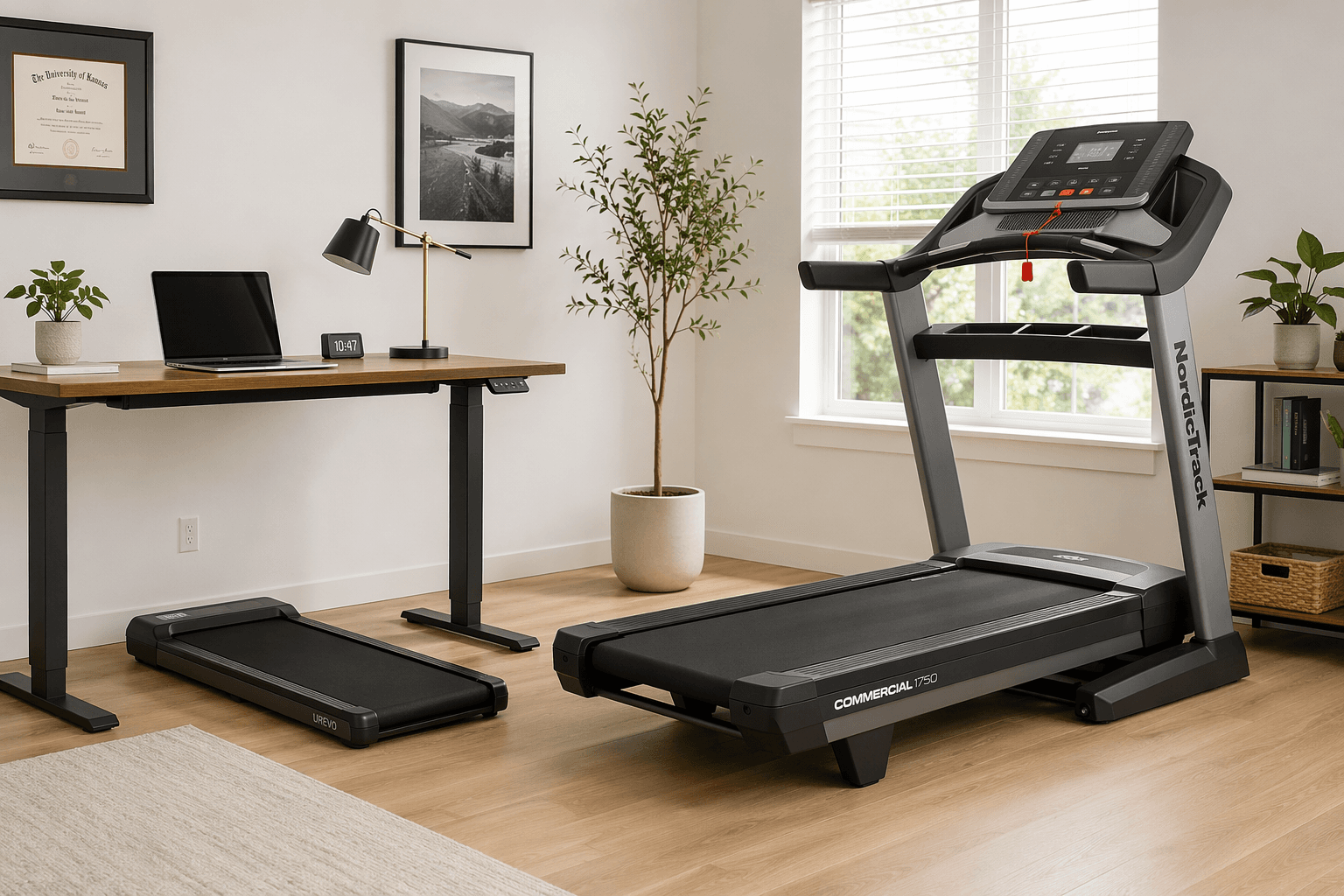
Here's the branching logic I walk every reader through. Ask yourself these questions in order:
- Do you need handrails? If yes → full treadmill. If no, ask next.
- Do you need incline? If yes → full treadmill. If no, ask next.
- Do you weigh over 220 lbs? If yes → full treadmill. If no, ask next.
- Is your primary use walking while working under a desk? If yes → consider a walking pad, provided the previous answers were all no. If no, ask next.
- What is your budget? Under $400 → walking pad (with caveats). $400–$700 → budget full treadmill like the Horizon T101. $1,000+ → premium full treadmill.
Most people answer yes to one of the first three questions. If you do, the walking pad is the wrong machine. Let me show you why each of those questions matters.
No Handrails, No Safety Net
Walking pads max out around 3–4 mph and have no handrails. That sounds fine for a steady walk, but think about what happens when you stumble. At 3 mph, a fall on a moving belt can land you hard, and there's nothing to grab. I've heard from several users who twisted an ankle stepping off wrong. Without handrails, the machine is safe only if you are fully alert and stable the entire time. For anyone over 60, anyone with balance concerns, or anyone who might be walking while distracted (taking a call, looking at a screen), the risk is real.
The Flat-Land Penalty: Why You Need Incline
Walking on a flat surface is not the same as walking up an incline. According to ACSM metabolic equations, a 150-pound person walking at 3.5 mph on flat ground burns about 80 calories per mile. At a 10% grade, that same person burns roughly 128 calories per mile — about 60% more. Some sources say walking flat burns 50% fewer calories than walking at a 10% incline. That number is an estimate, not a prescription, but the direction is clear: if you want to improve your cardiovascular fitness or maximize calorie burn in the same amount of time, you need incline. A walking pad gives you none.
You don't need incline to start, but you will want it within a few weeks. Walking flat quickly becomes too easy, and the calorie burn drops. A treadmill with incline lets you progress without buying new equipment.
Motor and Durability: The Real Cost of a Cheap Machine
Most walking pads use a 1 HP motor or less. That's fine for light, intermittent use — say, 20 minutes of walking while you type an email. But if you weigh over 200 lbs or plan to walk for 30 minutes or more, the motor will struggle. I've seen reports of motors stuttering under heavier loads, and the warranty tells you the manufacturer knows it: walking pads typically come with 90-day to 1-year warranties. A motor rated for light duty won't hold up to daily use at higher body weights.
Be wary of weight limits on Amazon listings. The GoYouth walking pad, for example, is marketed at 300 lbs, but customer support confirmed it's actually 220 lbs. Always check the manufacturer's spec sheet, not the listing headline.
The short warranty is not an accident. Walking pads are built to be replaced, not repaired. A 1-year warranty on a $300 machine means the manufacturer expects it to last about that long under normal use. Compare that to a full treadmill with a lifetime frame and motor warranty — the manufacturer is betting the frame will outlast you.
Let's put some numbers on it. Suppose you buy a $300 walking pad. It lasts 18 months (optimistic for regular use). You buy another $300 pad. Over three years you've spent $600. If you had bought a $649 treadmill, it would still be running after three years with years left on the warranty. The treadmill costs about $65 per year over a decade. The walking pad costs $200 per year if you replace it every 18 months. And you get no incline, no handrails, and a lower calorie burn for the same time spent walking.
What a Full Treadmill Gives You
Full treadmills cost more upfront, but they solve all three gaps. They have handrails and a wider deck, so you are safer. They offer incline, usually up to 10% or 15%, which means you can get a real cardio workout. And they have motors in the 2.0–2.5 CHP range — plenty for walking, and enough to last.
A 2.0–2.5 CHP motor is the sweet spot for walkers. It draws less power than a 3.0+ CHP motor, which you only need if you plan to run. The Sole F63 has a 3.0 CHP motor and 15% incline, but even the Horizon T101 at 2.5 CHP and 10% incline is more than enough for walking at a brisk pace. Both come with lifetime frame and motor warranties. That is the real long-term value.
| Model | Motor | Incline | Weight Capacity | Warranty | Price |
|---|---|---|---|---|---|
| Horizon T101 | 2.5 CHP | 0-10% | 300 lbs | Lifetime frame/motor | $649 |
| Sole F63 | 3.0 CHP | 0-15% | 325 lbs | Lifetime frame/motor | $1,199 |
| Horizon 7.0 AT | 3.0 CHP | 0-12% | 325 lbs | Lifetime frame/motor | $999 |
Concrete Picks for Each Branch
If the decision framework points you to a walking pad, here are two models that are worth considering — but only if you meet the conditions above.
| Model | Footprint | Max Speed | Weight Capacity | Motor | Warranty | Price |
|---|---|---|---|---|---|---|
| WalkingPad P1 | 56.4" x 21.5" x 5" | 3.75 mph | 220 lbs | 1 HP | 1 year | $499 |
| Merach W50 | Compact | 4 mph | 400 lbs | DC motor | Not specified | ~$350 |
| Urevo Strol 2E | Compact | 6.2 mph | 265 lbs | 1.5 HP | 90 days | ~$300 |
For the full-treadmill branch, the Horizon T101 at $649 is my top recommendation for walkers. It has enough motor, a 10% incline, a lifetime warranty, and a proven track record. The Sole F63 is a step up in power and incline, with a wider deck for taller users. Both are subscription-free — no monthly fees, unlike some iFIT-connected models. (For a deeper analysis of subscription traps, see our guide to connected vs. subscription-free treadmills.)
A quick note on warranty: a walking pad that dies after 18 months costs about $200 per year in purchase cost (if you replace it once). A $649 full treadmill that lasts 10 years costs about $65 per year. The cheaper upfront option often becomes more expensive in the long run.
What Still Confuses Buyers
Can I jog on a walking pad? Technically yes, some pads go up to 6 mph. But the deck is short, there are no handrails, and the motor is not built for repeated impact. You're better off with a full treadmill.
How fast is fast enough for walking? 3–4 mph is a brisk walk. Most walking pads top out there. That's fine if you only walk flat. But to get the same intensity as a moderate incline walk, you'd need to walk much faster — which pads can't sustain.
What about noise for apartment living? Walking pads are generally quieter than treadmills because they have smaller motors and no incline mechanism. If noise is your primary concern, see our tested dB ratings for quiet treadmills.
If you are still unsure, walk through the decision framework one more time. I'll say it plainly: unless you are under 220 lbs, never need incline, and only walk while typing at a desk, buy a full treadmill. Even then, be honest about whether that will stay true for more than a few months.
Comments
Join the discussion with an anonymous comment.