
The question that matters is not which treadmill has the shiniest screen or the longest list of features. It is this: does the subscription actually make you run more often?
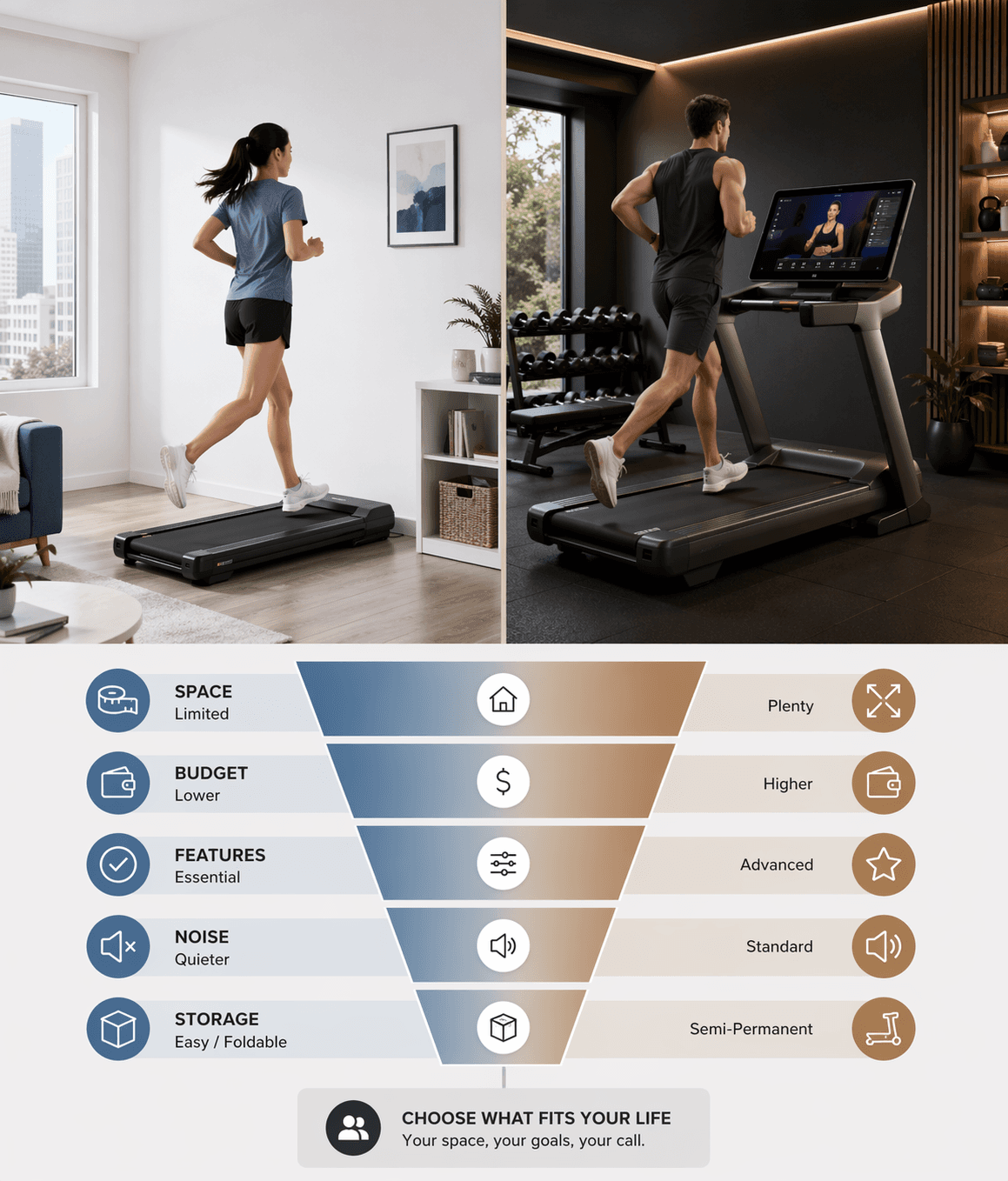
What a Connected Treadmill Gives You—and Takes Away
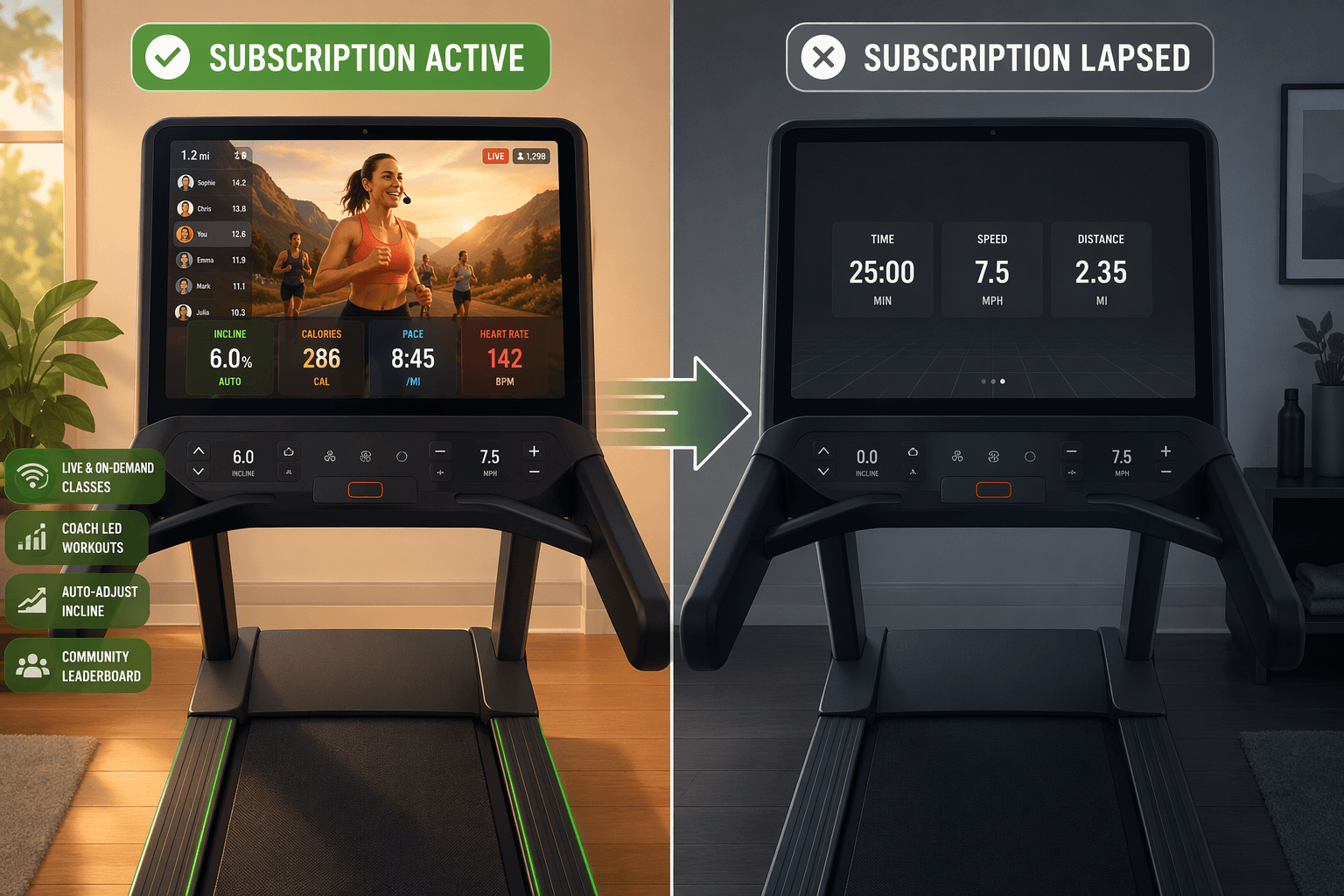
The connected pitch is straightforward: you get a large touchscreen, auto-adjust incline and speed synced to a coach on video, a library of thousands of classes, and the sense that you are not running alone in your basement. It is a polished experience when the subscription is active.
But the experience collapses when the subscription lapses. Without an active iFIT subscription, NordicTrack and ProForm treadmills offer manual mode only with no access to streaming, auto-adjust, or workout programs. The same applies to Peloton Tread without its All-Access membership. The NordicTrack Commercial 1750 has a 4.25 CHP motor, -3% to 15% incline/decline, and a 16-inch HD touchscreen, but that screen is essentially useless without iFIT. It becomes a very expensive manual treadmill.Without an active iFIT subscription, NordicTrack and ProForm treadmills offer manual mode only with no access to streaming, auto-adjust, or workout programs.
The Real Cost Over Three Years
Most buyers compare purchase prices. That misses the real financial picture. Here is what three years of ownership actually costs for three common choices, assuming the subscription stays active for the connected model.
| Model | Purchase Price | Monthly Subscription | 3-Year Total |
|---|---|---|---|
| NordicTrack Commercial 1750 | $2,500 | $39/mo (iFIT family) | ~$3,900 |
| Sole F80 | $1,900 | $0 | ~$1,900 |
| Horizon 7.0 AT | $1,100 | $0 | ~$1,100 |
The Outdoor Gear Lab 5-year analysis tells an even starker story: the Peloton Tread costs $5,639 over five years versus the Sole F80 at $1,900—a threefold difference. That extra money pays for something, but the question is whether what it pays for actually changes your running habits. I would not call that a good deal unless the subscription genuinely keeps you running.
Does the Subscription Actually Make You Run More?
This is the core claim the industry wants you to accept: a subscription provides motivation you would not otherwise have. The evidence for that claim is thinner than the marketing suggests.
The 40% unused-equipment statistic from Wirecutter covers all home gym gear, not specifically treadmills with subscriptions. It is the best data point we have on how many purchases end up gathering dust. But it does not tell us if subscriptions fix the problem. I have looked for a controlled study that proves a causal link between paying $39 a month for iFIT and running more frequently six months later. I haven't found one. The correlation argument—people who spend more on gear tend to use it more—is just that, a correlation. It does not tell you whether the subscription is the cause or whether people who already run a lot are more likely to buy the subscription.According to Wirecutter, 40% of home-gym equipment goes unused as often as the buyer had expected.
The absence of direct causal evidence is not a minor caveat; it is the central gap in the pitch. iFIT offers over 16,000 on-demand classes. Peloton offers over 10,000. Those are big numbers. But neither the quantity of content nor the quality of the platform guarantees that you will actually run. The quality of motivation is personal and hard to measure.
The claim that subscriptions make you exercise more is largely a correlation argument, not a causal one. The industry measures value by features; the buyer should measure it by changed behavior.
The strongest counterpoint to the lock-in argument is a workaround that already exists. The Horizon 7.0 AT uses Bluetooth FTMS to allow two-way communication with third-party apps like Peloton Digital and Zwift. You get connected workouts—coach-led classes, structured training, virtual routes—without paying the treadmill brand's subscription. The Horizon costs $1,100, plus you can subscribe to Peloton Digital for $12.99 a month if you want. That is $1,100 for the treadmill plus $468 in Peloton Digital over three years, for a total of $1,568. Cheaper than the Sole, and you get the connected content without being locked into a single platform's ecosystem. That is a smarter bet for most people.
When the Connected Choice Actually Makes Sense
I am not here to tell you that connected treadmills are a scam. For some people, the subscription genuinely changes their workout behavior. The profile is someone who knows they struggle with self-motivation, has the budget for the recurring cost, and is honest about it. If you have let gym memberships lapse, if you need the external structure of a scheduled class with an instructor who pushes you, and if you are willing to pay $39 a month because you have tried the free route and it did not stick—then the connected option might be the right investment.
There is also a practical nuance about where the treadmill will live. NordicTrack voids its warranty if the treadmill is stored or used in a garage; Sole does not. If your only available space is a garage, that alone might push you away from a connected model that requires a controlled climate for the touchscreen. It is a concrete constraint, not a theoretical one.
The Verdict: Choose Based on Your Adherence Reality
The decision framework is not complex. It comes down to an honest self-assessment of your workout habits and your willingness to pay for external motivation. Here is how it breaks down.
- Choose a connected treadmill (NordicTrack, Peloton) if: you know you run more when someone tells you what to do, you have room in your budget for the subscription, you are comfortable with the screen becoming dated in a few years, and you will actually use the auto-adjust and coach-led classes.
- Choose a non-connected treadmill (Sole F80) if: you prefer simplicity, you want to avoid monthly fees, you plan to use your own tablet for entertainment or fitness apps, and you value a lifetime frame and motor warranty.
- Choose the hybrid route (Horizon 7.0 AT) if: you want connected workouts without brand lock-in, you are willing to manage two accounts (treadmill + third-party app), and you want a lower total cost with flexibility.
For most buyers, the non-connected treadmill is the smarter, lower-risk choice. It does not require ongoing payments. It does not turn into a manual-only machine if you decide to cut costs. It does not force you to replace the whole treadmill because the operating system became obsolete. And the workaround already exists: you can still get connected content through your own tablet and a third-party app.
If you want the pure cost math without the adherence analysis, read our 5-year cost breakdown
. For a broader buying guide that includes space and budget constraints, see our tiered treadmill picks
. But if you are still deciding between connected and unconnected, stop counting dollars and start answering one question: will you actually run more because you are paying $39 a month? Only you know the answer.
Comments
Join the discussion with an anonymous comment.