
Why Your Neighbor Hears You
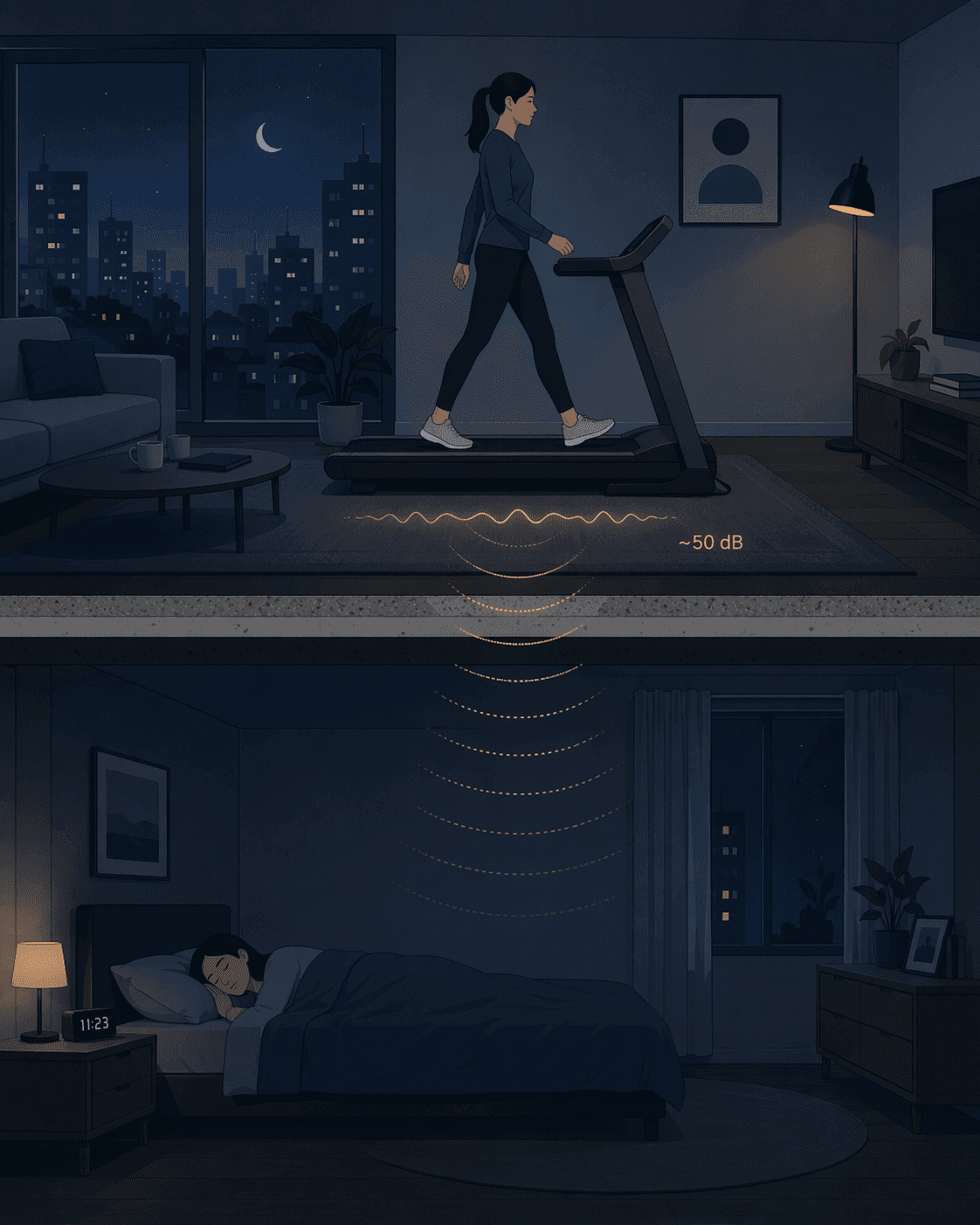
I have read hundreds of treadmill descriptions. I have yet to see one that says “this machine will make your downstairs neighbor text you at 6:30 AM.” Instead you get “whisper quiet” and “ultra-smooth” — none of which carry a measurement. The decibel scale is logarithmic. A jump from 50 dB to 60 dB is not a 20% increase; it is roughly a tenfold increase in sound intensity. A reading of 50.8 dB (the NordicTrack Commercial 1750 at a walking pace) is in the range of a quiet refrigerator. A reading of 70 dB (the Sole F63 while running) is closer to a vacuum cleaner — noticeable through a standard apartment wall.
The threshold I use for apartment safety is 50–60 dB. Below 55 dB, a neighbor a few feet away might hear something if they are listening for it, but it rarely crosses into complaint territory. Above 65 dB, the risk increases sharply. At 70 dB you are in normal office noise — constant, audible, irritating over time. Most buyer guides do not mention this. They compare horsepower, belt size, and incline range, then call a treadmill "quiet" if the motor is not obviously loud. They never put a meter on it.
How the Numbers Were Measured
I trust a decibel reading more than a marketing claim, but I also want to know how the number was produced. The data in this article comes from two independent testing sources — TreadmillReviews.com and TreadmillReviews.net. Both use a digital sound meter in controlled settings. That is a good baseline. But the conditions matter.
The Horizon 7.8 AT is described as "the quietest motorized treadmill tested by TreadmillReviews.com." But no precise decibel figure is published alongside that claim. I have no reason to doubt the ranking — the site has tested many machines — but I cannot tell you whether it measures 52 dB or 55 dB. That gap in the data matters, and I want to be honest about it before we move to the table.
The Decibel Readings That Matter
Here is the comparison that matters. These are actual readings from the two independent test sites, plus one additional source (Garage Gym Reviews) for the Horizon 7.0 AT. I have included the test conditions where available, because context changes how you interpret the number.
| Model | dB Reading | Test Conditions | Source |
|---|---|---|---|
| NordicTrack Commercial 1750 | 50.8 dB | 3.0 mph, no walker, lab setting | TreadmillReviews.com |
| Sole F80 | 53.8 dB | Walking speed, with walker, home-like setting | TreadmillReviews.net |
| Horizon 7.8 AT | Not specified | Claimed quietest motorized, no dB published | TreadmillReviews.com |
| Horizon 7.0 AT | Over 70 dB | Measured from 4 ft away | Garage Gym Reviews |
| Sole F63 | ~70 dB | Running, with walker | TreadmillReviews.net |
| WalkingPad X21 | Up to 75 dB peak | Peak speed, double-fold design | TreadmillReviews.com |
But a single dB number doesn't tell you the full story. A quiet motor with a hard foot-strike can still thud through the floor. The Sole F80’s Cushion Flex deck is claimed to reduce impact by 40% – but that’s a marketing spec, not an independent measurement. When you test a treadmill, the foot-strike noise from the belt and deck matters just as much as the motor hum. A cushioned deck can help, but it’s not a substitute for a low overall dB reading under load. And don’t assume walking pads are quiet: the WalkingPad X21 peaks at 75 dB, louder than some full-sized motorized treadmills. A mat can reduce vibration transmitted to the floor, but it won’t make a 70 dB motor quiet.
If you live above anyone, do not buy a treadmill without seeing a decibel reading measured at running pace. And do not trust a brand that does not give you one.
Comments
Join the discussion with an anonymous comment.