
Start with constraints, not brands. A full body workout machine can mean a $229 suspension trainer, a $990 rower, a $1,500 multi-station home gym, a $2,990 smart platform, or a wall-mounted system that can exceed $7,000 after several years of membership fees. Those products do not solve the same problem. Before comparing Tonal against Bowflex, REP, Vitruvian, TRX, or Concept2, decide four things: how much space you can leave open, how much you want to spend after five years, whether you will keep paying for software, and whether you need coaching or already know how to train.
For most buyers, that sequence eliminates more bad options than any ranked list can. A renter who cannot drill into a wall should not spend much time studying Tonal. Someone with a garage bay and no interest in a monthly app may get better long-term value from a functional trainer or power rack setup. A beginner who needs form guidance may reasonably pay for a smart gym, but the subscription is not a small add-on; it can become the largest cost difference over the life of the machine.
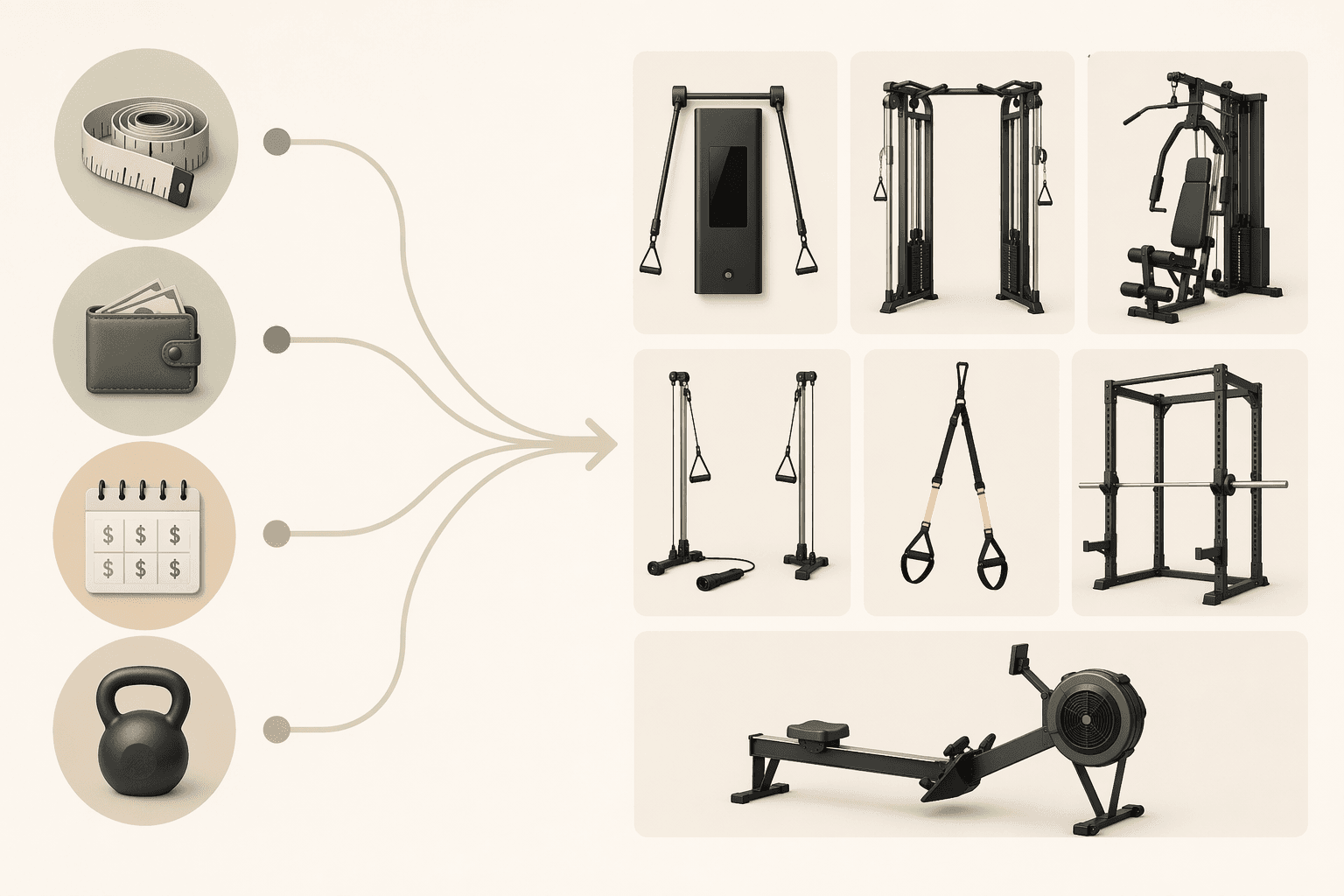
First, define what “full body” has to mean in your home
For this guide, a full body workout machine is equipment that can train upper body pulling, upper body pressing, legs, trunk, and conditioning or work capacity without requiring a separate room of machines. That includes seven practical categories: smart gyms, functional trainers, multi-station weight-stack gyms, portable cable trainers, bodyweight or suspension systems, power rack combinations, and cardio-based machines that recruit the whole body.
That definition still has boundaries. A rower can be a legitimate full-body conditioning machine, but it is not a complete strength system for someone who wants progressive heavy pressing, loaded squats, or cable isolation work. A suspension trainer can train nearly every movement pattern, but its resistance ceiling depends on body angle, loading skill, and exercise selection. A smart wall gym may provide guided strength training, but it is less useful if installation rules, subscription fatigue, or ceiling and wall conditions make it impractical.
The four questions that narrow the field
| Constraint question | If your answer is… | Start with these categories | Usually avoid |
|---|---|---|---|
| How much usable space can stay available? | Only a closet, under-bed area, or temporary living-room setup | Suspension trainer, portable cable trainer, compact smart platform, rower stored upright | Multi-station gyms, large functional trainers, most rack systems |
| What is your realistic five-year budget? | Under $1,000 | TRX, X3 Bar, Concept2 RowErg, some portable systems | Tonal-style wall gyms, premium dual-stack functional trainers |
| Will you tolerate a required or near-required subscription? | No | Functional trainer, multi-station gym, power rack combo, TRX, X3 Bar, Concept2 RowErg | Most screen-led smart gyms |
| How much guidance do you need? | High guidance, low training confidence | Smart gym, app-led portable trainer, simple multi-station gym | Bare rack setups unless you will follow a separate program |
The question that changes the math most often is subscription tolerance. A machine with a lower apparent footprint and more polished coaching can become the more expensive choice if the membership is not optional in practice. A brand-owned cost comparison estimates Tonal 2 at about $7,887 over five years when subscription fees are included, with $3,597 of that total coming from membership payments; because that source sells a competing product, the exact comparison should be treated directionally rather than as independent testing, but the arithmetic reflects the real issue buyers need to price in. [1]
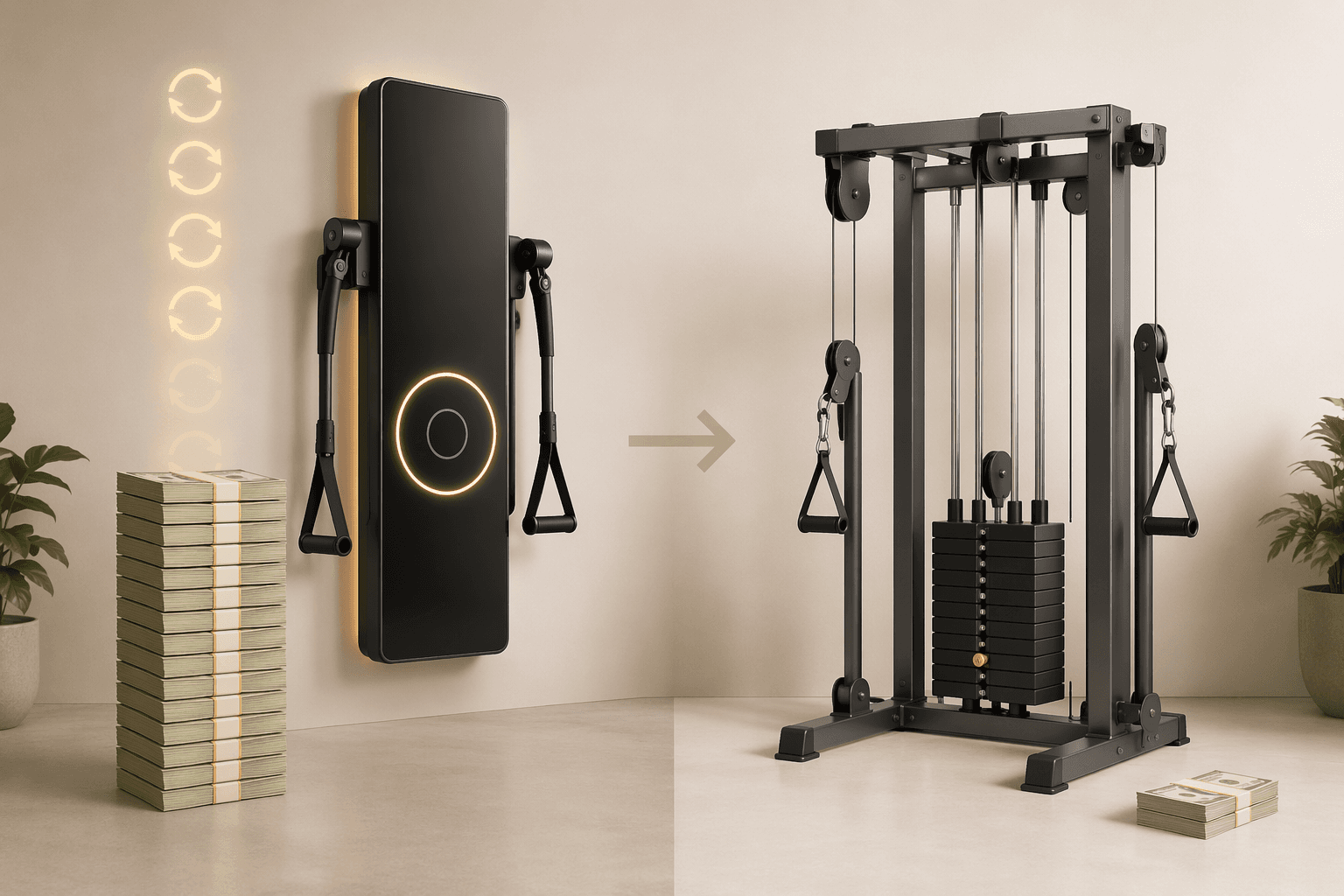
Do not compare resistance numbers as if they mean the same thing
The spec sheet can mislead even careful shoppers. Digital resistance, bands, bodyweight leverage, plate-loaded resistance, and weight-stack cable resistance do not feel identical at the same published number. Garage Gym Reviews notes that many weight-stack cable machines use a 2:1 pulley ratio, so 100 pounds on the stack may deliver roughly 50 pounds of felt resistance at the handle. Its testers also report that 200 pounds of cable tension can feel harder than 200 pounds on a weight stack. [2]
This matters most for intermediate lifters. A beginner may care more about consistency, coaching, and exercise coverage. Someone already pressing, rowing, hinging, and squatting with meaningful loads needs to ask whether the machine’s maximum resistance applies to one handle, two handles, a bar attachment, digital eccentric loading, or a pulley system that halves the stack. A 200-pound published number can be plenty in one format and limiting in another.
Smart gyms: guided strength with recurring fees
Smart gyms are the cleanest answer for buyers who want guided strength workouts, automatic resistance changes, compact hardware, and less decision-making. They are not the cleanest answer for buyers who want the lowest five-year cost or who dislike paying for access to the experience that made the machine attractive in the first place.
Tonal 2 is the reference point in this category: PCMag lists it at $4,295 plus $59 per month, with up to 250 pounds of digital resistance. It also requires professional installation and a clear 7-by-7-foot workout area, which makes it less renter-friendly than its wall-mounted profile first suggests. [3]
Vitruvian Trainer+ fits a different space problem. PCMag lists it at $2,990 plus $39 per month, with up to 440 pounds of digital resistance, and Garage Gym Reviews describes it as an 80-pound platform that can store under a couch. [3][4]
| Best fit | Model to start with | Why it fits | Watch before buying |
|---|---|---|---|
| Guided strength training with a polished wall-mounted interface | Tonal 2 | Compact wall system, coaching-first experience, 250 lb digital resistance | High hardware price, $59/mo subscription, professional installation, 7x7 ft clear area |
| Small-space buyer who wants heavy digital resistance without wall mounting | Vitruvian Trainer+ | 440 lb max digital resistance and under-couch storage profile | $39/mo subscription and a different feel than cable or free-weight loading |
Choose this category when the coaching layer is part of the value you will actually use. If you mainly want cables and progressive loading, a traditional machine often costs less over time.
Functional trainers: dedicated space and long-term value
A functional trainer is the strongest default for many home gyms because it trains pushes, pulls, rotations, arms, shoulders, and many lower-body accessories from adjustable pulleys. It does not coach you. It does not entertain you. It also does not keep billing you every month.
The category works best when you have a permanent space and already know, or are willing to learn, a basic strength program. Garage Gym Reviews’ 2026 full-body machine testing is useful here because it compares price, footprint, resistance type, and warranty across multiple machine types rather than treating every home gym as the same product. [2]
For buyers comparing this category against smart gyms, the most important distinction is not just subscription cost. It is also adjustability and tactile loading. A dual-pulley trainer can accommodate rows, flyes, pulldowns, lateral raises, curls, triceps work, split-squat variations, and anti-rotation work with little setup. But the pulley ratio must be checked before you assume the stack is heavy enough.
| Best fit | Model direction | Why it fits | Watch before buying |
|---|---|---|---|
| Dedicated room or garage buyer who wants cable versatility | REP-style or similar dual-stack functional trainer | Broad exercise library and no required subscription | Large footprint, assembly burden, pulley ratio may reduce felt resistance |
| Buyer who wants a more compact cable-centered setup | Compact functional trainer from a tested home-gym brand | Better long-term cost than subscription-led smart gyms if coaching is not needed | May still require significant floor clearance around the machine |
Multi-station gyms: simple guided stations without software
Multi-station gyms are less fashionable than smart gyms and less flexible than open cable trainers, but they still solve a common problem well: a beginner or returning exerciser wants familiar stations, controlled movement paths, and no subscription. The trade-off is that the machine decides much of the exercise menu for you.
FitnessFactory’s 2026 all-in-one home gym coverage places the Body-Solid EXM2500 in roughly the $1,500 range and emphasizes the kind of footprint and warranty details that matter for this category. [5]
This is a good lane if your main goal is consistent general strength training rather than barbell performance or a huge exercise library. The fixed paths can be reassuring. They can also become restrictive once you want more unilateral work, athletic movement patterns, or heavier progression than the stack and pulleys comfortably allow.
| Best fit | Model to start with | Why it fits | Watch before buying |
|---|---|---|---|
| Beginner or general-fitness household with dedicated floor space | Body-Solid EXM2500 | Station-based training, no app requirement, roughly $1,500 category pricing | Less exercise freedom than a functional trainer; confirm delivered footprint and stack feel |
Portable cable and compact resistance systems for tight spaces
Portable machines are not automatically compromise products. They are compromise-specific products. They can be excellent when the constraint is storage, travel, or a shared living area. They are less convincing when the buyer expects the feel, maximum loading, and stability of a commercial cable station.
Garage Gym Reviews’ 2026 coverage lists the X3 Bar at $549, making it a useful example of a compact strength system in this lane. MAXPRO sits higher, at $749 to $1,099, and represents the portable cable-trainer side of the category. These prices make both materially different buying decisions from wall-mounted smart gyms or full functional trainers. [2]
| Best fit | Model to start with | Why it fits | Watch before buying |
|---|---|---|---|
| Small apartment buyer who wants compact resistance training | X3 Bar | $549 entry point and minimal storage demand | Band resistance curve and exercise feel are different from cables or weights |
| Traveler or shared-space buyer who wants cable-style resistance | MAXPRO | $749–$1,099 range and portable profile | Check resistance ceiling, anchoring, and whether the app experience matters to you |
| Buyer who wants the smallest possible coaching-capable strength platform | Vitruvian Trainer+ | Stores under a couch and offers high digital resistance | Much higher hardware cost than non-smart portable systems |
A portable system is the right answer when it removes the barrier that would otherwise stop training. It is the wrong answer when the only reason for choosing it is that it looks easier to buy than measuring for a more appropriate permanent setup.
Suspension trainers for low budgets and clear expectations
TRX-style suspension training is the lowest-cost legitimate full-body option in this guide. Garage Gym Reviews lists TRX at $229, which puts it far below smart gyms, functional trainers, and multi-station machines. [2]
The appeal is obvious: pressing, rowing, lunging, squatting variations, hamstring curls, core work, and mobility drills can all fit into a bag. The limitation is just as important. Progressive overload depends on body position, tempo, range of motion, and exercise difficulty rather than simply adding a plate or selecting a heavier stack. That is enough for many beginners and general-fitness users. It may frustrate an intermediate lifter who wants precise loading and heavy lower-body progression.
| Best fit | Model to start with | Why it fits | Watch before buying |
|---|---|---|---|
| Lowest-cost full-body training in a small space | TRX | $229 price point and extremely small storage demand | Resistance ceiling and progression depend heavily on setup and skill |
Power rack combinations for strength progression
A power rack combination is the least ambiguous choice for someone whose definition of full body includes squats, presses, pull-ups, deadlift variations, and eventually heavier loading. It is also the least forgiving category for space, noise, flooring, and training knowledge.
BarBend’s 2026 home gym and full-body machine coverage includes pricing and hands-on testing methodology across multiple machines, though its data was last updated in February 2025 and current retail prices may have shifted by June 2026. [6][7]
This category becomes more attractive when the buyer already knows how to use a barbell or plans to learn from a structured program. It becomes less attractive when the buyer mainly wants a single guided machine. A rack can become a complete home gym, especially with a bench, bar, plates, pull-up bar, and cable attachment, but it is not a single self-explanatory station in the way a multi-gym is.
| Best fit | Model direction | Why it fits | Watch before buying |
|---|---|---|---|
| Intermediate lifter or strength-focused beginner with a dedicated space | Power rack with bench, barbell, plates, pull-up bar, and optional cable attachment | Best path for heavy progressive strength training | Requires more skill, more setup decisions, and more permanent space |
Cardio-based machines when conditioning is the priority
Cardio-based machines belong in the conversation only when the buyer’s main goal is conditioning, calorie expenditure, or general fitness rather than comprehensive strength development. The Concept2 RowErg is the cleanest example here, at $990. [2]
A rower uses legs, hips, trunk, back, and arms in every stroke. That makes it more full-body than a treadmill in the usual sense. But it still does not replace a strength machine if your goals include upper-body pressing, loaded unilateral leg work, or progressive resistance training across a broad exercise menu.
| Best fit | Model to start with | Why it fits | Watch before buying |
|---|---|---|---|
| Conditioning-focused buyer who wants a durable full-body cardio machine | Concept2 RowErg | $990 benchmark option with whole-body rowing pattern | Not a complete strength-training machine by itself |
A practical matching guide
If the decision still feels crowded, use the machine category as the first filter and the model as the second. The wrong category with a highly rated model is still the wrong purchase.
| Your situation | Best category | Start with | Reasonable boundary |
|---|---|---|---|
| You want guided strength training and accept ongoing fees | Smart gym | Tonal 2 or Vitruvian Trainer+ | The five-year cost can rise sharply once membership is included |
| You have a permanent room or garage and dislike subscriptions | Functional trainer | Dual-stack functional trainer from a tested home-gym brand | Confirm pulley ratio and felt resistance before assuming the stack is enough |
| You want simple machine stations for general strength | Multi-station gym | Body-Solid EXM2500 | Less flexible than adjustable pulleys or a rack |
| You live in a small apartment or need storage flexibility | Portable resistance system | X3 Bar, MAXPRO, or Vitruvian Trainer+ | Resistance feel and maximum useful loading vary widely |
| You want the lowest-cost full-body setup | Suspension trainer | TRX | Progression is less precise than stacks, plates, or digital loading |
| You want heavy strength training above all | Power rack combination | Rack, bench, barbell, plates, and optional cable attachment | Requires space, flooring, and training competence |
| You mainly want conditioning | Cardio-based full-body machine | Concept2 RowErg | Excellent for conditioning; incomplete as a strength system |
Where price should and should not decide
The market range is wide enough that price alone is a poor shortcut. A $229 suspension trainer and a $990 rower can both be rational purchases. So can a $2,990 smart platform or a roughly $1,500 multi-station gym. The error is buying the expensive machine to solve a low-cost problem, or buying the compact option when your real goal requires a heavier, more permanent setup. [2][3][5]
For smart gyms, use five-year cost rather than hardware cost. A $59 monthly subscription adds $3,540 over five years before any taxes, accessories, delivery, or installation changes. A $39 monthly subscription adds $2,340 over the same period. Those figures do not make smart gyms bad purchases; they make them coaching-and-software purchases, not just equipment purchases. [3]
For traditional machines, price should be checked against usable resistance, warranty, footprint, and assembly burden. A cheaper cable machine with a stack that feels too light after the pulley ratio is accounted for may not be cheaper in practice if it gets replaced early. A larger machine with no recurring fees may be the better value if it fits the room and the household will use it.
The shortest defensible answer
Buy a smart gym if you need coaching, like screen-led workouts, and accept that the subscription is part of the product. Buy a functional trainer if you have dedicated space and want the strongest subscription-free balance of versatility and long-term value. Buy a multi-station gym if you prefer fixed stations and simple general strength work. Buy a portable cable or compact resistance system if storage is the controlling constraint. Buy TRX if your budget is low and you understand bodyweight progression. Buy a power rack combination if heavy strength progression matters most. Buy a rower if your main goal is full-body conditioning rather than complete resistance training.
The best full body workout machine is not the one with the most features. It is the one whose space demand, five-year cost, resistance type, and learning curve match the way you will actually train.
References
- Best Tonal Alternatives, FitTransformer
- 11 Best Full-Body Workout Machines (2026), Garage Gym Reviews
- Best Smart Home Gym Equipment, PCMag
- Vitruvian Trainer+ Review (2026), Garage Gym Reviews
- Best All-In-One Home Gym Systems for 2026, FitnessFactory
- Best Full Body Workout Machines for 2026, BarBend, February 2025
- Best Home Gyms of 2026, BarBend, February 2025
Comments
Join the discussion with an anonymous comment.