
The cleanest way to compare a smart all in one home gym with a traditional weight-stack system is not the product page. It is the five-year bill. A Tonal 2 starts at $4,295, and its $59.95 monthly membership adds about $3,597 over 60 months, bringing the five-year total to roughly $7,892 before considering taxes, accessories, delivery, or installation variables. A Major Fitness B17 at about $4,200 has no required monthly training fee. A Bells of Steel All-in-One at about $1,900 also avoids the recurring charge. That does not make the smart machine a bad buy, but it does make the subscription the center of the decision, not a footnote. [1][2][3]
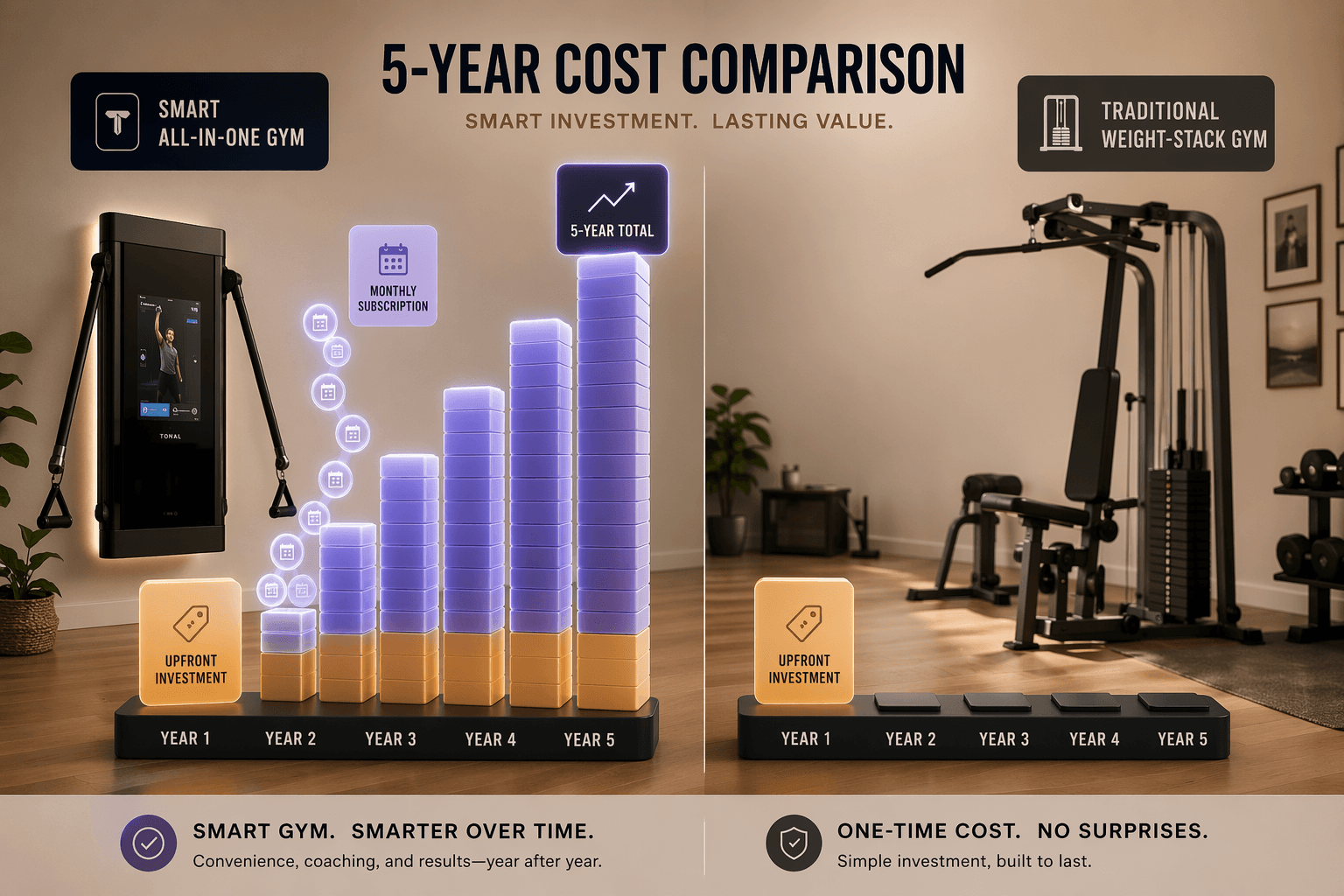
That five-year view is useful because smart gyms are designed to win the first 10 minutes. The screen looks helpful. The workout is already chosen. The resistance changes without walking to a stack or swapping plates. The machine tells you what to do next. For someone trying to build consistency at home, those are not cosmetic features. They are the product. The harder question is whether they are still worth paying for in month 47.
| System type | Example | Upfront cost | Monthly fee used here | Approx. 5-year cost | What the extra cost is buying |
|---|---|---|---|---|---|
| Smart wall-mounted gym | Tonal 2 | $4,295 | $59.95 | $7,892 | Guided workouts, automatic weight adjustment, AI coaching, compact wall-mounted setup |
| Traditional weight-stack all-in-one | Major Fitness B17 | $4,200 | $0 | $4,200 | Higher mechanical resistance headroom, no subscription, simpler long-term service path |
| Traditional all-in-one trainer | Bells of Steel All-in-One | $1,900 | $0 | $1,900 | Lower entry cost, no subscription, conventional cable-and-pulley ownership |
The table also shows why the usual “smart versus traditional” comparison can get mushy fast. The smart machine is not merely a nicer interface bolted onto the same gym. It changes where the money goes. A traditional stack asks for most of the money upfront and then mostly leaves you alone. A smart gym asks for a premium upfront and then keeps charging because its best features live in the software layer.
What the subscription has to justify
A $40–$60 monthly subscription is not automatically unreasonable. It is unreasonable only if it becomes rent on a screen you stop using. The useful version of the smart gym subscription replaces decisions: what workout to do, how much resistance to use, when to progress, how long to rest, and whether your form is drifting enough to matter.
Tonal 2 is the clearest example because its AI coaching can adjust weight automatically between sets, and the machine’s digital resistance system gives it more control over loading than a fixed plate stack. PCMag’s smart gym coverage highlights Tonal’s guided strength-training system and connected coaching features, while CNET’s smart gym testing also treats coaching and workout guidance as central reasons buyers consider these machines in the first place. [2][3]
Speediance makes the same argument from a different angle. Its Gym Monster 2 uses digital resistance and advertises more than 1,000 guided workouts, with a foldable footprint that makes it easier to fit into a room that cannot permanently surrender itself to gym equipment. That workout-library claim comes from the brand, so it should be read as a feature disclosure rather than independent proof that users will keep training. Still, it explains what the company is trying to sell: less planning, less setup, fewer reasons to wander away. [4]
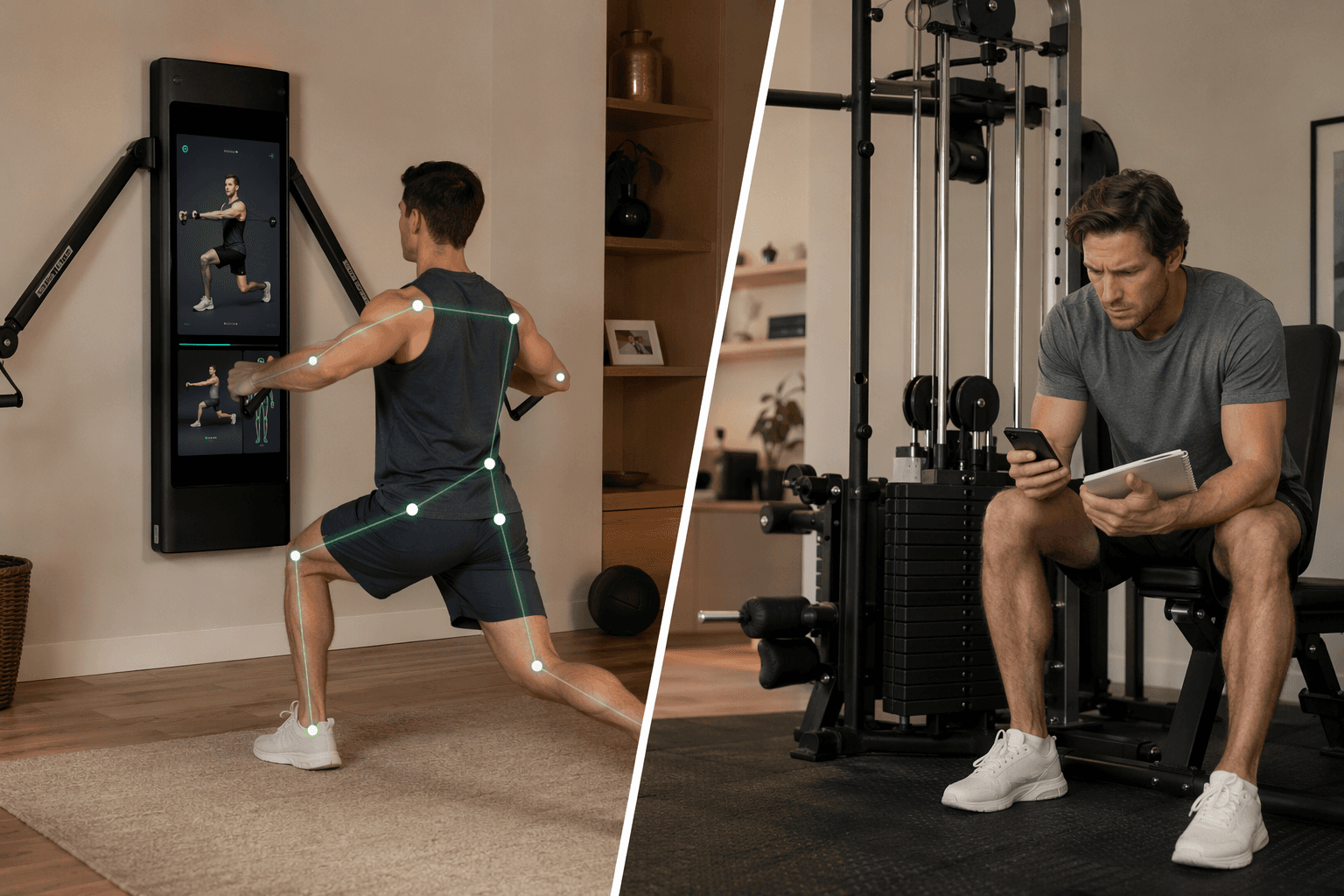
For an intermediate lifter, that can be a real advantage. Beginners often need basic instruction; advanced lifters often already know how they want to train. The awkward middle is where a smart system can feel most valuable: you understand the exercises, but you may not want to write a full progression plan, track every load change, or second-guess whether today should be a push day, a pull day, or a lower-body session. If a machine removes those decisions and gets used four days a week because of it, the subscription has done something more useful than decorate the wall.
The fairest comparison is not subscription versus nothing. It is subscription versus the help you would otherwise buy or avoid. In-person personal training can cost far more per month than the typical smart gym membership range identified in current smart gym coverage, so a connected machine can be cheaper than ongoing coaching for users who would actually pay for a trainer. [2][3]
That last condition matters. If you would never hire a trainer, never follow the guided classes, and mostly want cable rows, lat pulldowns, presses, and accessory work on your own schedule, then the subscription is not replacing a cost. It is creating one.
Resistance ceiling is where the traditional stack pushes back
Digital resistance is clever. It can change quickly, support eccentric-focused modes, and make a compact machine feel more capable than its physical size suggests. But it still has a ceiling. Speediance lists 110 pounds per arm, while Tonal 2 is rated at 250 pounds total. Those numbers are plenty for many accessory movements and a lot of general strength training, but they can become limiting faster on compound lower-body patterns, heavy pulls, and stronger bilateral work. [2][4]
Traditional dual-stack systems commonly push higher, with available machines in the 260–400-plus-pound total resistance range depending on model and stack configuration. That headroom changes the long-term value equation. A machine that feels challenging in year one but cramped in year three is not really a five-year bargain, even if it made training easy at the start. [1][5]
This is where buyer identity matters more than product category. A person training for general fitness, hypertrophy, controlled tempo work, and guided full-body sessions may never touch the top end of a smart gym’s resistance. Someone who expects their home gym to cover heavy rows, squats, deadlift variations, and long-term strength progression should be more skeptical. The issue is not whether 220–250 pounds of digital resistance is “good.” It is whether it is enough for the lifts you expect the machine to own.
A deeper resistance-type comparison belongs in a separate buying rabbit hole, but the practical split is straightforward: digital systems buy compact control and coaching; weight stacks buy familiar load, visible hardware, and more mechanical headroom. For buyers still sorting out the broader categories, a guide to all-in-one home gym types can help separate smart gyms, functional trainers, power rack hybrids, and selectorized stack systems before the price comparison gets too tangled.
The space tradeoff is real, especially in normal rooms
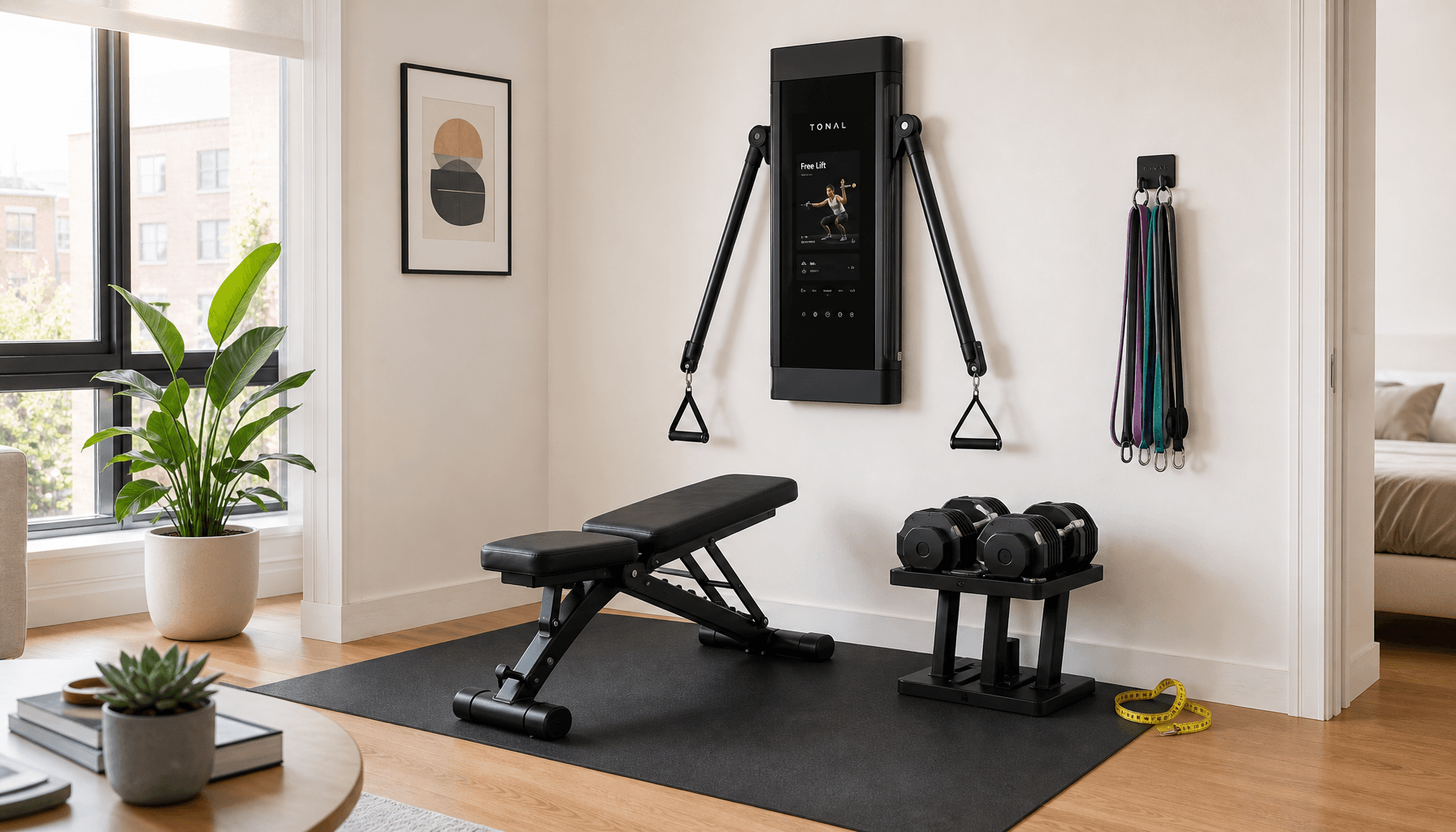
Smart gyms do not just win on coaching. They often win on footprint. Tonal 2 is a wall-mounted unit listed at 21.5 inches wide, while Speediance’s Gym Monster format is listed at 49 by 28 inches when unfolded. A traditional machine such as the Body-Solid G9B occupies about 60 by 36 inches, before leaving working room around the stations. [2][4][1]
That difference can decide the purchase in an apartment, spare bedroom, office, or garage that still needs to hold a car. A compact smart gym makes the dream version of home training more plausible: walk over, tap the workout, train, leave the room usable afterward. Traditional all-in-ones are more honest about their bulk. They look like gym equipment because they are gym equipment, and they usually keep occupying the same rectangle whether you train or not.
The catch is that wall-mounted compactness can come with its own friction. Tonal requires professional wall installation and about 7 feet of clear workout space, which means the “small” machine still needs a suitable wall, adequate clearance, and a more committed installation path than a freestanding unit. [2]
So space is not a separate category from cost and resistance. It is part of the same triangle. A smart gym may cost more over five years and offer less maximum resistance, yet still be the only realistic machine for a narrow room. A traditional stack may be the stronger long-term buy, yet fail the test if it turns the only spare room into a permanent equipment bay.
Year four is where repairability starts to matter
Most smart gym comparisons spend plenty of time on the screen and not enough time on ownership after the warranty glow fades. That is backwards for a $2,000–$5,000 purchase. A traditional weight-stack system is not indestructible, but its failure points are easy to understand: cables stretch or fray, pulleys wear, guide rods need lubrication, upholstery tears, bolts need checking. Replacement cables are commonly inexpensive parts rather than existential events for the machine. RitFit’s maintenance guidance emphasizes routine lubrication, inspection, and cable replacement as part of keeping all-in-one machines usable over the long term. [5]
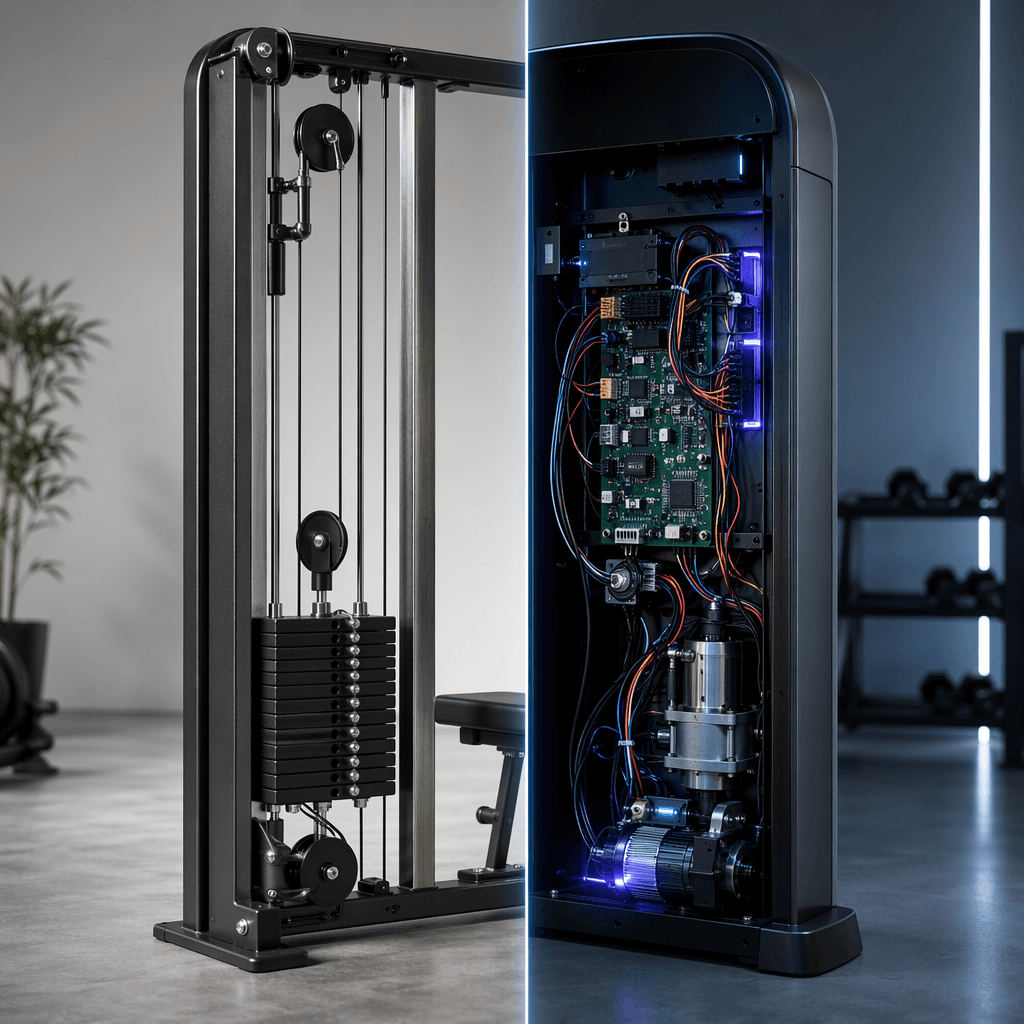
That kind of maintenance is annoying in the way owning equipment is always annoying, but it is legible. A cable-and-pulley machine can often be serviced by a reasonably handy owner or a local fitness-equipment technician. Competitors Outlet’s buying guidance for all-in-one gyms similarly treats frame quality, cables, pulleys, and serviceability as central durability considerations rather than optional details. [6]
A smart gym adds parts that are harder to judge from the outside: screens, sensors, motors, control boards, firmware, and brand-specific service processes. Those components may work beautifully for years, and the available evidence does not support claiming a specific failure rate. The narrower, safer point is enough: when a digital system does fail, the repair path is more likely to depend on the manufacturer than on generic mechanical parts.
That dependence changes the risk profile. If a traditional stack loses a cable, the machine is temporarily down and the fix is usually obvious. If a smart gym loses a board, motor function, or screen-dependent feature, the owner may be waiting on authorized service, proprietary parts, or brand support. Nobody wants to think about that while watching a polished product demo. It matters more once the machine is furniture.
Memberships can be paused, but the straight-line math is still useful
The five-year Tonal estimate assumes continuous membership for 60 months. Real people are messier. Some will pause, churn, restart, or use the machine differently after the first year. That can lower the actual cost compared with the straight-line projection. It can also reduce the reason for buying the smart gym in the first place, because the most persuasive features are tied to the guided and connected experience.
This is where ecosystem lock-in deserves a short but honest mention. If someone already lives inside a connected fitness ecosystem, enjoys app-led classes, and wants the same style of coaching on a strength machine, the subscription may feel less like a new bill and more like the continuation of a habit. That preference can override a spreadsheet. It should not be mistaken for proof that the machine is cheaper.
For Tonal-specific buyers, a dedicated Tonal home gym total cost of ownership breakdown is worth reading separately, because hardware promotions, accessories, installation, and membership assumptions can move the final number. The broader comparison here is simpler: once a subscription is part of the machine’s core value, the buyer has to judge the machine and the ongoing service together.
When the smart all-in-one makes sense
A smart all-in-one home gym makes the most sense when the coaching layer is not ornamental. The buyer who benefits most is not necessarily the weakest or the newest lifter. It is the person who trains more consistently when the machine chooses the session, sets the load, tracks the work, and reduces the number of small decisions between walking into the room and starting the first set.
- You want guided programming and would otherwise pay for coaching, classes, or an app stack to provide structure.
- You have limited space and a wall-mounted or foldable machine is the difference between having a gym and not having one.
- Your training goals fit within the machine’s resistance ceiling.
- You are comfortable with brand-dependent service and a software-driven ownership experience.
- You will actually use the classes, feedback, tracking, and automatic progression enough to make the subscription part of training rather than a forgotten bill.
In that scenario, the higher five-year cost is not irrational. It is buying compliance. If the smart machine turns an inconsistent lifter into a consistent one, the spreadsheet is not the only measure of value.
When the traditional weight-stack system is the better buy
A traditional all-in-one weight-stack system is the better long-term investment when you already know how to train, or when you are willing to follow a program without needing the machine to behave like a coach. It asks more from the owner at the beginning: choose exercises, track progress, manage rest periods, and adjust loads manually. In return, it avoids the permanent toll booth.
- You care more about five-year cost than guided convenience.
- You expect to grow into heavier resistance over time.
- You prefer mechanical parts that can be inspected, lubricated, replaced, and serviced without depending heavily on one connected-fitness brand.
- You have enough floor space for a larger machine and do not need the gym to disappear visually.
- You would rather spend money on equipment capacity than on ongoing programming.
This is the ownership case that tends to age well. A traditional stack will not correct your form or congratulate you for finishing a workout. It will also not ask for $59.95 next month before continuing to feel like the machine you bought.
The tradeoff you are actually paying for
Smart all-in-one gyms win on coaching, convenience, and compactness. Traditional weight-stack systems win on long-term ownership value, resistance headroom, and mechanical simplicity. The subscription is worth it when it replaces something real: a trainer, a class habit, a programming app, or the decision fatigue that keeps workouts from happening.
If you want a training assistant built into the machine and accept that the best version of the product requires ongoing payment, the smart option makes sense. If you want the stronger five-year buy, more resistance runway, and a machine that is easier to live with mechanically in year four and beyond, the traditional stack is the more rational long-term investment.
References
- Best Home Gyms 2026 — Garage Gym Reviews
- The Best Smart Home Gym Equipment — PCMag
- Best Smart Home Gyms 2026 — CNET
- Gym Monster 2 — Speediance
- Are All-in-One Machines Worth the Investment — RitFit
- How to Choose an All-in-One Home Gym — Competitors Outlet

Comments
Join the discussion with an anonymous comment.