
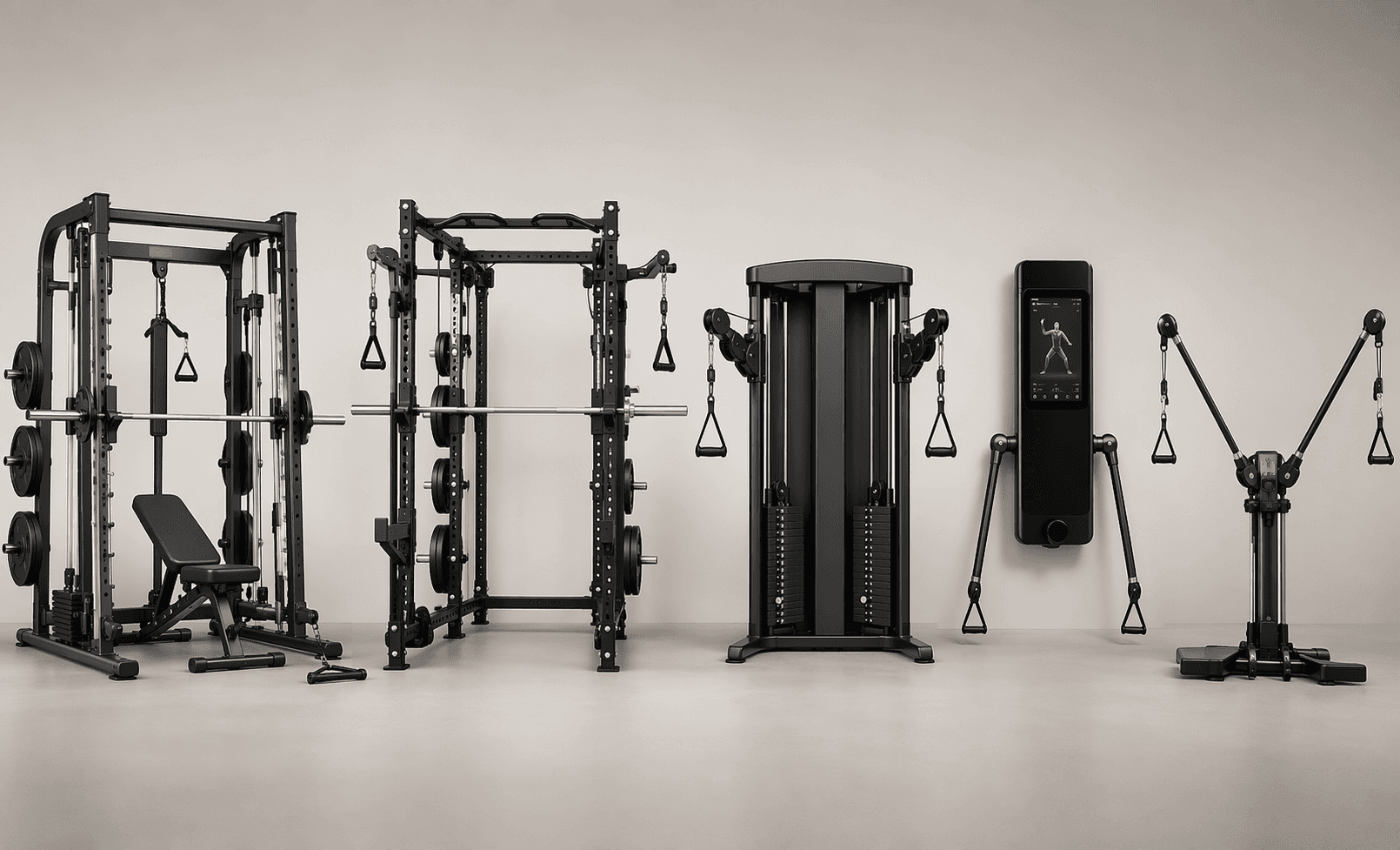
The phrase “all in one home gym equipment” sounds like it should describe one kind of machine. It does not. A Force USA-style Smith-and-cable tower, a REP Ares-style rack system, a Body-Solid multi-stack gym, a Tonal-style wall unit, and a Bowflex power-rod machine are all sold under that same umbrella, but they answer different questions.
That is why comparing them as if they are five versions of the same product gets messy fast. One buyer wants heavy barbell training with cable accessories. Another wants guided full-body workouts in an apartment. Another wants a safe selectorized machine with almost no setup between exercises. Those are not minor preference differences; they point to different machine architectures.
Start with the architecture, not the brand
Before looking at model names, sort the machine into one of five broad types. Some products blur the edges, especially plate-loaded rack systems with cable attachments, but the categories are still useful because they predict what the machine will feel like to train on after the honeymoon week is over.
| Architecture | Typical examples | Best fit | Space reality | Progression path | Typical mid-2026 budget |
|---|---|---|---|---|---|
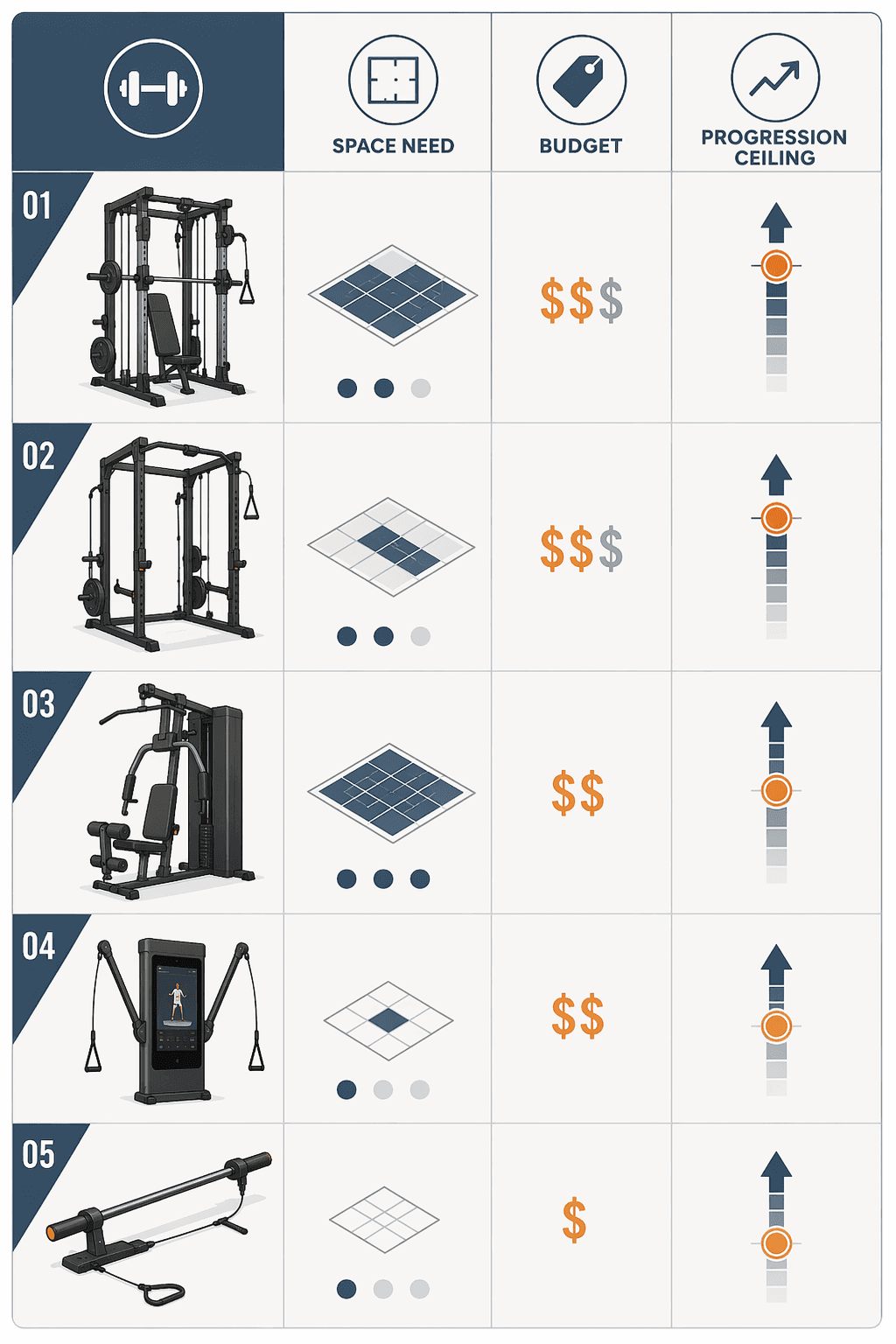
| Smith + cable combo | Force USA G20, Major Fitness B17 | Intermediate-to-advanced lifters who want guided bar work, cable isolation, and lots of exercise variety | Listed footprint often around 25–33 sq ft, but working area can be much larger once cable arms and lifting space are included | Usually strong, especially with plate loading or heavier stacks | $4,000–$6,000+ |
| Power rack + functional trainer | REP Ares 2.0, Bells of Steel All-in-One | Lifters who prefer open free-weight rack work plus cables | Often around 20–30 sq ft before accounting for bench movement, bar loading, and cable work | Excellent if the rack accepts standard plates and attachments | About $1,299–$1,900 for some budget systems; more for premium integrated racks |
| Traditional multi-stack gym | Body-Solid EXM2500, Life Fitness G2 | Beginners and general fitness users who want simple pin changes and familiar machine exercises | Usually more fixed than rack systems; still needs room for seats, arms, and entry/exit | Limited by stack weight and built-in stations | Around $1,795 for some midrange examples; higher for commercial-style units |
| Smart digital resistance | Tonal 2, Speediance Gym Monster | Small-space users who value coaching, guided programs, and fast transitions | Machine footprint can be under 10 sq ft, but workout area still matters | Limited by digital resistance cap, commonly around 220–250 lbs | Roughly $2,000–$3,995 before subscription costs, depending on model |
| Power rod system | Bowflex Xtreme 2SE | Beginners, low-impact general fitness users, and buyers under $1,500 | Compact and self-contained; fewer clearance surprises than cable-arm systems | Limited by rod resistance and resistance curve | Often under $1,500 |
Prices and availability move with sales, especially around major retail events, so the dollar ranges here should be treated as mid-2026 buying context rather than permanent price tags. The more durable lesson is that these machines are not competing on one clean scale. They differ in frame design, resistance source, cable path, bar setup, ceiling clearance, assembly burden, and upgrade path.
If you train like a lifter, separate Smith combos from rack combos
The most common buying mistake is treating a Smith + cable combo and a power rack + functional trainer as interchangeable because both are large, strength-oriented, and cable-capable. They are close enough to appear in the same search results, but not close enough to buy the same way.
Smith + cable combos: guided bar work plus cable variety
A Smith + cable combo gives you a fixed bar path, cable stations, and often a long accessory list packed into one frame. Models in this family, including Force USA G20-style systems, are appealing when you want machine-like control for presses, squats, rows, shrugs, and split squats, then want to move into cable flyes, pulldowns, curls, triceps work, and unilateral accessories without owning three separate machines.
That guided bar path is either the point or the problem. It can make solo training feel more controlled, especially for hypertrophy work and higher-rep sets. It can also feel restrictive if you care about free bar mechanics for squats, bench press, overhead press, or deadlift variations. If your main lifts need an open barbell path, the Smith station is not a substitute for a rack just because it looks serious.
These machines also ask more from the room than the product page usually admits. The Force USA G20 is listed around 29.2 sq ft, but working estimates that include cable-arm movement and lifter clearance can push the practical area closer to 80 sq ft. Reviewers also report major assembly demands for large all-in-one units; one Strong Home Gym report described a Force USA G20 solo build taking about 35 hours, while Garage Gym Reviews notes that two-person builds on similar machines can still take roughly 6–8 hours depending on the model and builder skill.[1][2]
That does not make the category a bad choice. It makes it a bad impulse buy. A Smith + cable combo is worth shortlisting when you want one dominant machine for bodybuilding-style training, guided barbell movements, and cable isolation, and when the room can support not just the frame, but the way the cables sweep through space.
Power rack + functional trainer: free-weight rack first, cables second
A power rack with an integrated functional trainer starts from a different assumption: the rack is still the heart of the gym. You squat, bench, press, pull from safeties, add a bench, load plates, and build around a free bar path. The cable system expands the rack rather than replacing the need for free weights.
That makes this architecture the cleaner choice for lifters who want the big lifts to behave like the big lifts. REP Ares 2.0-style setups and Bells of Steel all-in-one rack systems sit in this category, although some models blur the line between rack, functional trainer, and plate-loaded home gym. Mid-2026 pricing for some Bells of Steel all-in-one configurations sits roughly in the $1,299–$1,900 range, while more integrated premium rack systems can climb much higher.[1][3]
The upgrade path is the reason many serious home-gym owners end up here. A rack can accept benches, bars, plates, safety arms, landmine attachments, dip stations, storage, and future cable upgrades if the ecosystem is compatible. It also gives fewer excuses: if the bar path feels wrong, it is probably the lifter, not the Smith rails.
The cost is that open architecture needs open space. A 20–30 sq ft footprint does not include the full area needed to slide a bench, load plates, walk out from the rack if the setup allows it, or use the cable handles at angles. Anyone measuring a basement corner should tape the working area, not just the rectangle printed in the specifications.
If you want simple full-body training, multi-stack gyms still have a place
Traditional multi-stack gyms are less exciting in 2026 because they do not photograph like a transformer rack and they do not stream workouts from a wall screen. They are still useful for the buyer who wants to sit down, move a pin, and train without learning barbell setup, cable ratios, J-cup placement, or attachment compatibility.
Body-Solid EXM2500-style and Life Fitness G2-style machines usually organize training around fixed stations: chest press, pulldown, row, leg extension, curl, and sometimes pec deck or low pulley work. Fitness Factory’s 2026 all-in-one gym coverage separates these selectorized systems from rack-based and functional-trainer designs because the training experience is more guided and less modular.[4]
The trade-off is plain. You get a shorter learning curve and quick transitions, but less freedom. If the seat position, handle path, or station selection does not match your body or goals, there may not be much to modify. Stack weight also becomes the progression ceiling. For a beginner training consistently, that ceiling may be far away. For someone already strong on rows, pulldowns, or leg work, it can arrive sooner than expected.
Smart digital resistance is compact, but the subscription and resistance cap matter
Smart digital resistance machines are the easiest category to underestimate and overestimate at the same time. Underestimate them, and you miss how useful guided programming, quick weight changes, eccentric modes, tracking, and small-space storage can be. Overestimate them, and you treat a slim wall unit as if it has the same long-term loading runway as a rack and plates.
Tonal 2 and Speediance-style machines are built around compactness and coaching. Healthline’s compact-gym coverage and PCMag’s smart home gym testing both place smart systems in the small-space conversation, where wall-mounted or folding designs can make strength training realistic in rooms that cannot hold a rack.[5][6]
The footprint numbers show why they attract apartment dwellers. Speediance is described around a 9.5 sq ft machine footprint, with a practical workout area closer to about 28 sq ft once the user’s movement is included. That is still real floor space, but it is a different problem from planning around a large rack, cable arms, bar storage, and ceiling height.[1][5]
The cost comparison has to include software. Tonal 2 is listed at $3,995, and its required subscription is commonly reported around $49–$60 per month. Over five years, that adds $2,940–$3,600 before accessories, installation, or price changes, bringing the ownership calculation into a very different range than the sticker price alone suggests.[6]
| Tonal 2 cost component | Amount |
|---|---|
| Purchase price | $3,995 |
| Subscription at $49/month for 5 years | $2,940 |
| Subscription at $60/month for 5 years | $3,600 |
| Five-year total before other costs | $6,935–$7,595 |
Resistance caps are the other hard boundary. Digital systems in this class commonly top out around 220–250 lbs. That is plenty for many exercises and many users. It is not the same as saying the machine has an unlimited progression path. Intermediate lifters may run into the cap on lower-body pulls, bilateral presses, rows, or heavy hinge patterns, while beginners may never care.[6]
So the better question is not whether smart resistance is “serious.” It is serious for the right job: guided strength training in a small space with excellent convenience and a known ceiling. If your training identity is built around loading plates for years, the ceiling matters. If your biggest obstacle is consistency, coaching, and space, the same ceiling may be an acceptable trade.
Power rod systems are beginner-friendly, with a different kind of limit
Power rod systems such as the Bowflex Xtreme 2SE sit at the friendlier end of the category. They are usually less intimidating than rack systems, avoid plate loading, and can keep the user moving through a full-body session with relatively little setup. For buyers under $1,500 who want general fitness more than maximal strength progression, that is a legitimate lane.
The resistance is the defining feature. Power rods do not feel exactly like free weights because tension changes through the range of motion. The commonly cited 210-lb rod capacity is also a hard cap unless the system supports upgrades. For some beginners, that may be enough for a long time; for an intermediate lifter, especially on compound pulling or pressing patterns, it can become limiting within 6–12 months depending on starting strength and training consistency.[1][3]
This is the category to consider when safety, simplicity, and price matter more than replicating barbell or cable-stack resistance. It is not the machine to buy because a product page says it replaces a gym. It replaces a certain kind of beginner-friendly circuit gym, and that narrower promise is more useful.
Space: measure the workout, not the footprint
After training style, space is the next filter because it can disqualify an otherwise perfect machine in about thirty seconds. The listed footprint tells you where the frame touches the floor. It does not tell you where your elbows, barbell sleeves, cable handles, bench, plates, and ceiling will be.
Smith and rack-based systems commonly need about 88–91 inches of ceiling clearance when pull-up bars, Smith tracks, or tall uprights are involved. That rules out many basements and apartments before budget or brand preference enters the conversation.[1][2]
Cable clearance is the measurement people miss most often. A functional trainer invites you to step forward, angle the handles, perform flyes, chop patterns, rows, curls, and unilateral work. If the machine is squeezed against storage bins or a wall, the cable system becomes much less valuable. That is how a 29.2 sq ft listed footprint can become a practical working zone many times larger once real training is included.[1][2]
For rack systems, add room for the bar. Standard barbell sleeves need side clearance for loading plates, and the lifter needs enough room to set a bench in multiple positions. For smart systems, do not stop measuring because the machine is slim. You still need enough open floor for lunges, presses, rows, hinges, floor work, and any movement the guided program asks you to perform.
- If the ceiling is under the required height, remove tall Smith and rack-based systems from the list first.
- If the room cannot support cable arms or angled cable work, do not pay extra for a large cable system you cannot fully use.
- If the machine will share space with a car, desk, bed, or storage shelves, mark the working area with tape before comparing specs.
- If the only permanent open area is under 10 sq ft, smart digital resistance or a compact beginner system is usually the more realistic starting point.
Working-area estimates are not standardized across manufacturers and reviewers, so they should be treated as planning aids rather than laboratory measurements. Still, they are closer to the truth than footprint alone.
Budget: include assembly, subscriptions, and the cost of outgrowing the machine
The sticker price is only the first budget line. Large Smith combos and rack-cable systems may need delivery coordination, multiple boxes, paid assembly, or a full weekend that disappears into bolts and pulleys. Smart gyms may have easier physical setup, but the subscription can add thousands of dollars over a five-year period. Simpler beginner systems may be cheaper upfront, but the cost of replacing one after outgrowing it is still a cost.
Garage Gym Reviews’ 2026 home gym cost coverage makes the broader point that home-gym value depends on the full setup and time horizon, not just the first purchase. That applies even more strongly to all-in-one machines because the machine often becomes the entire training ecosystem.[7]
| Budget issue | Where it matters most | What to check before buying |
|---|---|---|
| Assembly time | Large Smith + cable combos and rack-cable systems | Number of boxes, two-person requirements, pulley routing, paid assembly option |
| Subscription lock-in | Smart digital resistance | Monthly fee, required membership terms, features lost if canceled |
| Upgrade limits | Power rods, fixed-stack gyms, some smart systems | Maximum resistance, stack upgrade options, attachment ecosystem |
| Accessory creep | Rack systems and Smith combos | Bench, barbell, plates, handles, storage, mats |
This is where the “all-in-one” label can become expensive. A $1,500 machine that you replace after a year because the loading ceiling is too low may be less economical than a more expensive rack-based system that grows with you. A $3,995 smart unit may be a space-saving bargain for someone who uses the coaching five days a week, but it should not be compared against a subscription-free rack without showing the five-year subscription math.
A practical way to narrow the category
The cleanest buying process is elimination, not ranking. Start by removing the architectures that cannot serve your training or your room, then compare models only inside the category that remains.
- If free-weight squats, bench press, overhead press, and long-term plate loading are central, shop power rack + functional trainer systems first.
- If guided bar work, bodybuilding accessories, and cable variety matter more than a free bar path, shop Smith + cable combos first.
- If the user is a beginner who wants simple machine circuits with fast pin changes, look at traditional multi-stack gyms.
- If space, coaching, and adherence are the main constraints, compare smart digital resistance systems and calculate the subscription over the ownership period.
- If budget, safety, and low intimidation matter most, consider power rod systems while being honest about the resistance ceiling.
Absolute beginners who are not sure whether they need an all-in-one machine at all may be better served by a broader home-gym decision framework before choosing a category. If you already know the machine architecture but are stuck on weight stacks, plate loading, digital resistance, or power rods, use the companion guide to all-in-one home gym resistance types. And if a Smith combo is the leading candidate, do the boring but necessary layout work with a dedicated Smith machine space and clearance guide before placing the order.
Choosing the right all-in-one home gym starts with architecture because architecture decides the exercise menu, the space reality, and the overload path before model-level differences have a chance to matter.
References
- Best Home Gyms (2026) Personally Tested, Garage Gym Reviews
- 8 Best All In One Home Gym Machines [131 Reviewed], Strong Home Gym
- Best Home Gyms of 2026 (Personally Tested), BarBend
- Best All-In-One Home Gym Systems for 2026, FitnessFactory.com
- The Best Compact Home Gyms for Small Spaces, Healthline
- The Best Home Gym Equipment We've Tested for 2026, PCMag
- How Much Does a Home Gym Actually Cost in 2026, Garage Gym Reviews
Comments
Join the discussion with an anonymous comment.