
Why Most “Best Home Gym” Lists Waste Your Time
Most “best home gym” roundups are designed for clicks, not for you. They rank ten machines by an overall score and call it a day. The ranking doesn’t know whether you have 20 square feet or a two-car garage, whether you’ve deadlifted before or you’re still figuring out what a rep is, or whether you’ll train three times a week or three times a month. So you read the whole list, click a few links, and end up more confused than when you started. I’ve watched too many buyers waste money on gear that looked great in a review but wouldn’t fit their apartment or their budget.
The Garage Gym Reviews team has tested over 50 home gym machines and helped more than 5,000 people in 2025. Even they say “with so many options… it’s easy to get overwhelmed.” That’s exactly the problem: a roundup, no matter how thorough, cannot match equipment to your floor plan or your budget. What you actually need is not a list of products—it’s a way to eliminate categories before you ever see a product name.
Your Four Constraints: Space, Budget, Experience, Goals
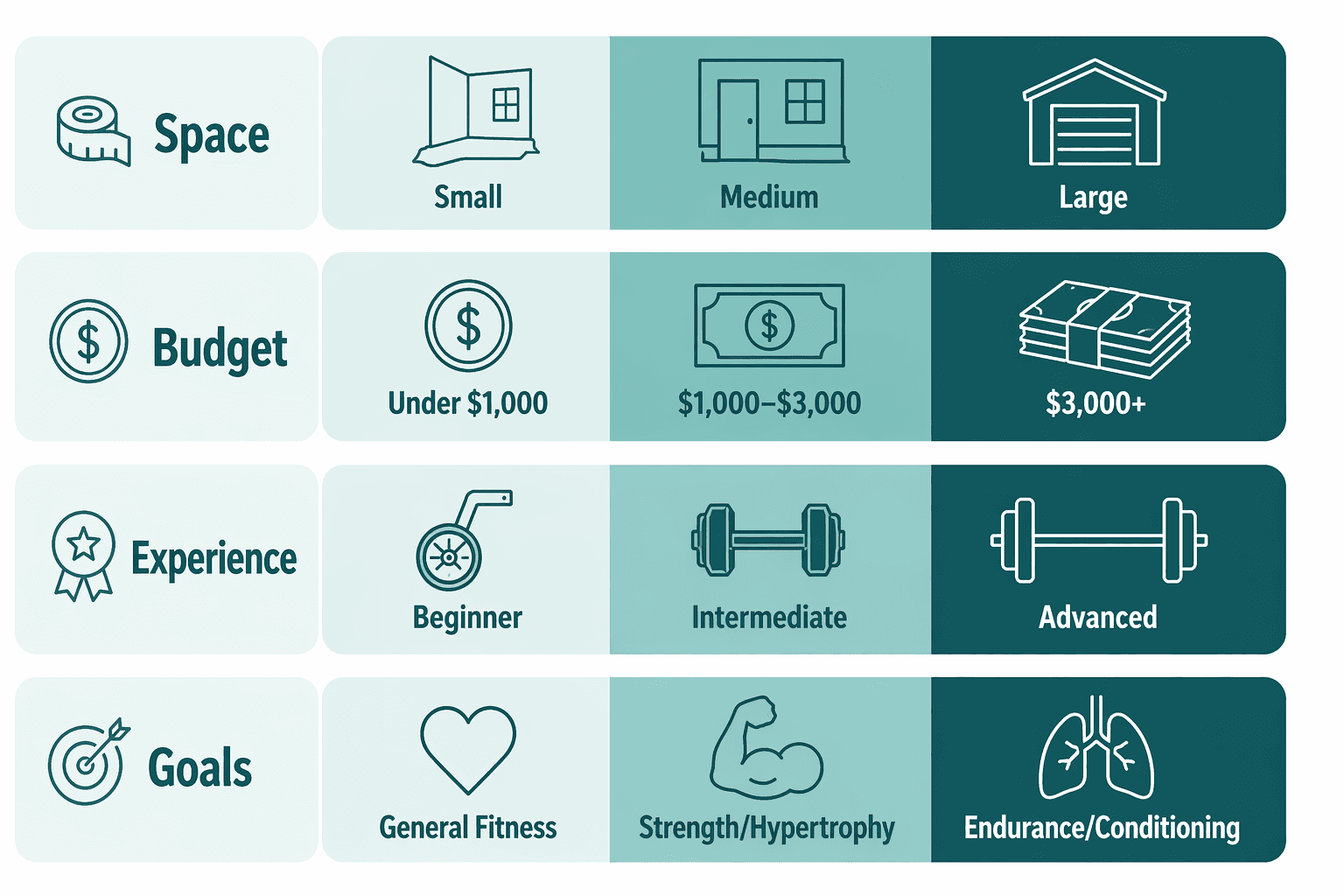
Before you look at any equipment, write down four numbers. Not vague ideas. Measurable ranges.
Available Floor Space
Measure the area you can dedicate to a gym. Do not count the whole room — account for clearance around the equipment. Here is a rough tier:
- Compact: less than 20 sq ft (think a corner of a bedroom)
- Medium: 20–50 sq ft (a spare room corner or a wide alcove)
- Large: 50+ sq ft (a garage or a full spare room)
Budget Ceiling
Be honest about the total you are willing to spend — equipment, delivery, flooring, and any subscription. For perspective:
| Budget Tier | Typical Product Examples | Price Range |
|---|---|---|
| Under $1,000 | Resistance bands, adjustable dumbbells, folding squat racks | $100 – $900 |
| $1,000 – $3,000 | All-in-one weight stack machines, mid-range functional trainers | $1,000 – $2,800 |
| $3,000+ | Smart gyms (Tonal, Speediance), full power rack + barbell sets | $3,000 – $5,000+ |
Training Experience
Beginner, intermediate, or advanced? Beginners benefit from guided systems (smart gyms, all-in-one machines with pre-set movements). Intermediates who know how to squat and deadlift can buy a barbell and rack. Advanced lifters need free weights and progressive overload that bands cannot provide.
Primary Goals
General fitness, strength and hypertrophy, or endurance and conditioning? The best equipment for building muscle (a power rack with a barbell) is different from what you need for home cardio (a cheaper solution or a smart bike). Write down your main goal — it will eliminate categories immediately.
The Decision Matrix: Map Your Constraints to the Right Category
Now take your four measurements and find the home gym type that fits. The five most common categories — identified by Garage Gym Reviews — are: Smart Home Gyms, Power Racks + Barbell, Functional Trainers, Resistance Band Systems, and All-in-One Machines. Each one serves a different combination of constraints.
| Category | Space | Budget | Experience | Best Goal |
|---|---|---|---|---|
| Resistance Band Systems | Compact | Under $1,000 | Beginner to intermediate | General fitness, portability |
| All-in-One Machines | Medium | $1,000 – $3,000 | Beginner to intermediate | General fitness, convenience |
| Functional Trainers | Medium | $1,000 – $3,000 | Intermediate to advanced | Strength, cable variety |
| Power Rack + Barbell | Large | $1,000 – $3,000 | Intermediate to advanced | Strength, powerlifting |
| Smart Home Gyms | Compact to Medium | $3,000+ | Beginner to intermediate | Guided training, small footprint |
Overlaps happen. For example, an intermediate strength-focused buyer with $2,000 and limited space could land on both a foldable power rack (like the PRx Profile PRO) and a functional trainer (like the Bells of Steel Cable Tower). The next section will help you choose between them based on preference for free weights versus cables.
Five Categories – What Each Excels At and Where It Falls Short
Resistance Band Systems
Cheap, compact, and portable. A set of Rogue Monster Bands gives you resistance from 9 to 225 pounds, and the X3 Bar system costs $549 and packs down to 10 by 19 by 1 inch. Perfect for apartment dwellers who travel or who have no dedicated space.
But bands cannot provide consistent progressive overload. The resistance curve changes as the band stretches, and adding small increments is difficult beyond a certain point. If your goal is building serious strength, you will outgrow bands within a few months.
All-in-One Machines
These are the old-school weight stack gyms with a cable pulley system, like the Body-Solid EXM2500 with a 210-pound stack or the Powerline BSG10X with 160 pounds. They arrive 90% pre-assembled (30 minutes setup), offer 40-plus exercises, and require no anchoring to walls.
The drawback: they are fixed in what they can do. You cannot easily add free-weight exercises like deadlifts or barbell squats. The weight stack is also the limit — once you can rep out the full stack, you are stuck unless you modify the machine. They take up a medium footprint (around 20–30 sq ft) and cost $1,000–$2,000.
Functional Trainers
Dual cable columns that let you perform hundreds of unilateral and bilateral movements. The Bells of Steel Cable Tower starts at $435 per tower, and more advanced models with dual stacks can cost $1,500–$3,000. They require a medium footprint but offer far more exercise variety than all-in-one machines.
The downside: they are primarily cable-based. You get little to no free-weight work unless you supplement with dumbbells or a barbell. For pure strength, a power rack is more straightforward. But if you want versatility in a medium space, a functional trainer is hard to beat.
Power Rack + Barbell
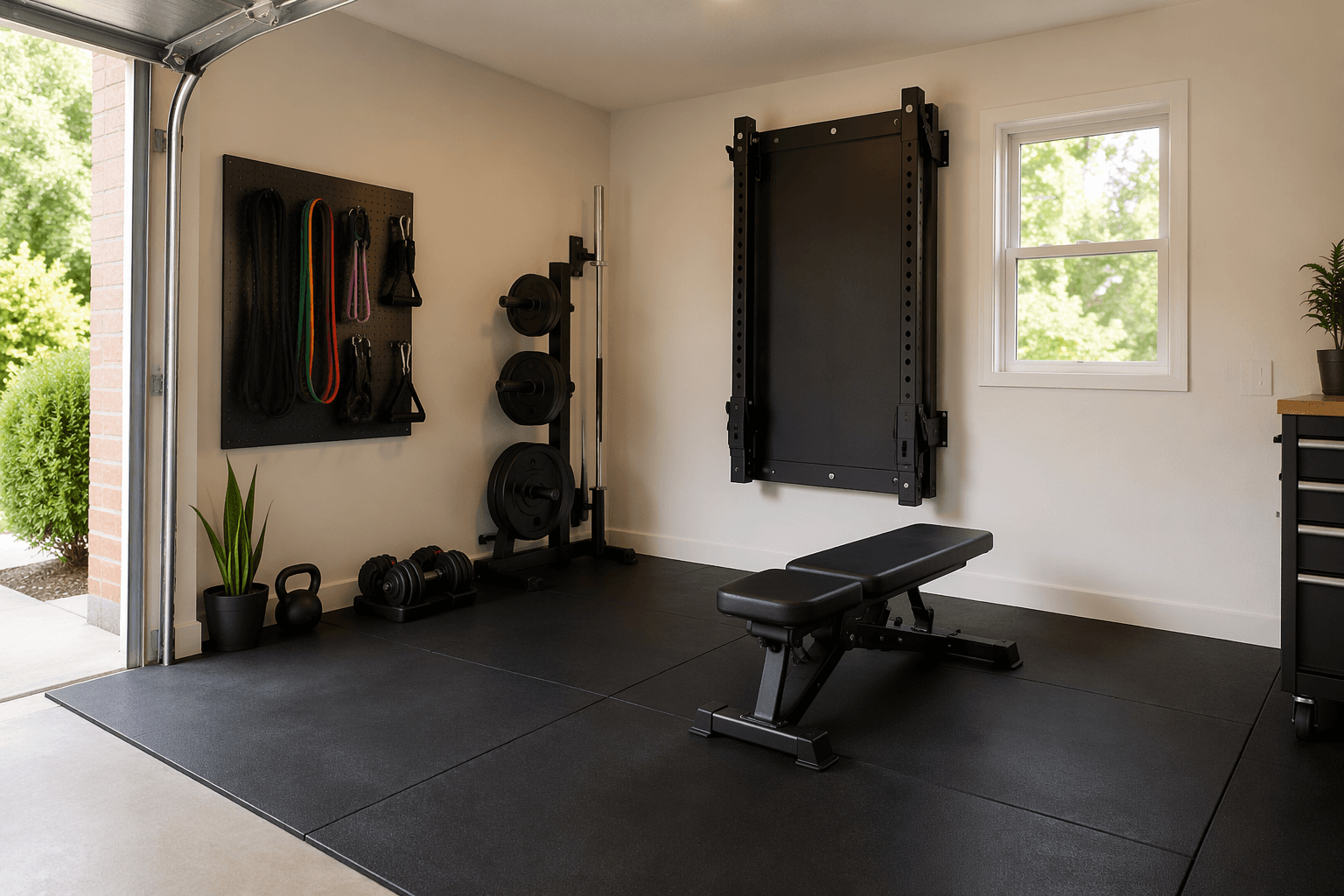
The gold standard for strength training. A power rack with a barbell and plates gives you squats, bench presses, deadlifts, and overhead presses — the core compound movements. Foldable options like the PRx Profile PRO (folds to 4 inches deep, $1,099) make it possible in a garage or spare room.
The trade-off: space. Even folded, you need room to lift: at least 40 sq ft for the rack alone, plus clearance for the barbell. And you need to buy a barbell, plates, and a bench, which adds to the cost. Total investment: often $1,500–$3,000. Beginners may find it intimidating without a coach or app.
Smart Home Gyms
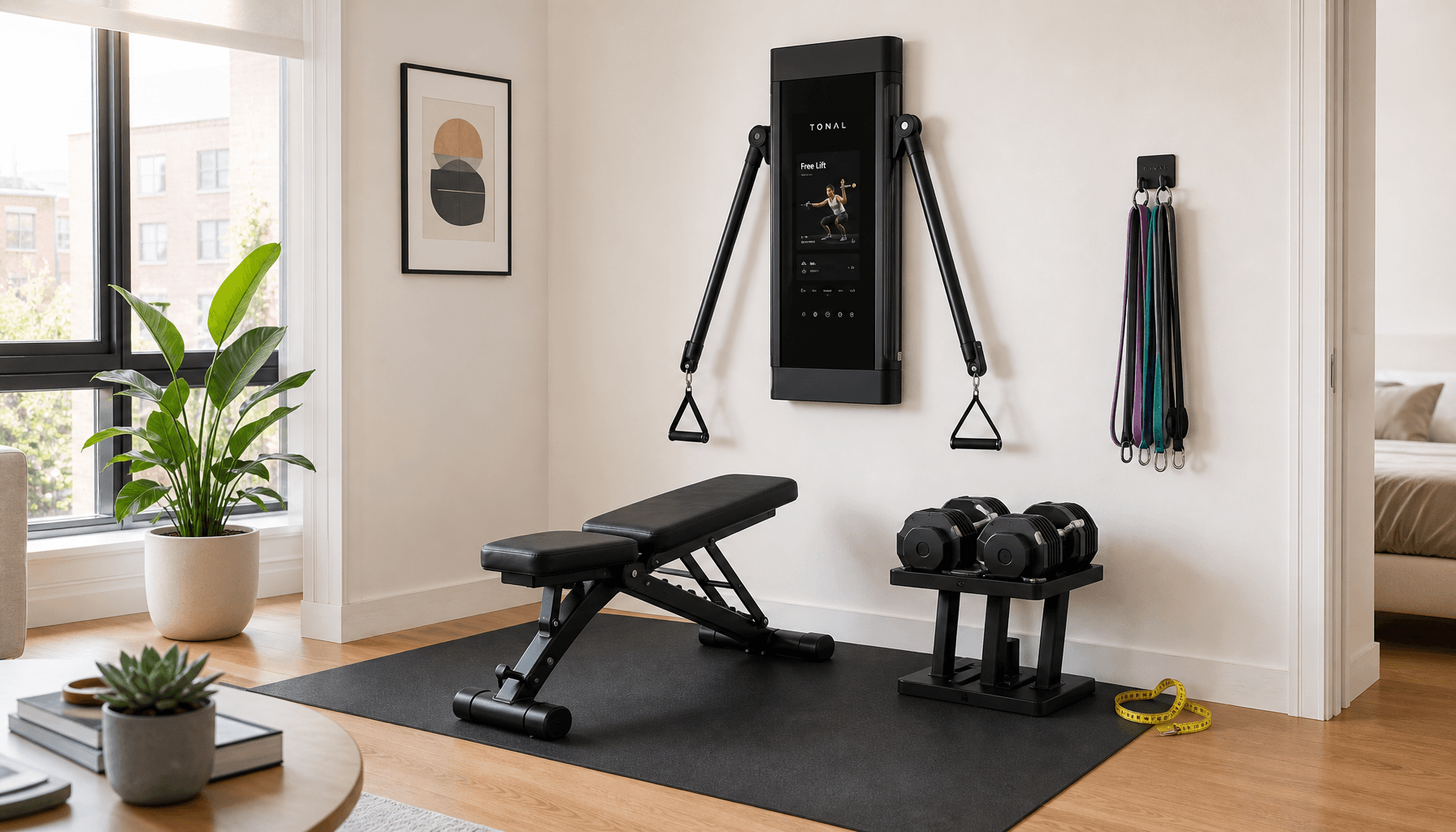
Wall-mounted systems like Tonal 2 and Speediance Gym Monster use electromagnetic or motorized resistance, offer guided workouts, and pack into a small footprint. Tonal 2 mounts to the wall (21.5" wide, 5.25" deep, 50.9" tall) and costs $4,295. Speediance unfolds to about 49" deep, costs $3,199.
The catch: subscriptions. Tonal 2 requires a $59.95/month membership with a 12-month commitment. Over five years that adds $3,597 to the price — more than the machine's upfront cost. Before you buy, read our total-cost analysis of smart home gym subscriptions. Also, resistance is capped at 250 pounds (Tonal) or 300 pounds (Speediance), so advanced lifters may hit the ceiling quickly.
Test the Framework: Four Real Buyer Profiles
Let’s walk through the matrix with real scenarios.
Profile 1: Apartment Dweller, $600 Budget, Beginner, General Fitness
Space is tight (under 15 sq ft), budget low, no experience, just wants to move more. The matrix points directly to resistance band systems. The X3 Bar ($549) or a set of Rogue Monster Bands gives full-body workouts with no mounting and almost zero footprint. No subscription, no assembly, easy to store under a bed.
Profile 2: Garage Owner, $4,000 Budget, Intermediate, Strength & Hypertrophy
Large space, solid budget, knows how to lift. The matrix lands on power rack + barbell. A setup like the PRx Profile PRO rack ($1,099), a quality barbell ($300–$600), plates ($500–$1,000), and a adjustable bench ($200–$400) leaves room for a cable attachment or dumbbell set. This delivers the best long-term value for strength.
Profile 3: Apartment Dweller, $2,000 Budget, Intermediate, Strength Focus
This is the overlap case. The matrix says both a foldable power rack and a functional trainer could work. How to choose? If you are comfortable with barbell training and have enough ceiling height to press, go with the foldable rack (PRx Profile PRO) — it offers the most direct strength progression. If you prefer cable movements and variety, go with a functional trainer like the Bells of Steel cable tower ($435) plus adjustable dumbbells. Both fit the budget and space, but the choice depends on which movement style you enjoy more.
Profile 4: Spare Room, $4,500 Budget, Beginner, General Fitness + Guided Training
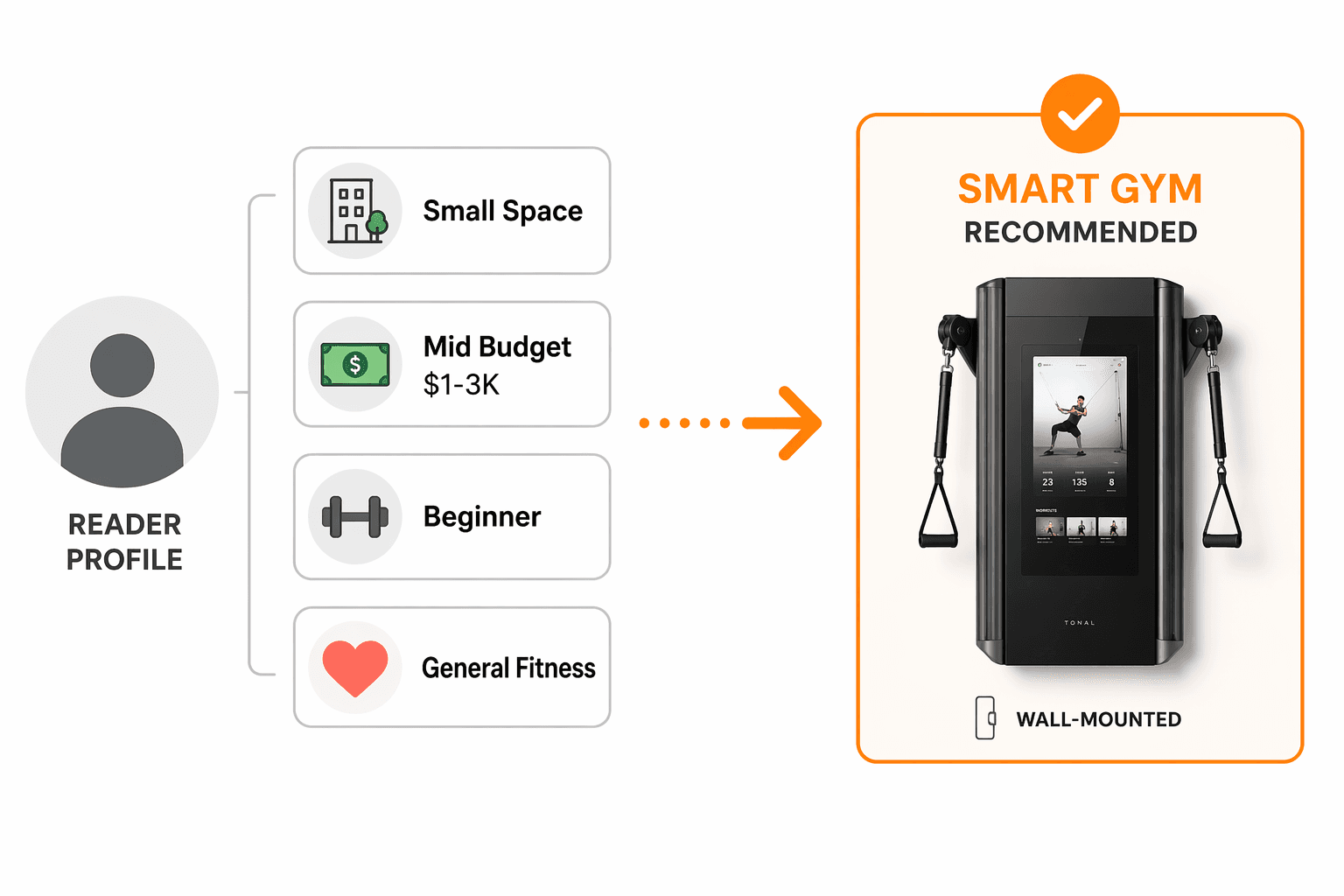
Medium space, high budget, no experience, wants a coach-like experience. The matrix points to smart home gyms. The Tonal 2 ($4,295) occupies minimal wall space and offers structured programs with automatic weight adjustment. Just be aware of the $59.95/month subscription. If that is a deal-breaker, consider a Speediance Gym Monster ($3,199) which has a less expensive subscription but still requires ongoing fees.
You Know Your Category – Now What?
You have narrowed your options to one or two home gym types. Now the real product research begins. Within your chosen category, evaluate each product on these criteria:
- Warranty length and coverage (frame, moving parts, electronics)
- Weight capacity or resistance max (will you outgrow it in a year?)
- Attachment ecosystem (can you add a lat pulldown, row, etc.?)
- Subscription cost and contract (some smart gyms require 12-month lock-ins)
- Assembly difficulty and delivery logistics
For a deep dive into the specific decision factors, see our Home Gym Equipment Decision Framework in the Beginner Hub. That article goes further into comparing products within each category. And if you are starting from zero, our beginner’s guide to the best home workout machine will walk you through what to buy first and what to skip.
The framework works because it forces you to answer the essential questions before you see a single product name. At that point, the choice becomes straightforward: you are not looking for “the best home gym” — you are looking for the best home gym for your space, budget, experience, and goals. That is a much simpler search.
Comments
Join the discussion with an anonymous comment.