
Why a single ‘best treadmill’ pick will disappoint you
You can spend $2,500 on a NordicTrack Commercial 1750 and never use the decline function, the 4.25 CHP motor, or the 16-inch touchscreen for anything but Netflix. Or you can spend $700 on a Horizon T101 and burn out the motor in under a year if you run on it regularly. These are not hypotheticals. About 40% of home fitness equipment ends up used less often than the buyer expected, according to Wirecutter’s long-term testing. I’ve watched too many people make this mistake. The problem is not buying a treadmill — it is buying one that doesn’t match how you actually intend to use it. The best home treadmill isn’t the highest‑rated model overall. It is the one matched to your specific use case. Start with three self‑diagnostic questions before you look at any spec sheet.
Three questions to diagnose your real treadmill profile
1. How fast will you go?
This spec rules everything. If you never exceed a brisk walk (3–4 mph), a motor rated 1.5 to 2.5 continuous horsepower is sufficient. If you jog (5–6 mph), you need at least 2.5 CHP. If you run (7–12 mph), aim for 3.0 CHP or higher — Runner’s World and Garage Gym Reviews both agree. Below that, the motor runs near its continuous duty limit, heat builds up, and the motor wears out far sooner than its rated life. I cannot give you an exact month‑by‑month timeline because nobody publishes that data, but the risk is real enough that every serious tester flags it.
2. How much floor space can you give up?
Consumer Reports recommends at least 2 feet of clearance on each side and 6 feet behind the treadmill. That means the footprint on the spec sheet is only half the story. A full‑size runner’s treadmill (roughly 6 ft by 3 ft) needs about 10 ft by 7 ft of cleared floor space. If you are working with less, a folding model or a shorter deck becomes necessary. Deck length matters especially for runners: a 55‑inch deck works for most walkers and shorter runners, but a 60‑inch deck is recommended for anyone over 6 feet tall. For a visual guide to what fits your height and room, see our compact treadmill deck size guide.
3. Are you willing to pay a monthly subscription?
This is about monthly willingness, not five‑year total cost. Peloton’s All‑Access membership runs $44 per month; iFit for NordicTrack and ProForm costs $39 per month. If you are comfortable paying that every month for on‑demand classes, connected treadmills make sense. If you balk at the idea of a recurring fee for a machine you already bought, look for subscription‑free brands like Sole, Horizon, Spirit, or Xterra — they offer Bluetooth connectivity with third‑party apps but no proprietary lock‑in. For the long‑term math, read our subscription cost comparison.
The walker, jogger, and runner tiers at a glance
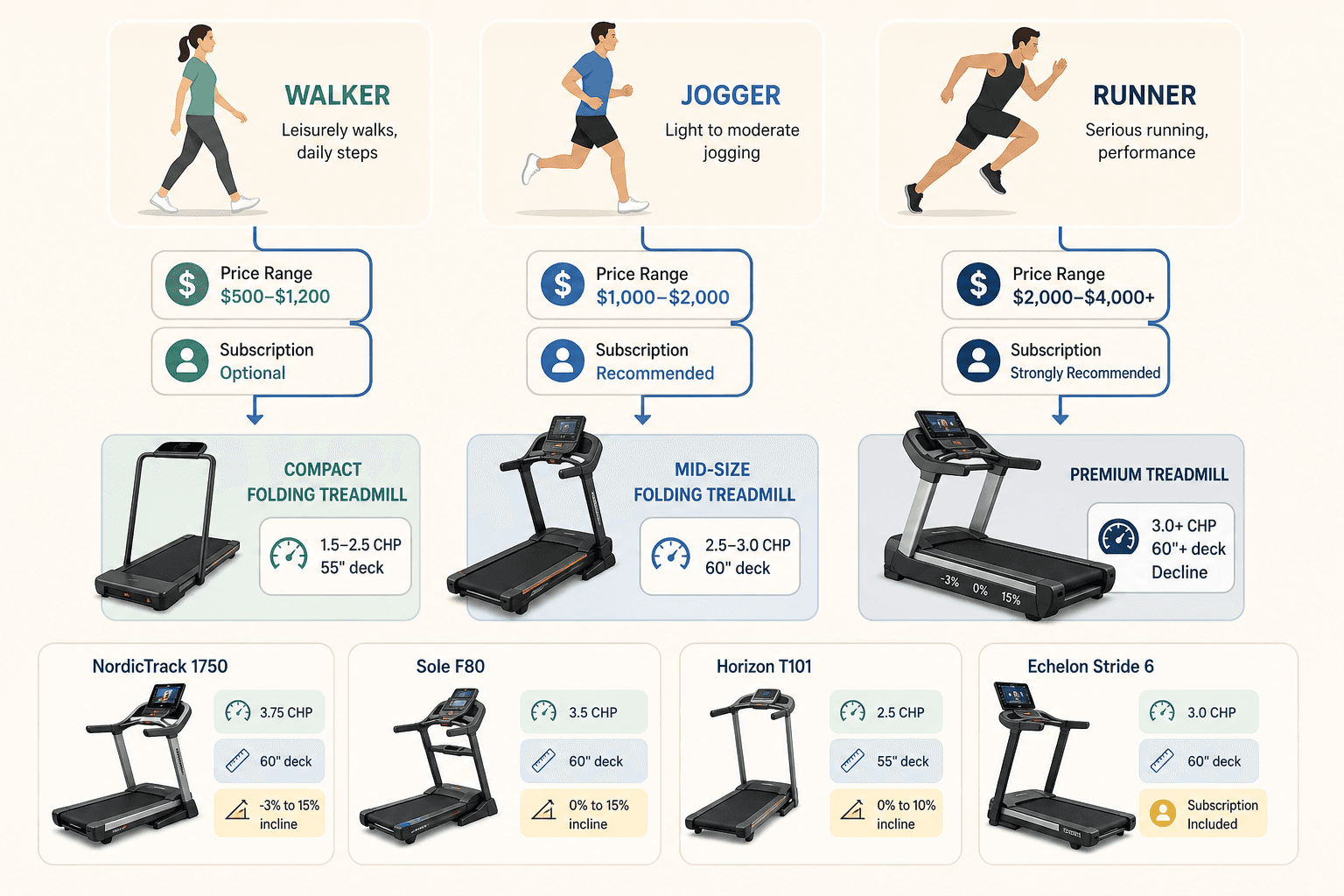
Based on your answers, you fall into one of three use‑case tiers. The table below summarizes the key specs and what to skip in each tier.
| Tier | Price range | Motor (CHP) | Deck length | Subscription | What to skip |
|---|---|---|---|---|---|
| Walker | $500–$1,200 | 1.5–2.5 | 55-inch is fine | Optional (not needed) | Runner‑tier machines with over‑powered motors and high price |
| Jogger | $1,000–$2,000 | 2.5–3.0 | 60-inch recommended | Optional, but common on connected models | Budget walker machines that can't handle sustained 5+ mph |
| Runner | $2,000–$4,000+ | 3.0+ | 60-inch minimum; 55-inch only if under 6 ft | Often required for full screen features | Any 2.5 CHP or lower machine — motor burn risk is real |
The deck length nuance is worth repeating: a 55-inch deck fits most walkers and joggers, but if you are over 6 feet tall or have a long stride, the 60-inch deck is non‑negotiable. Runner’s World found that shorter decks force stride shortening, which affects cadence and increases fall risk.
Model picks for your tier
Walker tier: Horizon T101
The Horizon T101 is the default recommendation for anyone who walks and wants a no‑nonsense machine. It has a 2.5 CHP motor, a 55‑ by 20‑inch deck, 10 mph top speed, 10% incline, and costs around $700.
What to skip: Do not buy a runner‑tier machine for walking. The NordicTrack Commercial 1750 at $2,500 gives you a 4.25 CHP motor and decline function you will never use. You pay for power that stays idle. The T101’s lifetime frame and motor warranty (per Garage Gym Reviews) is more than adequate for walking duty. For a deeper dive into walker‑specific features like cushioning and compact footprint, see our dedicated walking treadmill guide.
Jogger tier: Sole F80
If you jog regularly and want zero subscription obligations, the Sole F80 is a strong pick. OutdoorGearLab tested it and reports a 3.5 HP motor, 60‑ by 22‑inch deck, 12 mph top speed, 12% incline, and a $1,900 price. It has no subscription requirement — you can pair it with any third‑party app via Bluetooth FTMS. The deck is long enough for jogging and light running, and the lifetime frame and motor warranty covers you for years.
What to skip: Avoid the Horizon 7.4 AT ($2,399) if you are budget‑conscious; it overlaps with runner specs and adds cost without jogging benefit. Also skip any 2.5 CHP walker machine for jogging — the motor will be stressed at sustained 5+ mph.
Runner tier: NordicTrack Commercial 1750
For serious runners, the NordicTrack Commercial 1750 is the consensus top pick. Wirecutter, Runner’s World, Garage Gym Reviews, and OutdoorGearLab all agree: 4.25 CHP motor, 60‑ by 22‑inch deck, 12 mph top speed, 12% incline, and a modern 16‑inch touchscreen. It costs $2,500 and requires an iFit subscription ($39/month) to unlock full training programs and coach‑led content. The lifetime motor warranty is solid, but note that NordicTrack voids the warranty if you place the treadmill in a garage — a real problem for many home setups.
What to skip: Any treadmill under 3.0 CHP. The Horizon T101 (2.5 CHP) is simply not built for running — Garage Gym Reviews recommends 3.0+ CHP for running, and ignoring that means risking motor burnout. Also skip the BowFlex T9 (runner‑up per Wirecutter) if you want decline training — it has no decline function.
Small‑space runner: Echelon Stride 6
If you run but live in an apartment or have limited floor space, the Echelon Stride 6 folds flat to just 10 inches thick. It has a 3.0 CHP brushless motor, 60‑ by 20.5‑inch deck, 12.4 mph top speed, and 12 incline levels. OutdoorGearLab logged over 1,200 miles on it and measured noise at 60 dB (the quietest in their test). At $2,000, it is slightly cheaper than the NordicTrack 1750 but requires an Echelon subscription for full guided classes.
What to skip: If you have room for a full‑size machine, the Stride 6’s 20.5‑inch deck width is narrower than the NordicTrack’s 22 inches — runners who like a generous platform may find it tight. For more on folding mechanisms and space‑saving options, see our folding treadmill decision framework.
Pitfalls to watch for
Motor burnout on underpowered machines
I mentioned this earlier, but it bears repeating: a 2.5 CHP motor is not designed for sustained running speeds. The continuous duty rating means the motor can deliver 2.5 HP indefinitely — but at 7–8 mph, it is running near its limit. Heat buildup accelerates wear. Nobody publishes exact time‑to‑failure data, but the physics is clear: a motor pushed past its design point will fail sooner. If you run, get 3.0 CHP or higher.
Garage warranty voiding
NordicTrack and ProForm explicitly void their warranty if the treadmill is placed in a garage (Garage Gym Reviews confirms this for both brands). Temperature extremes, dust, and moisture are the stated reasons. If your garage is your only viable space, Sole, Horizon, or Echelon do not have this restriction — check the warranty terms before you buy.
Step‑up height for tall users
OutdoorGearLab measured step‑up heights ranging from 5.25 inches (Echelon Stride 6) to 13.6 inches (NordicTrack X16). If you are over 6 feet tall, a high step‑up can be awkward and increase fall risk when mounting or dismounting. Test the step‑up height in person if possible; it is rarely listed on spec sheets.
Once you know your tier, the detailed guides for walkers and runners provide full breakdowns of cushioning, warranty fine print, and real‑world testing notes. The decision matrix here is your starting point — use it to find your lane, then dive deeper from there.

Comments
Join the discussion with an anonymous comment.