
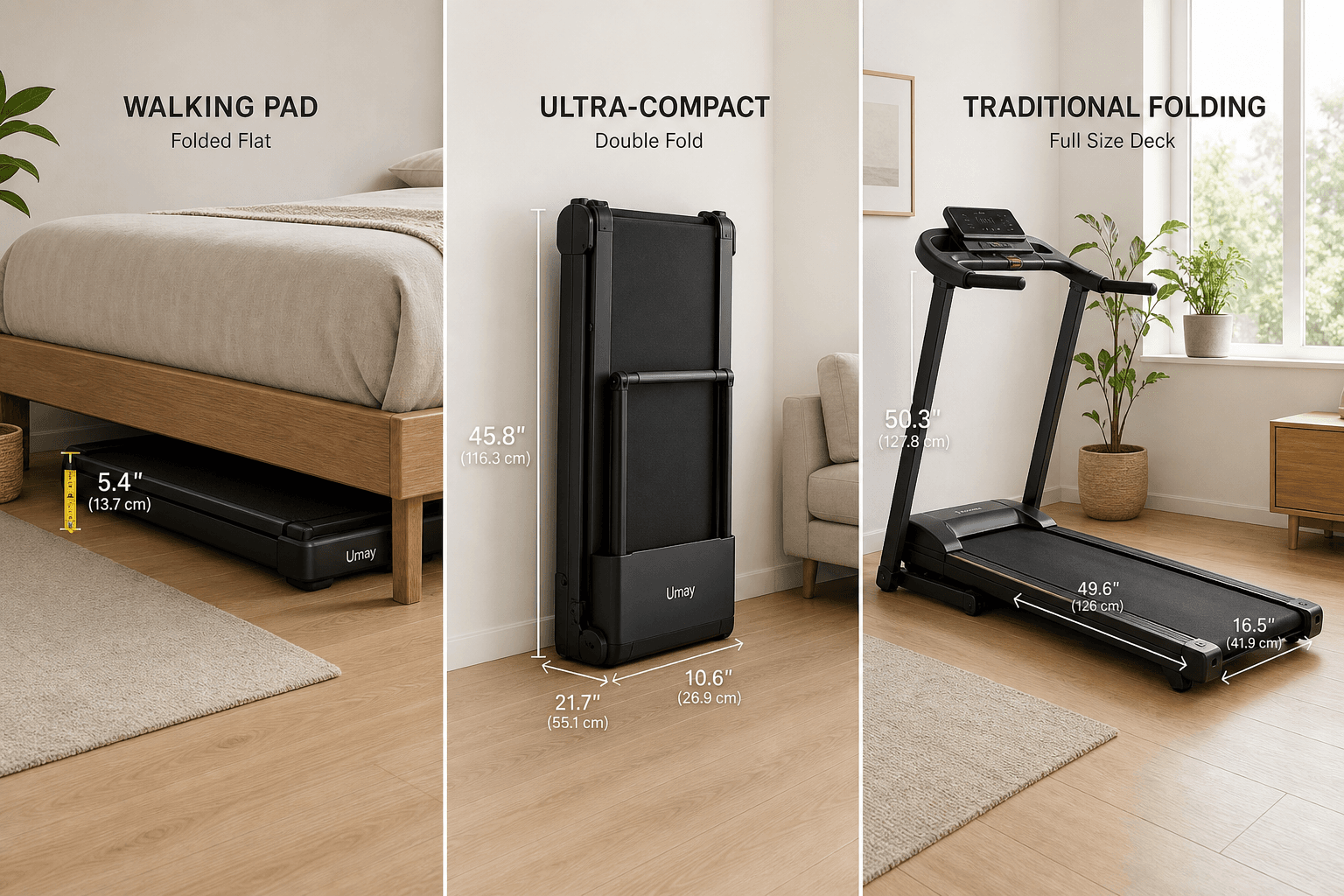
The Deck Size Problem: Why Listings Hide the True Running Surface
When you search for a small treadmill for home, the first specs you see are usually folded dimensions, weight, and price. Manufacturers know that buyers with limited space care about storage height and floor footprint, so those numbers get top billing. The running deck — the actual surface you stride on — is often buried in a sub-bullet or omitted entirely from the product title.
This matters because a treadmill that folds to 8 inches tall is useless if its deck forces you to shorten your stride to avoid stepping off the back. The gap between "fits in my apartment" and "safe to run on" is the most overlooked spec in the compact treadmill category. A 40-inch deck might look fine on paper, but for anyone over 5'6", it creates a real safety risk at jogging speeds.
If you are just starting to explore the category, our broader guide to small-space treadmills covers the full landscape of folding, compact, and walking pad options. This article zooms in on the one spec that determines whether a compact treadmill is safe for your height and activity level: the deck.
Minimum Deck Lengths by Activity and Height
Deck length determines whether you can complete a full stride without your heel hitting the back edge or your toes overhanging the front. The shorter the deck, the more you have to consciously shorten your gait — which changes your running mechanics and increases injury risk.
The table below summarizes the minimum deck lengths recommended by testers for each activity level and height range. These are not arbitrary numbers — they come from hands-on testing where experienced runners and walkers evaluated dozens of compact treadmills.
| Activity | Height | Minimum Deck Length | Notes |
|---|---|---|---|
| Walking | Any height | 40 inches | Shorter decks are acceptable because stride length is naturally shorter at walking speeds (2–4 mph). |
| Jogging | Under 5'9" | 50 inches | A 50-inch deck allows a natural jogging stride for most people under 5'9". Taller users will feel constrained. |
| Jogging | 5'9" and taller | 55 inches | Testers at 5'9" reported needing to shorten their stride on decks shorter than 55 inches. |
| Running | Any height | 55 inches minimum | 55 inches is the industry standard for safe running. Most full-size home treadmills use this length. |
| Running | Any height | 60 inches recommended | 60 inches provides full stride clearance for runners of all heights, including those over 6'." |
The key takeaway: if you plan to run, a deck shorter than 55 inches is a compromise. The Horizon T101 (55" x 20" deck) represents the absolute minimum for safe running. The Sole F63 and Echelon Stride-6S (both 60" decks) are the gold standard for compact running treadmills.
Minimum Deck Widths: Why 16 Inches Isn't Enough for Running
Deck width gets even less attention than length, but it is equally important for stability and comfort. A narrow deck forces your feet to land in a tight channel, which can alter your natural gait and increase the risk of stepping off the side — especially during faster running or when fatigue sets in.
Here is how width requirements break down by activity:
| Activity | Minimum Deck Width | Recommended Width | Why It Matters |
|---|---|---|---|
| Walking | 16 inches | 18 inches | Walking foot placement is narrow and predictable. 16" is acceptable for casual walking. |
| Jogging | 18 inches | 20 inches | Jogging introduces lateral movement. 18" is the minimum; 20" provides a comfortable margin. |
| Running | 20 inches | 22 inches | Running at 6+ mph creates wider foot splay. 20" is the industry standard; 22" is preferred by serious runners. |
Many ultra-compact treadmills — especially those under $500 — use 15- to 16.5-inch-wide decks. The UREVO Strol 2E has a 15-inch-wide deck. The GoPlus 2-in-1 has a 16-inch-wide deck. These widths are fine for walking but become unstable at jogging speeds. If you plan to run, look for a deck that is at least 18 inches wide — and ideally 20 inches.
Tested Comparison: 40-Inch vs. 47-Inch vs. 55-Inch vs. 60-Inch Decks
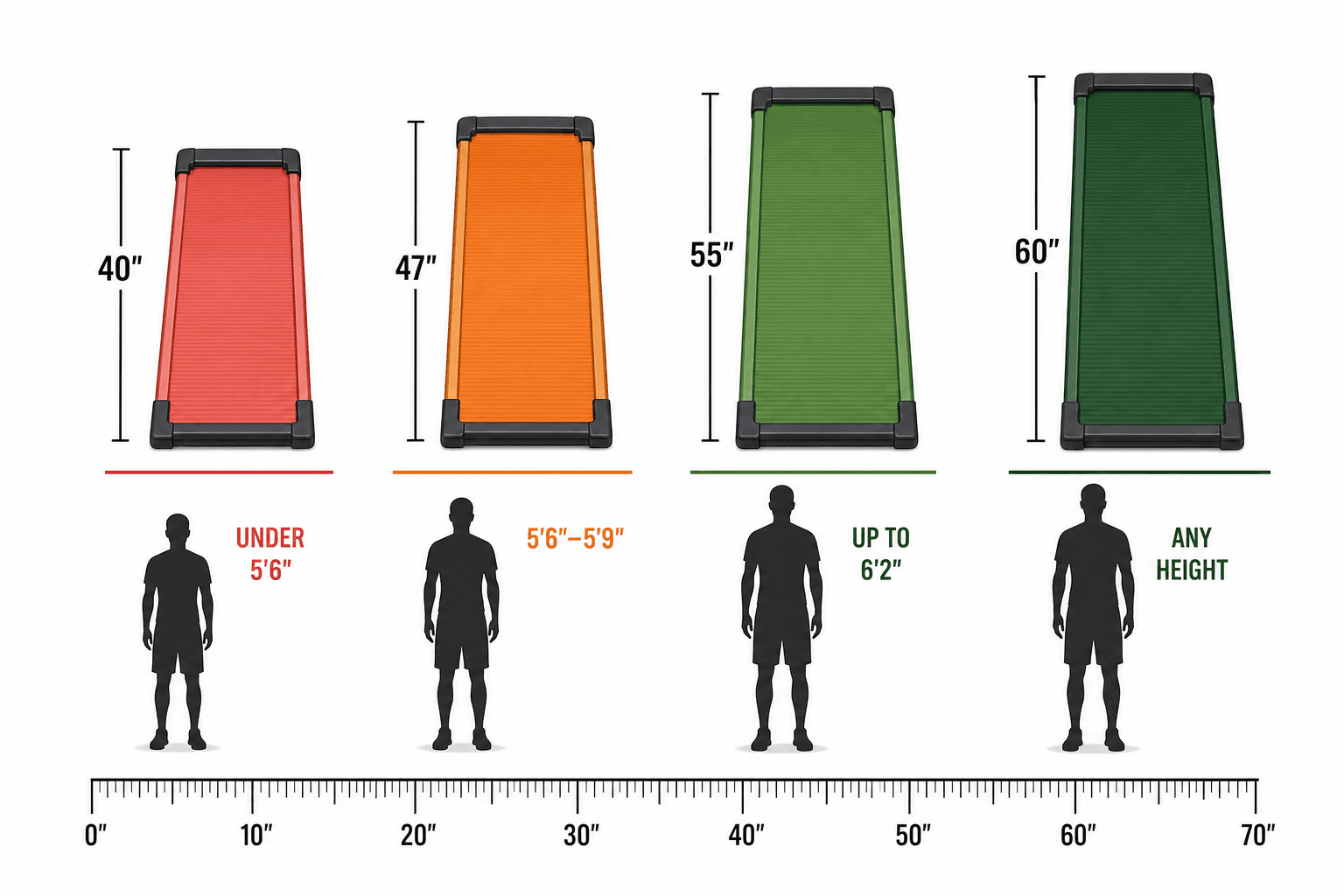
To make the deck size difference concrete, here is how four common deck length categories perform in real-world testing. Each category is represented by a specific model that testers have evaluated.
| Deck Length | Representative Model | Deck Dimensions | Max Speed | Tester Verdict |
|---|---|---|---|---|
| 40 inches | UREVO Strol 2E | 40.2" x 15" | 6.2 mph | Unsafe for running. GGR tester at 5'9" reported needing to 'make a conscious effort to shorten my stride to avoid falling off.' |
| 47 inches | WalkingPad X25 | 47.24" x 17.32" | 10 mph | Marketed for running but too short. Testers advise against running at 10 mph on this deck. |
| 55 inches | Horizon T101 | 55" x 20" | 10 mph | Industry standard for safe running. Adequate for runners of most heights. Folds to 46" height. |
| 60 inches | Echelon Stride-6S | 60" x 20.5" | 12.5 mph | Full-size deck in a compact fold. Recommended for serious runners of any height. |
The 40-inch and 47-inch categories are where most buyers get into trouble. A treadmill like the WalkingPad X25 has a 47.24-inch deck and a 10 mph top speed — which looks like a running treadmill on paper. But testers at TreadmillReviews.com advise against running at that speed on a deck that short. The marketing says "running," but the deck says "fast walking."
The 55-inch and 60-inch categories are where compact treadmills become genuinely useful for runners. The Horizon T101 (55" x 20") is the entry point for safe running. The Echelon Stride-6S (60" x 20.5") is the benchmark — it achieves full-size deck dimensions while folding flat enough for under-bed storage, setting the standard for what a compact running treadmill can be.
How to Measure Your Safe Deck Length
You do not need a treadmill to figure out your minimum safe deck length. A simple at-home test will tell you whether a 55-inch deck is enough or whether you need the full 60 inches.
- Find a straight line on the floor — a tile grout line, a floorboard seam, or a piece of tape.
- Stand with your toes at the line. This simulates the front edge of the treadmill deck.
- Take your longest natural running stride forward. Do not overstride — use the stride length you would use at your normal running pace.
- Mark where your heel lands. Measure the distance from the starting line to your heel mark.
- Add 6 to 10 inches of buffer. Your heel should never land within 3 inches of the back edge of the deck, and your toes should never overhang the front. A safe deck length is your stride length plus at least 6 inches of clearance.
For most people, this test produces a number between 50 and 60 inches. If your result is 52 inches, a 55-inch deck gives you 3 inches of clearance — which is tight but workable. If your result is 56 inches, you need a 60-inch deck.
Compact Treadmills That Don't Compromise on Deck Size
The good news: you do not have to choose between a compact storage footprint and a full-size running deck. Several folding treadmills achieve 55- to 60-inch decks while folding to a height and depth that fit in apartments, closets, and under beds.
These are the models that solve the deck size problem without creating a storage problem:
- Horizon T101 — 55" x 20" deck, folds to 46" height. The entry-level compact runner. Lifetime frame and motor warranty. Speeds up to 10 mph, incline 0–10%. This is the minimum viable deck for running.
- Horizon 7.0 AT — 60" x 20" deck, 3.0 CHP motor, 0–15% incline, 12 mph top speed. A step up from the T101 with a longer deck and more power. Still folds compactly.
- Sole F63 — 60" x 20" deck. A proven workhorse with a reputation for durability. Folds with a gas-shock-assisted system that makes storage easy.
- Echelon Stride-6S — 60" x 20.5" deck, 12.5 mph, 12 incline levels, 3.0 HP brushless motor. Folds flat for under-bed storage. The benchmark for compact running treadmills.
Each of these models achieves its compact storage through a folding mechanism, not by shrinking the deck. The tradeoff is price — these treadmills cost more than ultra-compact models — but the tradeoff buys you a safe running surface.
If you are still deciding between storage types, our storage-type guide for small treadmills explains how folding, flat-fold, and vertical-storage models compare for different room layouts.
Best Ultra-Compact Options for Walkers Only
Not everyone needs a running deck. If your primary use is walking — at speeds under 4 mph — and your space is extremely tight, a shorter deck may be a reasonable compromise. The key is knowing exactly what you are giving up.
Ultra-compact treadmills with 40- to 47-inch decks are genuinely useful for walking. They fold thinner, weigh less, and cost significantly less than their full-deck counterparts. The UREVO Strol 2E (40.2" x 15") and GoPlus 2-in-1 (40" x 16") are examples of this category. They are fine for walking, but they are not running machines — regardless of what the max speed spec says.
For walkers who are furnishing a full small-space fitness area — not just buying a single treadmill — our constraint-based buying guide for small spaces covers how to choose equipment when floor space is at a premium.
The bottom line: if you walk, a 40-inch deck works. If you jog or run, do not settle for anything under 55 inches. The deck size is not a minor spec — it is the spec that determines whether your treadmill is a tool or a hazard.
Comments
Join the discussion with an anonymous comment.