
Why Generic Treadmill Roundups Fail Runners
Open any treadmill roundup and you will see the same pattern: a list of machines sorted by price, a paragraph about the touchscreen, and a vague note about it being "great for runners." These guides treat a treadmill like an appliance you plug in and forget. But for someone running 15 to 30 miles per week, a treadmill is a training tool with specific mechanical demands that a walker or casual jogger simply does not place on it.
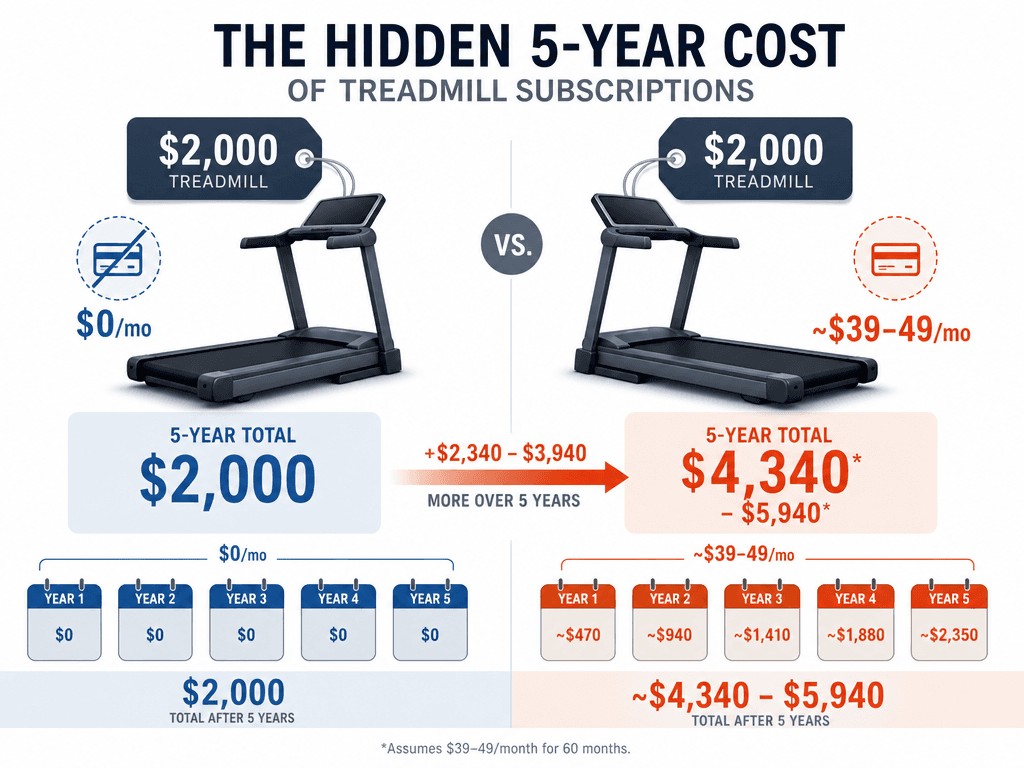
The disconnect is straightforward: a 2.5 CHP motor that handles a 15-minute morning walk will overheat and fail under a runner logging 30 miles of 8-minute pace work. A 55-inch deck that feels fine for a jogger forces a 5'10" runner to shorten their stride, altering gait mechanics and increasing injury risk. And a $2,000 treadmill with a $39-per-month subscription becomes a $4,000+ machine over five years — a cost that never appears in the headline price.
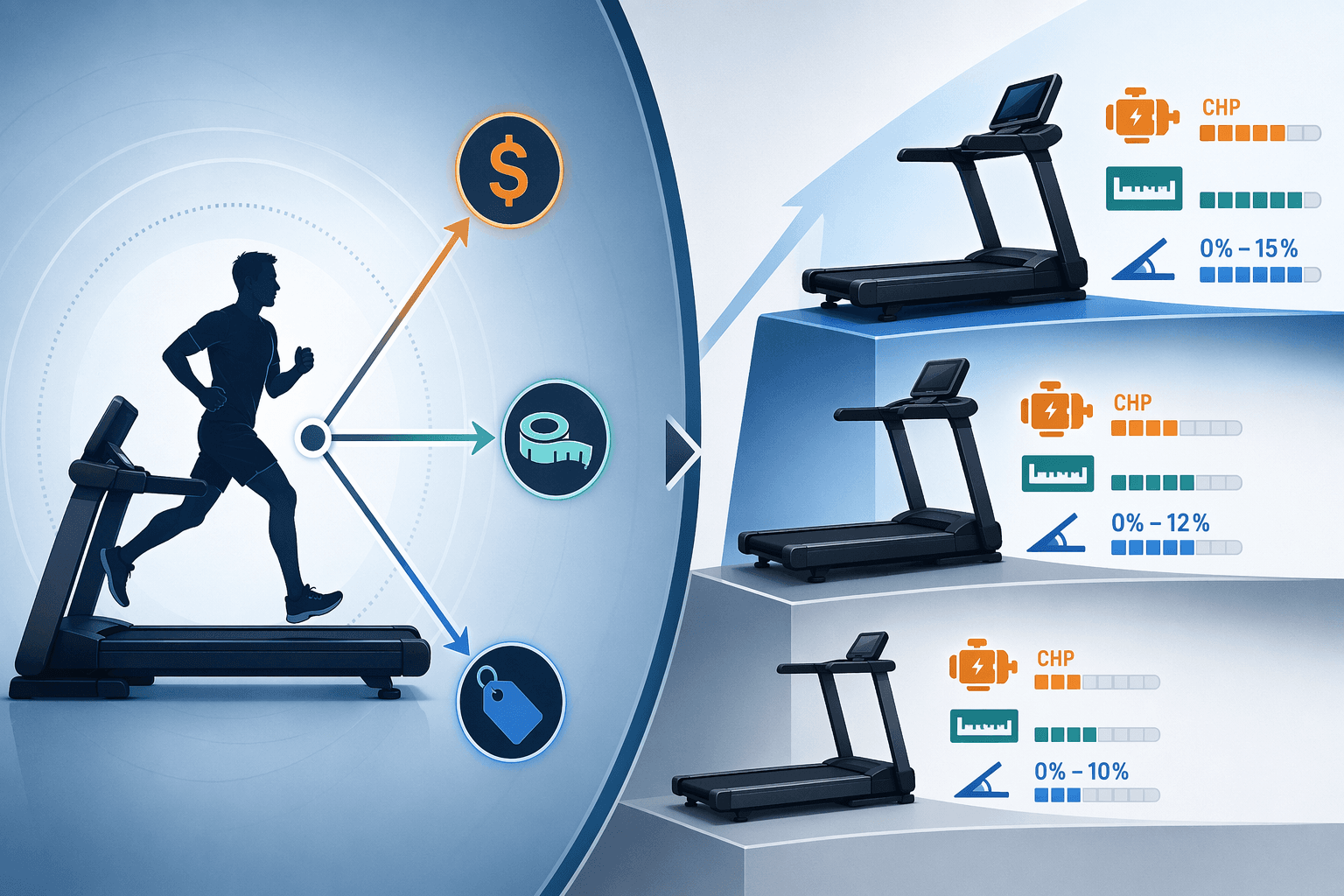
This article replaces the generic list with a three-constraint framework built specifically for runners. Instead of asking "What is the best treadmill?" it asks three questions that actually determine whether a machine will work for you:
- Training volume: Does the motor and deck size match your weekly mileage and pace?
- Space: Does the treadmill fit your room physically and functionally — folding or permanent?
- Subscription philosophy: Are you willing to pay $500+ per year for guided content, or do you want a machine that lets you bring your own app?
Each constraint eliminates a set of models. By the end, you will have a shortlist of two or three machines that actually fit your running life — not a list of ten treadmills you still have to research.
Constraint 1: Training Volume – Matching Motor and Deck to Your Mileage
Motor power is measured in continuous horsepower (CHP), and it is the single most important spec for a runner. A motor rated at 2.5 CHP can sustain a jogging pace for short durations, but it will struggle to maintain speed during incline work or longer sessions. For runners logging 15 to 30 miles per week, the industry consensus across multiple testing labs is clear: you need a minimum of 3.0 CHP and a deck at least 60 inches long.
Garage Gym Reviews, which has tested over 50 treadmills, specifies that high-volume running (20+ miles per week) requires a 3.0 CHP minimum and a 60-inch deck. NordicTrack's own buying guide recommends 3.0+ CHP for runners. TreadmillReviews.net's 2026 roundup reinforces this threshold, noting that a 3.0 CHP motor is the minimum for running and a 60-inch deck is necessary for runners over six feet tall.
| Mileage Band | Minimum CHP | Minimum Deck Length | Typical User | Example Models |
|---|---|---|---|---|
| Walkers / light joggers (<10 mi/wk) | 2.5 CHP | 55" | Casual fitness, recovery walks | Horizon T101 |
| Regular runners (15–30 mi/wk) | 3.0 CHP | 60" | Intermediate runners, 5K–half marathon training | Sole F63, Horizon 7.0 AT, NordicTrack 1750 |
| High-volume runners (30+ mi/wk) | 3.5+ CHP | 60"+ | Marathon training, incline work, speed work | Sole F80, NordicTrack 2450, Horizon 7.4 AT |
Deck length is equally critical. Runner's World recommends a running surface at least 20 inches wide and 55 inches long for running. But 55 inches is the absolute floor — a runner with a 30-inch stride length needs every inch of that 60-inch deck to avoid feeling cramped. If you are over 5'10" or have a long stride, prioritize 60-inch decks exclusively.
Constraint 2: Space – Folding vs. Permanent Footprint
A treadmill occupies roughly 30 to 40 square feet of floor space when in use. For runners with a dedicated home gym or garage, that is not a problem. For apartment dwellers or anyone using a multi-purpose room, it is the difference between a treadmill that gets used and one that becomes a clothes rack.
Folding treadmills solve this by allowing the deck to lift vertically or fold flat. The trade-off is that folding mechanisms add weight and complexity, and some folding decks feel less stable at higher speeds. However, the current generation of folding treadmills from NordicTrack, Sole, and Horizon has largely closed that gap.
| Model | Folding Type | In-Use Footprint (L x W) | Folded Depth | Best For |
|---|---|---|---|---|
| NordicTrack Commercial 1750 | Vertical fold (EasyLift Assist) | 77" x 36" | ~38" | Runners who want a full-featured machine that folds compactly |
| Sole F63 | Vertical fold (SoftDrop) | 74" x 35" | ~39" | Budget-conscious runners with limited floor space |
| Sole F80 | Vertical fold (SoftDrop) | 79" x 37" | ~41" | Runners needing a 60" deck and 3.5 CHP in a folding frame |
| Horizon 7.0 AT | Vertical fold (FeatherLight) | 76" x 35" | ~40" | Subscription-free runners who want a folding machine under $1,000 |
| Horizon 7.4 AT | Vertical fold (FeatherLight) | 78" x 36" | ~41" | Runners who want a 3.5 CHP motor without subscription lock-in |
| Echelon Stride-6 | Fold-flat (under-bed storage) | 60.5" x 20.5" | 10" | Apartment runners with extreme space constraints |
If you have a permanent gym space and do not need to fold the treadmill, you can consider non-folding models like the Echelon Stride-8S, which often have heavier frames and slightly better stability at sprinting speeds. But for the vast majority of home runners, a quality folding treadmill from this list will perform identically to a non-folding model during a workout.
Constraint 3: Subscription Philosophy – Ecosystem Lock-In vs. Bring-Your-Own-App Freedom
The subscription model has become the dominant business strategy for treadmill manufacturers. NordicTrack requires iFIT ($39 per month) to access its full library of trainer-led classes, automated incline adjustments, and scenic routes. Peloton charges $49 per month for its membership. Echelon's premium plan runs $40 per month. These fees add up quickly — and they are almost never factored into the purchase price comparison.
Outdoor Gear Lab's 2026 testing provides a clear picture of the five-year total cost of ownership. A NordicTrack Commercial 1750 with iFIT costs $4,479 over five years. A Horizon 7.4 AT, which requires no subscription, costs $2,399 over the same period. That is a difference of $2,080 — enough to buy a second treadmill.
| Model | Base Price (approx.) | Monthly Subscription | 5-Year Total Cost |
|---|---|---|---|
| Horizon 7.4 AT | $1,600 | $0 | $1,600 |
| Sole F80 | $1,900 | $0 | $1,900 |
| Sole F63 | $1,000 | $0 | $1,000 |
| Horizon 7.0 AT | $1,000 | $0 | $1,000 |
| NordicTrack Commercial 1750 | $2,000 | $39 (iFIT) | $4,340 |
| Peloton Tread | $2,995 | $49 | $5,935 |
| Echelon Stride-6 | $2,000 | $40 (EchelonFit) | $4,400 |
Outdoor Gear Lab notes that "a growing segment of treadmill buyers is pushing back against the subscription model" and identifies Horizon as "the go-to machine if you're fighting subscription fatigue." Horizon treadmills use Bluetooth FTMS, which means they work with any app that supports the standard — Peloton Digital, Zwift, Apple Fitness+, or the free Sole+ app. You are not locked into any ecosystem.
Tiered Recommendations Mapped to Runner Profiles
The following table maps specific treadmill models to runner profiles defined by the three constraints. Use your mileage band, space situation, and subscription preference to find your match.
| Runner Profile | Model | CHP | Deck | Incline Range | Folding | Subscription | Est. Price |
|---|---|---|---|---|---|---|---|
| Apartment runner on a budget | Sole F63 | 3.0 CHP | 20" x 60" | 0–15% | Yes | None | $1,000 |
| Subscription-free enthusiast | Horizon 7.4 AT | 3.5 CHP | 22" x 60" | 0–15% | Yes | None (Bluetooth FTMS) | $1,600 |
| High-mileage trainer | Sole F80 | 3.5 CHP | 22" x 60" | 0–15% | Yes | None | $1,900 |
| Ecosystem seeker (iFIT) | NordicTrack Commercial 1750 | 4.25 CHP | 22" x 60" | -3% to 12% | Yes | iFIT ($39/mo) | $2,000 |
| Ecosystem seeker (Peloton) | Peloton Tread | 3.0 CHP | 20" x 60" | 0–12.5% | No | Peloton ($49/mo) | $2,995 |
| Extreme small space | Echelon Stride-6 | 3.0 CHP | 20.5" x 60" | 0–10% | Fold-flat (10" depth) | EchelonFit ($40/mo) | $2,000 |
| Best value under $1,000 | Horizon 7.0 AT | 3.0 CHP | 20" x 60" | 0–15% | Yes | None (Bluetooth FTMS) | $1,000 |
Decision Flowchart: Find Your Treadmill in Three Questions
If you are still unsure, work through these three questions in order. Each answer eliminates models and narrows your shortlist.
- What is your weekly mileage? If you run 15–30 miles per week, you need at least 3.0 CHP and a 60-inch deck. Eliminate any treadmill with a 2.5 CHP motor or a 55-inch deck. This immediately removes sub-$800 machines and most "compact" treadmills.
- Do you need to fold the treadmill after each use? If yes, focus on folding models from Sole (F63, F80), Horizon (7.0 AT, 7.4 AT), or NordicTrack (1750). If you have a dedicated gym space, you can consider non-folding models like the Echelon Stride-8S or Peloton Tread.
- Are you willing to pay a monthly subscription? If no, your shortlist is Horizon (7.0 AT or 7.4 AT) or Sole (F63 or F80). If yes, consider NordicTrack (iFIT) or Peloton, but calculate the five-year total cost before committing.
By the end of these three questions, you should have a shortlist of two to three models. Cross-reference them against the recommendation table above to confirm the specs match your needs.
Key Specs Explained: What Runners Actually Need to Know
Beyond CHP and deck size, several other specs matter specifically for runners. Here is what each one means and why it matters.
Motor CHP (Continuous Horsepower)
CHP is the sustained power the motor can deliver without overheating. Garage Gym Reviews provides clear guidelines: 1.5–2.5 HP for walking and jogging, 2.5–3.0 HP for running, and 3.5–4.0+ HP for incline running. For a runner doing 15–30 miles per week with any incline work, 3.0 CHP is the floor. The Sole F63 (3.0 CHP) meets this threshold at a budget price. The Sole F80 (3.5 CHP) and Horizon 7.4 AT (3.5 CHP) provide a comfortable margin.
Deck Dimensions (Length and Width)
Runner's World recommends a running surface at least 20 inches wide and 55 inches long. For runners, 60 inches is the practical minimum — it allows a natural stride without worrying about stepping off the back. Wider decks (22 inches) provide extra comfort for taller runners or those with a wider stance. The NordicTrack 1750 and Sole F80 both offer 22" x 60" decks.
Incline Range (Including Decline)
Most treadmills offer 0–12% or 0–15% incline. A few, like the NordicTrack Commercial 1750, offer decline training (down to -3%). Decline is useful for runners preparing for downhill sections of road races — it engages eccentric muscle loading that flat running does not. If you train for hilly races, a treadmill with decline capability is worth the premium.
Cushioning Systems
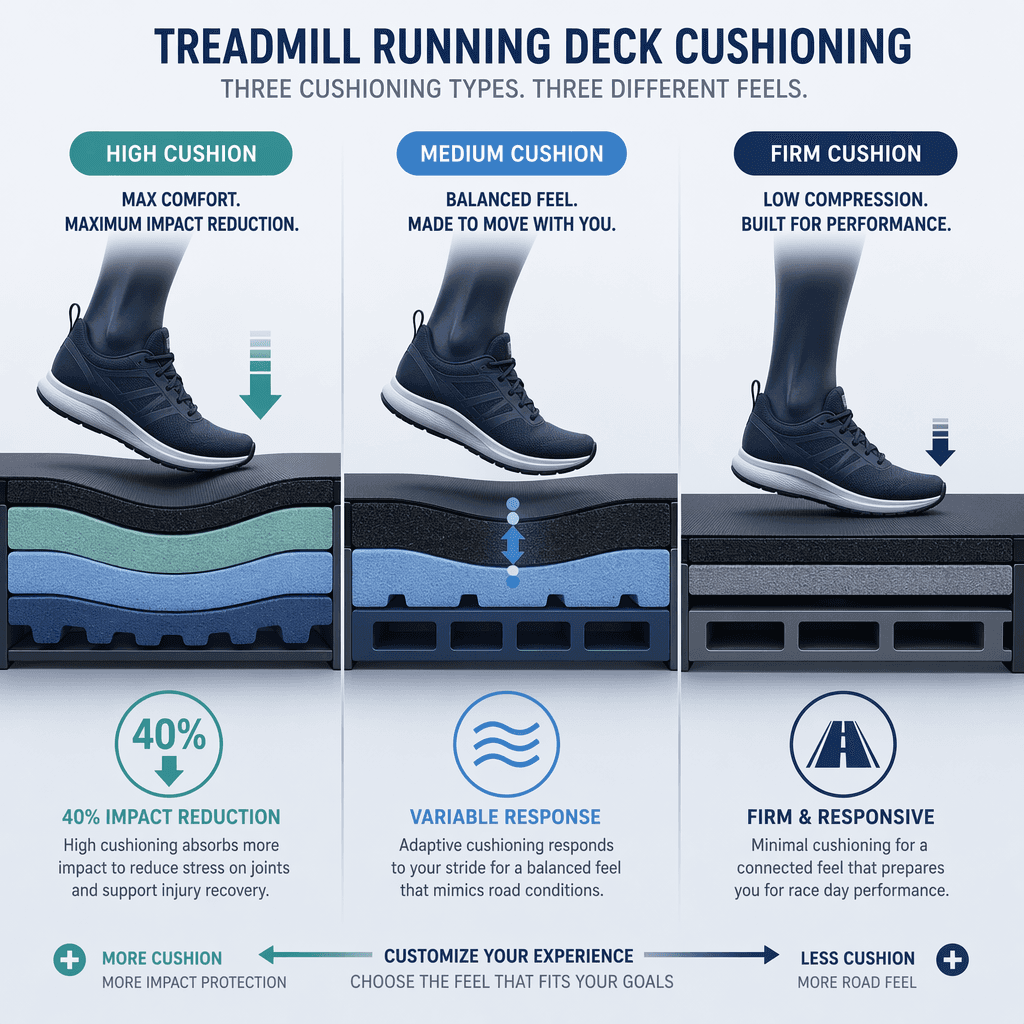
Cushioning is the most subjective spec on a treadmill, but it has real implications for runners with joint concerns. The three major systems differ significantly:
| Cushioning System | Models | Feel | Best For |
|---|---|---|---|
| Sole Cushion Flex Whisper Deck | Sole F63, Sole F80 | Plush, high shock absorption (40% impact reduction vs. asphalt) | Runners with knee or hip concerns, injury recovery |
| NordicTrack Runners Flex | NordicTrack Commercial 1750, 2450 | Balanced — plush under heel, firmer under toe | Runners who want a mix of comfort and responsiveness |
| Horizon Variable Response Cushioning | Horizon 7.0 AT, 7.4 AT | Firmer — three zones with less compression | Runners training for road races who want a surface that mimics asphalt |
Roller Size and Warranty
Larger rollers (2.5 inches or more) reduce belt friction and motor strain, extending the life of the treadmill. The Sole F63 includes 2.36-inch rollers, which is adequate for its price point. Higher-end models typically use 2.5-inch or larger rollers. Warranty is another durability signal: the Sole F63 offers a lifetime frame and motor warranty, which is exceptional for a $1,000 treadmill and indicates confidence in the build quality.
Runner-Specific Considerations: Noise, Decline, and Cushioning
Three additional factors matter specifically for runners that generic buying guides rarely address in depth.
Noise Levels for Shared Walls
If you live in an apartment or condo, treadmill noise is a neighbor relations issue. TreadmillReviews.net measured the Sole F80 at 53.8 dB during walking, describing it as "not much louder than a refrigerator." The Horizon 7.0 AT, by contrast, has been measured at over 70 dB — significantly louder. If noise is a concern, prioritize models with quieter motors and better vibration isolation. The Sole F80 and NordicTrack 1750 are consistently rated as quieter options.
Decline Training for Road Race Preparation
Most runners train on flat or incline-only treadmills, then struggle when a road race includes downhill sections. Decline training (-3% or steeper) prepares the quadriceps for eccentric loading, reducing post-race soreness and injury risk. The NordicTrack Commercial 1750 offers -3% decline, making it the best option for runners who race on hilly courses.
Cushioning for Injury Recovery and Joint Protection
Runners recovering from knee, hip, or shin injuries should prioritize cushioning. The Sole F80's Cushion Flex Whisper Deck claims a 40% impact reduction compared to asphalt, which can make a meaningful difference during high-mileage weeks. Runners without joint concerns who train primarily for road races may prefer the firmer Horizon Variable Response Cushioning, which more closely mimics the feel of running on pavement.
Comments
Join the discussion with an anonymous comment.