
I have watched people spend $4,000 on a single machine only to discover, six months later, that they cannot deadlift on it and their partner finds the seat adjustment too fiddly to share. The allure of a compact, all-in-one home gym is real — less clutter, fewer decisions, one box to unbox. But the price tag is only the beginning. The real question is what happens over five years: how much you actually spend, what you can still sell, and whether the machine grows with you or locks you in.
Every home gym decision comes down to one trade-off: Do you want a single compact machine that does everything in one footprint, or a collection of separate pieces you can swap, sell, and upgrade over time? Neither is inherently better. The answer depends on how you train, how much room you have, and how long you plan to keep the setup. But most comparisons stop at the upfront price. They ignore what happens the moment you want to change something. A separate power rack, barbell, and plates can be sold for 60–70% of their purchase price after five years if you take care of them. A dedicated all-in-one? More like 20–30%, if you can find a buyer at all. That gap alone shifts the five-year math more than any sale price.
Three Ways to Spend Your Money
Let’s look at the three main paths. I’ll keep the numbers tight — the table at the end will settle the debate.
Separate equipment: A starter build — power rack, Olympic barbell, bumper plates, adjustable bench, and a cable tower — runs $1,300 to $2,500 new. Here’s a realistic breakdown based on tested prices from Garage Gym Reviews:
- Barbell: $250
- Squat rack (e.g., Fringe Sport Squat Rack with pull-up bar): $349
- Bumper plates (260 lbs set): $424
- Adjustable bench: $150–$300
- Cable tower with weight stack (e.g., Bells of Steel Cable Tower): $435
- Kettlebell, rings, jump rope, horse stall mats: $193
Total roughly $1,800–$2,000 without counting sales or used deals. The key advantage: each piece can be replaced independently. Want a better barbell next year? Sell the $250 one for $150 and buy a $500 bar. Need heavier plates? Add them. The Where to Spend vs. Save on Affordable Home Gym Equipment guide digs into which pieces deserve your budget. Because these are standard-sized items (1-inch holes for racks, 2-inch diameter for Olympic bars), you are not locked into any single brand. That flexibility has a real dollar value when you upgrade or move.
All-in-one machines range from plate-loaded entry-level units around $1,300 to high-end weight-stack behemoths at $4,200. The hidden cost: plate-loaded machines need you to buy extra plates over time. For example, the Bells of Steel All-in-One Home Gym at $1,299.99 has a 300-lb cable capacity but is plate-loaded — you need your own Olympic plates. Start with a set of 255 lbs (~$400); you may want another 100 lbs within a year or two. At roughly $0.50–$1.00 per pound, that is another $50–$100 over five years. Weight-stack versions like the Major Fitness B17 Flying Fortress ($4,199.99) include two weight stacks expandable to 260 lbs each — no extra plates, but more than triple the price. The Bowflex Xtreme 2 SE ($1,499) uses resistance rods and can be upgraded to 410 lbs with an optional kit ($250). It is a fixed station — no barbell squats or deadlifts, but covers most cable exercises. Assembly also hurts: a rack and barbell setup takes an hour; an all-in-one often takes 4 hours to a full day, and some users hire help (another $100–$200).
Smart gyms like the Tonal 2 cost $4,295 upfront and require a $60/month membership for full access. Over five years, that is $4,295 + ($60 × 60) = $7,895 total. That is more than double the upfront price. Compare to the Speediance Gym Monster at $3,199 with no subscription — a one-time cost. The difference is $4,696 over five years. At $65 per month — the average gym membership — a commercial gym costs $3,900 over five years. A $1,500 home gym breaks even in about two years. But the Tonal 2, with its subscription, costs nearly double the gym membership over the same period. If you cancel the subscription, the machine becomes effectively unusable for connected training. That is a risk most buyers do not calculate.
The 5-Year Cost Table
The table below consolidates all three scenarios, including costs many buyers overlook: shipping (5–10% of price), assembly (if you hire help), ongoing plate purchases (for plate-loaded machines), subscription fees (for smart gyms), and resale value at year five. The "net cost after 5 years" column subtracts what you can realistically recover by selling the gear.
| Cost Factor | Separate Equipment | All-in-One (Plate-Loaded) | All-in-One (Weight Stack) | Smart Gym (Subscription) | Smart Gym (No Sub) |
|---|---|---|---|---|---|
| Upfront equipment | $1,800 | $1,300 | $4,200 | $4,295 | $3,199 |
| Shipping (est.) | $90–$180 | $65–$130 | $210–$420 | $215–$430 | $160–$320 |
| Assembly (if hired) | $0 (DIY) | $100–$200 | $100–$200 | $150 (pro install) | $100–$200 |
| Ongoing plate costs (5 yr) | $0 (included) | $50–$200 | $0 | $0 | $0 |
| Subscription (5 yr) | $0 | $0 | $0 | $3,600 | $0 |
| Total invested (5 yr) | ~$1,980 | ~$1,600 | ~$4,600 | ~$8,300 | ~$3,600 |
| Estimated resale value (5 yr) | 60–70% → $1,080–$1,260 | 20–30% → $260–$390 | 20–30% → $840–$1,260 | 10–20% → $430–$860 | 20–30% → $640–$960 |
| Net cost after resale | ~$700–$900 | ~$1,210–$1,340 | ~$3,340–$3,760 | ~$7,440–$7,870 | ~$2,640–$2,960 |
| Cost per year | ~$140–$180 | ~$242–$268 | ~$668–$752 | ~$1,488–$1,574 | ~$528–$592 |
The numbers tell a clear story: separate equipment is the cheapest option over five years by a wide margin, even after adding the cable tower that many all-in-one comparisons omit. The plate-loaded all-in-one is a middle ground — cheaper upfront than a weight-stack machine, but still more expensive than separate gear when you factor in plates and poor resale value.
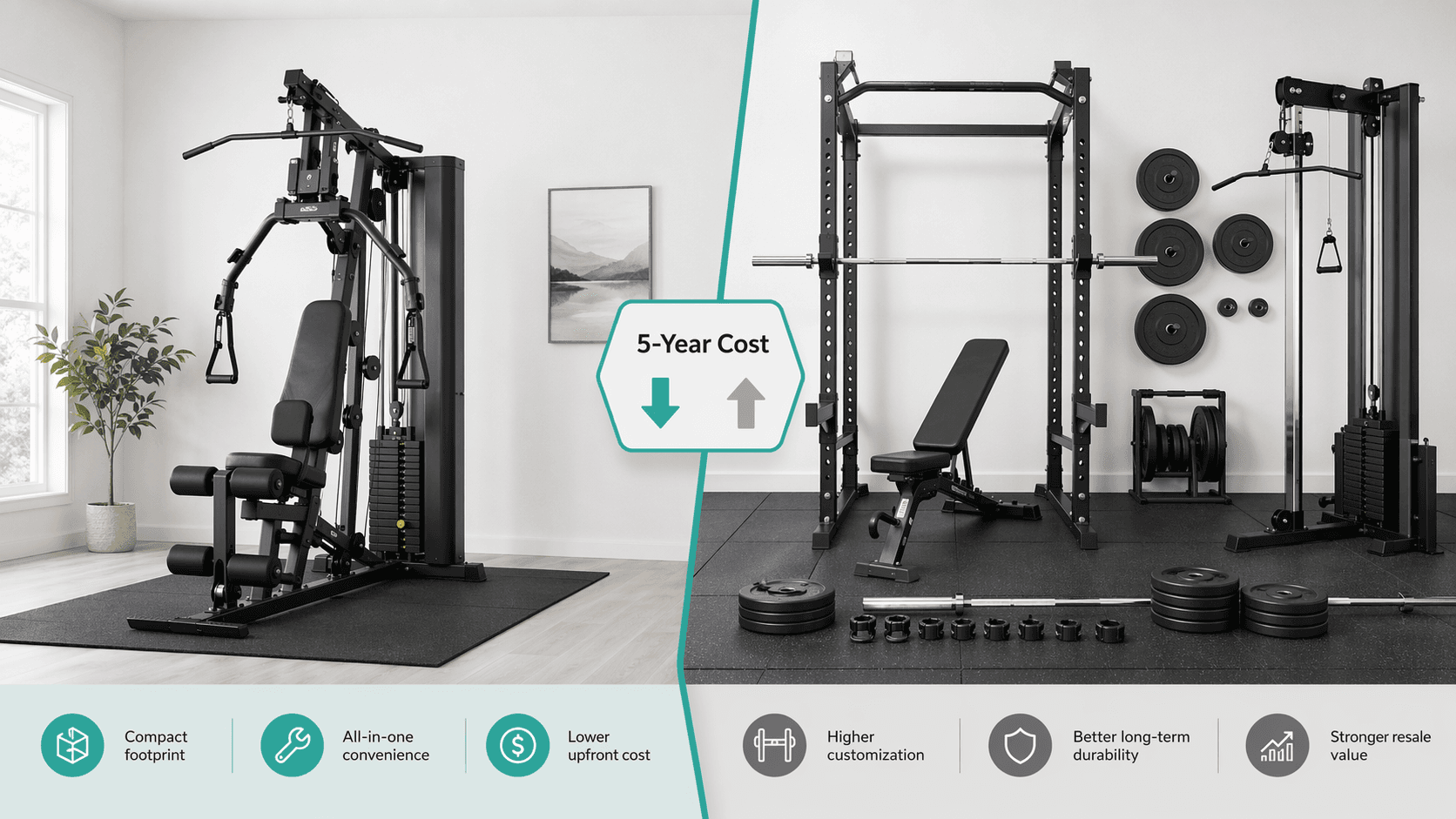
When All-in-One Makes Sense
I have argued that separate equipment is the better value, but I have also built both types of gyms. All-in-ones genuinely solve problems that separate gear cannot.
If you live in a studio apartment and your workout area is a 4×4 ft corner, no rack-and-barbell setup fits. A compact all-in-one like the Bells of Steel model takes up roughly that same footprint and packs cables, pulleys, and a lat pulldown into one column. You cannot do barbell squats, but you can do split squats, RDLs, and cable work that covers 80% of strength goals.
If you train alone and worry about safety under a heavy squat, a Smith machine or guided cable system gives you spotter catches and controlled movement paths. Beginners often feel more confident starting on a machine, and that confidence keeps them training. That has real value — it is just harder to put on a spreadsheet.
And if you are the only person in your household who lifts, an all-in-one avoids the clutter of a rack, bench, barbell, plates, and cable tower all standing separately. One machine, one footprint, one cleaning session.
When Separate Gear Wins
If you share your gym with a partner or plan to lift for more than two years, separate equipment almost always comes out ahead.
Two people of different heights rarely fit the same adjustment range on an all-in-one bench or seat. With separate gear, you can buy two barbells and two benches — or simply adjust each quickly without fighting a single machine's fussy mechanism. A family of lifters can each have their own rack heights and plate stacks.
Upgradability is the silent killer of the all-in-one value proposition. A power rack from REP or Rogue can be accessorized with dip handles, safety straps, a monolift, or a cable attachment. A $950 REP PR-4000 can turn into a $1,500 system over three years by adding a weight stack from REP. You cannot do that with an all-in-one — you buy the whole package or live with what you have.
And resale, as we covered, is dramatically better. A used Rogue barbell sells in days on Craigslist for $200–$250. A used all-in-one gym sits for months until you accept $300. The How to Build a Compact Home Gym in 3 Phases guide shows how to start with a rack, barbell, and plates, then add a cable tower in phase two, and upgrade to a fancier bench in phase three. That phased approach works because each component has a healthy secondhand market.
Decision Matrix
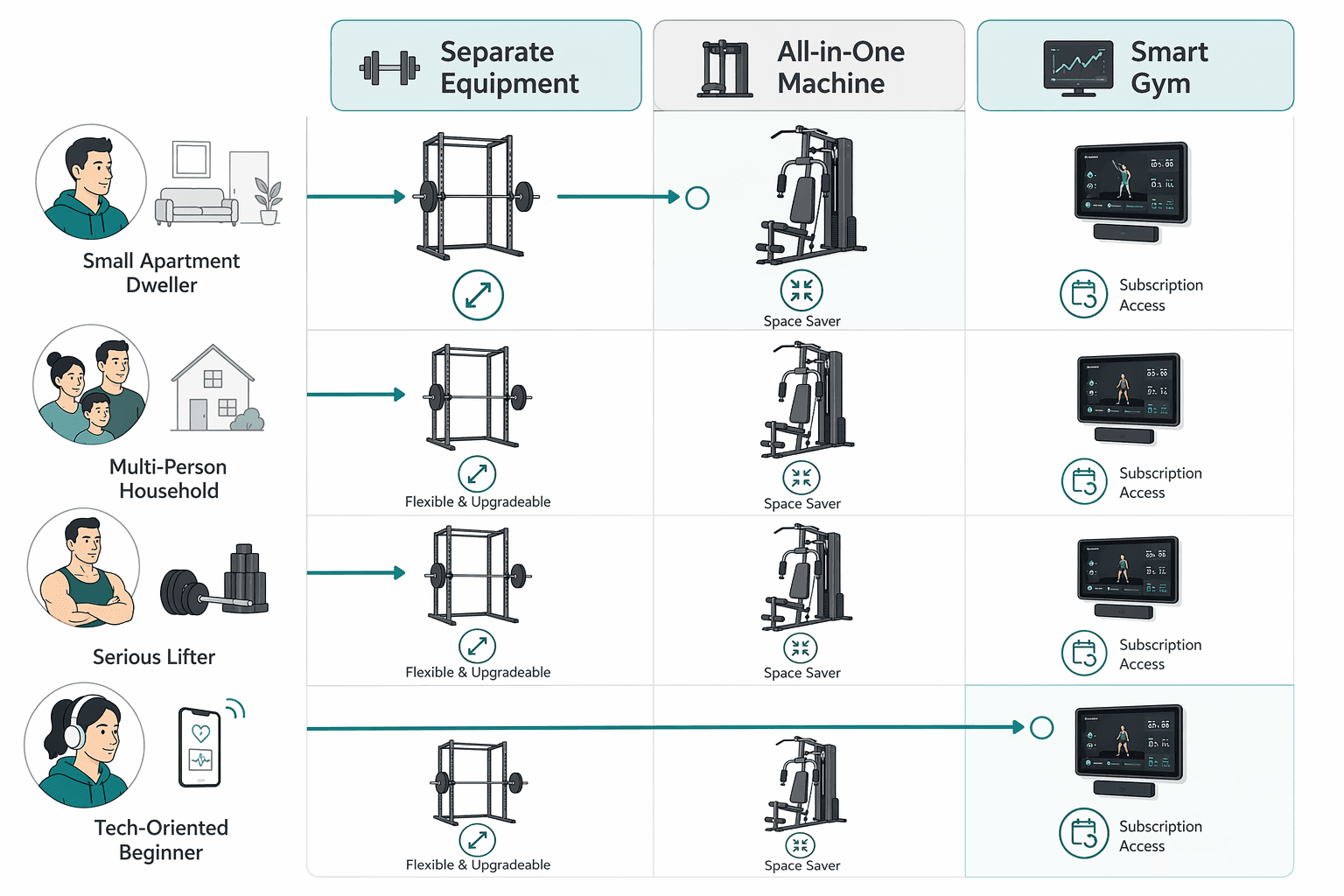
| Your Profile | Separate Equipment | All-in-One (Plate-Loaded) | All-in-One (Weight Stack) | Smart Gym (No Sub) | Smart Gym (With Sub) |
|---|---|---|---|---|---|
| Small apartment (under 200 sq ft) | Avoid (too much gear) | Best – space efficient | Good – if budget allows | Good – compact | Conditional – if sub cost is okay |
| Single user, beginner | Good – if space permits | Best – low cost, guided movements | Conditional – expensive for one | Good – guided workouts | Conditional – sub adds up |
| Multi-user household (2+ lifters) | Best – adjustable per person | Avoid – single station | Conditional – dual stacks help | Avoid – single user | Avoid – single user |
| Serious lifter / powerlifter | Best – barbell squats/deadlifts | Avoid – no barbell work | Conditional – if includes Smith machine | Avoid – digital resistance limit | Avoid – limited max load |
| Tech enthusiast / data lover | Good – can add smart attachments | Good – can track reps on app | Good – some have built-in screens | Best – digital training suite | Best – full ecosystem |
| Budget-constrained ($1,000–$1,500) | Best – starter set fits budget | Best – entry-level all-in-one fits | Not available (over budget) | Not available (over budget) | Not available |
A few takeaways: if you have room for a 6×8 ft area and lift with a partner, separate equipment is almost certainly the smarter buy. If you live in a 400 sq ft studio and train alone, a plate-loaded all-in-one gives you the most function per square foot. And if you are drawn to smart gyms, the no-subscription options like the Speediance Gym Monster avoid the long-term cost trap while still offering a sleek, technology-driven experience.
One final note: all prices in this article are from mid-2026 and may shift with sales, tariffs, or new model releases. Verify current prices before making a purchase decision. And if you are still torn, go to a store that has an all-in-one on display and try changing the seat position five times to see if it annoys you. That moment will tell you more than any table.
Comments
Join the discussion with an anonymous comment.