
You’re About to Build Your Home Gym Backward
Thirty-five-point-six percent of U.S. exercisers say cost is the main reason they don’t buy home fitness equipment. That number is real. But it’s also a distraction — because the problem isn’t the price tag. The average home gym runs $1,500–$2,500. The real problem is that most first-time buyers spend their money exactly opposite of where it matters.
They buy a cheap barbell, a flimsy rack, and a wobbly bench — then blow the rest on color-coded dumbbells and a foam roller that cost as much as the bar they should have bought. I’ve watched friends do it. I’ve done it myself once. This article is about the tradeoff logic: where to lock in your safety budget and where to pocket the difference.
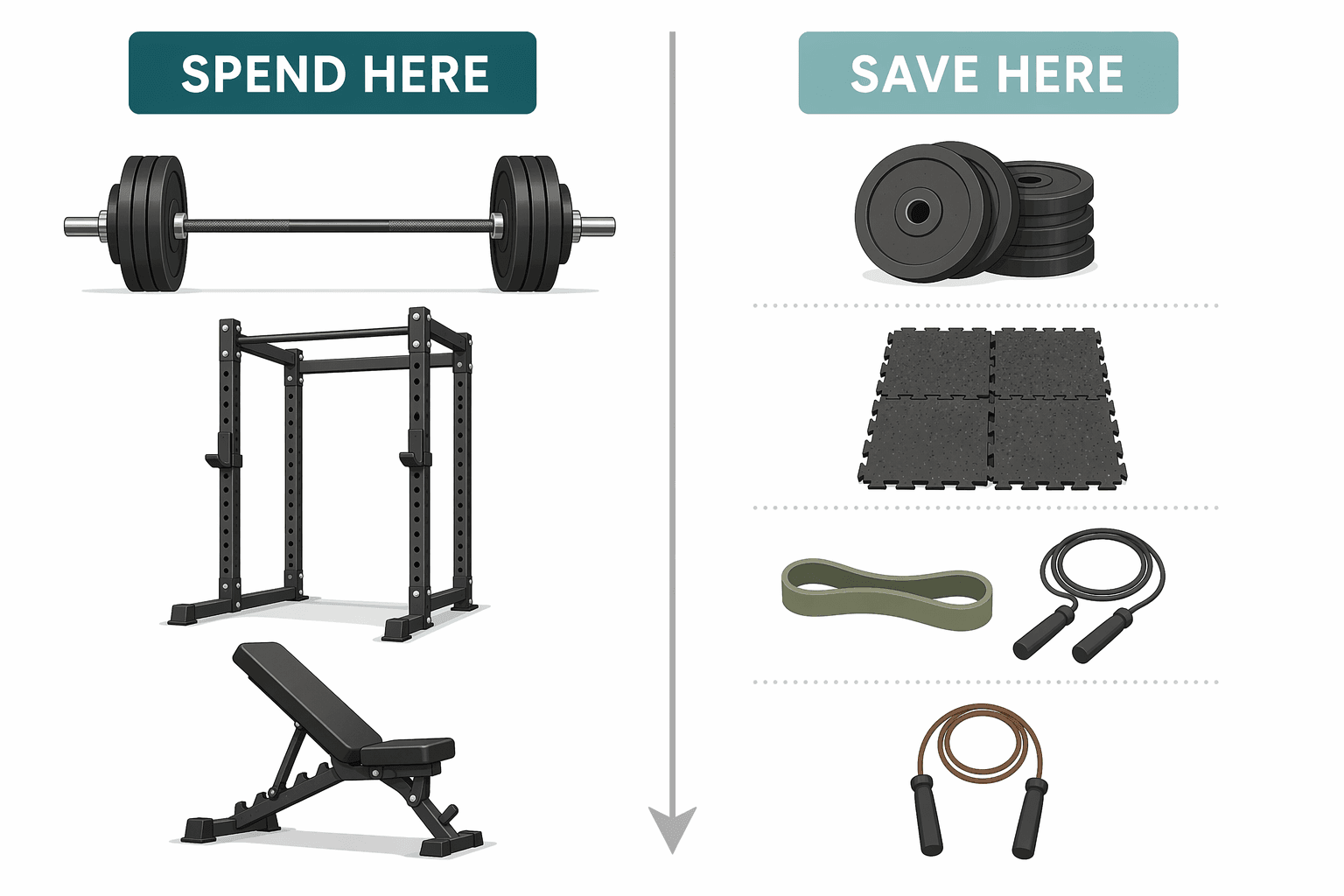
This isn’t a list of whole-setup budgets — that angle is covered in our complete budget setup guide. Here, I’m breaking down the tradeoff logic for each category: why spending more on the bar, rack, and bench is a safety investment, and why saving on plates, flooring, and accessories is a smart choice, not a compromise.
The Barbell: Spend Here or Risk It
A barbell looks like a metal bar. That’s what makes it dangerous to underspend. A $60 Amazon bar has unknown steel quality, unknown tensile strength, and no warranty. A bend or snap under load isn’t theoretical — it’s a trip to the ER and the end of your training hobby.
What you actually need is a bar with at least 190,000 PSI tensile strength and a lifetime warranty. The Synergee Games Cerakote Barbell starts at about $180, hits that tensile strength spec, and comes with a lifetime warranty. Compare that to the average Olympic bar price of $375 — you're getting real steel for nearly $200 below average. That’s not a compromise. That’s the smartest spend in your whole build.
But not all $180 bars are equal. Before you buy, check the tensile strength number and the warranty term. A bar that doesn’t list either is a gamble. I don't trust any bar that hides those specs.
The Squat Rack: Steel Gauge Is Not a Luxury
The rack holds the weight you lift over your body. Cutting corners here is the fastest way to regret your budget. A no-name rack with thin steel and missing safety pins can collapse — and I've seen the photos from the r/homegym subreddit. They're not pretty.
What you need: a rack with at least 14-gauge steel (lower gauge = thicker steel), a weight capacity over 700 lbs, and functioning safety pins. The REP PR-1100 Power Rack costs $380, uses 14-gauge steel, supports 700 lbs, and includes safety pins. That’s $328 below the average rack price of $708. You are not overpaying — you are meeting a spec that keeps you safe, and you're doing it at a bargain.
Any rack under $300 is almost certainly made from thinner steel (16-gauge or worse) and often skips the safety pins or uses cheap plastic ones. Don't trust it. A rack failure under a loaded squat is not a repair — it's a hospital visit.
The Bench: Stability Is Non-Negotiable
A bench that wobbles under your pressing weight is a problem you notice halfway through a heavy set. The fix is not 'tighten the bolts' — it's a different bench.
Here's where the data flips: the Major Fitness Adjustable Bench costs about $220 and has a 1,300-lb weight capacity. That's both cheaper than the average bench ($307) and stronger than the average capacity (949 lbs). This is a rare case where the budget-friendly option is also the safe option. Most sub-$200 benches top out around 600–800 lbs — enough for now, but without margin for a heavier future or for a second user.
Test the bench before you buy if possible. Sit on it in the position you'd use. If it creaks, wobbles, or feels unstable, walk away — even if the price is tempting. The same rule applies to used benches: if it feels loose under your body weight, it's not a deal, it's a hazard.
Where You Can Save Without Worry
If the three sections above made you nervous about the budget, this is where you relax. The following categories are low-risk for safety and high-reward for savings.
Weight Plates: Cast Iron Is Fine
Premium bumper plates are overkill for a sub-$1,000 home gym. Standard cast iron plates do the exact same job — they sit on the bar, they resist gravity, they don't break. CAP Cast Iron Hex Dumbbells cost as low as $1.10 per pound, compared to the average $3.23 per pound for dumbbells. On a set of 100 lbs, that's a $213 savings. The used market often runs around $1 per pound. Cast iron doesn't degrade with proper care — no safety concern, only noise and a little rust. That's a trade worth taking.
Flooring: Horse Stall Mats Work
Brand-name gym flooring can run $2–$4 per square foot. Tractor Supply 3/4-inch rubber stall mats cost about $50 for a 4x6 ft sheet — about $2 per square foot, but much thicker and more durable than most budget gym mats. The main downside is the rubber smell; air them out for a few days before installing. For thickness details and subfloor considerations, see our home gym flooring buyer's guide.
Accessories: The $20 Sweet Spot
A jump rope, resistance bands, and a yoga mat will get you 90% of the way for effective accessory training. The WOD Nation Double Under Speed Rope costs under $20 and includes an extra cable. The Vergali Mini Resistance Bands 4-pack runs about $20. That's pure save territory — but a quick warning: bands at the $5 price point snap easily. Stick with a reputable budget brand, not the cheapest no-name.
Cardio: Jump Rope or Used Market
A jump rope is mechanically simple, costs $20, and delivers excellent cardio. If you want a bike or treadmill, the used market can save you hundreds — but only if you can test the belt and motor in person. A used treadmill with a worn belt is a repair bill waiting to happen, not a savings. For reliability, the jump rope wins every time.
Spend vs. Save: The Decision Table
| Category | Action | Specs to Check | Risk if You Cheap Out | Example Product |
|---|---|---|---|---|
| Barbell | Spend | Tensile strength (190k+ PSI), lifetime warranty | High — bar bends or snaps under load | Synergee Games ($180) |
| Squat rack | Spend | Steel gauge (14+), weight capacity (700+ lbs), safety pins | High — collapse under load | REP PR-1100 ($380) |
| Bench | Spend | Weight capacity (1,000+ lbs), stability | High — wobbly bench reduces press safety | Major Fitness ($220) |
| Weight plates | Save | Cast iron or used; no cracks | Low — weight is weight | CAP hex dumbbells ($1.10/lb) |
| Flooring | Save | Thickness (3/4" stall mats suffices) | Low — brand name offers no safety benefit | Tractor Supply stall mat (~$50) |
| Accessories | Save | Avoid $5 bands; $20 is safe | Low — only risk is snapping bands | WOD Nation rope ($19), Vergali bands ($20) |
| Cardio | Save | Jump rope or tested used equipment | Low for jump rope; medium for untested used machines | Jump rope ($20) |
Hard Rules: What to Never Buy Used
The used market can save you money on plates and flooring. But on safety-critical gear, a so-called deal can cost you more in the long run — in repairs, replacements, and injury. These are hard rules, not suggestions.
- Never buy a used barbell with visible rust, pitting, or a bent shaft. The steel has already degraded. No price is low enough to justify the risk.
- Never buy a rack with cracked welds or missing safety pins. Welds cannot be field-repaired. A missing pin means the rack's fail-safe doesn't exist.
- Never buy a bench that feels unstable under your own body weight. If the frame has play, it will fail under heavier loads.
- According to the r/homegym community, which has seen plenty of replacement cycles, cheap equipment often costs 2–3 times more over five years because it has to be replaced. That community insight matches what I've seen in real purchases: the buyer who saved $60 on a barbell ends up buying two bars in two years.
The Bottom Line: Foundation First
A $1,000 home gym is absolutely achievable — and it will last, if you spend correctly. The barbell, rack, and bench come to about $780. That leaves $220 for plates, a mat, a jump rope, and bands. That's a complete, safe, and effective setup.
The mistake most first-time buyers make is prioritizing appearance over safety. I get it — those color-coded bumper plates look good on Instagram. But they don't make you stronger, and they don't protect you from a bent bar. A plain black barbell with 190,000 PSI and a lifetime warranty is ugly in comparison. It's also ten times smarter.
Spend on the foundation. Save on the frills. Do that, and your home gym will outlast your motivation.
Comments
Join the discussion with an anonymous comment.