
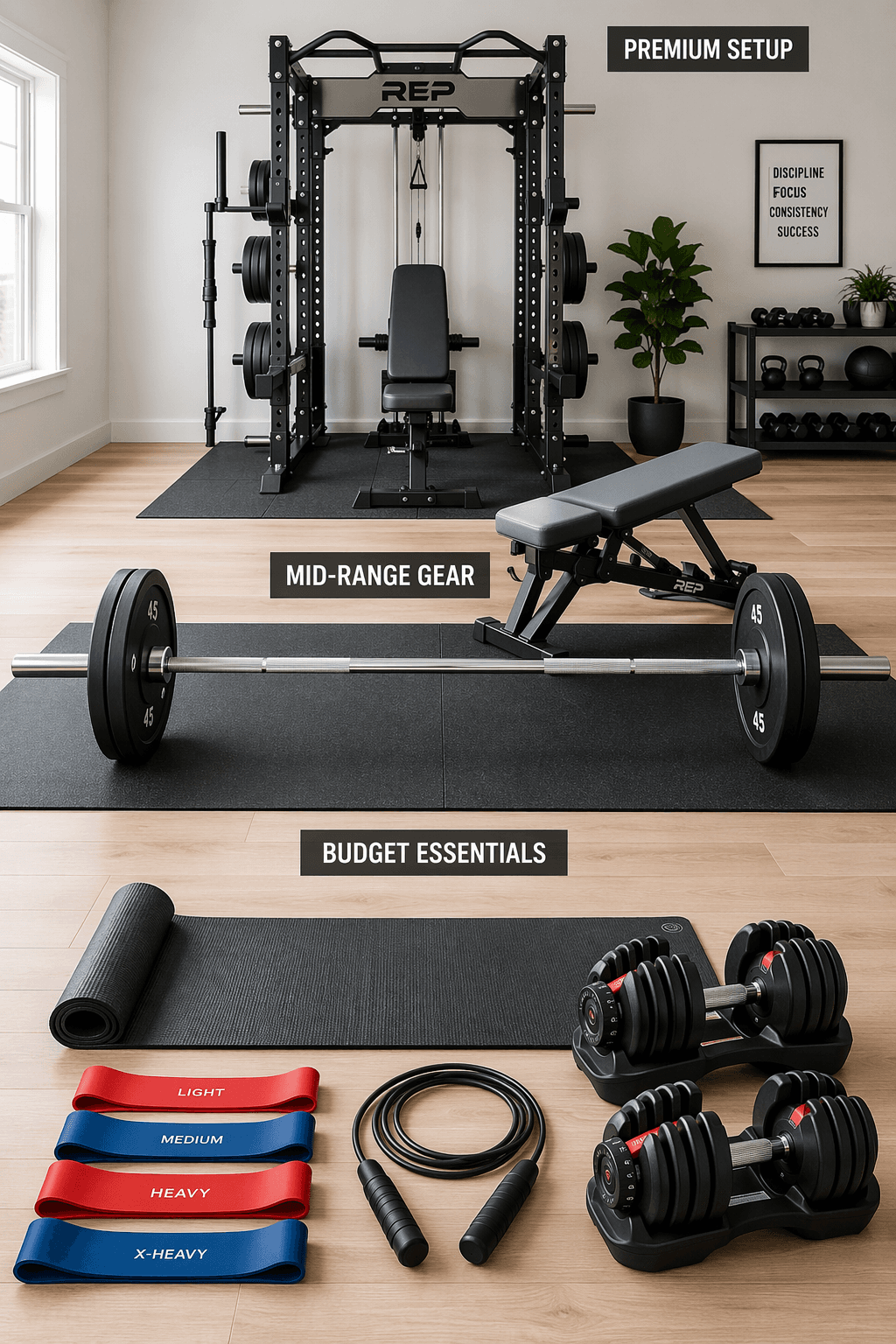
There’s no single “best” home gym product
Type “best home gym equipment” into a search bar and you get a list of top-rated products — a power rack, an adjustable dumbbell set, a treadmill. I learned the hard way: that’s not how a home gym works. You don’t buy one piece and call it a day. You buy a system that fits together, and the ceiling on that system is your budget.
The average gym membership runs about $65 a month. Spend $1,500 on a home gym and you break even in under two years. That math is simple, but it hides the real question: what does that $1,500 actually buy you, and what does it leave out? Most guides answer by listing individual products. I want to answer by showing you three complete setups — at $500, $1,500, and $3,000+ — with the trade-offs clearly marked, so you can decide which tier fits your training goals, not just your wallet.
If your budget is strictly under $500, the companion article Best Home Exercise Equipment for Every Budget: From $200 Starter to $2,500+ Complete Setup covers the $200 and $1,000 tiers in more depth. Here I’m aiming at buyers who have at least $500 to invest and want to know what a genuinely coherent setup looks like at each level.
$500 – Honest limits
A $500 budget will not buy you a power rack, a barbell, and a set of plates. If that’s what you need, skip this tier. But if you are willing to start with bodyweight and limited weight progression, $500 can build a genuinely useful starter kit that will keep you busy for months.
- Adjustable dumbbells: REP Fitness QuickDraw start at $335.99 for the 40-lb pair. They’re quick-change and decent quality for the price.
- Adjustable bench: Major Fitness sells one for $219.99 with a 1,300-lb capacity — overkill for dumbbells, but it will carry over if you upgrade later.
- Resistance bands and a jump rope: A set of bands costs about $30; a decent speed rope is under $20. These fill the gap for pulling exercises and cardio.
Total: around $585. A bit over $500, but you can trim by choosing a cheaper dumbbell option (non-quick-change adjustable) or skipping the rope. The floor cost for this tier is real — 38.6% of home gym buyers spend under $500 on a single piece, and a full setup at this level is possible only if you already have a pull-up bar or are willing to use bands for rows.
$1,500 – Where strength training begins
This is the sweet spot for most people. A $1,500 budget buys a complete strength-training system — power rack, Olympic barbell, weight plates, adjustable bench — and changes what you can train. I’d argue this is the minimum for a real home gym. With a rack you can squat and bench press safely, deadlift off the floor, and progress linearly for a year or more.
- Power rack: REP PR-1100, $380, 700-lb capacity, 14-gauge steel. It’s not the beefiest rack, but it’s safe and stable for most trainees.
- Barbell: Synergee Games Cerakote, $179.95, 190,000 PSI tensile strength, lifetime warranty. A barbell at this price point is a solid investment — avoid the cheap $100 bars that bend under moderate weight.
- Weight plates: Fringe Sport Black Bumper Plates, $1.79/lb, lifetime warranty. A 255-lb set runs about $456. Bumpers are quieter and more durable than iron, and the lifetime warranty means you won’t buy twice.
- Adjustable bench: Same Major Fitness bench as the $500 tier, $219.99. Reuse it here.
Total: about $1,580. A little over $1,500, but the incremental $80 gets you a rack that enables hundreds of exercises. The average home gym cost sits at $1,500–$2,500, and this setup lands right at the low end. What you gain versus the $500 tier: a barbell, a rack, and the ability to do heavy compound lifts safely.
$3,000+ – Commercial-lite, but watch subscriptions
At $3,000 you can add a cardio machine, proper flooring, and upgrade the rack to a heavier gauge. This is the “set it and forget it” tier — equipment that, with maintenance, lasts 10 to 20 years.
- Upgraded rack: Consider a REP PR-4000 or similar 11-gauge steel rack, $500–$700. More weight capacity and better accessory compatibility.
- Cardio machine: Sunny Health and Fitness Indoor Cycle Bike SF-B1002, $254.34, 49-lb flywheel — a budget pick that holds up well for home use. Or a rower for full-body cardio.
- Flooring: Rubber stall mats or interlocking tiles, about $200–$300 for a 6x8-ft area.
- Heavier plates: Add more weight to the barbell — another pair of 45-lb plates and some smaller increments.
Total: roughly $3,200–$3,500. That includes everything — rack, bar, plates, bench, bike, flooring. An industry estimate suggests a full home gym costs $3,000–$6,000, so this sits at the lower end of that range.
What each tier enables vs. excludes
| Capability | $500 Tier | $1,500 Tier | $3,000+ Tier |
|---|---|---|---|
| Bodyweight exercises & light dumbbell work | ✓ | ✓ | ✓ |
| Pull-ups (with bar) | ✓ (if you have a bar) | ✓ | ✓ |
| Barbell squats (racked) | ✗ | ✓ | ✓ |
| Barbell deadlifts | ✗ | ✓ | ✓ |
| Overhead press (barbell) | ✗ | ✓ | ✓ |
| Cardio machine | ✗ | ✗ (unless you reduce weight) | ✓ |
| Progressive overload beyond 40-lb dumbbells | ✗ (limited) | ✓ (to ~300+ lb) | ✓ (to 500+ lb) |
| Proper flooring for dropped weights | ✗ | ✗ (use mats) | ✓ |
| Commercial-grade longevity (10+ years) | ✗ | ✓ (for rack & bar) | ✓ |
The table makes it obvious: $1,500 is the minimum for a real strength gym. $3,000 adds cardio and durability. If you know you’ll never want a barbell, the $500 tier can still work. But most people who start with dumbbells alone eventually want to squat and deadlift heavier.
How to upgrade without waste
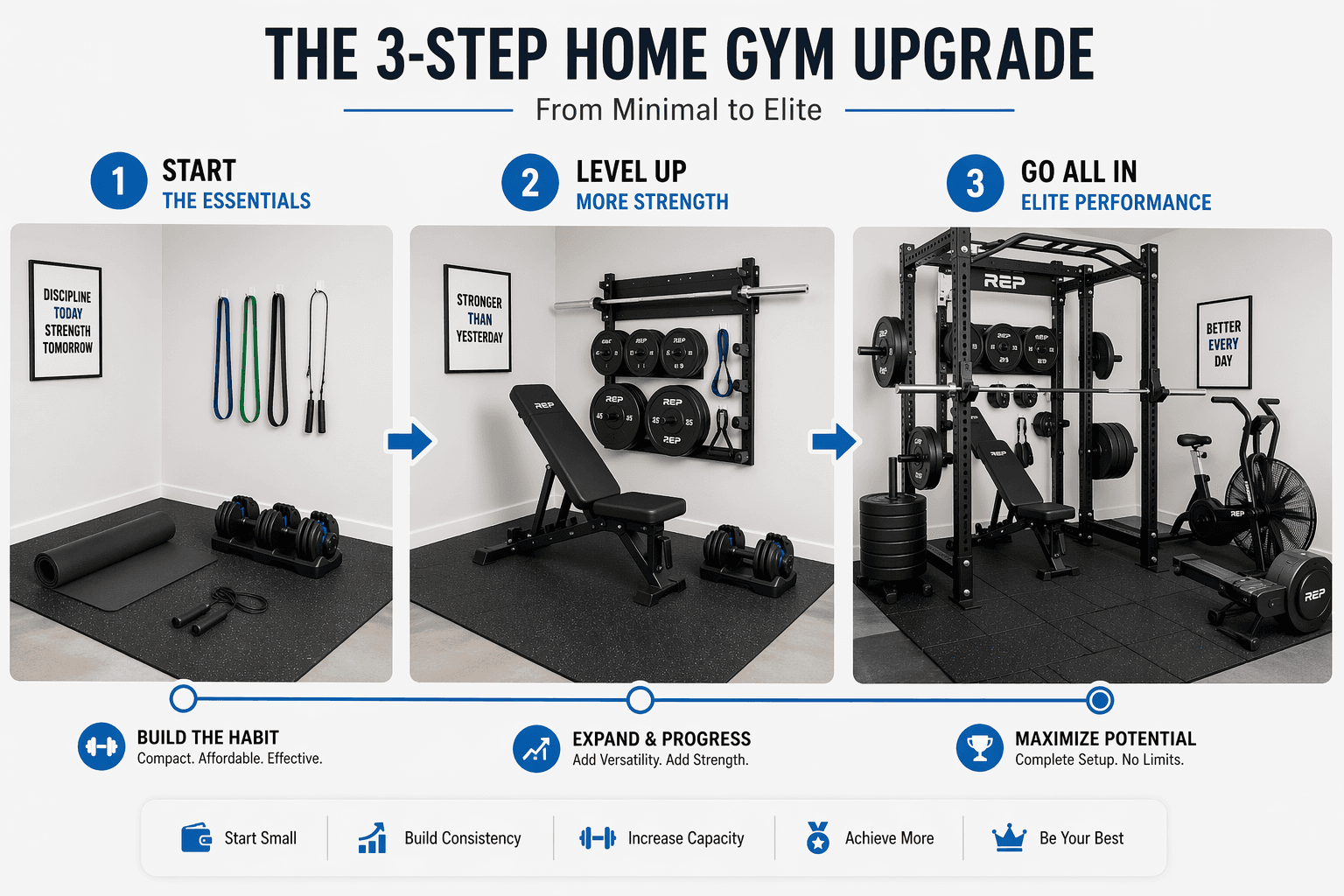
If you start at $500, you don’t have to throw away everything when you upgrade. The key is to choose initial gear that carries over.
- Phase 1 ($500): Buy adjustable dumbbells, a quality bench, and bands. Avoid cheap barbells or plate-loaded junk that won’t fit a standard rack later.
- Phase 2 (add ~$1,000): Add a power rack, barbell, plates. The adjustable dumbbells now become your accessory work tools, not your primary strength driver. The bench stays. You lose nothing.
- Phase 3 (add another $1,000+): Add a cardio machine, flooring, and heavier plates. The rack from Phase 2 is still fine — well-maintained racks last 10–15 years.
Common budget mistakes (and how to avoid them)
- Buying a cheap barbell that doesn’t fit standard racks. A $99 bar with 1-inch diameter sleeves won’t work with any quality rack’s J-hooks. Always buy a 2-inch Olympic bar.
- Underestimating plate shipping costs. Fringe Sport’s bumper plates at $1.79/lb have a lifetime warranty, but the shipping on 255 lbs can be $50–$100. Factor that into your total.
- Ignoring flooring until after equipment arrives. Dropping a 45-lb plate on bare concrete can crack the floor and damage the plate. Stall mats ($40–$60 each) protect both.
- Falling for subscription smart equipment at a premium price. A $2,500 treadmill that needs a $40/month subscription to track your runs adds up to $480/year. For a home gym that you already paid for, that ongoing cost can be frustrating.
If space is your primary constraint — not budget — the Compact Home Gym by Space Tier guide shows what you can fit in 10 to 100 square feet. And for apartment dwellers, the Home Gym Flooring for Small Spaces and Apartments guide covers noise reduction and floor protection.
Forget the brand. Forget the single product. The best home gym equipment is the setup you can afford that lets you train consistently, safely, and with room to grow. Match your ceiling to your goals, and you won’t regret a single dollar you spent.
Comments
Join the discussion with an anonymous comment.