
Why “best” is the wrong question
The REP Ares 2.0 scores 4.5/5 from Garage Gym Reviews and 94/100 from Strong Home Gym. That sounds like a slam dunk—until you realize it’s rack‑mounted and requires a compatible REP PR‑4000 or PR‑5000 power rack. If you do not already own one, you’re looking at an additional $700–$1,200 just for the rack. The machine itself starts at $2,999. Suddenly that “best” rating applies to a tiny fraction of buyers.Garage Gym Reviews gives it 4.5/5. Strong Home Gym scores it 94/100. I don’t care how high the score is—if you don’t have a REP rack, the Ares is irrelevant.
Across 30+ models, the average cable machine costs $2,265—but that average hides a spread from $500 to over $4,000. A single ranked list pretends all these products compete in the same market. They do not.
Your real constraints: space and budget
Cable machines are not interchangeable. A $750 portable unit and a $4,200 all‑in‑one serve completely different buyers. The two dimensions that actually separate your options are how much floor space you can spare and how much you are willing to spend.
- Apartment / small space (under 10 sq ft, $500–$1,500) – You need something that folds, rolls, or hangs on a door. Floor space is the absolute limit.
- Garage / dedicated gym (30–50 sq ft, $1,500–$3,500) – You have room for a functional trainer or a cable crossover. Budget is the main concern after space.
- Power‑rack owner (0 sq ft added, $1,000–$3,000) – You already have a rack and want a cable attachment. You skip the footprint entirely.
The typical cable machine footprint is 25.6″ L × 31.8″ W × 49.4″ H (from GGR’s database), but the range is enormous. A portable unit like the MAXPRO folds to the size of a laptop. A full‑size crossover like the Force USA G12 eats 33 sq ft. If you do not have that space, no spec sheet matters.
Tier 1: Small space, small budget ($500–$1,500)
At this tier you have two serious options, plus a cheap DIY alternative. Each involves a real trade‑off.
The MAXPRO SmartConnect ($749) weighs 9 pounds and folds to 16″×10″×4″. It offers digital resistance up to 300 pounds and scores a perfect 5/5 for portability. The appeal is obvious: it fits in a backpack. But the resistance is magnetic, not a weight stack. It lacks the inertia feel of a real cable pull. If you’re a serious lifter who wants to feel the weight at the bottom of a lat pulldown, you’ll notice the difference. I’ve used it—it’s fine for travel, but not a replacement for a real cable station.
The Bells of Steel Cable Tower 2.0 (~$500 base) is a real plate‑loaded cable station. Strong Home Gym rates it 96/100 for value. It occupies about 6 sq ft and offers 33 cable positions. That’s impressive for the price. But the $500 base price is deceptive: you need weight plates—typically $300–$600 for a decent set. That pushes the real cost to $800–$1,100. Still the cheapest serious option, but not $500 cheap.
If even $800 is too much, a DIY pulley system (a cable, a carabiner, and a loading pin) can be assembled for $50–$150. It works, but it’s not adjustable, and it won’t give you smooth lateral movements. Use it as a stopgap, not a permanent solution.
Tier 2: Garage gym, mid‑budget ($1,500–$3,500)
This is the most competitive tier. If you own a REP rack, the Ares 2.0 is the obvious answer—it adds zero floor space and gives you dual 260‑lb weight stacks with a 2:1 ratio. REP has a lifetime frame warranty, but moving parts (pulleys, cables, bearings) are covered for only one year. That’s worth remembering.REP has a lifetime frame warranty, but moving parts (pulleys, cables, bearings) are covered for only one year. That is worth remembering.
If you don’t have a REP rack, you have two strong alternatives:
- Titan Fitness Functional Trainer ($2,999) – Dual 200‑lb stacks, 2:1 ratio, aluminum pulleys, 44″×64″ footprint. One‑year warranty. GGR rates it 4.1/5.
- Body‑Solid GDCC250 – Dual 210‑lb stacks at a true 1:1 ratio (200 lb feels like 200 lb), 40 sq ft footprint, lifetime frame plus three years on pulleys and cables. Strong Home Gym gives it 88/100. Body‑Solid’s pulley coverage is longer than most – a meaningful difference if you plan to keep the machine for years.
The pulley material matters. REP and Body‑Solid use aluminium pulleys with brass bushings that stay smooth for years. Titan uses nylon, which tends to glaze by year three. That fits the warranty pattern: cheaper machines save on materials, and you pay for it later.
Tier 3: Premium all‑in‑one, max versatility ($3,500+)
Once you cross $3,500, the question shifts from “which machine is best?” to “which add‑on costs will I be locked into?”
The Force USA G12 ($4,200) is a brute: dual 200‑lb stacks at a true 1:1 ratio, 33 sq ft, and a 10‑year warranty on moving parts – the longest I have seen in the home gym market. Strong Home Gym scores it 90/100. It replaces roughly eight pieces of equipment. If you have the space, it is a buy‑once solution.
The Major Fitness B17 ($4,199) integrates a Smith machine and offers interchangeable 1:1 and 2:1 pulley ratios. Dual 130‑lb stacks are expandable to 260 lb. But its footprint is 68″×78″ – the largest in this tier – and the warranty is only one year. GGR gives it 4.2/5.
Then there is the Tonal 2 ($4,295 + $59/month). It mounts on a wall, takes almost no floor space (5.25″ deep), and delivers 250 lb of digital resistance. The sleekness is real. But over five years you will have paid $7,835 – nearly twice the one‑time cost of the G12. The subscription is a deal‑breaker for anyone who does not want a recurring bill on top of a $4,295 purchase. Strong Home Gym rates it 88/100.
Head‑to‑head: How the top picks compare
The table below consolidates the critical specs for all eight machines discussed. Use it as a quick reference, not a final verdict – the decision matrix follows.
| Machine | Footprint | Max Resistance | Pulley Ratio | Frame Warranty | Moving Parts Warranty | Subscription | Starting Price |
|---|---|---|---|---|---|---|---|
| REP Ares 2.0 (rack‑mounted) | 0 sq ft added | Dual 260 lb (upgradable to 310 lb) | 2:1 | Lifetime | 1 year | No | $2,999 |
| Titan Fitness Functional Trainer | 44″×64″ | Dual 200 lb | 2:1 | 1 year | 1 year | No | $2,999 |
| Body‑Solid GDCC250 | 40 sq ft | Dual 210 lb | 1:1 | Lifetime | 3 years (pulleys/cables) | No | ~$2,500 |
| Force USA G12 | 33 sq ft | Dual 200 lb | 1:1 | Lifetime | 10 years | No | $4,200 |
| Major Fitness B17 | 68″×78″ | Dual 130 lb (expandable to 260 lb) | 1:1 / 2:1 | 1 year | 1 year | No | $4,199 |
| Tonal 2 | 5.25″×21.5″×50.9″ (wall‑mounted) | 250 lb digital | Digital (constant tension) | 2 years | 2 years | $59/month | $4,295 |
| Bells of Steel Cable Tower 2.0 | 6 sq ft | Plate‑loaded (any weight) | 2:1 | Limited lifetime | 1 year | No | ~$500 (base) |
| MAXPRO SmartConnect | Folded: 16″×10″×4″ | 300 lb digital | Digital (magnetic) | 2 years | 2 years | No | $749 |
Decision matrix: Which machine fits your profile?
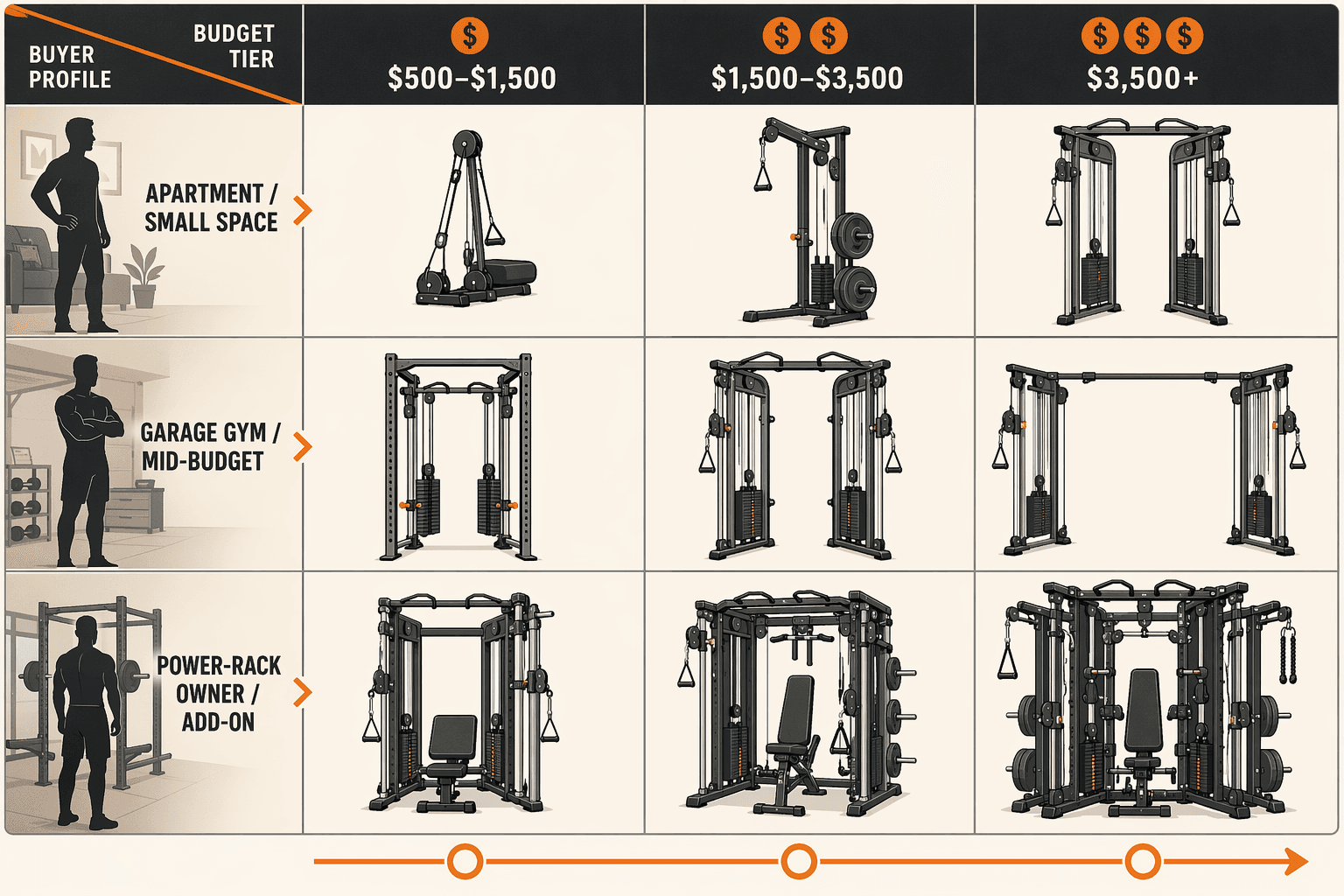
This grid distils the whole article into one glance. Find your space type and budget, and read the corresponding cell. Asterisks mark conditional picks that depend on already owning a REP rack.
| Budget → | $500 – $1,500 | $1,500 – $3,500 | $3,500+ |
|---|---|---|---|
| Apartment / small space (<10 sq ft) | MAXPRO SmartConnect | Bells of Steel Cable Tower 2.0* (with plates, total ~$800–$1,100) OR Titan FT (44″×64″ – measure carefully) | Tonal 2 (watch subscription cost) |
| Garage gym (30–50 sq ft) | – (not realistic at this budget) | REP Ares 2.0* (requires REP rack) OR Titan FT $2,999 OR Body‑Solid GDCC250 | Force USA G12 OR Major Fitness B17 |
| Power‑rack owner (0 sq ft added) | DIY pulley $50–$150 or BoS Cable Tower 2.0 (if you have space beside rack) | REP Ares 2.0 (requires REP rack) OR REP Athena (plate‑loaded $1,500 for single stack) | REP Ares 2.0 (build dual stack) OR Force USA G12 (standalone, frees up rack) |
The real cost of ownership: what the sticker price doesn’t tell you
I have seen too many people buy a BoS Cable Tower 2.0 and then realise they need another $400 in plates. Or pick up a Titan FT and face a nylon pulley repair after three years. The upfront price is only part of the story.
- Weight plates: Plate‑loaded machines (BoS Cable Tower, REP Athena) need plates. Budget $300–$600 for a usable set.
- Subscription: Tonal 2 adds $708/year. Over five years that is $3,540 – enough to buy a second machine.
- Cable replacement: Nylon pulleys glaze by year three. Replacement cables cost $20–$50 each. Aluminium pulleys last much longer – but at a higher initial price.
- Warranty reality: “Lifetime” almost always means the frame only. Moving parts – cables, pulleys, bearings – get 1–3 years. The Force USA G12’s 10‑year moving parts warranty is an outlier and genuinely valuable.
If you want to dig deeper into total investment across different equipment categories, our full cost breakdown by price tier covers the full picture from $300 to $6,000+.
Final verdict: Pick your constraint, then your machine
The REP Ares 2.0 is a fine machine – for REP rack owners. The Tonal 2 is clever – if you can stomach the subscription. The BoS Cable Tower is a steal – once you account for plates.
Cable machines are not interchangeable. A $750 unit and a $4,200 unit serve different people. The best cable machine is the one that fits your available floor space and your total budget – including every hidden cost. Use the decision matrix above to find your match, then browse our full‑body cable workouts for ways to put it to use.

Comments
Join the discussion with an anonymous comment.