
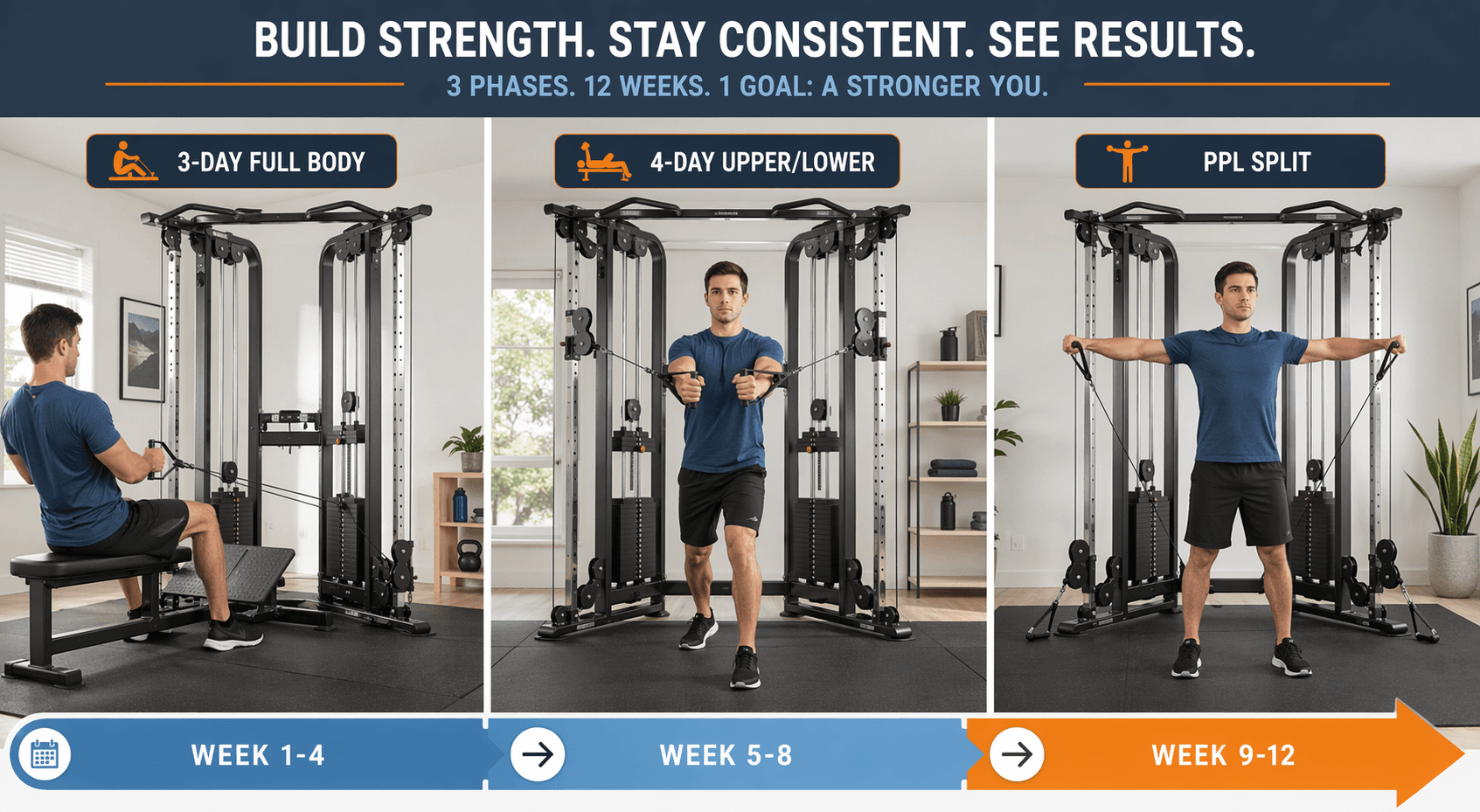
You pin 100 pounds on a dual-stack functional trainer, pull the handle, and it moves easily. The same 100 pounds on a single-stack tower feels like a grinder. That is not a failure of effort — it is a 2:1 pulley ratio giving you half the felt resistance but twice the cable travel. Most cable workout programs ignore this. They list exercises as if every machine behaves the same. They do not, and a routine that works on a commercial functional trainer will leave you stuck on a single-stack machine with limited range of motion for flyes or crossovers.
The thesis here is simple: any single cable machine — tower, functional trainer, or rack-attached — can support a complete, periodized resistance training program. But only if exercise selection matches the machine's capabilities and progression uses micro-loading, tempo, and volume rather than just piling on plates. I will walk through three phases — beginner 3-day full body, intermediate 4-day upper/lower, advanced 6-day push-pull-legs — with concrete substitution tables that tell you exactly which exercises work on your machine and which need adaptation.
If you are still on the fence about whether cables can build muscle at all, the science comparison between cable and free-weight training already settles that question. The rest is programming.
Why most cable programs miss the mark
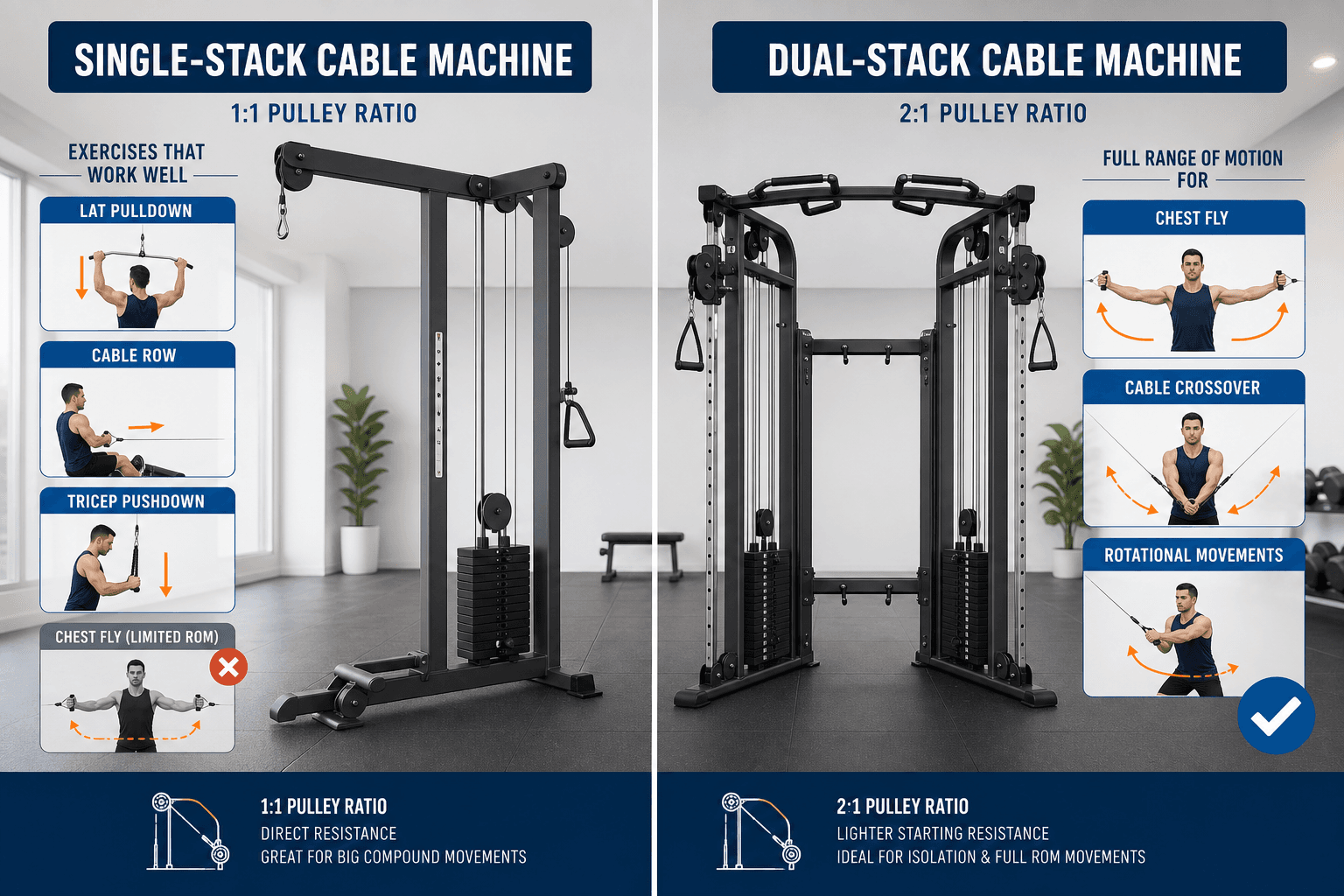
The core problem is the pulley ratio. A 1:1 pulley ratio means the weight you select is the weight you feel. The cable moves exactly as far as the weight stack. Single-stack machines — common in budget home gyms and rack-attached cable systems — use this ratio. They are built for heavy pulling: lat pulldowns, rows, and face pulls with a foot plate to anchor the body. But the limited cable travel makes chest flyes and crossovers nearly impossible.
A 2:1 pulley ratio — found on most dual-stack functional trainers — gives you twice the cable travel for the same pin setting. Pin 100 pounds and you are pulling against 50 pounds of resistance. That tradeoff opens up full range of motion for flyes, cable crossovers, and rotational movements. But you lose the leg roller and foot plate, so heavy pulldowns require a different anchoring strategy (or a lap pad).
Some machines, like the REP ARES 2.0, use a hybrid system: a 2:1 ratio throughout but with a connector bar at the lat pulldown and low row stations that creates a 1:1 ratio for heavy pulling. That is the exception. Most home cables follow one of the two standard configurations.
Know your machine before you start
Before you touch a handle, run the one-foot test: set the pin to 50 pounds, pull the handle one foot toward you, and watch the weight stack. If the stack moves exactly one foot, you have a 1:1 ratio. If it moves six inches, you have a 2:1 ratio. That is all you need to know for this program.
If you want a deeper dive into the mechanics — including how different brands implement these systems — the pulley ratio explainer covers it in detail. For the purposes of this program, you just need your ratio and whether you have a single-stack or dual-stack machine. Rack-attached cable systems are almost always 1:1, though some budget units use a 2:1 reduction to increase cable travel with a lighter stack. The machine's manual or a quick pull test will tell you.
Which exercises work on your machine
The following table maps common cable exercises to three machine types. Green means the exercise works as written. Yellow means it needs a simple adaptation — usually switching to a single-handle or adjusting the pulley height. Red means the movement requires a dual-stack or extra cable travel beyond what a single-stack machine can provide, and you should substitute it with a different exercise.
| Exercise | Single-Stack 1:1 | Dual-Stack 2:1 | Rack-Attached 1:1 |
|---|---|---|---|
| Lat Pulldown | ✅ Green — use lap pad or leg roller | ✅ Green — use lap pad or belt | ✅ Green — use lap pad |
| Seated Row | ✅ Green | ✅ Green | ✅ Green |
| Chest Fly / Crossover | ❌ Red — limited cable travel; substitute Single-Arm Chest Press | ✅ Green | ❌ Red — same limitation |
| Single-Arm Chest Press | ✅ Green — works with D-handle | ✅ Green | ✅ Green |
| Shoulder Press (overhead) | 🟡 Yellow — use low pulley, stand in front; limited ROM | ✅ Green — middle pulley works best | 🟡 Yellow — same as single-stack |
| Lateral Raise | ✅ Green — use low pulley, short ROM | ✅ Green | ✅ Green |
| Face Pull | ✅ Green | ✅ Green | ✅ Green |
| Tricep Pushdown | ✅ Green | ✅ Green | ✅ Green |
| Bicep Curl | ✅ Green | ✅ Green | ✅ Green |
| Pallof Press | ✅ Green | ✅ Green | ✅ Green |
| Cable Pull-Through | ✅ Green — use ankle strap or rope | ✅ Green | ✅ Green |
| Cable Squat / Goblet Squat | ✅ Green — use low pulley, hold handle at chest | ✅ Green | ✅ Green |
| Cable RDL | 🟡 Yellow — use low pulley, stand on platform; stack may limit heavy loading | 🟡 Yellow — same concern | 🟡 Yellow |
| Cable Lunge | ✅ Green — hold handles or use crossover attachment | ✅ Green | ✅ Green |
The yellow exercises are not deal-breakers. For example, shoulder press on a 1:1 machine works if you stand far enough from the pulley to create a straight push — you will just have a shorter range of motion than with dumbbells. Cable RDLs are fine for moderate loads, but if you outgrow the stack you will need to switch to a free-weight alternative. The substitution principle throughout this program is simple: when an exercise is red, replace it with the green alternative listed next to it.
Phase 1: Full body, three days (weeks 1–4)
This phase builds foundational movement patterns and work capacity. All exercises are drawn from the green column, with substitutions noted for single-stack owners. Rest 60–90 seconds between sets for isolation exercises, 90–120 seconds for compound movements like pulldowns and rows.
| Day | Exercise | Sets x Reps | Single-Stack Note |
|---|---|---|---|
| Day 1 | Lat Pulldown | 3 x 10–12 | Use lap pad if available |
| Day 1 | Single-Arm Chest Press | 3 x 10–12 per side | Use D-handle, stabilise core |
| Day 1 | Pallof Press | 3 x 10–12 per side | |
| Day 1 | Tricep Pushdown | 3 x 12–15 | |
| Day 1 | Face Pull | 3 x 15–20 | |
| Day 2 | Seated Row | 3 x 10–12 | |
| Day 2 | Cable Goblet Squat | 3 x 10–12 | Hold handle at chest |
| Day 2 | Lateral Raise | 3 x 12–15 | Low pulley, slight lean |
| Day 2 | Bicep Curl | 3 x 10–12 | |
| Day 2 | Cable Pull-Through | 3 x 12–15 | Use rope or ankle strap |
| Day 3 | Single-Arm Row | 3 x 10–12 per side | |
| Day 3 | Shoulder Press (alternate: Single-Arm Chest Press) | 3 x 10–12 | If press not available, do chest press |
| Day 3 | Cable Lunge | 3 x 10–12 per side | Hold handles at side |
| Day 3 | Face Pull | 3 x 15–20 | |
| Day 3 | Tricep Pushdown | 3 x 12–15 |
Use 1–2 reps in reserve (RIR) on all sets except the last set of each exercise, where you can take it to failure or close to it. If you are on a 1:1 machine, the felt resistance is higher at the same pin setting compared to a 2:1 machine. That means you may need to drop the pin by 5–10 pounds and aim for the upper end of the rep range to start. The goal is to reach 12 reps on the last set before increasing weight.
Phase 2: Upper/lower, four days (weeks 5–8)
After four weeks, your work capacity and technique should allow more volume. This split divides the body into upper and lower sessions, each hit twice per week. Unilateral work increases for single-stack owners — single-arm rows and single-arm chest presses become the primary exercises, since bilateral flyes remain unavailable.
| Day | Exercise | Sets x Reps | Single-Stack Note |
|---|---|---|---|
| Upper 1 | Lat Pulldown | 4 x 8–12 | |
| Upper 1 | Single-Arm Chest Press | 4 x 8–12 per side | Primary press |
| Upper 1 | Cable Laterals | 4 x 10–15 | Leaning away for full stretch |
| Upper 1 | Face Pull | 3 x 15–20 | |
| Upper 1 | Bicep Curl | 3 x 10–12 | |
| Upper 1 | Tricep Pushdown | 3 x 10–12 | |
| Lower 1 | Cable Goblet Squat | 4 x 10–15 | Focus on depth |
| Lower 1 | Cable RDL | 4 x 8–10 | Moderate load; use deficit if possible |
| Lower 1 | Split Stance Lunge | 4 x 8–10 per side | Hold handles at side |
| Lower 1 | Cable Pull-Through | 3 x 12–15 | Rope attachment |
| Upper 2 | Single-Arm Row | 4 x 8–12 per side | |
| Upper 2 | Single-Arm Chest Press (incline if possible) | 4 x 8–12 per side | Change angle |
| Upper 2 | Pallof Press | 3 x 10–12 per side | |
| Upper 2 | Face Pull | 3 x 15–20 | |
| Upper 2 | Bicep Curl | 3 x 10–12 | |
| Upper 2 | Overhead Tricep Extension (single arm) | 3 x 10–12 per side | |
| Lower 2 | Cable Squat | 4 x 10–15 | Same as Goblet Squat |
| Lower 2 | Cable RDL | 4 x 8–10 | |
| Lower 2 | Walking Lunge (cable) | 3 x 8–10 per side | Use two handles |
| Lower 2 | Hip Adduction / Abduction (if attachment available) | 3 x 12–15 each | Ankle strap |
Progress by increasing weight when you can hit the top of the rep range on all sets. On a 2:1 machine, a 5-pound jump on the pin is only 2.5 pounds of felt resistance — that is a small enough increment to keep progression steady. On a 1:1 machine, a 5-pound jump is a full 5 pounds felt, so you may need to use fractional plates or tempo adjustments instead.
Phase 3: Push-pull-legs, six days (weeks 9–12)
This phase maximizes volume and specialization. Each muscle group is trained twice per week with higher set counts. The push-pull-legs split allows you to focus on movement patterns rather than body parts, and the cable machine's constant tension becomes a real advantage for high-rep pumping sets.
| Day | Exercise | Sets x Reps | Single-Stack Note |
|---|---|---|---|
| Push | Shoulder Press (or Single-Arm Chest Press) | 4 x 6–8 | If press limited, use chest press |
| Push | Single-Arm Chest Press | 3 x 10–12 per side | Use slight incline if possible |
| Push | Lateral Raise | 4 x 12–15 | Leaning away |
| Push | Tricep Pushdown | 4 x 8–10 | |
| Pull | Lat Pulldown | 4 x 6–8 | Wide grip |
| Pull | Single-Arm Row | 4 x 8–10 per side | |
| Pull | Face Pull | 3 x 15–20 | |
| Pull | Bicep Curl | 4 x 8–10 | |
| Legs | Cable Squat | 4 x 10–15 | |
| Legs | Cable RDL | 4 x 8–10 | Moderate load |
| Legs | Split Stance Lunge | 3 x 8–10 per side | |
| Legs | Cable Pull-Through | 3 x 12–15 |
The volume here is significant — roughly 16 working sets per major muscle group per week. On a single-stack machine, you will rely heavily on unilateral work to get the volume in. If the stack starts feeling too light on a particular exercise, do not rush to increase the pin. You have other tools.
When you hit the stack ceiling
Maxing out the weight stack is a real concern, especially on lighter stacks like the common 150-pound setups. When you can do 12+ reps on the highest setting with good form, adding more weight is off the table. That is where progression methods beyond the pin come in.
- Slow the eccentric to 3 seconds. A single rep takes longer under tension, and the time under load increases without adding a pound. This works especially well on pulldowns, rows, and tricep pushdowns.
- Add unilateral work. If bilateral lifts max out, switch to single-arm or single-leg variations. You double the volume per side and often can handle slightly more relative load.
- Use paused reps. Pause for 2 seconds at the peak contraction. This reduces momentum and forces the muscle to work harder without changing the pin.
- Try rest-pause sets. Take the last set to failure, rest 15 seconds, then continue for 3–5 more reps. Repeat once or twice. This is brutal but effective.
- Magnetic micro-loading plates. A 2.5-pound or 5-pound magnet plate attaches directly to the weight stack, giving you fractional increments that a pin cannot provide. This is the closest thing to adding weight when the stack is maxed.
For a practical example of how these strategies work on a specific machine with a 150-pound stack, the Marcy MWM-990 workout plans show creative progression in action. The principles transfer to any stack-limited cable machine.
What cables still can't do well
Cables are excellent for hypertrophy, constant tension, and joint-friendly movement. But I will not pretend they replace free weights for everything.
Eccentric overload is weaker on cables. Free weights let you lower a heavier load through the negative portion of a lift — cables cannot replicate that easily, because the stack only provides the selected resistance throughout the full range. You can slow down the eccentric, but you cannot overload it past the pin setting. For maximal strength development, heavy barbell work still has an edge.
Lower-body training with cables also requires more creativity. Squats and RDLs work, but the load ceiling is lower than what a barbell or leg press offers. If your primary goal is maximum strength in the squat or deadlift, a cable-only program will leave you short. For general fitness, hypertrophy, and endurance, the gap is small.
The honest conclusion: cables are a complete training tool for most home gym owners. They are not a universal replacement for free weights, but the phases above are designed to work within the machine's strengths and accept its limits with substitutions.
One machine, three phases, twelve weeks
The program is modular. You can repeat Phase 1 if you are not ready to advance, extend Phase 2 to 8 weeks, or jump straight to Phase 3 if you have training history. The compatibility table is your reference for any exercise substitution – bookmark it.
Here is a quick checklist to get started:
- Test your pulley ratio using the one-foot pull test.
- Identify which exercises from the table are green, yellow, or red for your machine.
- Start with Phase 1, focusing on form and 1–2 RIR.
- Increase weight or use tempo adjustments when you hit the top of the rep range.
- When the stack runs out, use the progression methods above rather than giving up.
That is the plan. Print the tables, check your pulley, and get to work.


Comments
Join the discussion with an anonymous comment.