
The smart home gym system you’re considering maxes out at 250 pounds. That number looks respectable on a spec sheet. But if your deadlift is already 300 pounds—or you want it to be—that cap isn’t a limitation. It’s a wall.
It’s 2026, and the global smart home gym equipment market is growing at a 5.1% CAGR according to GM Insights, estimated at $3.77 billion in 2023. Smart systems are no longer a niche curiosity. But when the question is “which builds muscle better?”, the marketing language around “adaptive weight” and “AI coaching” glosses over a concrete number: how much resistance can the machine actually produce? That number—220 or 250 pounds for most systems—is the single most important detail for anyone who plans to train for more than a year.
The Real Limit: 250 Pounds
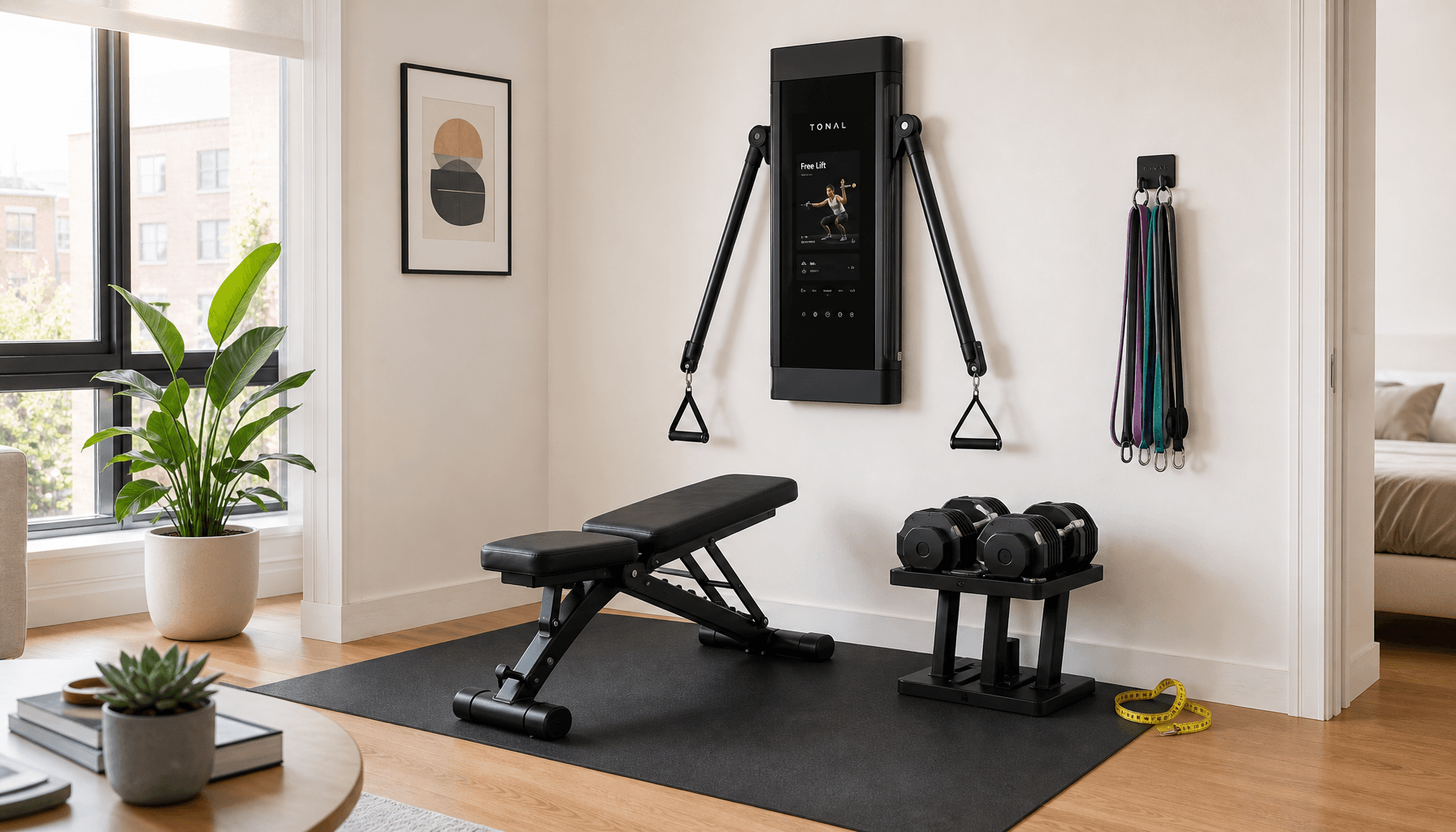
Smart home gyms use electromagnets or motors to create resistance. You select a load on a screen, and the machine applies that tension to cables or arms. The resistance is smooth, quiet, and can be adjusted in small increments between reps—something a barbell cannot do without changing plates. But the key detail is that each machine has a hard cap: Tonal 2 delivers up to 250 pounds of total digital resistance, and Speediance Gym Monster 2 offers 220 pounds. That cap applies to the movement you’re performing—not a stack you can pile on. For a cable row or a lat pulldown, 250 pounds is more than enough for most people. For a deadlift or a squat, it’s a ceiling that intermediate lifters will hit within months.
Take a concrete scenario. A man who weighs 185 pounds and has been training consistently for two years might deadlift 315 pounds for a working set of five reps. That’s common, not exceptional. On a Tonal 2, he cannot even set 315 pounds—the machine stops at 250. He could do higher reps with less weight, but the mechanical tension that drives hypertrophy is highest at heavy loads. Spending months under 80% of a 250-pound cap means his lower back and legs are simply not getting the stimulus they need to grow further.
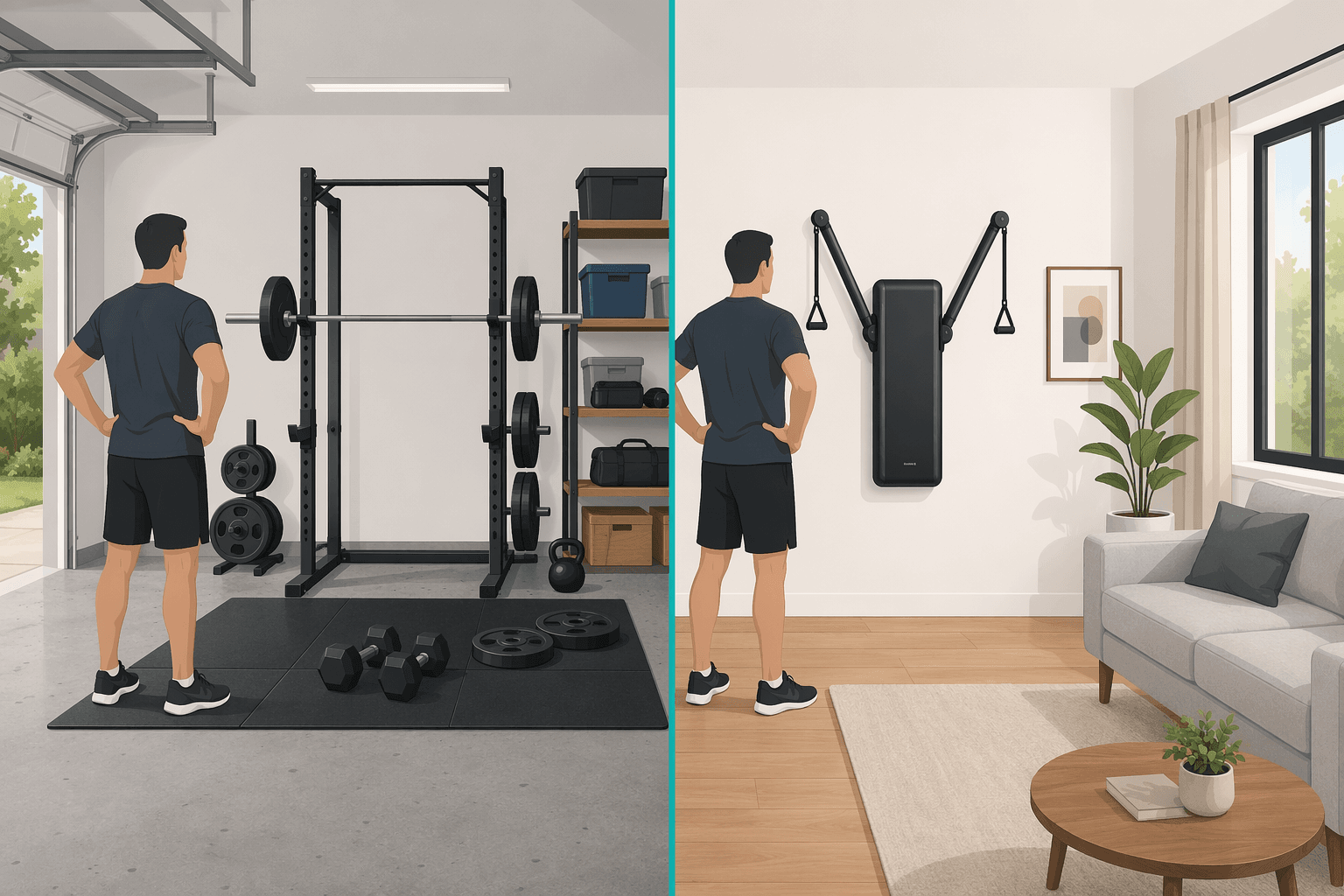
Traditional free weights have no such cap. A barbell can hold 500, 600, or 800 pounds. The only limit is the rack’s weight capacity and your floor’s ability to handle dropped plates. That difference is not academic.
Why the Ceiling Matters for Progressive Overload
The principle of progressive overload is simple: to keep gaining muscle, you must consistently increase the demand on your muscles. The most straightforward way is to add weight to the bar. A smart home gym system lets you add weight in small increments—as little as one pound—which is excellent for fine-tuning. But it can only add weight up to its ceiling. After that, your only option is to increase reps or reduce rest times, both of which have diminishing returns.
Traditional free weights allow infinite increments. You can add 5 pounds to a squat for years, decade after decade. The system never tells you “max load reached.” The progressive overload is fundamentally unlimited. Smart systems also offer software-based progression: the AI might adjust weights session to session, or suggest new rep schemes. That coaching aids consistency, but it cannot conjure more resistance than the hardware can produce.
- If your working sets are under 200 pounds, a smart gym can take you through many months of linear progression.
- If your working sets are between 200 and 250 pounds, you are close to the ceiling—progress will slow and may stall.
- If your working sets exceed 250 pounds, smart gyms cannot support the load needed for continued strength gains.
Men’s Health Fitness Director Ebenezer Samuel, C.S.C.S., uses a smart home gym as a complement: “I do one or two exercises on it per session.” He doesn’t rely on it for his core lifts. That tells you something.
What About Exercise Variety?
Free weights require your stabilizer muscles to work constantly. A dumbbell bench press demands balance and coordination; a barbell squat forces you to brace, control the bar path, and engage your core. Smart gyms, with their fixed cable paths and guided arms, offload much of that stabilization. That’s great for isolating a target muscle and reducing injury risk for beginners. But it means you are not training the same movement pattern.
For advanced muscle development, different angles and grips matter. You can do a floor press, a Z-press, a one-arm dumbbell row, or a wide-grip pull-up—each changes the stimulus. Smart gyms offer dozens of exercises, but they are all variations of a cable or lever movement. The freedom of free weights is not just about load; it’s about the variety of movement vectors. Samuel again: he uses his smart gym for “finishing movements,” not for building his foundational strength. That’s a clear signal that the system is a tool, not the whole solution.
Cost and Space: Useful but Not Deciding
Smart systems win on space. Tonal 2 requires a 7-foot wall clearance and mounts flush; Speediance is freestanding and folds flat. A traditional barbell setup with a rack and plates needs about 20 square feet of floor space plus headroom. If you live in a studio apartment, the decision may be made before you even consider loads.
Cost is more nuanced. Tonal 2 costs $4,295 plus a $59.95 monthly subscription (minimum 12 months). Over five years, that’s $4,295 + $3,597 = roughly $7,892. A premium traditional setup—say, a Rogue rack, barbell, plates, and a pair of adjustable dumbbells—can be had for $2,500 to $4,000 with zero recurring fees. The smart gym is more expensive over time, but it also includes coaching, classes, and data tracking. For the beginner who needs structure, that subscription may save a personal trainer fee.
| Approach | Upfront cost | Ongoing cost | 5-year total (est.) |
|---|---|---|---|
| Tonal 2 | $4,295 | $59.95/mo | ~$7,900 |
| Traditional free weights | $2,500–$4,000 | $0 | $2,500–$4,000 |
| Speediance (basic use) | $3,199 | $0 (optional AI $24.90/mo) | $3,199 (or ~$4,800 with AI) |
But again: these are supporting factors. If your training goals demand loads above 250 pounds, cost and space are irrelevant—you need the barbell.
Who Should Buy What (and When)
Translate the numbers and trade-offs into a simple decision rule based on your current working set weight—not your one-rep max, but the weight you can move for 5–8 reps.
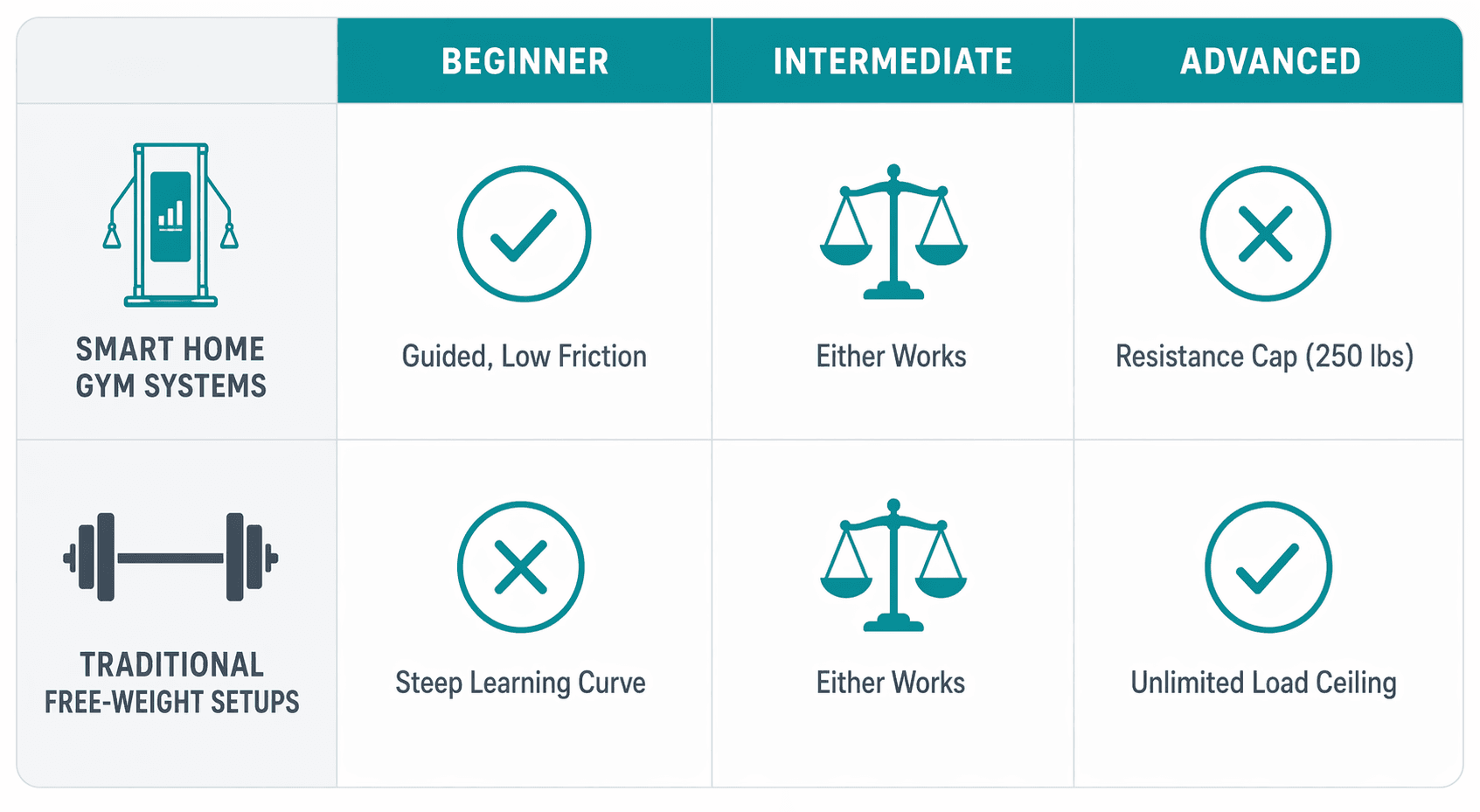
- Working sets under 200 lbs: A smart home gym system is viable and likely effective. You have room to progress, and the guided coaching will accelerate your learning curve.
- Working sets 200–250 lbs: Either approach works, but you’re near the ceiling. Consider hybrid: use the smart gym for isolation work and accessory lifts, but invest in a barbell and a simple rack for your heavy compounds.
- Working sets over 250 lbs: Traditional free weights are mandatory. A smart gym cannot provide the load needed for continued muscle growth in the lifts that drive overall mass.
The Hybrid Path: Smart Apps, No Hardware Lock-In
If you want the coaching and data tracking of a smart system but don’t want to be stuck at a 250-pound ceiling, there’s a third path: use a smart fitness app with traditional free weights. Apps like Shred ($9.99 per month) provide AI-driven periodization, video form tips, and training logs. You pair them with a basic barbell and dumbbell setup that can hold any weight.
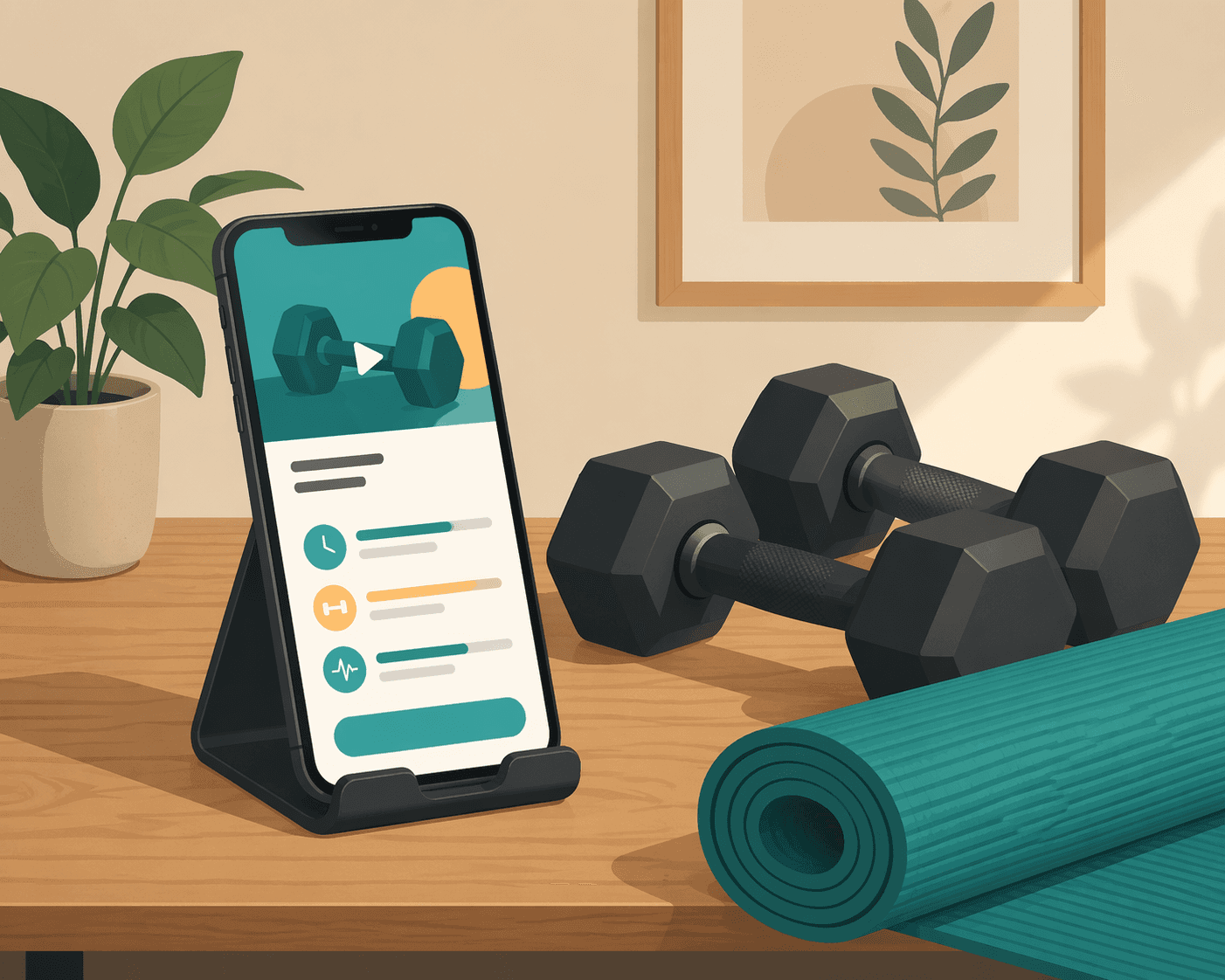
This hybrid approach solves the core tension. You get the guided programming and data tracking that make smart gyms appealing, but you keep the unlimited load ceiling of free weights. Your deadlift can keep climbing past 300 pounds because the app doesn’t cap you—only your rack does. Samuel’s approach of using a smart gym as a “complement” works in both directions: you can complement free weights with a smart app.
The hybrid is not free; the app costs $9.99–$15 per month, and you need to invest in equipment. But the total cost over five years is still lower than a premium smart gym subscription, and you remove the load ceiling entirely. For the intermediate lifter who is on the fence, this may be the most honest answer.
The market is growing, smart systems are getting better, and future models may raise the cap. But in 2026, the physics is still the physics. Buy the tool that matches the load you actually need.
Comments
Join the discussion with an anonymous comment.