
Build a Compact Home Gym Setup Around Your Training Goal
Choosing compact home gym equipment starts with knowing how you actually train. This guide breaks down the minimal equipment sets for strength, cardio, bodyweight, and hybrid goals, so you buy only what you'll use.
Items included: —
The fastest way to waste money on a compact home gym is to start with the equipment category before you decide what kind of training the room has to support. A folding rack, a rower, a cable trainer, a smart gym, a suspension trainer, and adjustable dumbbells can all be the “right” answer in a small space. They are not right for the same person.
Use this order: choose your primary training goal, filter by space and budget, then compare products. If you are brand new and do not yet know whether you like lifting, conditioning, bodyweight work, or coached variety, start with Home Gym Equipment for Beginners: A Decision Framework first. This guide works best once you have at least a loose training preference.
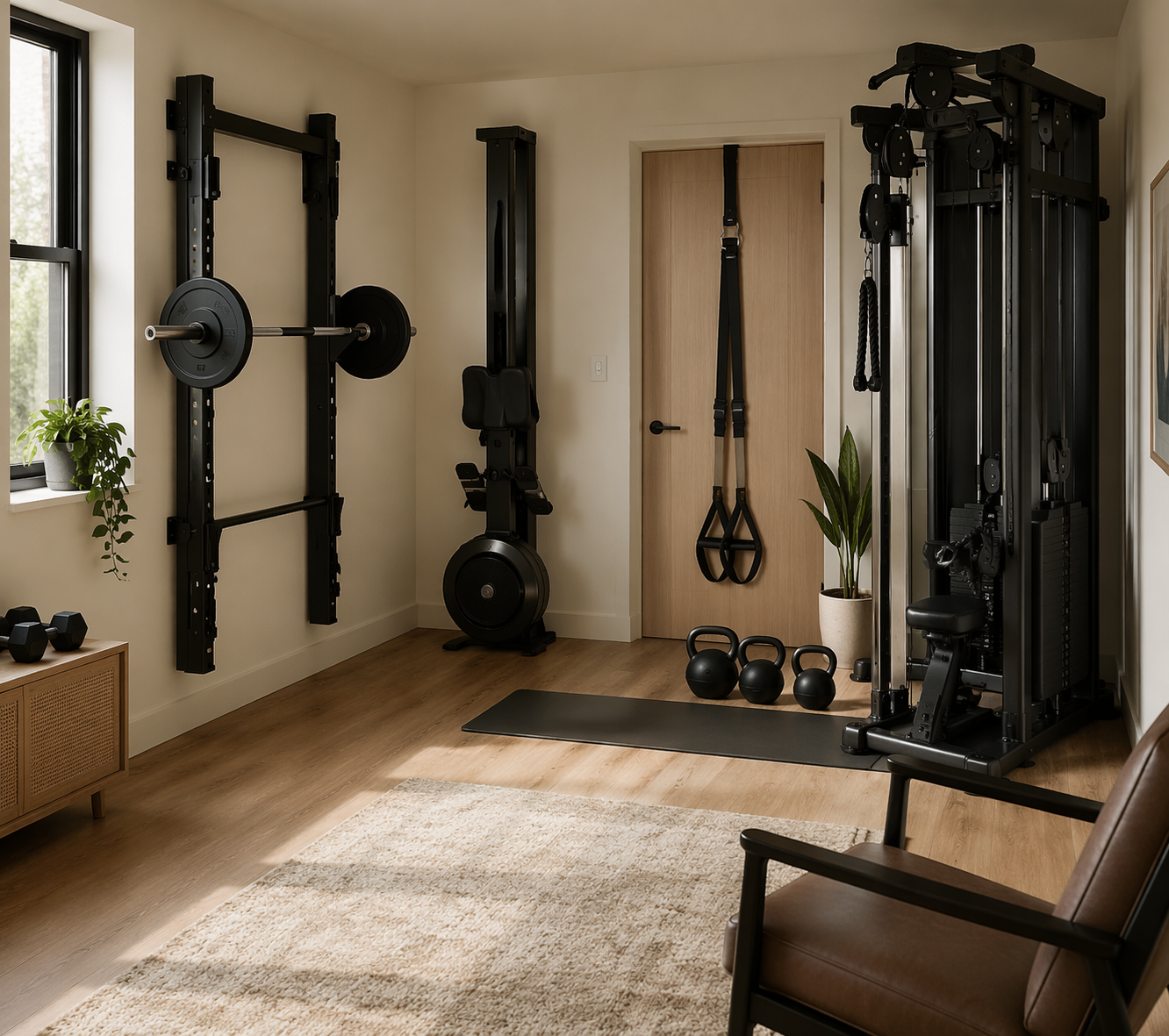
Start With the Minimum Setup for Your Goal
A compact home gym should start smaller than most shopping lists. The first version only needs to make your main training repeatable and able to progress. Everything else can wait until it proves it deserves floor space.
| Primary goal | Minimum viable setup | What it supports | Where it stores well | Progression path | What it does not solve | Read next |
|---|---|---|---|---|---|---|
| Strength-first | Folding rack or squat stand, barbell, plates, bench, flooring | Squats, presses, pulls, deadlifts, long-term progressive overload | Garage wall, spare room wall, basement wall, or a room where folded depth matters | Add plates, specialty bars, dumbbells, cable attachments, better bench | Usually needs permanent wall or floor planning; not ideal for quiet apartments | Home Gym Flooring for Small Spaces and Apartments |
| Cardio-first | Compact rower, bike, or other single-purpose cardio machine | Repeatable conditioning with low setup friction | Against a wall, behind a door, or upright if the machine supports it | Longer intervals, harder pacing, heart-rate structure, strength accessories later | Does not build heavy strength by itself | Compact Home Gym by Space Tier |
| Bodyweight/minimal | Suspension trainer, resistance bands, adjustable kettlebell | Bodyweight strength, mobility, conditioning, travel-friendly training | Closet shelf, under-bed bin, door anchor, small corner | Harder leverage, heavier kettlebell work, more band tension, later dumbbells | Bands and light implements eventually cap heavy lower-body strength | Home Gym Workout Plan by Equipment Tier |
| Hybrid | All-in-one trainer, compact cable trainer, smart gym, or modular rack-plus-cables setup | Exercise variety, strength plus accessories, guided or cable-based training | Dedicated wall, compact room, garage bay, or apartment wall depending on model | Add plates, attachments, programming, or move toward barbell work | Headline price may omit plates, accessories, subscriptions, or resistance limits | All-in-One Home Gym vs. Separate Equipment: 5-Year Total Cost of Ownership |
If your space or budget is the real bottleneck, it is fine to reverse the order temporarily. A renter with one wall and downstairs neighbors may need Compact Home Gym in an Apartment: Renters Guide before choosing gear. Someone fitting equipment into a laundry room may need Choose Home Gym Equipment Based on Your Room Type. Just do not let a space-saving product talk you into a training style you will not repeat.
Strength-First: Compact Does Not Have to Mean Light
For a strength-first compact home gym, the main question is whether you want barbell progression or “good enough” resistance training. Those are different lanes. A rack, barbell, bench, plates, and proper flooring take more planning, but they keep the ceiling high. Adjustable dumbbells, kettlebells, and bands are easier to store, but they usually hit a progression wall sooner.
This is where folding racks earn their keep. The PRx Profile PRO folding rack is listed with a folded depth of 6.75 inches and a 1,000-pound capacity, which means a small room can still support barbell training instead of becoming a room-sized compromise.[1] That number matters more than a long exercise menu. Folded depth tells you whether the rack can stop being a household argument when training is over.
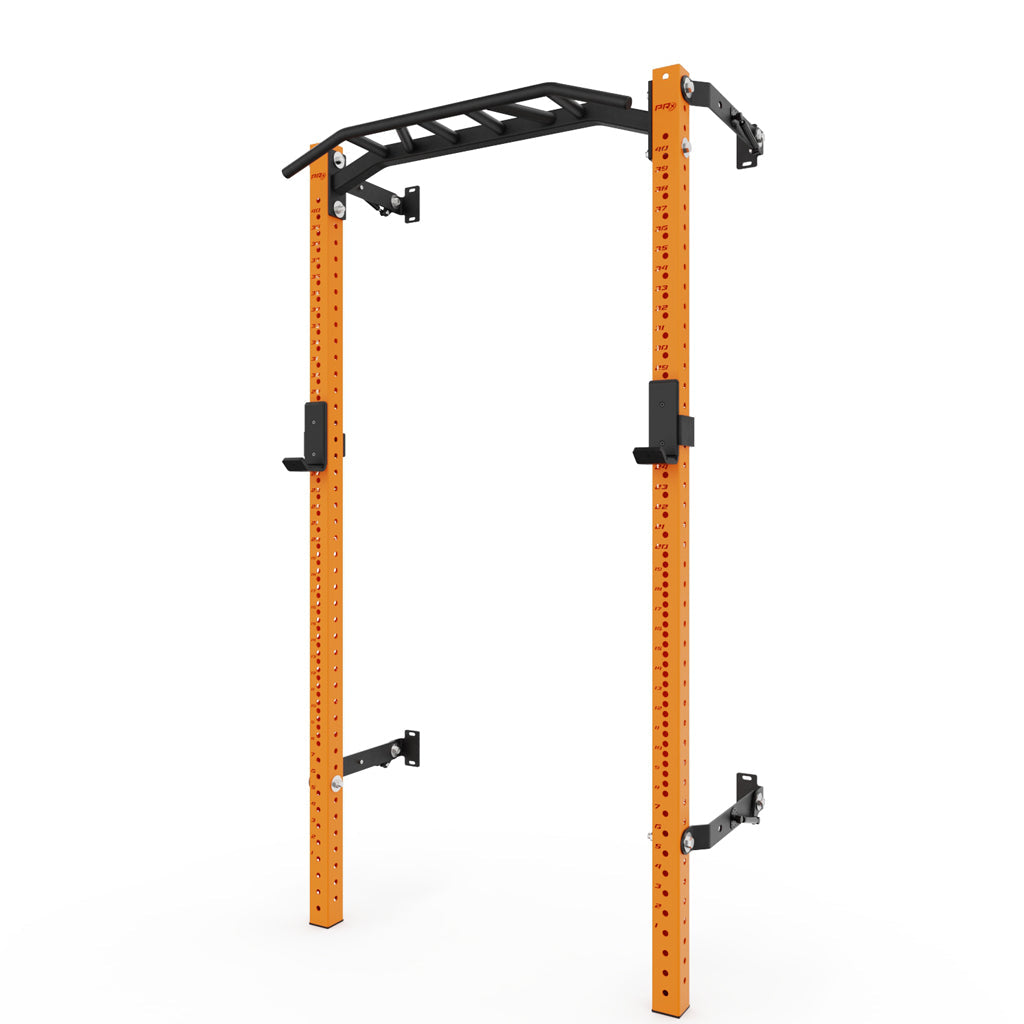
The catch is that a folding rack does not make the rest of barbell training disappear. You still need room to load plates, walk a bar out safely, set a bench, store plates, and protect the floor. For any setup involving loaded weights, Home Gym Flooring for Small Spaces and Apartments belongs in the plan before the first heavy deadlift, not after the first complaint.
Choose the rack-and-barbell path if your main goal is to increase squat, deadlift, press, bench, and row strength over years. Choose dumbbells or kettlebells first if your strength goal is general fitness, apartment-friendly training, or learning movement patterns without committing a wall and a plate tree. That is not a downgrade; it is a different ceiling.
A dumbbell-centric strength setup can be very good in a small room: adjustable dumbbells, an adjustable bench, a mat, and maybe bands for assistance work. It is also the better answer for many renters. The tradeoff shows up later, when leg training needs heavier loading than the handles or your storage tolerance can provide. If that is the route you choose, pair it with a real program such as Full Body Dumbbell Workout for Apartment Dwellers instead of collecting random exercises.
Cardio-First: Buy the Machine You Will Leave Ready
A cardio-first compact gym should minimize setup friction. If the machine has to be dragged out, unfolded, paired, adjusted, and negotiated around furniture every session, it will quietly lose to the couch.
A rower is often the cleanest cardio-per-square-foot answer because one machine trains hard conditioning without needing running space. The Concept2 RowErg weighs 57 pounds, stores upright, and received a 5-out-of-5 footprint and portability score with a 4.6-out-of-5 overall rating in Garage Gym Reviews testing.[1] Those are practical numbers: light enough for many people to move, tall enough to store vertically, and proven enough that you are not betting the whole room on a novelty machine.
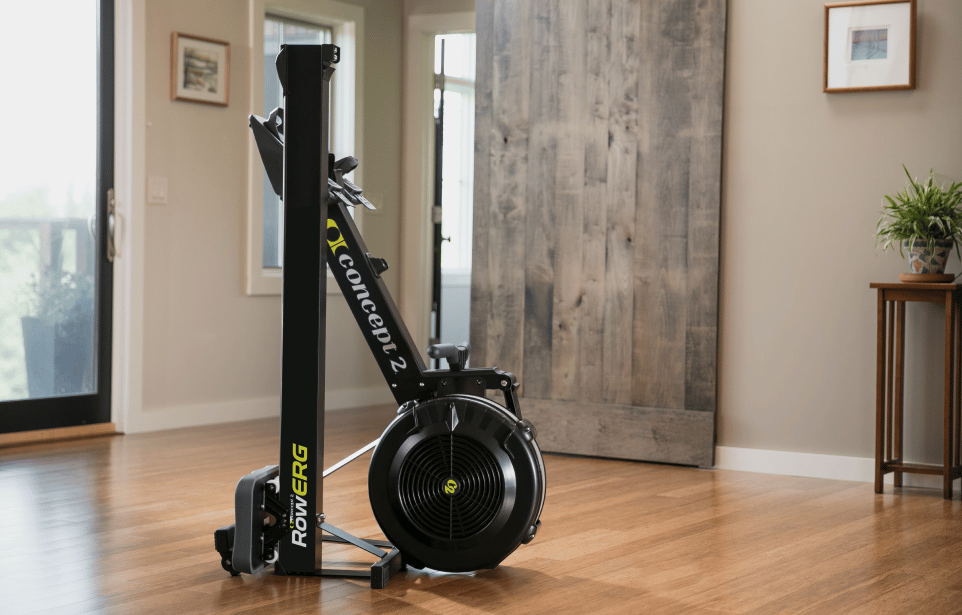
A rower does not solve strength training. It gives you conditioning, repeatable pacing, and a compact storage story. If you also want strength, add a small strength layer later: kettlebell, adjustable dumbbells, bands, or a suspension trainer. Do not buy a large hybrid machine just because you feel guilty that cardio is “only one thing.” One thing done four times a week beats five functions you avoid.
Bodyweight and Minimal: Small Gear Can Be Serious, Until It Is Asked to Be Something Else
The leanest useful setup is a suspension trainer, resistance bands, and an adjustable kettlebell. A quality band set can start around $129, and an adjustable kettlebell such as a PowerBlock model can reach 62 pounds at roughly $199 to $299, putting the trio under about $500 before optional mats or anchors.[1] Stored well, it can fit in a closet, a bin, or the corner that used to hold shoes.
This setup covers rows, presses, split squats, hinges, loaded carries, swings, core work, mobility, and conditioning. It is especially good for people who want low visual impact at home and do not want equipment to define the room.
The honest limitation is heavy progression. Bands can make exercises harder, but tension is uneven and budget sets commonly top out in a finite resistance range. They are not a permanent substitute for a barbell if your goal becomes heavy squats, deadlifts, or loaded lower-body strength. Treat this setup as a strong minimalist lane, not a magic replacement for every other gym category.
Hybrid: Versatility Is Useful Only After You Price the Whole System
Hybrid buyers have the hardest decision because all-in-one trainers and smart gyms look like the obvious compact answer. Sometimes they are. If you want cables, guided variety, accessories, and a clean wall-facing setup, a hybrid machine can make a small room feel more capable than a pile of separate gear.
The mistake is comparing the headline price instead of the usable price. All-in-one trainers such as Bells of Steel models may sit around $1,300 to $1,900, but plate-loaded systems can require another $300 to $800 in plates that are not included in the visible starting price.[2] That does not make them bad. It means the real comparison is machine plus plates plus attachments plus floor space, not just the frame.
Smart gyms move the tradeoff somewhere else. Tonal 2 is listed at $4,295, with $495 accessories and a $59.95 monthly membership, while Speediance Gym Monster is listed at $3,199 with a bench and attachments included and no required subscription.[3][4] Those differences matter if the machine is partly replacing coaching, programming, and exercise selection. They matter even more if the subscription is the thing that keeps the product useful.
Resistance ceilings are the fit test for stronger lifters. Smart gyms commonly sit in the 220-to-250-pound resistance range, which can be enough for many intermediate users but insufficient for advanced compound lifts.[3] This is not a moral flaw in digital resistance. It is a boundary. If your goal is heavy barbell progression, a smart gym may become an accessory machine. If your goal is coached full-body training, cables, variety, and low floor disruption, it may be the cleanest answer in the room.
Before choosing a hybrid machine, read Home Gym Decision Guide: Which Type of Gym Machine Actually Fits Your Training Style? for the training-style question, then use All-in-One Home Gym vs. Separate Equipment: 5-Year Total Cost of Ownership if the price looks close. If smart gyms are still on the shortlist, move to the Smart Home Gym Comparison Guide 2026 rather than trying to settle model details here.
Use Space, Budget, Noise, and Storage as Filters
Once the goal lane is clear, the secondary filters get much easier. They are not small details; they are the difference between equipment that lives peacefully in the home and equipment that has to be moved before dinner.
- Space: Measure the stored footprint and the training footprint. A rack folded to the wall still needs open space when loaded; a rower stored upright still needs full rail length during workouts.
- Budget: Price the complete setup, including plates, flooring, collars, bench, handles, anchors, delivery, installation, subscriptions, and replacement parts.
- Noise: Cable stacks, dropped weights, rowing, jumping, and kettlebell work create different kinds of sound. Apartment setups need a noise plan before they need more attachments.
- Storage: If the equipment blocks a closet, hallway, laundry zone, or guest-room function, it will become a household problem even if it technically fits.
If constraints are now doing most of the deciding, use Compact Home Gym by Space Tier for square-foot tradeoffs, Home Fitness Budget Tiers for cost boundaries, and How to Choose a Compact Home Gym That Works for Your Space, Budget, and Noise Tolerance when the decision is more about the room than the workout.
Upgrade Paths After the First Setup
Upgrades make sense only after the starter setup has proven it gets used. A compact home gym should earn expansion, especially in shared rooms.
| Goal lane | Around 6 months | Around 12 months | Around 24 months |
|---|---|---|---|
| Strength-first | Add plates, a better bench, or flooring if those are limiting training | Add adjustable dumbbells, cable attachment, or specialty bar based on weak points | Expand storage, add heavier plates, or move toward a more permanent rack zone |
| Cardio-first | Add a mat, heart-rate tracking, or basic strength accessory | Add kettlebell or dumbbells for strength balance | Add a second modality only if the first machine is still used consistently |
| Bodyweight/minimal | Add heavier kettlebell options or better anchors | Add adjustable dumbbells or a bench if strength work is now central | Move to rack, cables, or hybrid machine only if the goal has changed |
| Hybrid | Add missing handles, ankle straps, mat, or plates after real program needs appear | Add plate storage, bench upgrade, or app/programming support | Decide whether to deepen the system or split into separate strength and cardio equipment |
If you want a staged buying plan after choosing your lane, use How to Build a Compact Home Gym in 3 Phases. A phased plan is useful because it delays the gear that people often buy out of anxiety: extra handles, duplicate bands, specialty bars, and machines that solve a problem the training has not created yet.
Make Sure the Setup Matches a Program
The equipment list is not finished until it can support a real training plan. Progressive overload needs some way to increase load, reps, range of motion, density, difficulty, or skill over time. Barbell and plate setups have the cleanest load progression because adding plates is straightforward. Dumbbells and kettlebells progress well until the available jumps or maximum weight become the bottleneck. Bands and smart gyms can be excellent inside their resistance limits, but they should not be treated as limitless just because the software or exercise library is large.
Once your compact home gym category is chosen, move from shopping into programming. Use Home Gym Workout Plan by Equipment Tier if you need a plan matched to what you own. Strength and hybrid users who want coaching structure can also compare Best Strength Training Apps for Limited-Equipment Home Gyms.
Your shortlist should now be a category, not a shopping cart: folding rack and barbell for long-term strength, rower or single cardio machine for conditioning, suspension trainer plus bands plus kettlebell for minimalist training, or an all-in-one or smart system for compact variety. After that, product comparisons can do their actual job.
References
- Expert-Tested: The Best Compact Exercise Equipment (2026), Garage Gym Reviews
- Best Home Gyms (2026) Personally Tested, Garage Gym Reviews
- Best Home Gyms of 2026 (Personally Tested), BarBend
- Best Smart Home Gyms for 2026, CNET
Some links on this page are affiliate links — they may earn us a commission at no extra cost to you. Our tier and tests are decided before we ever check which links pay; see our full affiliate disclosure.
Spot something off?
Noise and floor-damage claims carry real deposit-risk consequences if we get them wrong — tell us if your experience with this build didn't match what's above.