
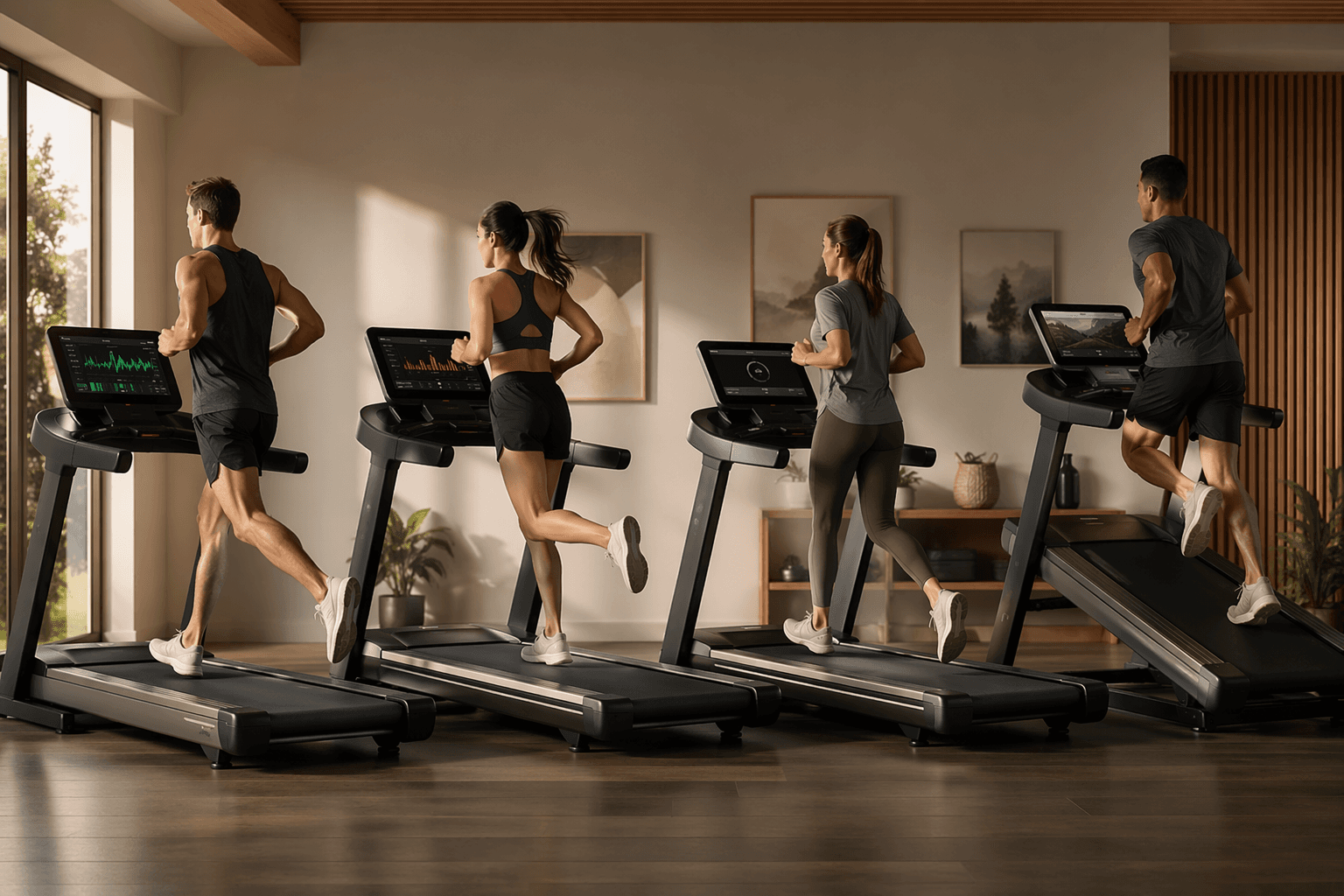
The best home treadmill for running is not the one with the flashiest screen or the longest feature list. It is the one that can repeat the kind of running you actually do: steady weekly mileage, fast interval changes, easy 5K prep, or steep climbing. That distinction matters because the same treadmill that feels sensible for a casual jogger can become the wrong machine for a runner logging 20-plus miles a week, and the same premium deck that works for marathon training may still disappoint someone buying mainly for hill work.
| Runner type | Best shortlist | What matters most | Main caution |
|---|---|---|---|
| Marathon or high-mileage runner | NordicTrack Commercial 1750; Sole F80 | Motor endurance, 60-inch deck, warranty confidence, subscription preference | Do not treat a guided platform and a durable subscription-free platform as the same purchase |
| HIIT or speedwork runner | Horizon 7.0 AT; Horizon 7.8 AT; Bowflex T6 as a secondary option | Fast speed response, quick controls, 60-inch deck, stable interval feel | A slow console can ruin the workout even if the top speed looks fine |
| Casual jogger or 5K runner | Horizon T101; NordicTrack T Series 10; Sole F63 | Reasonable price, enough motor for light running, usable deck length | Value models stop being value if weekly mileage climbs |
| Incline or hill-training runner | NordicTrack X24; NordicTrack Commercial 1750 | Grade range, decline capability, climbing specificity | Ordinary 12% to 15% incline is not the same category as 40% |
For High Mileage, Start With the Deck and Motor
For marathon training or any runner around 20-plus miles per week, the NordicTrack Commercial 1750 and Sole F80 are the two machines that deserve the closest look. Runner’s World names the Commercial 1750 its best overall treadmill, while Garage Gym Reviews names it the best treadmill for home overall with a 4.4 out of 5 rating; the current spec set includes a 4.25 CHP motor, a 60-inch deck, and a -3% to 12% incline and decline range with iFIT integration.[1][2] Those numbers are not decoration. A 60-inch belt gives longer-stride runners room to open up, and the motor rating matters more when the treadmill is asked to absorb repeated weekday runs rather than an occasional walk.

The Sole F80 is the cleaner answer for the runner who wants a sturdy running platform without building the purchase around a subscription. Its Q2 2026 price range is listed around $1,599 to $1,899, with a 3.5 CHP motor, a 60-inch deck, Sole’s Cushion Flex Whisper Deck, and lifetime frame and motor warranty coverage.[1][2] Sole’s often-repeated 40% impact-reduction claim for that deck should be read carefully: it is a manufacturer claim that review sites repeat, not an independently audited lab conclusion in the available material. Still, the broader buying logic is sound. If you mainly want reliable miles and do not care whether a coach is calling the next hill, the F80 is not a “cheaper 1750.” It is a different kind of treadmill.
This is also where warranty becomes more than fine print. Garage Gym Reviews reports expert estimates that treadmill motors may need replacement after roughly 7 to 12 years, with the actual interval varying heavily by use and maintenance.[2] That estimate is not a promise, but it explains why a lifetime frame and motor warranty on Sole, Horizon, and Bowflex models carries real weight for runners who plan to use the machine often. For a deeper way to sort mileage, space, and subscription tolerance together, use the three-constraint framework alongside this runner-type view.
HIIT Runners Should Care About Speed Changes, Not Just Top Speed
Interval runners are easy to underserve because treadmill spec sheets make top speed visible and speed response harder to judge. For HIIT, the treadmill has to move quickly between work and recovery without turning every interval into button tapping and waiting. Garage Gym Reviews specifically highlights the Horizon 7.0 AT and 7.8 AT for speed changes that feel “instantly” responsive, crediting Horizon’s quick-dial controls and fast motor response.[2]
The Horizon 7.0 AT is the practical first stop for many speedwork runners: around $1,099 on sale in Q2 2026, with a 3.0 CHP motor, 60-inch deck, and 15% incline.[2] The Horizon 7.8 AT is the stronger pick if intervals are the point of the purchase rather than an occasional workout type, because its appeal is not a luxury console but the way the machine responds when pace changes are frequent. The Bowflex T6, listed around $999 on sale with a 3.0 CHP motor, 60-inch deck, and 15% incline, belongs in the secondary conversation for shoppers comparing subscription-optional machines.[2]
A runner doing short repeats has a different failure point from a runner doing long aerobic work. If the treadmill lags, the hard segment shrinks; if the controls are clumsy, the recovery gets messy; if the belt feels cramped, fast mechanics get cautious. That is why Horizon’s controls deserve more attention here than a streaming screen. Runners who already know they want to avoid mandatory monthly content should also compare these models against other subscription-free running treadmills before paying for a guided ecosystem they may not use.
Casual Joggers Can Save Money, But Not Without a Mileage Limit
Casual jogging and 5K training do not demand the same machine as marathon prep. The Horizon T101 is the obvious example of a value treadmill that can make sense for lighter use: Runner’s World calls it a best value pick, while Garage Gym Reviews is more cautious, saying it is “not a good treadmill for someone looking to do lots of running.” Its Q2 2026 price range is roughly $649 to $829, with a 2.5 CHP motor and a 55-inch deck.[1][2] That combination is reasonable for easy jogging, walking, and entry-level consistency; it is not the machine I would steer toward a runner planning serious weekly mileage.
The NordicTrack T Series 10 sits in the same lighter-running conversation, especially for shoppers who like guided workouts and do not need the more robust Commercial 1750. The Sole F63 is the safer value step-up for actual running under $1,500, with a listed price around $1,199, a 3.0 CHP motor, a 60-inch deck, and lifetime frame and motor warranty coverage.[1][2] Shape’s 2026 budget treadmill testing also gives shoppers another budget-oriented reference point with models such as the Sunny Health & Fitness Active 400, but budget testing should not be confused with high-mileage suitability.[3]
This is the category where overbuying and underbuying both happen. If you jog a few times a week and mostly want consistency through bad weather, a lower-cost model may be the right restraint. If you are already nudging toward longer runs, faster workouts, or heavier shared household use, the extra money for a stronger motor, longer deck, and better warranty stops being a splurge. Runners balancing this choice with apartment or spare-room limits should check the small-space treadmill guide before assuming compact automatically means runner-ready.
Incline Training Is Its Own Purchase
Incline shoppers should separate ordinary hill settings from real climbing range. The NordicTrack X24 is the standout because its 40% incline is described by TreadmillReviews.net as more than triple the maximum incline of any other home treadmill, making it the clear specialist for trail-race preparation and low-impact, high-intensity climbing work.[4] If steep uphill training is the reason you are buying, that single spec changes the shortlist more than screen size, folding design, or brand preference.
The NordicTrack Commercial 1750 still belongs in the incline conversation, but for a different runner. Its -3% decline is useful for road racers who care about downhill eccentric loading, while its 12% maximum incline is enough for ordinary hill sessions but not a substitute for the X24’s climbing profile.[1][2] Anyone choosing incline work partly for comfort should also look at deck feel and impact management in a dedicated treadmill cushioning guide or, if joint sensitivity is the main filter, the guide to running treadmills for joint concerns.
Subscription Cost Can Change the Winner
A guided platform can be worth paying for if it keeps you training, but it should be counted as part of the treadmill. TreadmillReviews.net lists iFIT at $39 per month, Peloton at $44 per month, JRNY at $19.99 per month, and Zwift at $14.99 per month; using its example, a $1,999 NordicTrack Commercial 1750 plus five years of iFIT reaches $4,339 total.[5] That does not make the 1750 a bad buy. It does mean the buyer should want the coached routes, auto-adjusting workouts, or content ecosystem enough to keep paying for them.
Subscription-optional models such as the Sole F63, Sole F80, Horizon 7.0 AT, and Bowflex T6 can save about $180 to $528 per year compared with paid training platforms, depending on which service would otherwise be used.[5] Prices in this guide reflect Q2 2026 research and sale pricing moves often, so verify current totals before buying. Several cited review sites use affiliate links, and some specs can shift across 2025 and 2026 model updates, so repeated agreement is useful but not flawless. If the monthly math is becoming the real decision, the cleaner place to go deeper is the treadmill total cost of ownership comparison rather than pretending the sticker price tells the whole story.
The Short Answer by Runner Type
Buy the NordicTrack Commercial 1750 if you want the strongest all-around running treadmill with guided training, a long deck, decline capability, and enough motor for serious home use. Buy the Sole F80 if you want high-mileage durability without making a subscription central to the purchase. Buy the Horizon 7.0 AT or 7.8 AT if interval speed changes matter more than entertainment polish. Buy the Horizon T101 only if your running is genuinely light, and step up to the Sole F63 if you want the better value floor for regular running. Buy the NordicTrack X24 if steep incline is the reason you are shopping at all.
The right treadmill is the one whose motor, deck, controls, grade range, warranty, and ongoing cost match the way you run after the first month, when the novelty is gone and the boring Tuesday miles still have to get done.
References
- The 8 Best Treadmills in 2026, Runner’s World
- Best Treadmills (2026) Personally Tested, Garage Gym Reviews
- The 10 Best Budget Treadmills of 2026, Tested, Shape
- Best Treadmills for Running (2026), TreadmillReviews.net
- Treadmill Subscription Services Compared, TreadmillReviews.net
Comments
Join the discussion with an anonymous comment.