
How Bogdan Guskov Trains Knockout Power in a Small Space
Adapt Bogdan Guskov's fight-winning knockout patterns into a compact 45-minute home circuit that fits in 4×4 feet and uses only adjustable dumbbells, resistance bands, and a jump rope. Based on his fight tape and stated training split, this routine shows how small-space athletes can develop genuine punching power.
Before you start
- Equipment required
- Adjustable dumbbells, resistance bands, jump rope
- Assumes build tier
- No specific tier required
- Duration
- 45 minutes
- Difficulty
- Intermediate
Bogdan Guskov is a current problem, not a nostalgia study. His scheduled July 25, 2026 fight with Magomed Ankalaev puts the question back in front of anyone who likes knockout tape but trains in a room that also has a couch in it: what, if anything, can a small-space home athlete borrow from a UFC light heavyweight whose wins have all ended before the judges were needed?
The honest version starts with limits. This is not Guskov’s exact GOR MMA program. His public UFC Q&A gives a broad daily rhythm — morning run, afternoon technique, evening conditioning — and lists the right hand as his favorite strike, but it does not publish his private drill menu.[1] The circuit here is built from his stated schedule and visible fight patterns, then cut down for a home athlete with about 4×4 feet of open floor, 45 minutes, adjustable dumbbells, resistance bands, a jump rope, and no heavy bag.
That matters because Guskov’s appeal is not just “big man hits hard.” His professional record includes 18 wins, with 15 knockouts and 3 submissions, so the 100% finish rate applies to his wins only, not to his full record.[1] He also has 13 first-round finishes.[1] Those numbers do not tell a home athlete how to train, but they do point toward the thing worth studying: he gets to damaging positions early, keeps the mechanics compact, and finishes through the target instead of posing after contact.
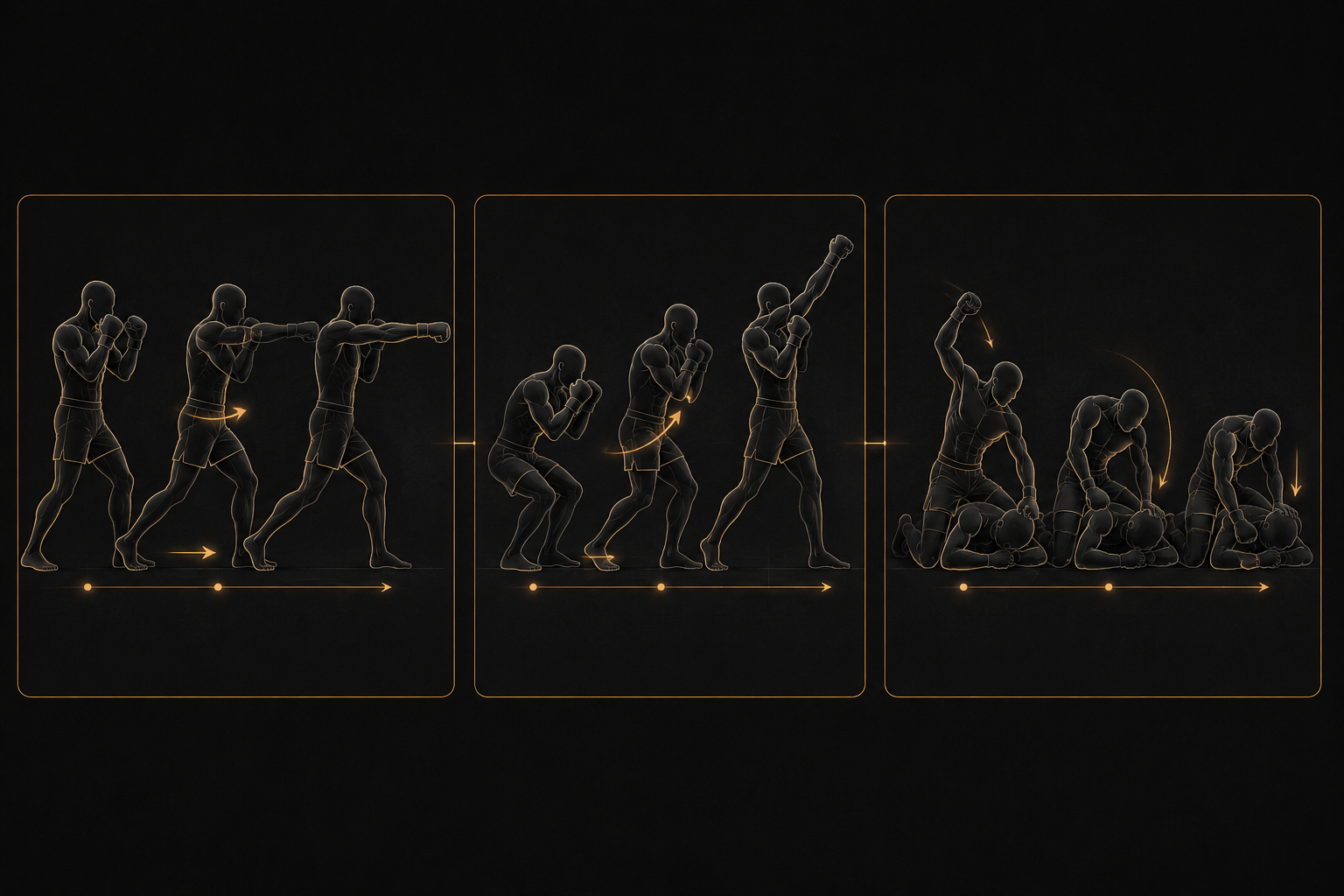
The Three Guskov Patterns Worth Training
A good apartment routine cannot copy the spectacle of a fight. It has to choose the mechanism. With Guskov, the useful mechanisms are unusually clear: the patient straight right when an opponent enters, the intercepting uppercut in the pocket, and the ground-strike follow-through after damage has already been created.
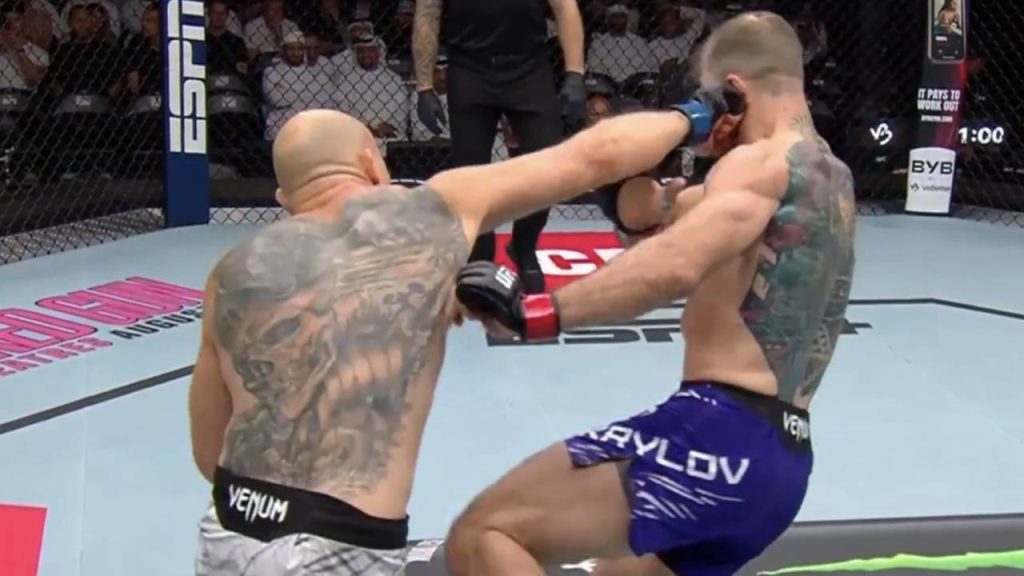
The straight right is the cleanest place to start because it matches both the public profile and the tape. UFC lists his favorite strike as the right hand.[1] In the Nikita Krylov finish, the important part is not wild forward motion; Cageside Press described Guskov’s pressure as patient and flat-footed before the straight-right finish, which is exactly why it translates better to a small room than a sprinting combination would.[2]
For training purposes, the straight-right pattern preserves four things: a quiet stance, a small entry step, hip-to-shoulder sequencing, and a finish that keeps the rear shoulder traveling after the hand arrives. What gets lost at home is the opponent’s real entry. A band, shadowboxing line, or footwork cue cannot punish you for being late. That is why the drill has to be patient rather than fast for its own sake.
The pocket uppercut gives the routine its second power angle. After the Jan Blachowicz draw, MMA Fighting noted the pattern of Guskov entering the pocket and producing a knockdown.[3] That is not the same as saying every uppercut he throws is a magic punch. The transferable piece is the shape: he gets close enough that the strike rises from a braced lower body rather than swinging wide from the arm.
In a 4×4-foot space, this becomes a short-range power drill. The feet do not need to travel far. The hips load, the ribs stay stacked over the pelvis, the rear heel can turn without a stomp, and the fist rises along a tight line. If the drill turns into a biceps curl with a mean face, it has missed the point.
The third pattern is less glamorous and more useful than most people want to admit: follow-through after the opponent is already hurt. UFC Stats credits 84% of Guskov’s significant strikes as standing, with a 3.87 significant-strikes-landed-per-minute rate and 50% striking defense.[4] So this is not an argument that his offense is primarily a ground-and-pound system. It is narrower than that. When damage creates a finishing window, the same power qualities — bracing, shoulder travel, balance over the base — have to continue on the floor.
That last piece is where many home routines get too theatrical. You do not need to pound the floor or shake the apartment. You need to learn how to transfer force from a stable base while one or both knees are down, then recover position without collapsing through the wrists, shoulders, or low back.
A 45-Minute Small-Space Circuit Inspired by the Tape
The circuit uses the public clues carefully: Guskov’s right-hand preference, his broad run-technique-conditioning day, and the fight patterns above.[1] It does not pretend that adjustable dumbbells and bands recreate a professional fight camp. They do something more modest and more useful for an apartment: they load the same sequencing without needing a bag, rack, or full mat room.
| Block | Time | Purpose |
|---|---|---|
| Quiet rope and stance prep | 6 minutes | Raise temperature without stomping and set the stance width you can actually use |
| Dumbbell power hinge and press series | 9 minutes | Train leg drive, bracing, and shoulder transfer before punching patterns |
| Patient straight-right sequence | 10 minutes | Practice waiting, stepping small, rotating late, and finishing through the line |
| Intercepting uppercut sequence | 8 minutes | Build short-range hip load and vertical strike mechanics |
| Floor follow-through block | 7 minutes | Train stable ground-strike posture without impact noise |
| Reset and breathing | 5 minutes | Downshift shoulders, hips, and calves so the session does not end as tension practice |
Quiet rope and stance prep
Use the jump rope as a rhythm tool, not a downstairs-neighbor test. If jumping is too loud, ghost rope in place: hands turn as if holding the handles, feet pulse lightly, and the calves stay springy. Work three easy rounds of 60 seconds with 30 seconds between them. In the breaks, step into your fight stance and check the room: front foot, rear foot, one small step forward, one small step back. If that already hits furniture, the drill later will too.
The last 90 seconds are stance switches and guard resets. Do not bounce around like the room is bigger than it is. Find the amount of motion you can repeat without drifting. This is the first useful apartment filter: any punch pattern that requires you to chase across the room is not part of this session.
Dumbbell power before punching
Before the strike-specific work, load the body in shapes that make punching mechanics easier to feel. Use moderate adjustable dumbbells. The weights should move crisply; if the set turns into slow grinding, it is no longer helping punch speed.
- Dumbbell Romanian deadlift to fast stand: 3 sets of 6 reps, focusing on a braced hinge and sharp hip extension.
- Split-stance dumbbell push press: 3 sets of 5 reps per side, using a small leg drive and a quiet rear-heel turn.
- Band anti-rotation hold: 3 holds of 20 seconds per side, keeping the ribs down while the band tries to pull you open.
The split-stance push press is the one to police. It is not a max-effort shoulder exercise. Set the feet as if you were about to throw the right hand, dip an inch or two, drive from the floor, and let the hip and shoulder arrive in order. The dumbbell teaches you whether your trunk leaks force. If your ribs flare and your low back takes over, reduce the load.
Patient straight right without a bag
Set a resistance band behind you at chest height if you have a safe anchor. If not, do the drill unloaded. The band is helpful, but it is not the point. The point is to delay the punch until the step and hip have created a lane.
- Start in stance with your rear hand loaded but relaxed.
- Take one short entry step, no longer than your own foot.
- Let the rear hip turn before the shoulder chases.
- Extend the right hand through an imaginary target, then recover the hand to your face.
- Reset your feet before the next rep instead of drifting forward.
Run this as 5 rounds of 60 seconds with 60 seconds of rest. The first two rounds are slow and exact. The next two add snap. The last round alternates one feint with one right hand, because the Krylov pattern matters only if patience survives the urge to throw early.[2]
The common cheat is reaching. In a bagless room, reaching feels productive because there is no target to expose the mistake. Keep the head over the hips, move the body first, and let the punch be the last visible piece of the action. If the shoulder arrives before the foot settles, the rep does not count.
Intercepting uppercut in the pocket
The uppercut block starts with a level change, not an arm swing. Stand in stance, sink slightly as if an opponent has stepped into range, and keep the elbow close. The punch rises because the legs and hips unwind; the fist is just the end of the chain.
- Shadow uppercut: 4 rounds of 30 seconds per side, moving at half speed until the line stays tight.
- Band-resisted uppercut: 3 sets of 6 reps per side, using light resistance and a clean return to guard.
- Pocket reset: after every rep, take a two-inch angle step and re-square your base.
This is the movement most likely to get silly in a living room. Do not throw it so high that your shoulder shrugs into your ear. Do not dip so low that your knees complain. The usable version is compact: load, rise, recover. If you want a broader fighter-style template after this Guskov-specific session, the general small-apartment UFC training guide is the better place to add more footwork and conditioning volume.
Floor follow-through without floor pounding
This block trains finishing posture, not noise. Use a yoga mat or thin exercise mat. Start in a high-kneeling stance, one knee down and one foot planted, with a light dumbbell held close to the chest or no load at all. Rotate the torso as if throwing a short downward strike, stop before impact, and return to a braced tall position.
- High-kneeling rotational strike path: 3 sets of 8 reps per side.
- Bear-plank shoulder tap: 3 sets of 10 total taps, keeping knees close to the floor.
- Half-kneeling get-up to stance: 3 sets of 4 reps per side, standing without pushing off furniture.
The bear-plank tap is not there for social-media toughness. It teaches the shoulder and trunk to stay organized while one hand leaves the floor. The get-up matters because follow-through is only useful if you can recover position afterward. In a fight, that recovery is chaotic. At home, it is controlled, but the joint positions still matter.
How to Place It in a Real Week
Guskov’s stated day — run in the morning, technique in the afternoon, conditioning in the evening — makes sense for a professional fighter’s life.[1] A home athlete with work, neighbors, and limited flooring should not reproduce that schedule. The useful adaptation is the separation of qualities: easy aerobic work, skill rehearsal, and harder conditioning do not all have to be smashed into one exhausted block.
| Day | Session | Small-space focus |
|---|---|---|
| Monday | 45-minute Guskov power circuit | Straight right emphasis, moderate dumbbell loading |
| Wednesday | 45-minute Guskov power circuit | Uppercut emphasis, lighter band resistance, cleaner resets |
| Friday or Saturday | 45-minute Guskov power circuit | Floor follow-through emphasis, slightly higher conditioning pace |
| Optional 2 days per week | 20- to 30-minute easy walk, bike, or quiet rope intervals | Aerobic base without turning every day into fight camp |
Keep at least one day between the full circuits at first. The punches are unloaded or lightly loaded, but the hips, calves, shoulders, and trunk still accumulate fatigue. If the right hand gets faster while your stance gets sloppier, you are not getting more powerful; you are practicing leakage.
For readers building from almost nothing, this circuit is more specific than necessary. Start with a broader UFC fighter home workout routine or a 3-day fight training routine for home if you still need a base of strength, mobility, and conditioning before worrying about fighter-specific mechanics.
Why Guskov Is a Better Small-Room Study Than He First Looks
The biography is useful only if it explains the body of work. Sherdog has noted Guskov’s background as a welder and bouncer, along with Master of Sport credentials.[5] That does not need to become a hard-man origin myth. It simply fits the tape: his power looks physical, compact, and practiced under constraint rather than built on long, decorative exchanges.
His UFC Stats profile also keeps the study grounded. A fighter whose significant strikes are overwhelmingly standing gives a home athlete a clearer striking sample than someone whose offense is mostly clinch wrestling or top control.[4] At the same time, the listed 50% striking defense is a reminder not to turn this into fantasy. Home drills can teach entry patience, rotation, bracing, and follow-through. They do not teach you to read a live counterpuncher.
If you are deciding what to buy for this kind of routine, spend less time imagining a garage gym and more time solving the actual room. Adjustable dumbbells, a safe band anchor, a jump rope you can use quietly, and a mat cover nearly everything here. The compact apartment equipment guide is the cleaner next stop for a minimal setup, while the home gym equipment decision framework helps if you are still choosing between bands, dumbbells, and larger pieces.
The closest companion study is Johnny Eblen, because his power also rewards a closer look at mechanics rather than mythology. If Guskov is the small-room lesson in right-hand timing and finishing posture, the Johnny Eblen knockout-power routine is a useful contrast in pressure, wrestling-linked power, and heavy hands without a heavy bag.
What the Routine Can and Cannot Promise
This Guskov-inspired fight breakdown routine can make a home athlete better at producing force from position. It can make the rear hand less arm-dominant, the uppercut less sloppy, and floor-based follow-through less chaotic. It can also expose whether your stance disappears the moment you try to move fast.
It cannot make you punch like Guskov in any complete sense. There is no sparring partner entering on you, no coach correcting your timing, no consequence for leaving your chin high, and no live defensive read. Those missing pieces are not small. They are the difference between practicing mechanics and fighting.
The credible lesson is still strong enough: Guskov’s finishes show power as timing, stance, sequencing, and follow-through, not just aggression. Those pieces can be trained honestly in a small apartment if the room is treated as a constraint instead of ignored.
References
- Bogdan Guskov | UFC, UFC.
- UFC Abu Dhabi: Bogdan Guskov Comes Back, Sleeps Nikita Krylov, Cageside Press.
- UFC Atlanta results: Jan Blachowicz vs. Bogdan Guskov declared majority draw, MMA Fighting.
- Bogdan Guskov Fight Statistics, UFC Stats.
- 5 Things You Might Not Know About Bogdan Guskov, Sherdog.
Don't have the gear this routine assumes? Find the build that covers it.
Wondering how much rest you need after this? Read our ACSM-cited recovery reference.
Questions about form, substitutions, or a correction? Leave it below.
Comments
Join the discussion with an anonymous comment.