
How Costello van Steenis's Training Injury Warns Solo Home Gym Athletes
Costello van Steenis's injury withdrawal and Johnny Eblen's admission about fighting hurt show how training alone without structured deloads can derail even elite athletes. A balanced 60/30/10 training split offers solo home gym athletes a practical way to avoid overtraining.
Before you start
- Equipment required
- Dumbbells, pull-up bar
- Assumes build tier
- No specific tier required
- Duration
- 20 minutes
- Difficulty
- Intermediate
Costello van Steenis's training for the Eblen rematch should have been a fight-camp story. Instead, it became a clean warning about the part of training most solo athletes handle badly: deciding when a hard session has stopped being useful.
Van Steenis was out of the July 18 rematch with Johnny Eblen after the PFL announced his withdrawal on June 5, 2026. Weeks later, he described an injury serious enough that he could not "jump on a bike or even walk stairs," while saying he expected to be 100 percent in four weeks and wanted a Q4 unification bout.[1][2]
That detail lands harder than the usual vague phrase "training injury." A missed title date is abstract. Stairs are not. Anyone who trains in a spare bedroom, beside a couch, or between a bench and a laundry rack knows the difference between ordinary soreness and the kind of pain that follows you into the rest of the day.

The useful part is not guessing what happened inside van Steenis's camp. He did not disclose the injury type or body part, and there is no reason to pretend otherwise. The useful part is the timing and the contrast: one elite fighter withdrew after training pushed him past the line; the fighter waiting across from him had already said he probably should have done the same before their first bout.
The Rematch Fell Apart From Both Sides of the Same Decision
Eblen's admission is what keeps this from becoming a simple "fighter gets hurt" note. Before the planned rematch, he said he was injured six weeks out from the first van Steenis fight, took about one and a half to two weeks off, fought anyway, and "probably should have pulled out."[3]
That gives home gym athletes both endings. Van Steenis pulled out and lost the date. Eblen fought hurt and lost the bout. Neither outcome looks attractive when you are the person who has already built the calendar in your head: the test week, the weight PR, the photo, the race, the challenge, the rematch.
It is easy to admire the refusal to back off. It is also easy to misunderstand it. Elite fighters are surrounded by structure even when they make risky calls: coaches, training partners, medical staff, scheduled phases, and consequences visible to more than one person. A solo lifter usually has a notebook, a timer, a mirror angle that may or may not show what matters, and a mood.
The problem is not intensity. Hard training is not the villain here. The problem is bargaining. One more round when the footwork is gone. One more heavy set because the plan said heavy. One more conditioning finisher because the watch says there is time. In a compact home gym, no one sees the form decay unless the athlete has already decided to look for it.
Van Steenis is not a casual example. He is listed at 6 feet 1 inch and 185 pounds, born in Rotterdam and raised in Altea, Spain, with training ties including MMA Vlaardingen under Ricardo Wondel, Gegard Mousasi's team, and Kill Cliff FC. His record is listed as 18–2 with 14 finishes, including 6 KO/TKO and 8 submission wins.[7]
That background matters only because it removes the comforting excuse. This was not a beginner confusing soreness with injury after a random internet workout. Serious athletes can still misjudge the line. Serious home athletes can, too.
What Replaces a Coach When No One Is Watching?
"Listen to your body" is true, but it is weak advice at the exact moment it is needed most. Most self-coached athletes already hear the signal. The harder part is having a rule that beats the argument forming in their head.
A coach can lower the load, cut a round, change the drill, or end a session before the athlete has to admit defeat. Alone, the athlete has to be both the person chasing the goal and the person protecting the next month of training. Those two jobs do not always cooperate.
The replacement is not motivation. It is pre-commitment: rules written before fatigue, pain, ego, or a deadline get a vote. For a home gym athlete, that means the week needs limits built into it before the first warm-up set.
| Warning signal | What it changes before the session escalates |
|---|---|
| Pain changes normal movement | Do not load the painful pattern; switch to non-aggravating movement or stop |
| Warm-up sets feel slower than expected | Cap intensity below planned top sets instead of chasing the original number |
| Technique breaks early | Move the work into skill practice, tempo work, or recovery conditioning |
| A joint feels worse as the session continues | End the exercise rather than waiting for the set to prove the point |
| Daily life is affected after training | Treat the next session as a deload or rest decision, not a toughness test |
The stairs-and-bike detail belongs in that last row. When training spills into basic movement, the question is no longer whether the workout was hard enough. The cost has already left the gym.
Use the 60/30/10 Split as a Load-Balancing Tool
TRX's MMA workout guide gives a simple split: 60 percent technical drills, 30 percent conditioning, and 10 percent strength training, with a three-day weekly template.[4] That should not be read as van Steenis's personal program or as a magic formula for fighters. Its value for a home gym athlete is more basic: it prevents every session from becoming a max-effort strength-and-conditioning pileup.
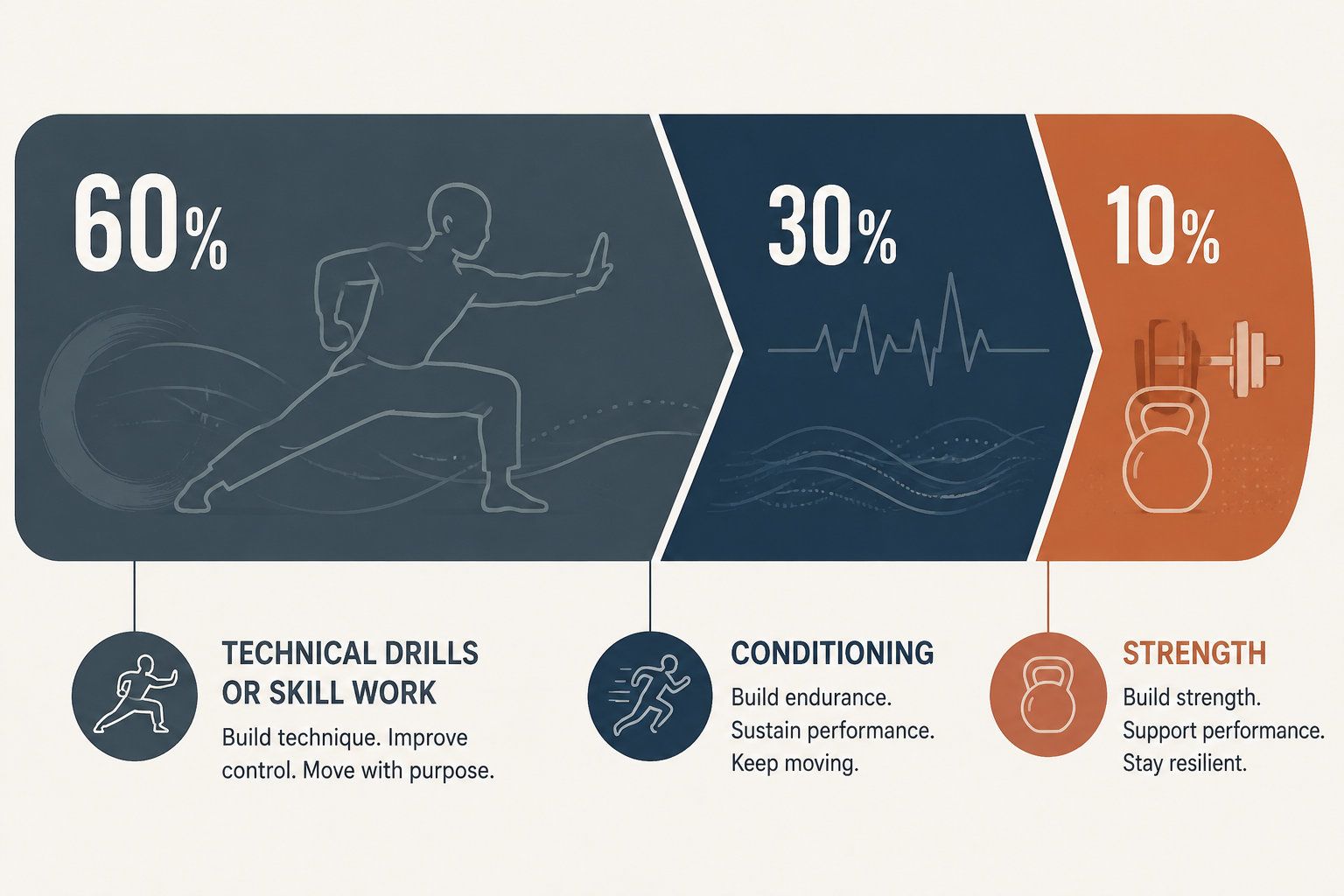
Most people training at home are not doing fight practice. The categories still translate well if they are understood by function rather than sport.
| MMA label | Home gym translation | What it should feel like |
|---|---|---|
| 60% technical drills | Movement quality, skill practice, controlled reps, mobility, balance, tempo work | Focused, repeatable, clean |
| 30% conditioning | Jump rope, circuits, intervals, loaded carries, bike, rowing, bodyweight density work | Challenging but recoverable |
| 10% strength | Heavy compound lifts, weighted pull-ups, heavy presses, squats, hinges | Precise and limited, not endless |
That split is especially useful in a small space because home equipment tends to tempt repetition. If the heaviest dumbbells are sitting in reach, strength work expands. If the jump rope is the easiest setup, conditioning expands. If a pull-up bar is the proudest piece of the room, every day quietly becomes a pulling day.
A balanced week does not require more square footage. It requires deciding what kind of stress each session is allowed to create. A technical day can still be serious. It just measures success by better reps, cleaner positions, steadier breathing, or less wasted motion instead of by exhaustion.
A Simple Three-Day Home Version
The exact exercises can change, but the weekly job should stay clear. This is a structure for controlling load, not a promise that injury cannot happen.
| Day | Main emphasis | Example home gym focus |
|---|---|---|
| Day 1 | Technical quality plus limited strength | Tempo squats, push-up or press practice, hinge patterning, a small number of heavier sets |
| Day 2 | Conditioning without form collapse | Jump rope intervals, low-impact circuits, carries, or bike work kept below the point where movement gets sloppy |
| Day 3 | Technical quality plus mixed conditioning | Pull-up skill, single-leg control, mobility under light load, short finishers only if movement stays clean |
The hidden win is that strength no longer has to carry the whole identity of the week. A lifter can still train heavy, but heavy work becomes one part of the program instead of the default answer to every burst of ambition.
Heavy Work Needs a Ceiling
Breaking Muscle's MMA strength and conditioning guidance from coach Sabina Skala reinforces the same idea from another angle: limit heavy compound lifts to two per session, and do not let gym training dominate the main sport or goal.[5]
For a fighter, that means the weight room supports the fight rather than swallowing it. For a home gym athlete, the same rule can protect the real goal. If the goal is a stronger pull-up, a healthier running block, better conditioning, or simply training consistently through the year, then a single session should not spend so much recovery that the next three sessions become negotiations.
Two heavy compound lifts are often enough for one day in a small home setup: squat and press, hinge and pull, split squat and row. After that, assistance work can stay lighter, cleaner, and easier to recover from. This is not timid programming. It is accounting.
The athlete training alone needs that accounting because no one else is limiting the session. No coach is watching the third heavy lift turn into a lower-back argument. No partner is saying the last rep looked different. A written ceiling gives the athlete a way to stop without needing the stop to feel dramatic.
Elite Discipline Has More Supervision Than It Looks Like
One of the quieter details from van Steenis's camp history is that he described flying in his original Spanish coach to live with him during camp so training could be "as professional as possible."[6]
That is the part many amateurs leave out when copying elite effort. They see the hard rounds, the sweat, the body composition, the aggression toward a deadline. They do not copy the external structure: another person in the room, a coach who knows the athlete's habits, a camp rhythm, and someone with permission to pull the intensity down.
A home gym version of that support system can be modest. It can be a four-week block with a deload already written in. It can be a rule that any pain affecting stairs, sleep, or normal walking cancels heavy lower-body work until movement is normal again. It can be sending form video to a knowledgeable friend before adding load. It can be logging readiness honestly instead of only logging the sets that make the week look impressive.
- Write deload weeks before the block starts, not after the body forces one.
- Separate technical, conditioning, and strength work so one category cannot quietly dominate.
- Cap heavy compound lifts before the session begins.
- Treat daily-life limitations as stop signs, not soreness trivia.
- Use video, logs, or outside feedback when no coach is physically present.
Deloads Are Decisions Made Early
A deload week is not proof that the previous weeks were soft. It is a planned reduction in training stress so the next phase can happen without every session depending on hope. In a home gym, where there is no coach pacing the room and no team schedule forcing variation, the deload has to be visible on the calendar.
The simplest version is a four-week rhythm: build for three weeks, reduce load or volume in week four. The reduction does not need to be theatrical. Fewer sets, lighter loads, cleaner tempo, shorter conditioning blocks, and more technical practice can all lower stress while keeping the habit intact.
The more ambitious the goal, the less optional that rhythm becomes. A deadline makes people bargain. If a test date is coming, the athlete will want the missed set back, the bad day redeemed, the number confirmed. A planned deload gives the program a brake before the athlete has to invent one under pressure.
Van Steenis's own recovery expectation was his stated estimate, not medical guidance. He said he expected to be 100 percent in four weeks, while the injury itself remained undisclosed.[1] For everyone outside his camp, the lesson stops before diagnosis and rehab. The safer question is what structure might prevent a training block from reaching the point where stairs and biking become part of the injury report.
Solo home gym athletes do not need to train less seriously. They need a program that makes some days easier before pain makes the decision for them.
References
- PFL champ Costello van Steenis vows to smash Johnny Eblen in rematch: 'If you lose against Impa, you mean even less than nothing to me', MMA Fighting, July 18, 2026
- Costello van Steenis out of Johnny Eblen rematch at PFL Austin, new opponent booked for interim title bout, MMA Fighting, June 5, 2026
- Johnny Eblen: 'Probably should have pulled out' of Costello van Steenis fight, Yahoo Sports / MMA Junkie
- MMA Workout Guide, TRX Training
- How To Train Strength And Conditioning For MMA, Breaking Muscle
- Costello van Steenis Discusses Fighting In Paris, Says Doumbe and Baki Have Been Good For French MMA, Cageside Press, 2024
- Costello van Steenis, Wikipedia
Don't have the gear this routine assumes? Find the build that covers it.
Wondering how much rest you need after this? Read our ACSM-cited recovery reference.
Questions about form, substitutions, or a correction? Leave it below.
Comments
Join the discussion with an anonymous comment.