
How to Exercise Safely During Severe Weather
This guide explains the specific weather thresholds that make outdoor exercise dangerous and provides tiered indoor workout substitutes based on your home gym budget and equipment.
Before you start
- Equipment required
- none
- Assumes build tier
- No specific tier required
If you are already dressed to go out and the weather app flips to heat alert, smoke haze, thunder, or bitter wind, the real question is not whether exercise is still “good for you.” It is whether the outside is still safe enough for the workout you planned. The fastest way to decide is to sort the day into a few hard thresholds, then swap the session before the weather makes the decision for you.
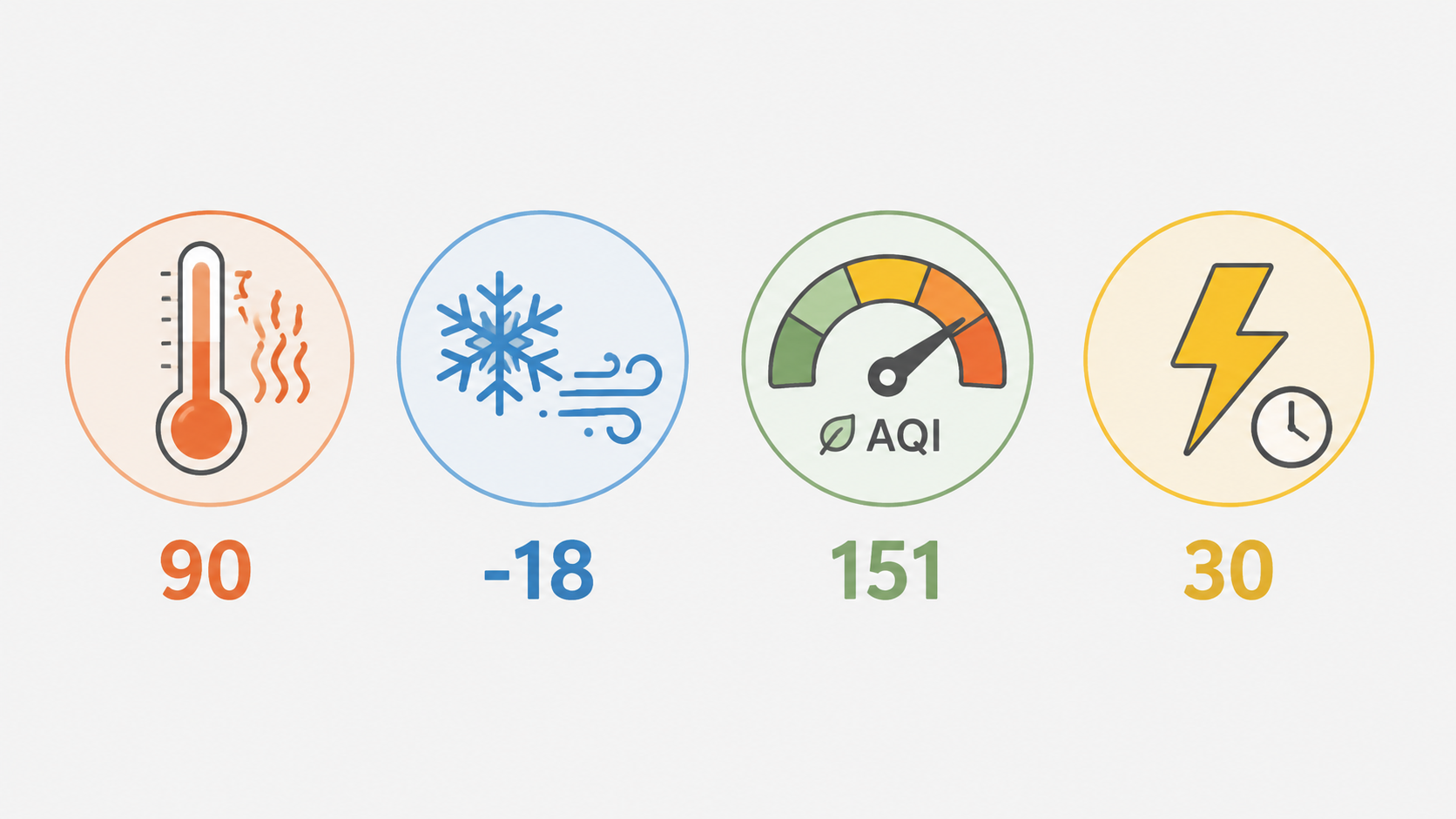
| Hazard | Threshold to notice | What it means for exercise |
|---|---|---|
| Heat | Heat index above 90°F [1] | Outdoor exercise starts carrying a real heat-illness risk, especially before you have acclimatized. |
| Cold | Wind chill below -18°F, and ACSM guidance to avoid exercise when air temperature falls below -8°F [3][4][5] | Frostbite and unsafe exposure become the issue, not just discomfort. |
| Air quality | AQI above 100, and especially above 151 [6][7] | Sensitive groups are at risk first; by 151, healthy athletes should move indoors. |
| Lightning | Thunder within 30 seconds of lightning, then a 30-minute wait after the last thunder [8][9] | Thunder is the signal to go inside; lightning can strike more than 10 miles from the storm. |
Those thresholds matter because they are the point where judgment stops being the main protection. In heat, the body needs about 4 to 14 days of gradual exposure before it starts adapting, so the first hot week is not the time to test pace [1][2]. In cold, skin can be damaged long before a workout feels “too cold” in the usual sense, which is why air temperature and wind chill are not interchangeable [3][4][5].
How the thresholds change the workout
Heat: when the run stops being a simple run
Once the heat index climbs above 90°F, outdoor training stops being just uncomfortable and starts carrying a meaningful heat-illness risk [1]. That does not mean every warm day becomes a rest day. It means pace, duration, and timing matter more than stubbornness. If you have not acclimatized yet, keep the session shorter, lower the intensity, and move it earlier or indoors. Heatstroke is the line you do not train through: core body temperature above 104°F (40°C) is the danger point [1]. Mass General Brigham also emphasizes cooling and hydration as part of safe warm-weather exercise, not as a loophole that makes hot conditions harmless [2].
Cold: wind chill and air temperature are different problems
Cold weather has two separate questions. According to ACSM guidance, exercise should be avoided when air temperature falls below -8°F, and wind chill below -18°F can cause frostbite on exposed skin in 30 minutes or less [3][4][5]. If the wind is doing damage faster than you can protect your face, ears, and fingers, the workout is already too expensive. Layering helps, and so do gloves and face coverage, but they do not turn a dangerous wind chill into a normal training day [4][5].
Air quality: the number that changes the plan before your lungs do
AQI is where “I can still breathe” becomes the wrong test. Above 100, sensitive groups are already in the caution zone; by 151, even healthy athletes should train indoors; above 200, outdoor exercise is not recommended [6][7]. One useful wrinkle is that, when air quality is poor, reducing duration matters more than simply reducing intensity. A short, hard substitute usually exposes you to less smoke than a long, easy outing that drags on outside [7].
Lightning: the cleanest hard stop
Lightning is the easiest cutoff to use because the conservative standard is so simple. If thunder follows lightning within 30 seconds, go indoors, and stay there for 30 minutes after the last thunder [8][9]. The short version — when thunder roars, go indoors — works because lightning can strike well away from the visible storm core, including more than 10 miles from the storm itself [8][9].
When the answer is stop entirely
Once the body starts sending warning signals, the weather question is over. The workout ends, even if the interval is not finished.
- Heat illness: dizziness, nausea, a hot or worsening feeling that does not settle, or any concern that you are nearing the heatstroke range where core body temperature exceeds 104°F [1].
- Hypothermia signs: body temperature below 95°F, confusion, slurred speech, or poor coordination [4][5].
- Smoke inhalation symptoms: coughing, chest tightness, wheezing, or shortness of breath in smoky air [6][7].
- Any confusion, disorientation, or loss of coordination that appears mid-workout.
The indoor fallback should replace the training effect, not the route
The best backup is the one you can repeat without negotiation. Small-space training works best when each tier solves a different problem: no equipment, a few hundred dollars, or enough room for a true cardio machine. The goal is to keep the stimulus alive, not to recreate the exact outdoor session one object at a time.
| FitAtHome tier | Typical budget | Best-fit tools | What it is good for |
|---|---|---|---|
| Tier 1 | $0-100 | Bodyweight HIIT, jump rope, stair climbing, resistance bands | A same-day safety net when you need to train in a small apartment with almost no setup. |
| Tier 2 | $100-300 | Foldable stationary bike, mini elliptical, adjustable dumbbells, resistance bands, yoga mat | The most practical renter-friendly cardio setup and the closest match for a regular outdoor run replacement. |
| Tier 3 | $300-800 | Compact treadmill, indoor bike trainer, adjustable weights, kettlebells | A more faithful stand-in for mileage, interval work, or longer mixed-modal sessions. |
Tier 1: the no-excuses floor space plan
This tier is for the day the weather turns fast and the apartment is all you have. Squats, lunges, push-ups, planks, and resistance bands can be arranged as a circuit that keeps your heart rate up without waiting for a shipment. Jump rope works if your space and neighbors allow it; stair climbing works if the building, your knees, and your lease all say yes. Tier 1 is not fancy, but it is enough to stop a weather cancellation from becoming a lost week.
Tier 2: the apartment sweet spot
For most renters, this is the most realistic balance of cost, footprint, and repeatability. A foldable stationary bike or mini elliptical gives you steady cardio without turning the living room into a studio, while adjustable dumbbells and bands keep strength work from disappearing on bad-weather days. If your normal habit is a 30-minute outdoor run, this tier is usually the easiest way to keep the training day from feeling like a compromise.
Tier 3: the closest thing to a true indoor training room
Tier 3 is for people who know they will use the setup often enough to justify a bigger footprint. A compact treadmill or indoor bike trainer keeps the session structure familiar, and the extra weights make it easy to blend cardio and strength into one workout. If you want a 40-minute mixed-modal session that still feels like training rather than improvisation, this is the tier that makes it easiest.
- Outdoor run → stationary bike, mini elliptical, treadmill, or a bodyweight circuit if equipment is limited.
- Outdoor walk → stairs, brisk marching intervals, or a low-impact circuit.
- Outdoor bike ride → indoor bike trainer or stationary bike session.
Severe weather stops being a training problem when the thresholds are clear enough to trigger a decision and the apartment already has a default plan waiting. Without that, the weather gets to decide whether you train.
References
- How to Be Active Safely in Warm Weather — American Heart Association
- Prevent Overheating During Workouts — Mass General Brigham
- Exercising in the Cold: Chilled, not Shaking! — ACSM
- Tips for Cold Weather Training — Mayo Clinic Health System
- How to Stay Active in Cold Weather — American Heart Association
- Is it safe to exercise outside when there is wildfire smoke in the air? — Colorado State University
- High AQI: Safe to Exercise Outside? — TrainingPeaks
- Lightning Safety and Outdoor Sports Activities — NOAA/National Weather Service
- Lightning Safety — Centers for Disease Control and Prevention
Don't have the gear this routine assumes? Find the build that covers it.
Wondering how much rest you need after this? Read our ACSM-cited recovery reference.
Questions about form, substitutions, or a correction? Leave it below.
Comments
Join the discussion with an anonymous comment.