
Why You Should Avoid Outdoor Exercise During a Flash Flood Warning
Flash floods kill more Americans each year than hurricanes or tornadoes, yet many runners and cyclists continue training when a warning is issued. This article explains why that decision is deadly and provides a zero-equipment bodyweight workout you can do in a small apartment.
Before you start
- Equipment required
- none
- Assumes build tier
- No specific tier required
- Duration
- 25 minutes
- Difficulty
- beginner
- Noise level
- quiet
Your shoes are on, the route is already in your head, and your phone says flash flood warning. That is the moment to stop. A flash flood warning means flash flooding is imminent or already occurring; it is not a heads-up for later, and it is not the same thing as a watch. The National Weather Service’s instruction is immediate protective action: move to higher ground and do not travel through flood water.[1]
When a flash flood warning is issued, the decision point is brutally simple: the outdoor workout is over. Not shortened. Not rerouted. Not moved to the “safe” streets you know better than anyone else. Once the warning is issued for your area, the run, ride, walk, or hike moves indoors.
What changes the instant a warning is issued
Regular outdoor exercisers are good at negotiating discomfort. Cold rain, humid air, ugly wind, sloppy sidewalks—none of those automatically cancel a workout. Flash flooding is different because the ground itself can change faster than your judgment can update. A familiar underpass, creek crossing, drainage dip, trail bridge, curb cut, or low road can become a moving-water hazard while you are already committed to the route.
The numbers that matter are small enough to feel insulting until you picture your own route. Six inches of fast-moving water can knock an adult off their feet. Twelve inches of moving water can carry away many vehicles.[2][3][4] That means a flooded trail segment is not “ankle deep,” and a road with water across it is not a puzzle to solve from the shoulder. It is a force problem, and your fitness does not change the physics.
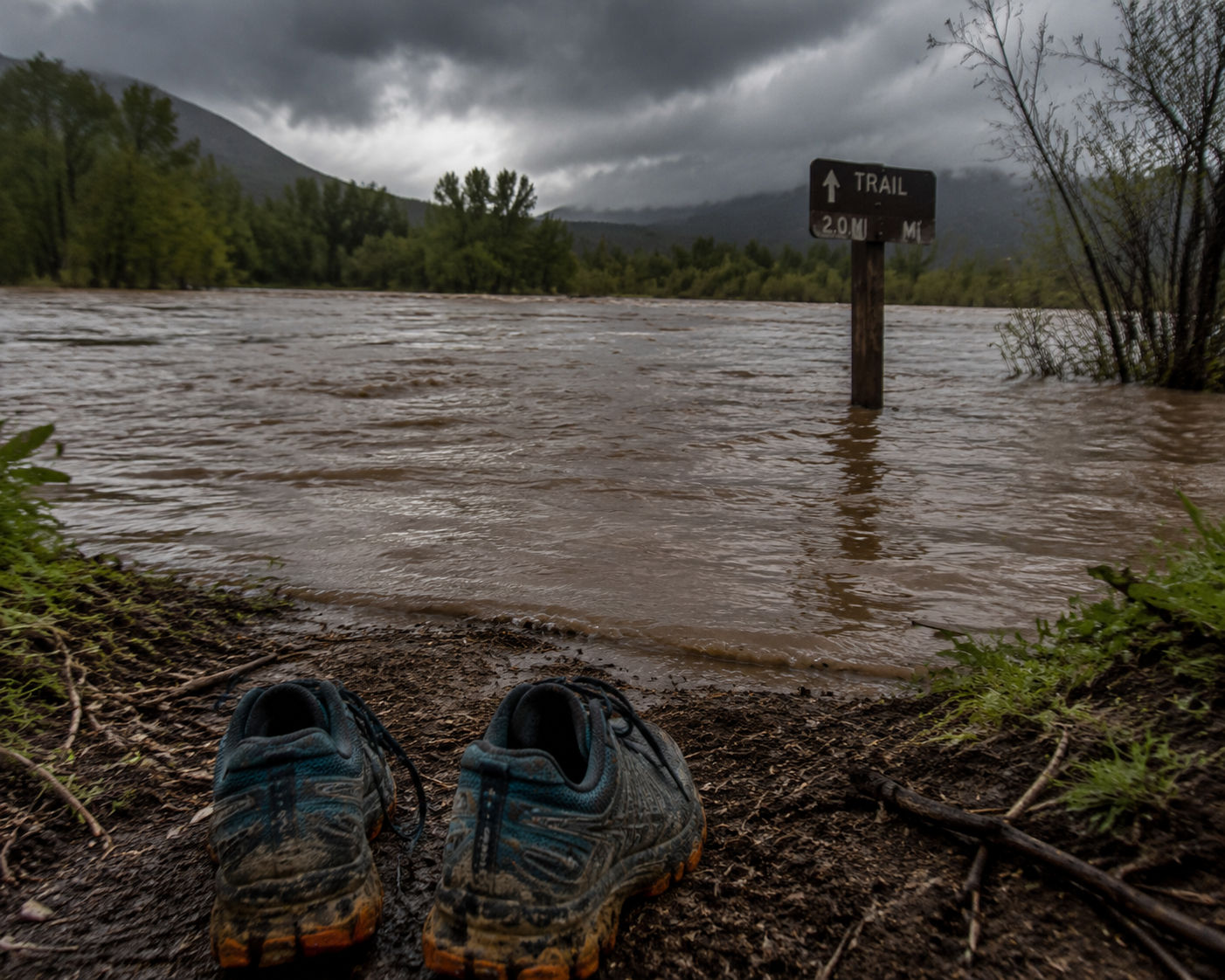
Flooding is also not a rare fringe hazard in U.S. storm safety. National Weather Service fatality statistics identify floods as one of the country’s deadliest weather hazards, with an average of 88 flood deaths per year in recent HazStats reporting.[5] The Washington Post reported in July 2025 that 2024 had 145 flood deaths, well above the 25-year average of 85.[6] Those totals include many situations, not just people exercising, but they explain why flood warnings are treated differently from ordinary bad-weather alerts.
Vehicles make the trap worse, not safer. In a July 2025 NPR interview after the Texas Hill Country flooding, disaster researcher Jennifer Horney noted that more than half of flash flood deaths are vehicle-related.[7] For a runner or cyclist, that matters because the bad bargain often becomes, “I’ll drive to a safer route,” or “I’ll park closer and just do a short loop.” During a warning, adding a car can add another exposure point: low-water crossings, flooded intersections, road washouts, and the temptation to judge water depth from behind a windshield.
The July 2025 Texas Hill Country floods are hard to think about precisely because the setting is so recognizable: water rising fast, people caught with too little time, and familiar terrain becoming dangerous. The lesson for training decisions is not that every warning will become that catastrophe. It is that a warning is issued for the kind of situation where waiting for personal confirmation can be too late.[7]
The usual runner logic fails here
The private arguments are familiar: the rain has not started yet; the radar looks worse north of town; the creek is usually low; the route is only three miles; the training block is finally going well. None of those arguments answers the thing a flash flood warning is actually saying. The warning is not asking whether you are tough enough to be wet. It is telling you that dangerous flooding is imminent or already happening in the warned area.[1]
Outdoor exercise adds specific vulnerabilities. Music and podcasts can cover thunder, sirens, rushing water, or shouted warnings. Dawn and after-work workouts often happen in low light. Urban paths commonly dip below roads. Trail systems follow creeks because creeks make pleasant routes on normal days. Cyclists may travel far enough in a short time to move from dry pavement into a flooded drainage area before they fully understand what changed.
The CDC’s general flood guidance is plain about the behavior that overlaps with exercise routes: avoid floodwater, do not walk, swim, or drive through it, and stay away from downed power lines and other hazards that can be hidden by water.[8] That advice sounds broad until you are staring at a favorite path with brown water crossing it. Then it becomes specific enough.
Do this instead: a 6-by-6-foot indoor conditioning swap
Canceling the outdoor session does not have to mean breaking the training habit. The better move is to keep the appointment and change the terrain. A small-space bodyweight circuit can fit in roughly the footprint of a hallway or apartment corner; Nerd Fitness describes small-space training as workable in about a 6-by-6-foot area.[9] That is enough room to squat, lunge in place, plank, do wall push-ups, and move continuously without jumping.
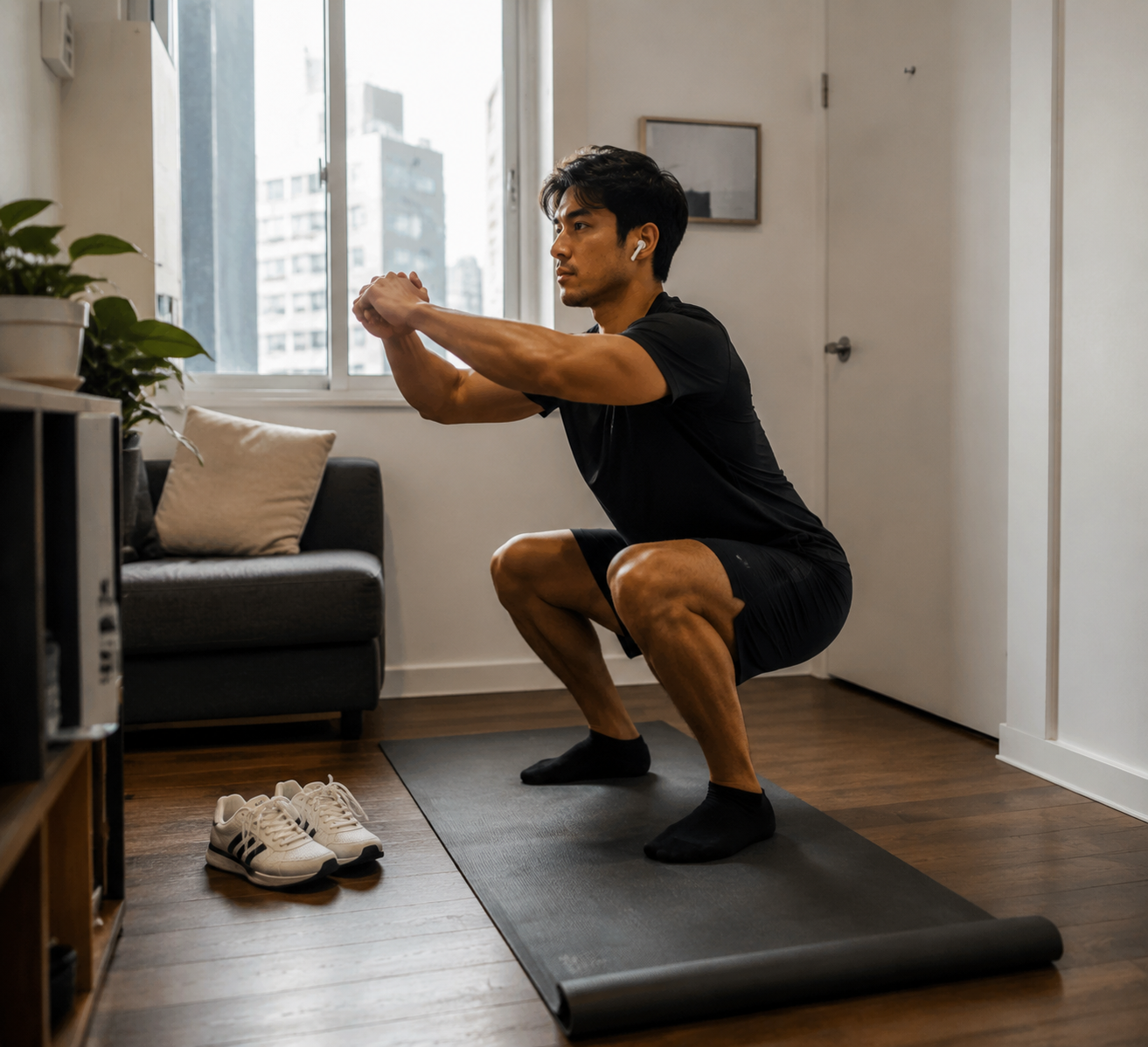
This is not an identical replacement for a run, ride, or hike. Your stride mechanics, cycling position, and outdoor terrain stimulus are different. But if you move with control, keep rest periods short, and choose variations that match your current fitness, the circuit can provide a real cardiovascular and muscular-conditioning stimulus while the dangerous part of the day passes.
| Block | Move | How to keep it apartment-friendly |
|---|---|---|
| Warm-up | March in place, arm circles, hip hinges | Stay light on the feet; use the time to raise body temperature, not to jump |
| Lower body | Squats | Slow down the lowering phase; stop before form collapses |
| Lower body | Reverse lunges or split squats | Step back quietly; hold a wall or chair for balance if needed |
| Upper body push | Push-ups, incline push-ups, or wall push-ups | Use the wall version if floor push-ups turn into grinding reps |
| Core and cardio | Plank or controlled mountain climbers | Move knees deliberately instead of hopping the feet |
| Upper body pull | Towel rows if your setup is safe | Use only a secure method; skip if the door, towel, or footing is questionable |
| Optional cardio add-on | Step-ups or stairs | Use a stable step; keep the pace controlled and quiet |
A practical version for a warning day
Set a timer for 20 to 30 minutes. Work through the circuit below at a steady pace, resting as needed. If you were planning an easy run, keep the intensity conversational. If you were planning a harder session, shorten the rests rather than adding impact.
- Warm up for 3 to 5 minutes: march in place, hinge at the hips, circle the arms, and do a few easy squats.
- Do 8 to 15 squats, using a slow lowering phase if the movement feels too easy.
- Do 6 to 12 reverse lunges per side, or hold a split-squat stance if stepping bothers your knees or annoys your downstairs neighbor.
- Do push-ups, incline push-ups against a counter, or wall push-ups for clean reps.
- Hold a plank, or do controlled mountain climbers without bouncing your feet.
- Add towel rows only if you can set them up securely. Nerd Fitness describes towel-row variations as a small-space pulling option, but the setup matters more than forcing the exercise.[9]
- Repeat for 3 to 5 rounds, adjusting pace so you finish worked, not wrecked.
If your apartment has sturdy stairs inside the building and you can reach them without going outdoors or crossing flood-prone areas, 5 to 10 minutes of controlled stair climbing can be used as a cardio add-on. Keep one hand available for the rail, skip sprinting, and stop if the stairwell is crowded, wet, dark, or needed by neighbors.
For a quieter session, remove the bounce before you remove the work. Use slow squats instead of jump squats, reverse lunges instead of jumping lunges, wall push-ups instead of burpees, and controlled mountain climbers instead of high knees. If you want a full no-impact template for future bad-weather days, use this no-jumping HIIT workout. If you need something more playful and still equipment-free, an apartment-friendly dance cardio session can fill the same slot.
Before the next workout, fix your warning source
A watch means conditions are favorable; a warning means flooding is imminent or already occurring.[1] That distinction should be visible before you leave, not discovered at mile two. Check a reliable source before dawn runs, after-work rides, long walks, and trail sessions when storms are in the forecast.
Phone alerts help, but they are not a complete plan. The National Weather Service notes that most flash flood warnings do not trigger Wireless Emergency Alerts, and NOAA Weather Radio is a direct way to receive NWS warnings.[1] If you train in places where cell service is weak, or if you tend to silence your phone overnight, that matters. The failure point may happen before you ever decide whether to run.
- Before leaving, check whether your area is under a flash flood watch or warning.
- If a warning is active, stay indoors and move the workout inside.
- If only a watch is active, treat the outdoor plan as conditional, shorten exposure, avoid low-lying routes, and be ready to cancel.
- Do not drive to another route through warned or flood-prone areas.
- Do not use visible water depth as your safety test.
If stormy, humid weather keeps pushing workouts indoors, solve the indoor environment instead of renegotiating with floodwater. Cooling can be the limiting factor in a small apartment; these low-cost home-workout cooling fixes help when the air feels heavy. For a longer-term setup, a compact home gym plan or a quiet walking pad can give you more options without needing much room. If noise is the concern, start with this ranking of the quietest walking pads for apartments.
The call
During a flash flood warning, the successful workout is the one you are alive to repeat. The route can wait. The streak can continue indoors. The training day is not normal, so the workout should not pretend it is. Stay inside and use the small-space circuit.
References
- Flood Warning vs. Watch — National Weather Service
- During a Flood — National Weather Service
- Flood Safety — American Red Cross
- Floods — Ready.gov
- Weather Related Fatality and Injury Statistics — National Weather Service
- Flood deaths are rising in the US — Washington Post, July 2025
- What to do if you get a flash flood warning — NPR, July 2025
- Floods and Your Safety — Centers for Disease Control and Prevention
- The Small Space Workout — Nerd Fitness
Don't have the gear this routine assumes? Find the build that covers it.
Wondering how much rest you need after this? Read our ACSM-cited recovery reference.
Questions about form, substitutions, or a correction? Leave it below.
Comments
Join the discussion with an anonymous comment.