
Exercising in Smoky Air? Tips for Your Home Gym Setup
When wildfire smoke drives up the AQI, your home gym becomes a safety asset. This guide maps each FitAtHome budget tier to specific workout modifications—from bodyweight circuits to HEPA-filtered cycle sessions—so you can train without risking lung damage.
Before you start
- Equipment required
- bodyweight, resistance bands, dumbbells, indoor cycle
- Assumes build tier
- No specific tier required
- Difficulty
- beginner
- Noise level
- quiet
On a smoky day, your home gym is not a convenience feature. It is the thing that lets you make a safer decision without bargaining with the air outside. The useful question is simple: what tier do you have, what is today’s AQI, and how hard can you train without turning a workout into extra particulate exposure?
That order matters. Check the air first. Then pick the routine. During exercise, ventilation can rise roughly 10–20 times above resting levels, which means a smoky jog is not just “being outside for 30 minutes.” It is 30 minutes of pulling much more PM2.5 through your airways than you would at rest.[1]
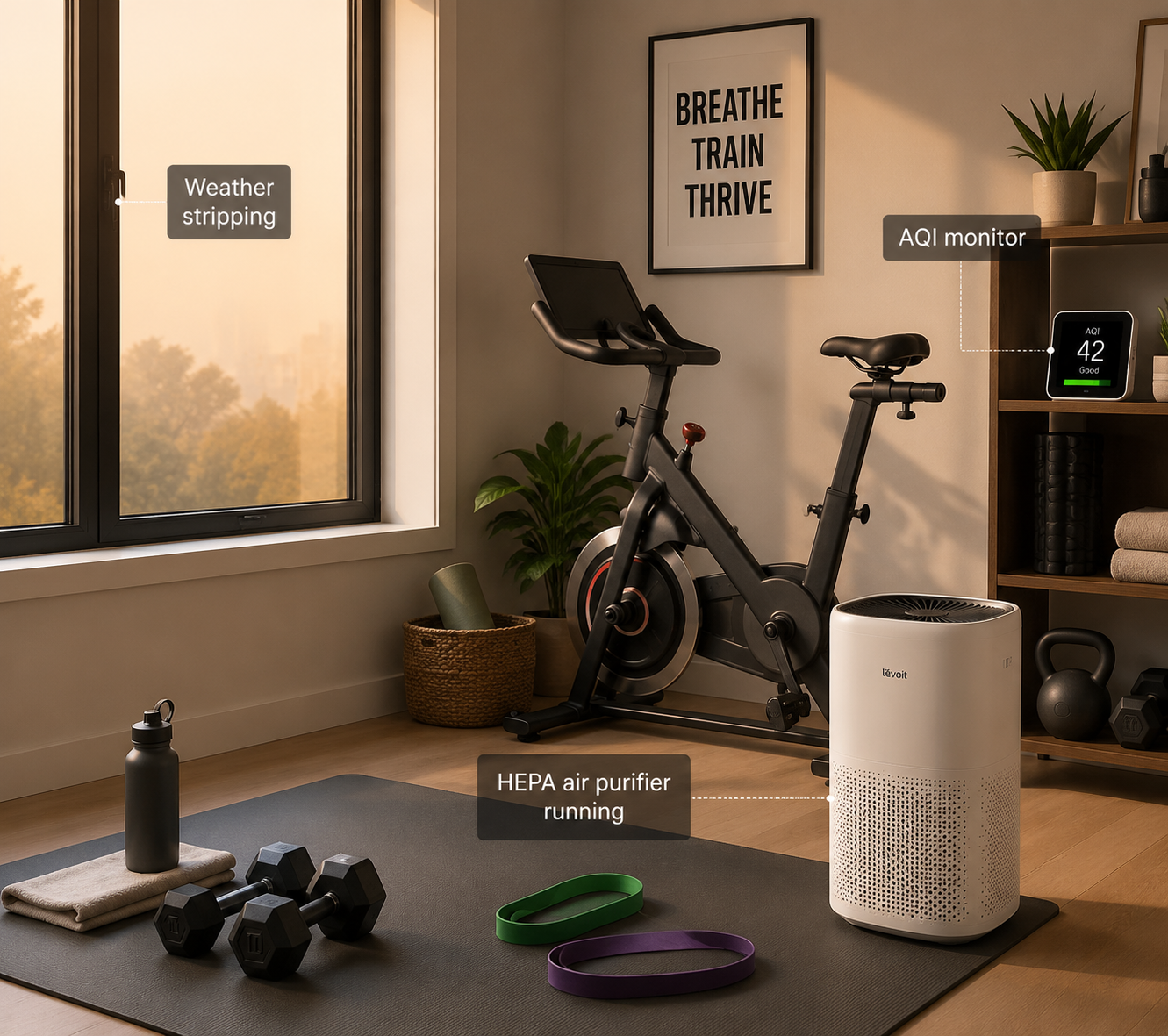
For the baseline AQI decision tree, start with Wildfire Smoke Exercise Safety Tips for Every AQI Level. This article picks up after that and routes the workout through the setup you already have: bodyweight, bands and light dumbbells, or an indoor cardio machine with dumbbells.
The smoke-day rules before you start the workout
Treat AQI 151 and above as the line where outdoor exercise is off the table for healthy adults. A Public Health Institute expert panel, reported by the San Francisco Chronicle, identified AQI 151+ as the point where even healthy adults should avoid outdoor exercise.[2] That is the Red category, and it is not the day to prove that your lungs are “used to it.”
Orange AQI is different, but not harmless. At AQI 101–150, Stanford sports medicine guidance cited in the research brief recommends limiting outdoor exercise for healthy adults to about 20–30 minutes.[3] For a home-gym routine, that usually means you can keep training if your indoor air is cleaner than outside and you cap the session instead of drifting into a long, sweaty workout.
Before you train indoors, close the room. Shut windows and doors, reduce obvious leaks if you can, and run air conditioning on recirculate if available. AirNow and CDC guidance both warn that many household air conditioners do not remove fine smoke particles unless they are equipped with a proper filter, such as MERV-13 or better where the system can safely handle it.[4][5]
A portable HEPA air cleaner is the most realistic upgrade for many renters. AirNow, CDC, and USC Schaeffer all point to portable air cleaners with adequate room sizing as a practical way to reduce indoor particle levels during smoke events.[4][5][6] If you need a fuller room-prep walkthrough—especially for a studio apartment or bedroom gym—use 3 Conditions for Safe Indoor Workouts During Wildfire Smoke in Small Spaces before choosing a harder session.
Also stop sabotaging the room. Do not vacuum, fry food, burn candles, or run a gas stove right before training in your “clean” workout corner; those activities can worsen indoor air quality during smoke events.[4][5] A cloth mask is not a backup plan for smoke. N95 respirators can reduce exposure when properly fitted, while cloth masks provide negligible protection against fine smoke particles.[4][5][6]
Quick routing map: match your tier to today’s AQI
Use this as the first pass. If your indoor AQI is close to outdoor AQI, choose the more conservative column. If you do not have an indoor monitor, assume your room is only as good as your sealing and filtration, not as good as the fact that it has a roof.
| Home gym tier | Orange AQI 101–150 | Red AQI 151–200 | Purple / very unhealthy AQI 201–300 | Hazardous AQI 300+ |
|---|---|---|---|---|
| Tier 1: $0–100 bodyweight setup | 20–30 minutes, low-impact bodyweight strength, no max-effort intervals | 15–20 minutes, controlled tempo, longer rests, stop before heavy breathing | 10–15 minutes of mobility, easy core, or very light strength only if the room is filtered | Rest, breathing-safe mobility, or skip |
| Tier 2: $100–300 bands + light dumbbells | 25–35 minutes, band strength and light dumbbell circuits at moderate effort | 20–25 minutes, strength-biased session, avoid dense circuits | 10–20 minutes, low-rep band work, mobility, no conditioning finishers | Rest or very light movement |
| Tier 3: $300–800 cycle or rower + dumbbells | 20–35 minutes, easy Zone 2-style cardio or strength; keep breathing controlled | 15–25 minutes, filtered room only, easy cardio or dumbbell strength, no HIIT | 10–20 minutes only if indoor air is clearly cleaner; choose easy spinning or mobility | Rest; do not chase cardio |
The table is intentionally conservative at Red and above. In a Colorado State University Adult Fitness Program example, indoor AQI in a well-sealed space with recirculated AC and a HEPA filter measured less than half the outdoor value, but that is a setup-dependent result, not a promise that every apartment is safe just because the windows are closed.[7]
Tier 1: bodyweight-only routines when the room is small and the gear is minimal
A Tier 1 setup is usually a mat, maybe a towel, maybe a door draft stopper, and the discipline not to turn every circuit into apartment HIIT. That is enough to preserve a training habit during smoke season, but only if the routine stays controlled.
At Orange AQI, use a 20–30 minute bodyweight strength session. Keep the work low-impact: squats, reverse lunges, hip bridges, incline push-ups, dead bugs, side planks, bird dogs, and slow mountain climbers instead of jumping versions. A simple format works well: 4–6 moves, 2–3 rounds, 40 seconds of work, 30–60 seconds of rest.
At Red AQI, cut the session to 15–20 minutes and remove the conditioning intent. The point is to load muscles without forcing a high breathing rate. Use controlled reps instead of speed: three seconds down on squats, a pause at the bottom, then stand without holding your breath. Rest as soon as your breathing stops feeling conversational.
- Good Red-AQI Tier 1 block: 6 slow squats, 6 incline push-ups, 8 glute bridges, 20–30 seconds side plank per side, then rest.
- Bad Red-AQI Tier 1 block: burpees, jump squats, fast mountain climbers, squat jumps, then a plank finisher.
- Useful intensity check: you should be able to breathe through your nose for parts of the session or speak in short sentences without strain.
At Purple or worse, bodyweight training becomes mostly mobility and joint maintenance unless your room has real filtration and you can verify cleaner indoor air. Think hips, ankles, thoracic rotation, gentle core, and a few easy sets of squats or wall push-ups. If the AQI is 300+, be boring. Rest is the smarter workout.
You are not trying to recreate an outdoor run in a studio apartment. You are keeping your movement pattern alive while reducing the amount of smoky air you pull into your lungs.
Tier 2: bands and light dumbbells let you train harder without breathing harder
The main advantage of a Tier 2 setup during smoke season is not variety. It is resistance. Bands and light dumbbells let you make muscles work without relying on jumps, sprints, or high-rep cardio circuits.
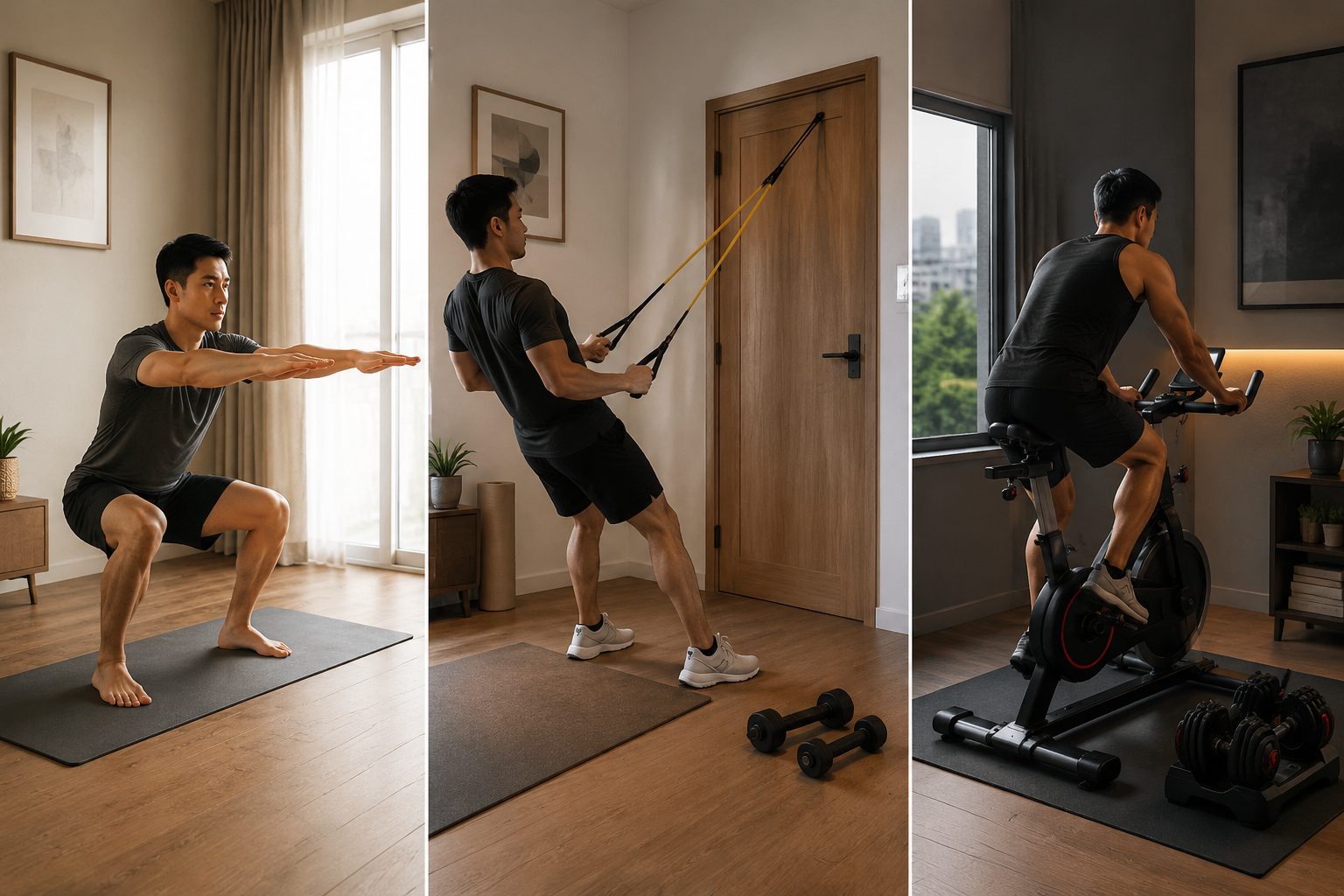
At Orange AQI, a 25–35 minute strength session is reasonable if indoor air is controlled. Build it around rows, presses, hinges, split squats, curls, triceps extensions, carries if you have space, and core work. Keep the circuit spacious: perform a set, put the weights down, breathe normally, then move on. Do not compress the rests just to make it feel like cardio.
| Outdoor move you might want | Tier 2 smoke-day swap | Why the swap is cleaner |
|---|---|---|
| Hill sprints | Band-resisted split squats + band rows | Leg and back work without sprint-level ventilation |
| Tempo run | Light dumbbell Romanian deadlifts + floor press + dead bugs | Strength stimulus with planned rest |
| Boot-camp circuit | Straight sets of band presses, rows, squats, and carries | Less breath stacking than continuous stations |
| Jump-rope finisher | Calf raises, step-back lunges, and mobility | Lower impact and lower breathing demand |
At Red AQI, use 20–25 minutes and bias the session even more toward strength. A good format is 3–5 exercises for 2–3 sets each, with rest that feels slightly too generous. Choose a band tension or dumbbell weight that lets you finish every set without bracing hard or holding your breath. Smoke days are a bad time to grind reps.
At Purple AQI, a Tier 2 setup should feel almost clinical: a few low-rep movements, plenty of rest, no finishers. If you have a HEPA cleaner, run it before and during the session in the smallest practical room. If you do not, the workout should shrink to mobility and very light band activation.
This is also the tier where a portable HEPA cleaner often makes more sense than buying another pair of dumbbells. For smoke-season resilience, cleaner indoor air changes more decisions than a heavier curl weight. If you are still building the setup, the small-space home exercise equipment guide is the place to compare compact upgrades.
Tier 3: indoor cycle or rower sessions need filtration, not bravado
A Tier 3 setup can be the best smoke-season training option because it moves cardio indoors. It can also be the easiest setup to misuse. An indoor cycle in a poorly filtered room is still an exercise machine that makes you breathe more air.
The University of Montana work is worth taking seriously here. In a June 2025 study discussed by The Conversation, a single 2-hour smoky cycling session caused temporary declines in blood vessel function, which rebounded within an hour in clean air.[1] That does not mean every indoor ride during smoke season is dangerous. It does mean long cardio exposure in smoke-affected air deserves less forgiveness than people give it.
At Orange AQI, keep cycle or rower work easy and capped around 20–35 minutes unless you can verify excellent indoor air. You are looking for controlled breathing: no intervals, no threshold testing, no “just one hard block.” Add dumbbell strength after if you want more training effect without extending the cardio exposure.
- Better Orange session: 20 minutes easy cycling, then 2 sets of dumbbell Romanian deadlifts, floor press, rows, and carries.
- Better Red session: 10–15 minutes very easy spin, then 10 minutes of dumbbell strength with full recovery between sets.
- Better Purple session: skip the cardio machine unless indoor air is clearly cleaner; choose mobility, breathing-easy strength, or rest.
At Red AQI, the machine is allowed only if the room is sealed and filtered. Keep the ride or row short, easy, and boring. If you use heart rate, stay below the point where breathing becomes heavy. If you use perceived effort, it should feel like a warm-up you decided not to progress.
At Purple AQI and especially above 300, the indoor cardio machine should stop being the default. Even indoor air may be unhealthy when outdoor levels are extreme, especially in leaky apartments or rooms without adequate filtration.
The shorter-session idea, with the caveat it deserves
One useful but easy-to-abuse idea is that a shorter session may reduce total particulate exposure compared with a much longer easy session. Colorado State University’s Adult Fitness Program discusses this “shorter and harder versus longer and easier” tradeoff based on diesel-exhaust laboratory studies, not wildfire-smoke-specific proof.[7]
So do not turn that into permission for smoky-air HIIT. The practical version is narrower: if the air is marginal, avoid stretching a workout to 60–90 minutes just because the intensity feels easy. A compact 15–25 minute strength-biased session in a cleaner room is usually a better bet than a long indoor cardio session in a questionable one.
Timing can also help, but it is not a guarantee. The Conversation notes that afternoon or evening AQI can sometimes be better than morning because thermal expansion and winds may disperse particulates.[1] Check the current reading rather than assuming the day will improve on schedule.
Common smoke-day mistakes in small home gyms
The riskiest mistakes are usually mundane. They come from treating “indoors” as a complete safety plan.
- Doing HIIT in a room with no filtration because the workout is technically indoors.
- Assuming a window AC removes PM2.5 when it may only cool and move air.
- Vacuuming, frying food, lighting candles, or cooking on a gas stove before training.
- Wearing a cloth mask and treating it as smoke protection.
- Choosing a long “easy” cardio session when the room’s air quality is unknown.
- Leaving the air purifier across the apartment instead of placing it in the room where you will actually breathe hard.
For readers who are not using the tier system yet and just need an emergency indoor pivot, How to Work Out at Home During an Air Quality Alert and Swap Your Outdoor Workout for This Home Routine When Air Quality Is Bad are simpler starting points. If you want more options after the air is handled, use Best Indoor Workouts for Bad Air Quality.
A repeatable protocol for smoky training days
Use the same sequence every time smoke shows up:
- Check the current AQI before deciding on the workout.
- If AQI is Red or worse, do not exercise outdoors.
- Close the room, reduce leaks, use recirculated AC if available, and run HEPA or MERV-13+ filtration when possible.
- Pick the Tier 1, Tier 2, or Tier 3 modification that matches both the outdoor AQI and your confidence in the indoor air.
- Keep the session shorter than usual, avoid breath-stacking, and stop before the workout becomes a ventilation test.
- At AQI 300+, choose rest or very light movement unless you have unusually strong evidence that your indoor air is clean.
Those tools are not lifestyle props. They make it easier to choose the least bad training decision on a bad-air day.
References
- Wildfire smoke can make your outdoor workout hazardous – a sports cardiologist explains why, The Conversation / University of Montana, June 2025.
- Is it safe to exercise outside when air quality is bad? Here’s what Bay Area experts say, San Francisco Chronicle / Public Health Institute.
- Air Quality and Exercise, Stanford Health Care.
- When Smoke is in the Air, AirNow.gov.
- Safety Guidelines: Wildfires and Wildfire Smoke, Centers for Disease Control and Prevention.
- Five Tips to Protect Yourself from Wildfire Smoke, USC Schaeffer Center.
- Exercise and Air Quality, Colorado State University Adult Fitness Program.
Don't have the gear this routine assumes? Find the build that covers it.
Wondering how much rest you need after this? Read our ACSM-cited recovery reference.
Questions about form, substitutions, or a correction? Leave it below.
Comments
Join the discussion with an anonymous comment.