
How to Progress a Full Body Dumbbell Workout When Your Weights Are Maxed Out
If you've outgrown your heaviest dumbbells, this article explains how to keep making gains using tempo, pause reps, unilateral work, and volume adjustments — without buying new weights.
Before you start
- Equipment required
- None
- Assumes build tier
- No specific tier required
There is a very specific kind of frustration that shows up in a full body dumbbell workout after the beginner gains have settled down. You are still training. You are still writing things down. But the heaviest setting on the adjustable dumbbells is already in your hands, and the logbook has stopped giving you the easy answer.
That does not automatically mean the program has failed. It means the progression target has to change. If you cannot add load, you need to make the same load produce a harder, cleaner, more targeted training stimulus — at least until the dumbbells truly become the limiting factor.
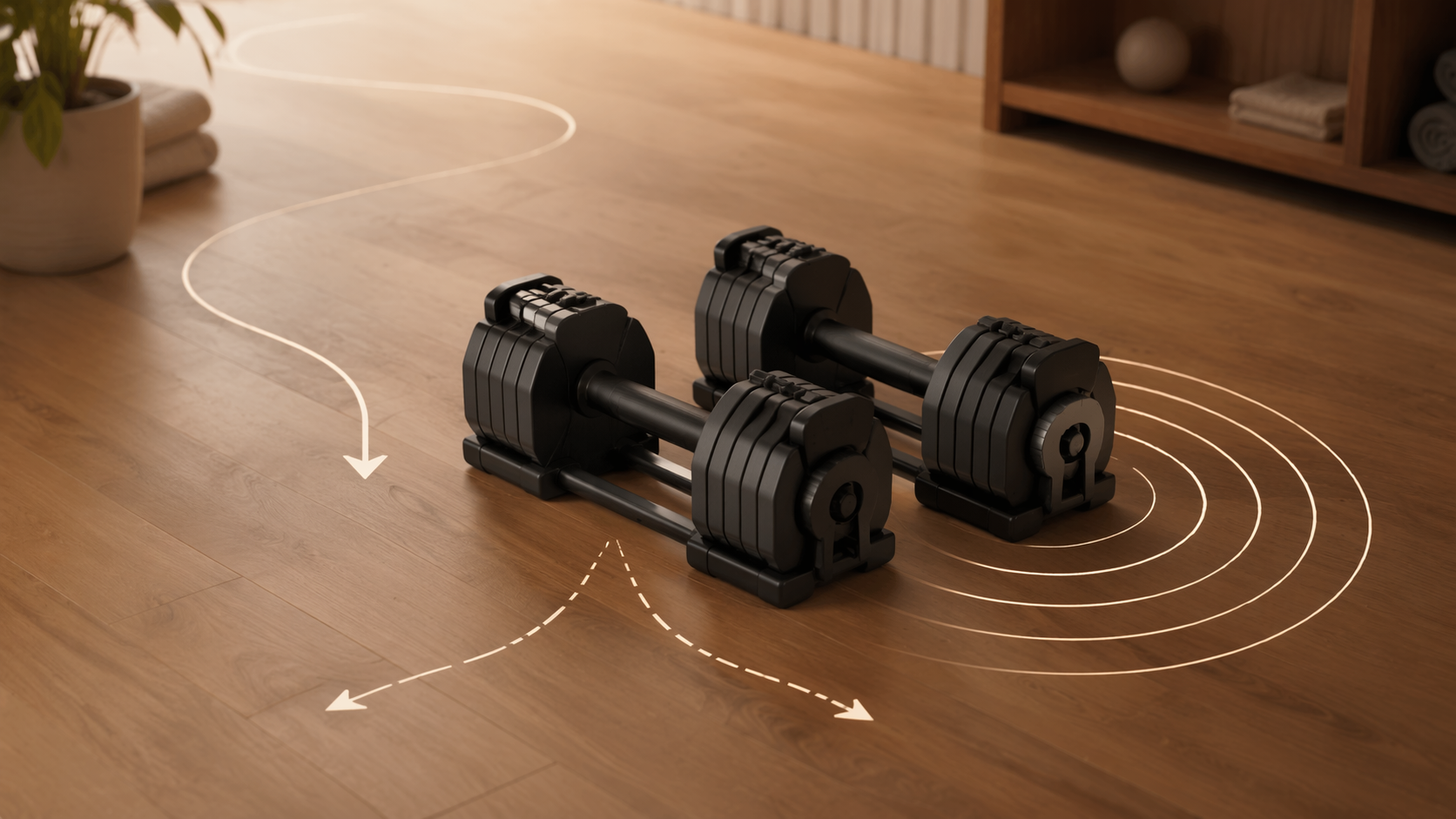
For many home lifters, that ceiling arrives around the top end of an adjustable pair, often roughly 20–25 kg or 45–55 lb per hand. Upper-body lifts may still have room. Lower-body lifts, especially goblet squats and Romanian deadlifts, usually complain first. The fix is not always “buy heavier dumbbells.” Sometimes it is. But it should be the last answer after you have made the current pair work honestly.
First, make sure you are actually hitting a weight ceiling
Before adding pauses, slow eccentrics, split squats, extra sets, and every other intensity trick in the drawer, check whether the lift is really too easy. A lot of “my weights are too light” problems are actually consistency problems hiding inside familiar exercises.
Run this diagnostic on the exercises that feel capped:
- Are the reps clean from the first rep to the last, or are you borrowing range of motion as the set gets harder?
- Is the range of motion the same as it was when the weight first felt challenging?
- Are your rest periods consistent, or did a 90-second rest quietly become three minutes?
- Is the target muscle limiting the set, or is grip, balance, bracing, or breathing ending the exercise first?
- Are you recovering between sessions, or are you trying to solve fatigue with more difficulty?
This matters because advanced progression methods work best when the base lift is already controlled. A three-second lowering phase on a sloppy Romanian deadlift does not make it more advanced. It just gives you more time to practice a position you should probably fix first.
If you are not yet tracking progression systematically, step back to a simple week-by-week structure before adding complexity. A structured progressive overload system for dumbbell training is more useful than guessing whether a set felt hard enough.
The fixed-weight progression hierarchy
When load is capped, progression has to come from somewhere else. The order matters. You want changes that increase stimulus without turning every set into a circus act or making recovery impossible.
| Progression lever | Use it when | Main caution |
|---|---|---|
| Tempo control | The weight is still challenging, but reps are moving too fast to create useful tension | Do not make every rep painfully slow forever |
| Pauses and one-and-a-half reps | You need more difficulty at a specific part of the range | Use where the position is stable and makes mechanical sense |
| More volume | You can recover well and session length is still reasonable | Extra sets stop helping when recovery starts falling apart |
| Unilateral variations | Bilateral lower-body lifts are no longer hard enough | Balance should not become the main limiter |
| Exercise or rep-range changes | The current variation is too efficient or too easy at the available load | Choose harder variations, not novelty for its own sake |
This is also why a good 3-day full-body dumbbell program should feel like a system, not a random pile of dumbbell moves. The outside load is only one variable. Reps, sets, exercise choice, tempo, and range of motion are part of the program too. Bony to Beastly’s full-body dumbbell programming and Muscle & Strength’s three-day dumbbell model both frame the week around repeated full-body exposure rather than isolated, disconnected exercise days.[1][2]
Use tempo first, but do not treat it like magic
Tempo is usually the cleanest first adjustment because it changes the set without changing the exercise. If your goblet squat, press, row, or RDL has turned into a fast drop and a bounce back up, slowing the eccentric makes the same dumbbell demand more control.
A practical starting point is a 3–4 second lowering phase. LoadMuscle presents this kind of tempo manipulation as a way to increase time under tension when heavier loading is unavailable, while also keeping the broader progression logic tied to measurable training variables rather than vibes.[3]
Here is what that looks like in a normal training log:
| Exercise | Before | Tempo progression |
|---|---|---|
| Goblet squat | 3 sets of 12 with the heaviest dumbbell | 3 sets of 10–12 with a 3-second lower |
| Dumbbell RDL | 3 sets of 10, fast eccentric | 3 sets of 8–10 with a 4-second lower and controlled hip position |
| Dumbbell floor press | 3 sets of 12 with loose bottom control | 3 sets of 10–12 with a 3-second lower and steady pause near the floor |
Tempo works best when it makes the target muscle do more work. It works poorly when it turns into counting theater. If you slow the lowering phase but lose bracing, shorten the range, or stop anywhere that makes the lift easier, the rep is not more productive just because it took longer.
Use tempo on the exercises where you can still own the position. Romanian deadlifts, rows, presses, split squats, lateral raises, and goblet squats usually tolerate it well. High-fatigue conditioning-style dumbbell moves usually do not need it. Neither does every warm-up set.
A good rule for the next block: pick two or three main lifts and apply tempo there. Do not slow every rep of every exercise until your full-body session doubles in length and your next workout suffers.
Add pauses and one-and-a-half reps where the position earns them
Pauses and one-and-a-half reps are useful when a lift has a clear hard point you can safely spend more time in. They increase difficulty without needing a heavier dumbbell, especially when the weight already feels close but not quite hard enough.
Good places to use them:
- A one-second pause at the bottom of a goblet squat, if you can keep your torso and pelvis organized
- A pause near the bottom of a dumbbell RDL, if hamstrings and glutes remain the limiter
- A bottom pause in a dumbbell floor press, if your shoulders stay comfortable
- One-and-a-half reps on split squats, lateral raises, curls, or goblet squats
One-and-a-half reps are exactly what they sound like: perform a full rep, move halfway back through the hardest portion, then complete the rep again. For a squat, that might mean down, halfway up, down again, then stand. For a lateral raise, it might mean up, halfway down, back up, then lower with control.
Do not force these onto exercises where the limiting factor becomes awkwardness. A one-and-a-half rep single-leg RDL is often more balance test than hamstring work for home lifters. A paused overhead press can be excellent for some people and shoulder-irritating for others. The method is not the prize. The hard, recoverable set is the prize.
Increase volume before buying weight, but keep the math honest
If you cannot raise the weight, adding a set can still be progression. The simple volume calculation is sets × reps × weight. LoadMuscle uses that volume-based logic to show why progress can continue even when the dumbbell weight stays fixed.[3]
For example, if you keep the same dumbbells and move from 3 sets of 10 to 4 sets of 10, total work has gone up. That is not fake progression. It is just not unlimited progression.
| Week | Load | Sets and reps | Volume direction |
|---|---|---|---|
| Week 1 | Same dumbbells | 3 × 10 | Baseline |
| Week 2 | Same dumbbells | 3 × 11 | Higher |
| Week 3 | Same dumbbells | 3 × 12 | Higher |
| Week 4 | Same dumbbells | 4 × 10 | Higher than baseline with the same load |
The fourth set is most useful for lifts that still feel productive and recoverable. Rows, presses, split squats, RDLs, and curls often tolerate a modest volume increase. Heavy-feeling lower-body work might tolerate it too, but watch what happens to the next session. If adding sets makes your reps uglier, your joints crankier, or your workout too long to repeat consistently, the extra volume has stopped being helpful.
Volume is a lever, not a punishment. Use it when one more set gives you quality work. Stop using it when it mainly gives you fatigue.
For lower body, unilateral work is usually the real unlock
Most people do not outgrow every dumbbell lift at the same time. The lower body gets there first. A pair of maxed-out adjustable dumbbells might still be plenty for lateral raises, curls, presses, and rows, while goblet squats feel like cardio and bilateral RDLs feel like a grip event.
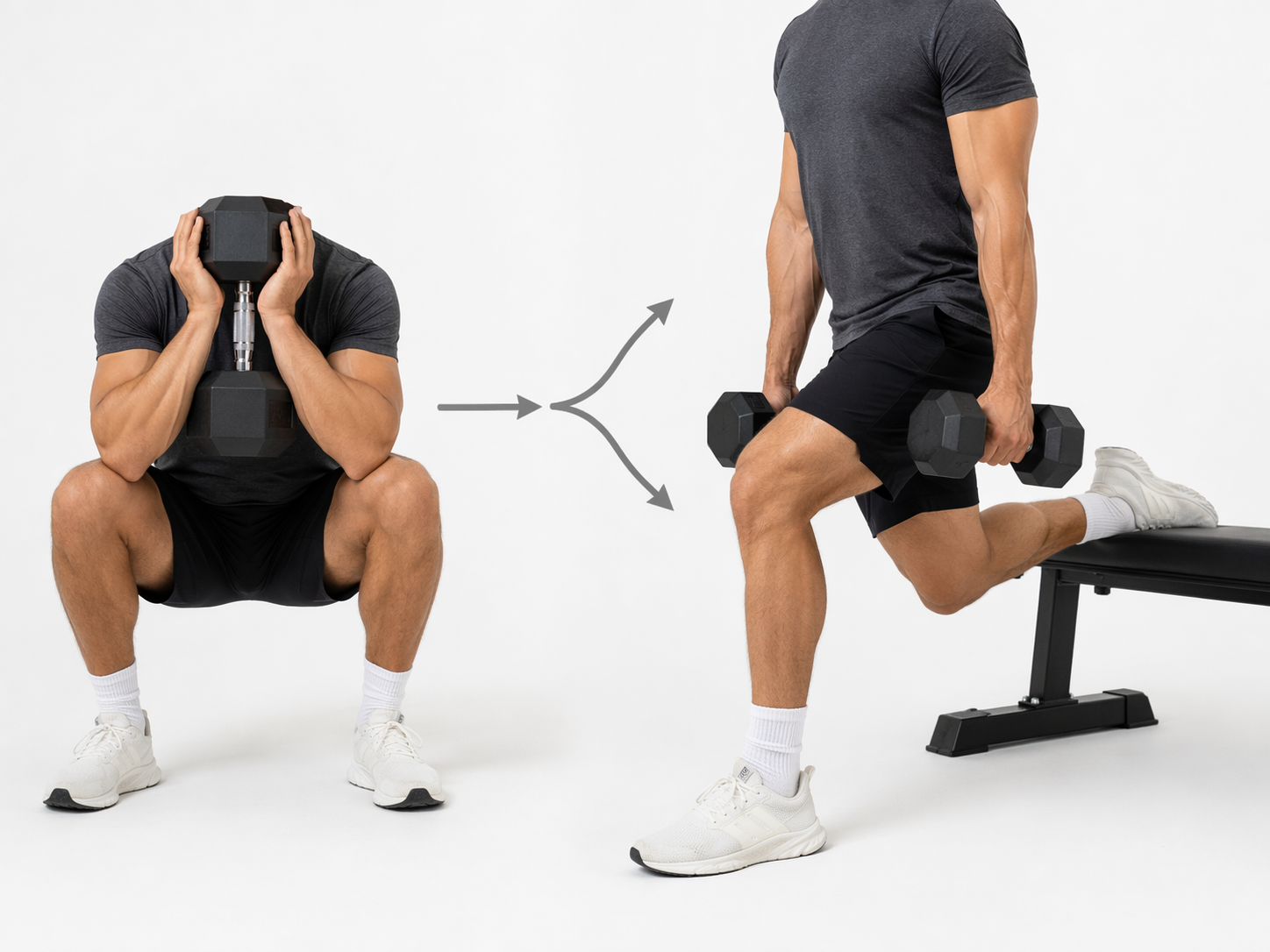
That is where unilateral loading earns its place. A Bulgarian split squat, reverse lunge, step-up, single-leg RDL, or kickstand RDL lets one side do more of the work with the same dumbbells. You have not made the dumbbells heavier, but you have changed the demand on the working leg.
| If this is capped | Try this first | Then consider |
|---|---|---|
| Goblet squat | Bulgarian split squat | Front-foot elevated split squat or slower split squat tempo |
| Dumbbell squat with two dumbbells | Reverse lunge | Step-up with controlled lowering |
| Bilateral dumbbell RDL | Single-leg RDL | Kickstand RDL if balance limits the single-leg version |
| Glute bridge with dumbbell | Single-leg glute bridge | Hip thrust variation with pause at lockout |
The mistake is jumping to the most impressive-looking single-leg variation before you can load it well. If a single-leg RDL makes your foot wobble, your spine rotate, and your hamstring barely notice the work, regress it. A kickstand RDL, where the back foot lightly helps with balance, is often the better training choice. It keeps the emphasis on hip hinging instead of survival.
Bulgarian split squats deserve special mention because they solve the home-training squat ceiling better than almost anything else. They are hard with moderate dumbbells, they do not require much floor space, and they expose side-to-side differences that bilateral squats can hide. They are also easy to overdo. Start with the same rep range you can control, not the one your ego wants because goblet squats used to be easy.
A practical lower-body swap might look like this:
- Day 1: Replace goblet squats with Bulgarian split squats.
- Day 2: Keep dumbbell RDLs, but use a 3–4 second eccentric.
- Day 3: Replace bilateral RDLs with kickstand RDLs or single-leg RDLs.
That is enough change for one block. You do not need to turn every lower-body slot into a maximal balance challenge in the same week.
Change the exercise before you assume the muscle is done adapting
Sometimes the current exercise has simply become too efficient. You know exactly how to brace, where to rest, how to shift the load, and how to survive the set. That skill is useful, but it can also make the fixed weight feel easier than it should.
Exercise selection can make the same dumbbells feel heavier without becoming random. A goblet squat can become a double-dumbbell front squat if your setup allows it. A standard reverse lunge can become a front-foot elevated split squat. A two-arm row can become a one-arm row with a longer pause at the top. A floor press can become a slow eccentric floor press or a single-arm floor press if trunk control is solid.
Rep ranges can shift too. If you have been living at 8–10 reps and cannot add weight, moving into 10–15 or 12–20 reps can keep a hypertrophy-focused block productive. If your goal has changed because the weight cap makes pure strength work harder to pursue, a goal-specific dumbbell program for strength, hypertrophy, or fat loss can help you stop forcing one progression model onto every outcome.
A simple way to build your next 4-week block
Do not add every lever at once. If you change tempo, volume, exercise selection, and rep ranges in the same week, your logbook will stop telling you what worked.
Use this instead:
- Choose the lifts that are truly capped. Leave the lifts that are still progressing alone.
- Add tempo to one or two main exercises, usually a 3–4 second lowering phase.
- For lower-body bilateral lifts that are no longer hard, swap to unilateral or kickstand variations.
- If recovery is good, add one set to selected exercises rather than to the entire workout.
- Track reps, sets, tempo, rest, and variation names so the next block is based on evidence, not memory.
A capped dumbbell block might look like this in the log:
| Lift | Old progression | New progression target |
|---|---|---|
| Goblet squat | Add weight when reps hit the top of the range | Bulgarian split squat, then add reps before adding tempo |
| Dumbbell RDL | Add weight | Keep weight, use 4-second eccentric, then add reps |
| Dumbbell row | Add weight | Add pause at top or add a fourth set |
| Dumbbell floor press | Add weight | Add reps, then controlled bottom pause |
| Lateral raise | Add weight | Add reps in a higher range with strict control |
The important part is that each change has a job. Tempo improves control and time under tension. Unilateral work raises the relative demand per side. Volume increases total work. Exercise changes remove the easiest path through the movement. If you know why you made the change, you can judge whether it helped.
When buying heavier dumbbells is the right answer
There is a point where programming creativity becomes avoidance. If unilateral variations, tempo, pauses, reasonable rep-range changes, and a modest volume increase no longer create hard sets with good form, you may have outgrown the setup for that exercise.
This is most likely on lower-body patterns. If Bulgarian split squats, single-leg or kickstand RDLs, and controlled higher-rep work are all recoverable but not meaningfully challenging, heavier dumbbells or a different loading option becomes a training decision, not an impulse purchase.
Before spending, decide what problem you are solving. If you need heavier loading across many lifts, compare broader options with a home gym system cost breakdown. If space is the main constraint, use a small-space equipment buying guide before you turn a living room into a storage problem.
The next move is simple: pick one or two progression levers for the next block, write them into the program, and track them as carefully as you used to track weight increases. Maxed-out dumbbells are a programming constraint first. For some lifters and some lifts, they eventually become a real equipment limit. Your logbook will tell you which one you are dealing with.
References
- 3-Day Full-Body Dumbbell Workout, Bony to Beastly, https://bonytobeastly.com/3-day-full-body-dumbbell-workout
- 3 Day Full Body Dumbbell Workout, Muscle & Strength, https://www.muscleandstrength.com/workouts/3-day-full-body-dumbbell-workout
- Full Body Dumbbell Workout, LoadMuscle, https://loadmuscle.com/blog/full-body-dumbbell-workout
Don't have the gear this routine assumes? Find the build that covers it.
Wondering how much rest you need after this? Read our ACSM-cited recovery reference.
Questions about form, substitutions, or a correction? Leave it below.
Comments
Join the discussion with an anonymous comment.