Rock Climbing Training at Home on a $0–100 Budget
A practical guide to training for rock climbing at home without breaking the bank or your landlord. Covers a $0 bodyweight circuit and renter-friendly hangboard options for under $100.
Before you start
- Equipment required
- none
- Assumes build tier
- No specific tier required
- Duration
- 25 minutes
- Difficulty
- beginner
- Noise level
- quiet
If you rent, cannot drill, and have $0–100, rock climbing training at home has to start with constraints before ambition. The useful question is not whether you can recreate a climbing gym in your apartment. You cannot, at least not on this budget and not without making your lease nervous. The useful question is whether you can train the pulling, pushing, core tension, posterior-chain strength, balance, and finger control that make gym sessions more productive.
Here is the short decision path before any gear talk gets louder than it deserves to be.
| Budget tier | Best move | Who it fits | Main limit |
|---|---|---|---|
| $0 | Run a 20–30 minute bodyweight circuit 2–3 times per week | Newer climbers, renters, anyone without a safe mount | No direct replacement for real climbing or progressive finger loading |
| $40–70 board, plus mount cost | Consider a minimalist hangboard only after enough climbing base | Climbers with at least about a year of regular climbing experience | No-drill mounting can cost more than the board |
| About $90 board, plus mount cost | Choose a nicer budget wooden board if comfort matters and the mount still works | Experienced home trainers who will actually follow a progression | Still not automatically safer or more useful than the cheaper edge |
Prices and models in this article are a Q3 2026 snapshot, using budget hangboard pricing published in February 2026 and renter-mounting information available from current product guides. Treat load ratings and mount capacities as buying information, not as a promise that your specific doorframe, trim, bar, body weight, and technique are safe together.
Start With the $0 Circuit
A good no-equipment climbing session should not feel like random calisthenics with the word “climbing” taped to it. This circuit is a curated synthesis from climbing-focused bodyweight exercise recommendations, including training-anywhere drills, home exercises for climbers, no-equipment strength work, and off-wall movement practice; no single source prescribes this exact session as written here.[1][2][3][4]
Do it as a circuit, not as a maximal strength test. Move well, keep two or three reps in reserve on hard movements, and stop any finger exercise that produces sharp pain. The goal is to arrive at your next climbing session more prepared, not to turn your living room into the place where your pulleys learned regret.
| Block | Exercise | Time or reps | Why it belongs |
|---|---|---|---|
| Warm-up | Wrist circles, shoulder circles, scapular pushups, easy air squats | 3–4 minutes | Raises temperature and wakes up shoulders, wrists, hips, and knees before harder loading |
| Pull | Door-frame rows or table rows, if the setup is unquestionably stable | 6–10 reps | Trains pulling and scapular control without needing a pull-up bar |
| Push | Raised-leg diamond pushups or regular pushups | 6–12 reps | Builds pressing strength and shoulder balance for climbers who mostly pull |
| Core | Plank variation, side plank, or slow mountain climbers | 30–45 seconds | Trains body tension for keeping feet connected to holds |
| Posterior chain | Superman holds or glute bridges | 20–40 seconds | Counters the curled climbing posture and supports hip extension |
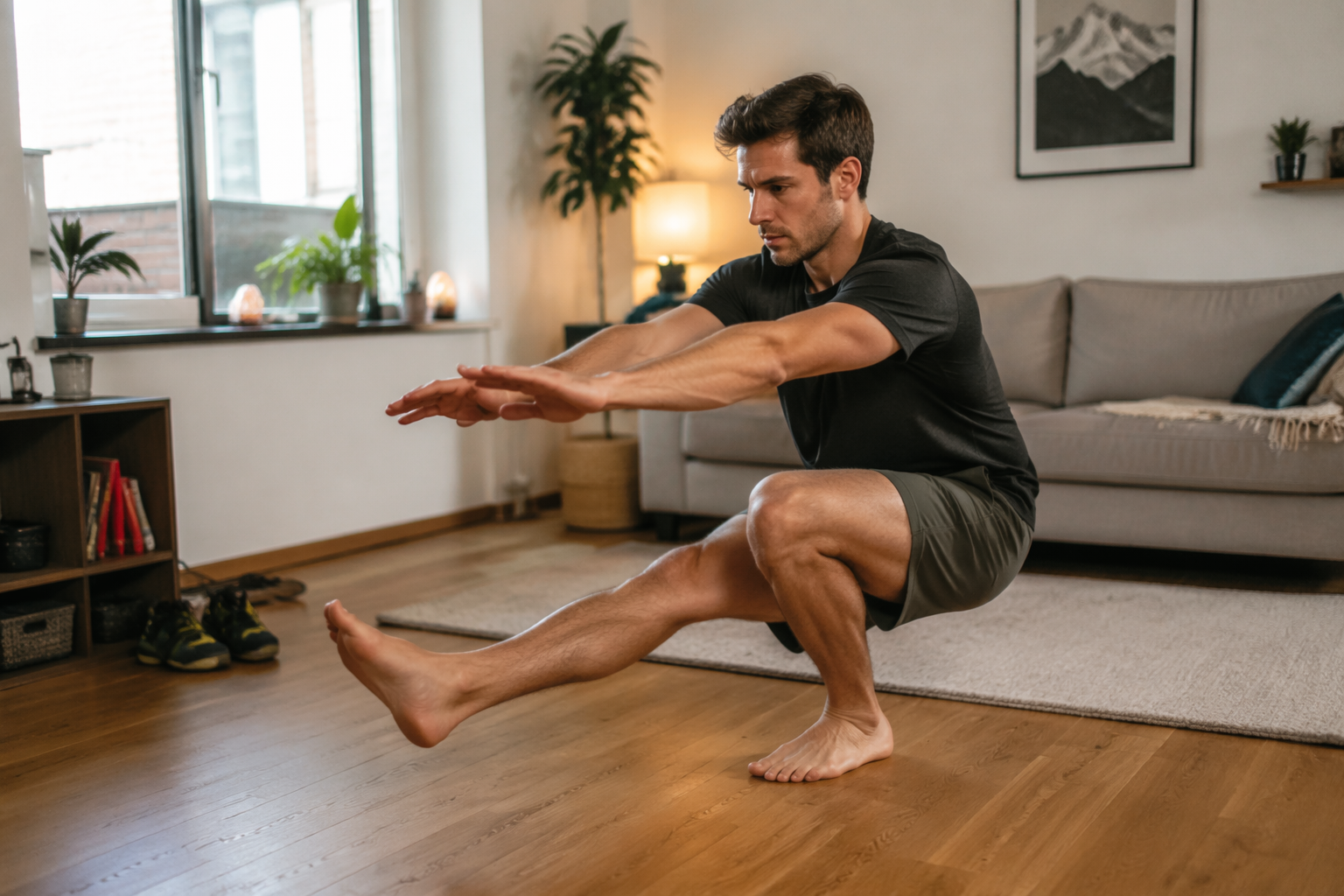
| Leg strength and balance | Pistol squat progression, split squat, or controlled step-down | 5–8 reps per side | Trains single-leg control for high steps, rock-overs, and quiet feet |
| Power option | Stair jumps or squat jumps | 5–8 controlled reps | Adds lower-body explosiveness if your knees and downstairs neighbor allow it |
| Finger tension, optional | Finger plank on the floor or very light door-frame fingertip contact | 10–20 seconds | Introduces hand tension without full-body hanging |
Run 2–4 rounds depending on your current fitness. Rest 30–60 seconds between exercises if quality drops. Most people can finish two rounds in about 20 minutes and three rounds in under 30 minutes if they do not turn every transition into a phone break.
How to Scale It Without Buying Anything
For pulling, a sturdy table row is useful only if the table is heavy, stable, and shaped in a way that will not tip. If that sentence creates doubt, skip it. Use prone Y-T-W raises, scapular pushups, and slow reverse snow angels instead. They are less satisfying than hauling on a bar, but they still train shoulder positioning and control.
For legs, pistol squats do not need to be full pistols. Use a chair behind you, hold a doorframe lightly for balance, or swap in split squats. A climber who can lower under control, keep the knee tracking cleanly, and stand back up without collapsing inward is getting useful work.
For core, avoid chasing the longest plank in the room. Climbing asks for tension that transfers between hands and feet. A shorter plank with ribs down, glutes on, and controlled breathing beats a two-minute sagging plank that trains you to tolerate bad position.
For fingers, stay conservative. Finger planks and light fingertip contact can help you learn tension, but they are not a license to max out on a doorframe. Apartment trim was not designed as a training tool, and your fingers are not impressed by rent-friendly bravado.
When a Hangboard Is Not the Next Step
A hangboard is simple in the same way a sharp knife is simple. The object is not complicated; the consequences of using it badly can be. The safety boundary for this budget plan is plain: if you do not have roughly a year of regular climbing experience, stay with the $0 circuit and actual climbing for now.
That rule is not gatekeeping. Newer climbers usually improve fastest by climbing, learning footwork, building shoulder capacity, and letting connective tissues adapt gradually. Finger strength training is more specific, more measurable, and easier to overdo than most bodyweight work. A board does not know whether your fingers are ready.
Skip hangboarding for now if any of these apply:
- You have been climbing less than about one year.
- You currently have finger, wrist, elbow, or shoulder pain.
- Your only mounting option is a questionable doorframe, thin trim, hollow-core door, or improvised anchor.
- You know you will turn every session into a max hang contest.
- You cannot warm up properly before hanging.
If the board is appropriate, the point is not to buy the most dramatic one. For beginner and early-intermediate home training, a usable edge and a safe mounting path matter more than a museum wall of pockets.
The Under-$100 Hangboard Decision
The budget promise gets slippery here because the board and the mount are separate costs. A $40 board is not a $40 setup if you cannot drill. A renter-safe mount can add more than the board itself.
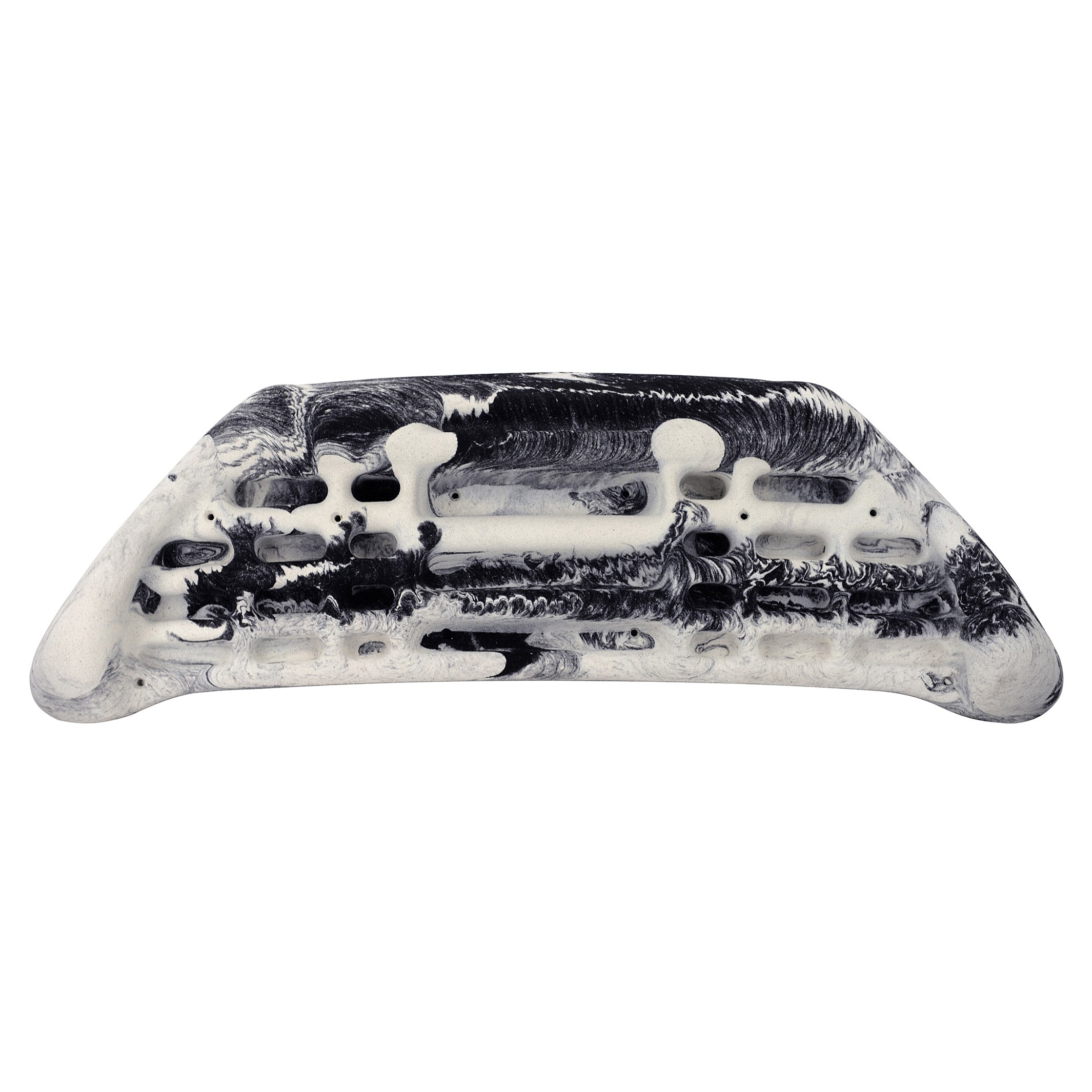
In The Hangboard’s February 2026 budget guide, the Metolius Contact Training Board is listed around $35–45 and described as the cheapest serious hangboard worth buying. The same guide also lists The Hangboard at $89.99 as a premium-feeling budget option with wood quality and hold design positioned below the $100 mark.[5]
| Option | Board price snapshot | Why consider it | What to watch |
|---|---|---|---|
| Metolius Contact Training Board | About $35–45 in February 2026 budget listings | Lowest-cost serious board; includes useful edge options including a 20mm edge | Resin texture can feel less skin-friendly than wood; no-drill mounting likely pushes total cost higher |
| The Hangboard | $89.99 in February 2026 budget listings | Wood construction and more premium hold feel while staying under $100 for the board alone | Leaves almost no room in a $100 budget once renter mounting is included |
The important training detail is not the logo. A 20mm edge asks your fingers to do 20mm-edge work whether the board costs about $40 or much more. Expensive boards may feel better, offer more hold variety, or be kinder to skin, but they do not magically make basic repeaters more productive.
Why the Mount Can Decide the Budget
For renters, the cheapest safe-looking board can become less cheap once it needs somewhere to live. The Hangboard’s renter mounting guide lists dedicated no-drill pull-up bar and backboard setups at about $45–70 excluding the board itself, and says these setups support full-body-weight training when properly installed.[6]
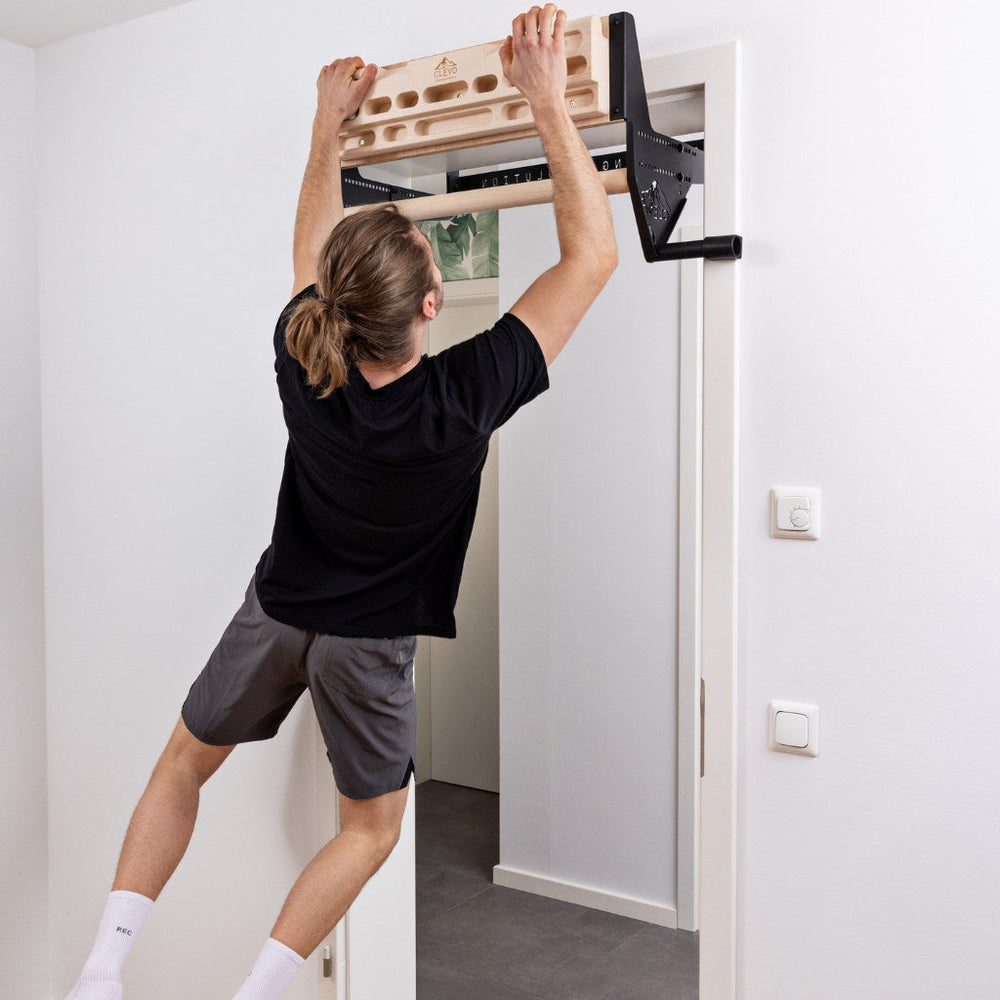
Dedicated door-frame mounts such as Frictitious and CLEVO are also reported with capacities around 285 lb or 130 kg, but those figures come from product specifications and guide reporting rather than a guarantee about your apartment’s trim or your installation.[6][7]
This is where the under-$100 ceiling becomes conditional. A Metolius Contact board plus a $45–70 no-drill mounting setup may land roughly inside or just above the budget depending on the actual price you find. The $89.99 wooden option can stay under $100 only if you already have a compatible, safe mount or use a lower-cost hanging method that the manufacturer supports.
| Setup | Approximate cost | Lease impact | Practical verdict |
|---|---|---|---|
| $0 bodyweight circuit | $0 | No holes, no mount, no gear storage problem | Best default choice for newer climbers and cautious renters |
| Metolius Contact plus no-drill backboard setup | About $80–115 using cited board and mount snapshots | No drilling if the doorway and mount are compatible | Most realistic low-cost hangboard path, but not always truly under $100 |
| The Hangboard plus existing safe mount | About $89.99 for the board alone | Depends entirely on the mount you already have | Good if you want wood feel and do not need to buy the mounting system |
| The Hangboard plus new no-drill mount | About $135–160 using cited snapshots | No drilling if compatible | Still budget-minded, but outside the article’s strict $100 ceiling |
A Beginner Hangboard Progression That Stays Boring on Purpose
If you have the climbing base, a safe mount, and no current pain, keep the first hangboard block almost disappointingly controlled. 99Boulders’ beginner plan uses 10-second hangs with 30 seconds of rest, progressing over eight weeks from 3 sets of 4 reps to 5 sets.[8]
| Weeks | Work | Rest | Total volume target |
|---|---|---|---|
| 1–2 | 10-second hangs | 30 seconds between hangs | 3 sets of 4 reps |
| 3–4 | 10-second hangs | 30 seconds between hangs | Add volume only if all hangs feel controlled |
| 5–6 | 10-second hangs | 30 seconds between hangs | Build toward 4–5 sets |
| 7–8 | 10-second hangs | 30 seconds between hangs | Up to 5 sets if pain-free and consistent |
Warm up first with easy movement, shoulder activation, and easier grip loading before any 20mm-edge work. Keep the grip open-handed or half-crimped unless you have coaching and a clear reason to do otherwise. Do not add weight. Do not test max hangs at the end because the session felt too easy. Easy is part of the design.
Place hangboarding after a warm-up and before a tiring strength circuit, or on a separate short day. Tired fingers make sloppy decisions. If you climb the same day, put serious fingerboard work before hard climbing only if you know how your body responds; otherwise separate the stress so you can tell what caused the soreness.
The progression rule is simple: add only one thing at a time. More sets, smaller edge, shorter rest, extra weight, and more sessions are all separate changes. For this budget plan, the first two months do not need heroics. They need repeatable, pain-free exposure.
Putting the Week Together
The home plan should support climbing, not crowd it out. If you climb once or twice per week, two short home sessions are usually enough. If you are brand new, make both home sessions the $0 circuit. If you are ready for hangboarding, replace one circuit with a short hangboard session rather than stacking everything into a single punishment block.
| Experience level | Home training week | Gear |
|---|---|---|
| Less than about one year of regular climbing | 2–3 bodyweight circuits; no hangboarding | $0 |
| About one year or more, no pain, no safe mount | 2 bodyweight circuits; keep climbing; wait on the board | $0 |
| About one year or more, safe mount available | 1 beginner hangboard session plus 1 bodyweight circuit | $40–100+ depending on board and mount |
| Experienced and consistent | 1–2 hangboard sessions only if recovery stays good, plus selected strength work | Budget board is still enough for basic edge training |
A simple week might look like this: climb on Tuesday, run the bodyweight circuit on Thursday, climb on Saturday, and do a short mobility or shoulder-control session on Sunday. For an experienced climber with a safe hangboard, Thursday could become the 10-second hang session followed by a shortened circuit without extra finger work.
That kind of week is not flashy, which is one reason it works in an apartment. It does not require moving furniture, explaining chalk clouds, or patching holes. It also leaves enough recovery to actually climb.
The Practical Buy-or-Wait Call
Buy nothing if you are new, inconsistent, injured, or unsure about mounting. The $0 circuit gives you plenty to do: stronger shoulders, better single-leg control, more trunk tension, and a habit of training without needing perfect conditions.
Consider the Metolius Contact route if you have the climbing base, want the lowest-cost serious board, and can solve the mount safely. It is the cleanest budget answer because the training edge does not need to be expensive to be useful. Just price the mounting system before declaring victory.
Consider the $89.99 wooden option if you already have a safe mount or you value skin feel enough to spend nearly the whole board budget there. It is still a budget board, but once a new no-drill mount enters the cart, the full setup moves beyond a strict $100 article.
Meaningful rock climbing training at home under $100 is realistic. The catch is that the best first purchase may be no purchase at all. Build the routine first, earn the need for the board, and make the mount pass the same test as the workout: useful, repeatable, and not something your fingers or landlord will make you regret.
References
- How to Train Everywhere and Anywhere, Climbing.com
- 7 Home Workout Exercises for Rock Climbers, AMC
- No Equipment Necessary: 10 Body Weight Exercises, Rockstar Volumes
- Ten Off-The-Wall Exercises to Improve Your Climbing, Three Rock Books
- Best Budget Hangboards Under $100, The Hangboard, February 2026
- Hangboard for Renters: No-Drill Mounting Options, The Hangboard, February 2026
- 6 Best Hangboards for Climbing of 2026 (Tested), Treeline Review, 2025
- Hangboard Training for Beginners: A Simple 8-Week Workout, 99Boulders
Don't have the gear this routine assumes? Find the build that covers it.
Wondering how much rest you need after this? Read our ACSM-cited recovery reference.
Questions about form, substitutions, or a correction? Leave it below.
Comments
Join the discussion with an anonymous comment.