
Storm Cancelled Your Outdoor Workout? Try This No-Equipment Routine
When a storm cancels your outdoor run or ride, this 18–25 minute no-equipment indoor circuit matches the effort type of your planned session. You'll get a complete warm-up, bodyweight HIIT or sustained cardio work depending on your original plan, and a cool-down—all in about 6x6 feet of space with quiet modifications for apartment dwellers.
Before you start
- Equipment required
- none
- Assumes build tier
- No specific tier required
- Duration
- 20 minutes
- Difficulty
- beginner
The storm canceled the session, you are already dressed, and the move now is to match the effort type before the window of motivation closes. If the outdoors is unsafe, stay in and swap the planned run, ride, or hike for a short indoor circuit that keeps the same training purpose instead of turning the day into a random hard workout.
Brooks treats bodyweight circuits and stair climbs as legitimate substitutes when you cannot run outside, and Runner's World recommends matching the indoor session to the original workout by RPE or heart rate rather than by pace [1][2].
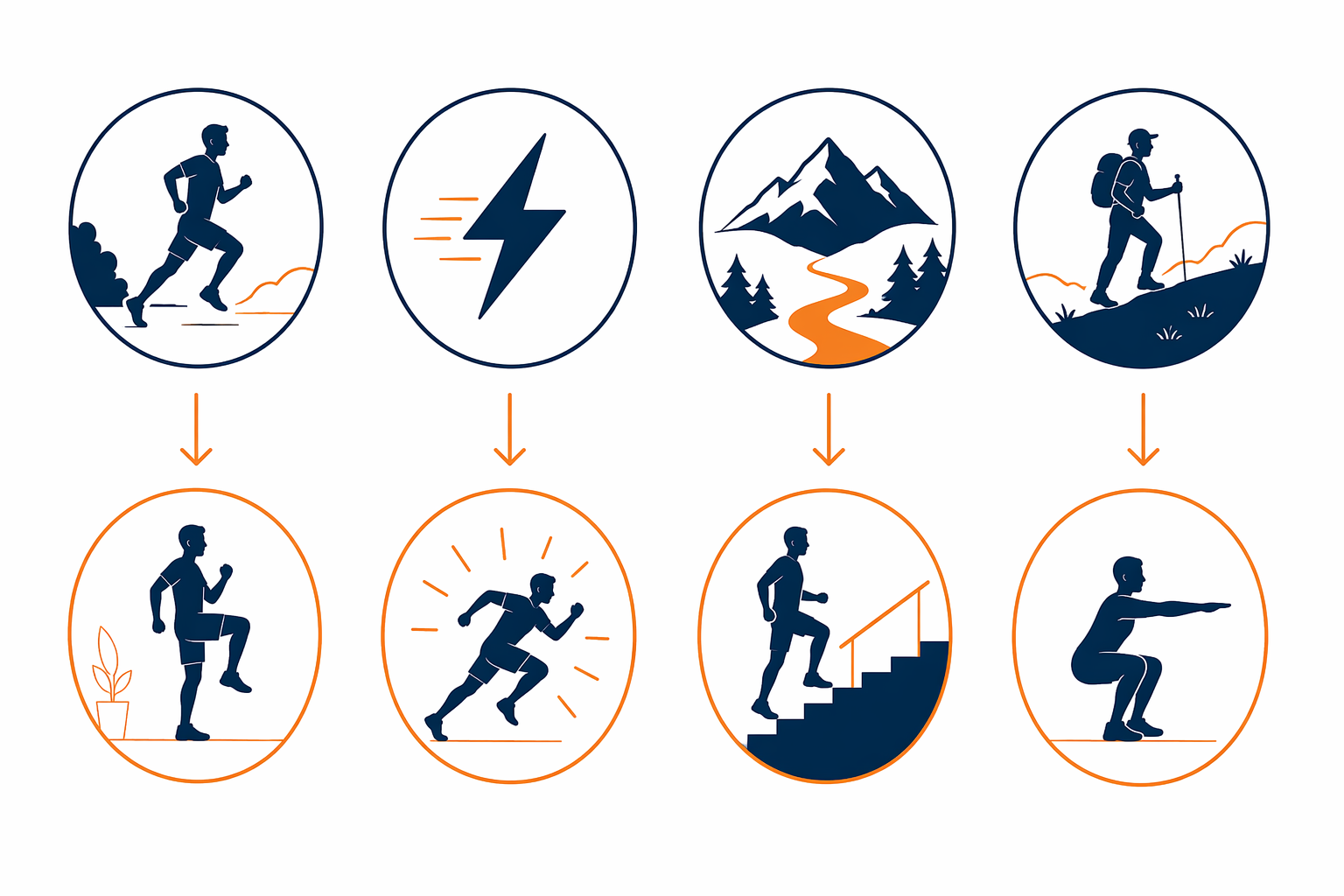
Choose the Replacement
| Cancelled session | Indoor match | What to keep | Quiet apartment swap |
|---|---|---|---|
| Easy run | Sustained low-impact cardio | Conversational breathing and steady output | March, step up, or slow mountain climb without jumping |
| Speedwork or intervals | Bodyweight HIIT | Sharp effort and short recovery | Fast squats instead of squat jumps; shoulder taps instead of plank jacks |
| Long run | Stairs or step-ups plus density work | Leg demand and aerobic grind | Use stairs, step-ups, and controlled split squats with no pounding |
| Strength hike | Loaded bodyweight circuit | Time under tension and steady leg fatigue | Keep it bodyweight if that is all you have, or use a backpack only if it is already available |
Run the 20-Minute Version
Set a timer for 4 minutes of warm-up, 10 minutes of work, and 3 to 4 minutes of cool-down. The main set uses five rounds of 20 seconds on and 10 seconds off, so the whole replacement stays in the 18 to 25 minute range without feeling like a second full training day.
- Warm-up: 4 minutes total. Move through marching in place, ankle circles, hip hinges, easy bodyweight squats, arm swings, and a few slow lunges. Keep the first minute almost too easy so the circuit feels like a replacement, not a shock.
- Easy run replacement: 5 rounds of march with arm drive, alternating step-ups, lateral step-touches, and slow mountain climbers. Keep the pace smooth enough that you could still talk. This preserves the easy aerobic feel better than a random hard video.
- Speedwork replacement: 5 rounds of fast air squats or squat jumps, push-ups, reverse lunges, and plank shoulder taps or mountain climbers. If you share walls or floors with neighbors, drop the jumps and keep the moves crisp, quick, and quiet instead.
- Long run replacement: 5 rounds of stairs or step-ups, split squats, wall sits or glute bridge marches, and calf raises. Keep the pace steady and unbroken. MIT Recreation uses stairs for exactly this kind of gravity-based leg and cardio demand in a small footprint [3].
- Strength hike replacement: 5 rounds of slow squats, reverse lunges, step-ups, and a loaded hold or march only if a backpack or other household weight is already handy. If not, keep the work bodyweight and slow the lowering phase so the legs still have something real to do.
- Cool-down: 3 to 4 minutes. Walk slowly in place until your breathing settles, then hold a calf stretch, quad stretch, hip flexor stretch, and easy forward fold for about 20 to 30 seconds each.
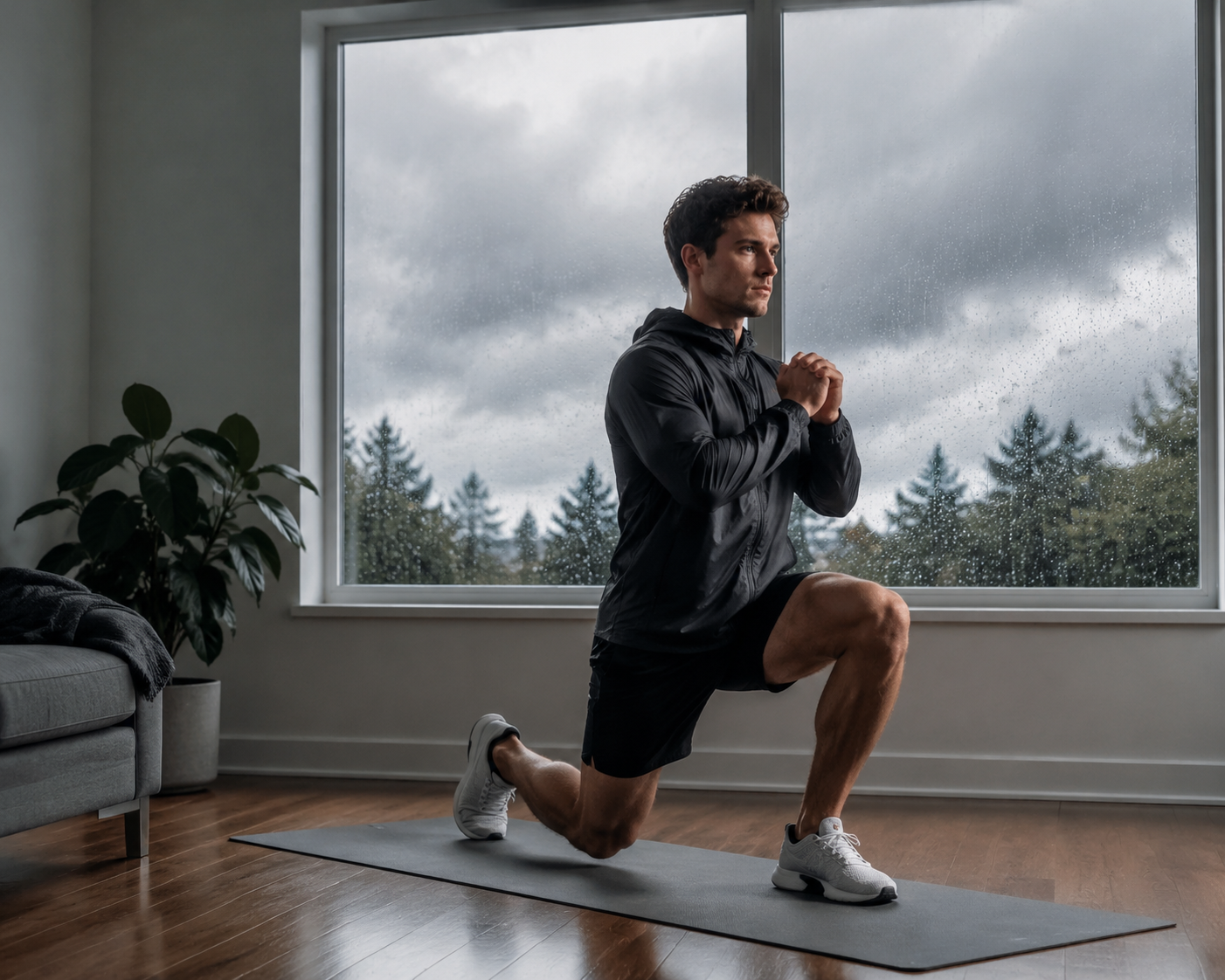
For apartment floors, the quiet version is simple: remove jumps, keep both feet close to the ground, use step-ups instead of hops, and choose shoulder taps over plank jacks when the room needs to stay calm. The point is not perfect recreation of the outdoor route; it is preserving the stimulus without disturbing the building.
Why This Holds Up
Fitness Connection and Run Project both publish storm-day or rainy-day bodyweight circuits, which makes the move list above feel like a practical substitute rather than an improvised consolation prize [4][5]. One 2019 study indexed in PMC found that a 20-minute functional bodyweight HIIT circuit produced VO2max improvements similar to running-based HIIT, so a short no-equipment swap can still be meaningful even though that is only one study, not a universal rule [6].
If storms keep interrupting training, the next useful reads are the no-jump HIIT guide, the bodyweight training evidence piece, the wildfire-smoke indoor alternative, and the small-space home gym build pages. For today, the decision stays simple: keep the effort type close enough, and the day is not wasted.
References
- 3 Alternatives to Running When You Can't Make It Outside, Brooks Running.
- Indoor Run Workout: Tips for Moving Your Run Workout Indoors, Runner's World.
- Indoor Snow Day Workout, MIT Recreation.
- No Rain Checks: Try Out the Perfect At-Home Exercise Circuit for Stormy Days, Fitness Connection.
- 5 Workouts to Try Indoors on a Rainy Day, Run Project.
- 2019 PMC study on functional bodyweight HIIT and running-based HIIT, PMC.
Don't have the gear this routine assumes? Find the build that covers it.
Wondering how much rest you need after this? Read our ACSM-cited recovery reference.
Questions about form, substitutions, or a correction? Leave it below.
Comments
Join the discussion with an anonymous comment.