
A Weekly Exercise Routine for GLP-1 Weight Loss
This weekly exercise routine helps people on GLP-1 medications preserve muscle while losing weight, using only bodyweight or a pair of dumbbells in a small apartment space. It includes day-by-day sessions for 4-5 days per week, with modifications for common side effects.
Before you start
- Equipment required
- bodyweight or dumbbells
- Assumes build tier
- No specific tier required
- Difficulty
- beginner
- Noise level
- quiet
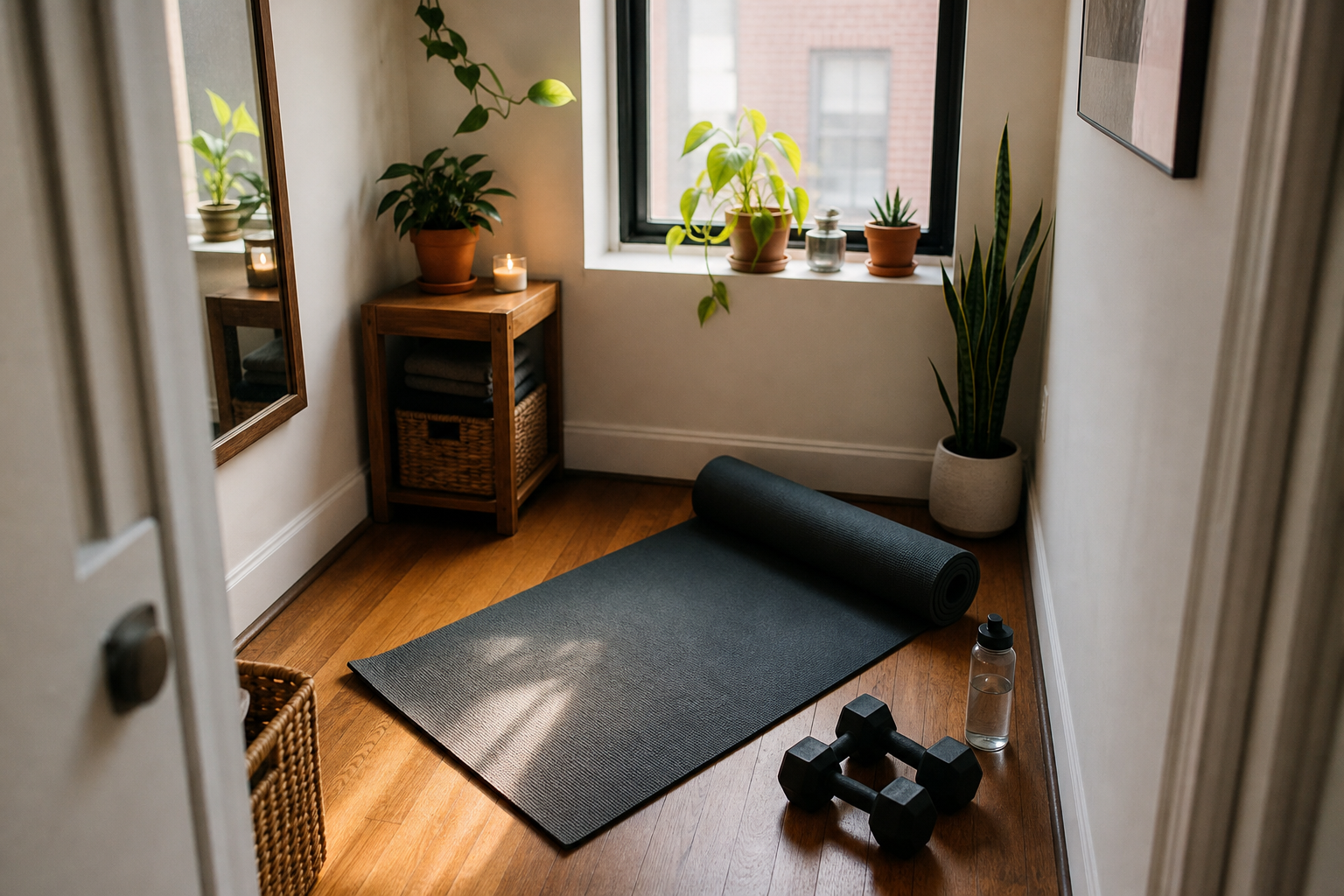
If you are taking Ozempic, Wegovy, Mounjaro, Zepbound, or another GLP-1 medication, your weekly exercise routine does not need to look like a gym program. It needs to be repeatable on a low-appetite week: 4 to 5 days, 20 to 30 minutes at a time, using bodyweight or one pair of dumbbells in roughly a 6-by-6-foot space.
The goal is not to burn off the medication-assisted weight loss. The goal is to give your muscles a reason to stay while your body weight changes. Some analyses have estimated that 25% to 39% of weight lost on GLP-1s can come from lean mass, though estimates vary and some later expert commentary suggests the muscle-loss concern may be less severe than early headlines implied.[1][2] That is still enough reason to train, just not enough reason to panic.
The Weekly Routine at a Glance
Use this as your default week. If medication side effects are strongest during a certain day after your dose, place the easiest day there. If you are brand new to exercise or the first few weeks on medication feel rough, start with 3 days and use the gentler 8-week beginner routine for GLP-1 weight loss before adding more.
| Day | Session | Time | Bodyweight tier | Dumbbell tier |
|---|---|---|---|---|
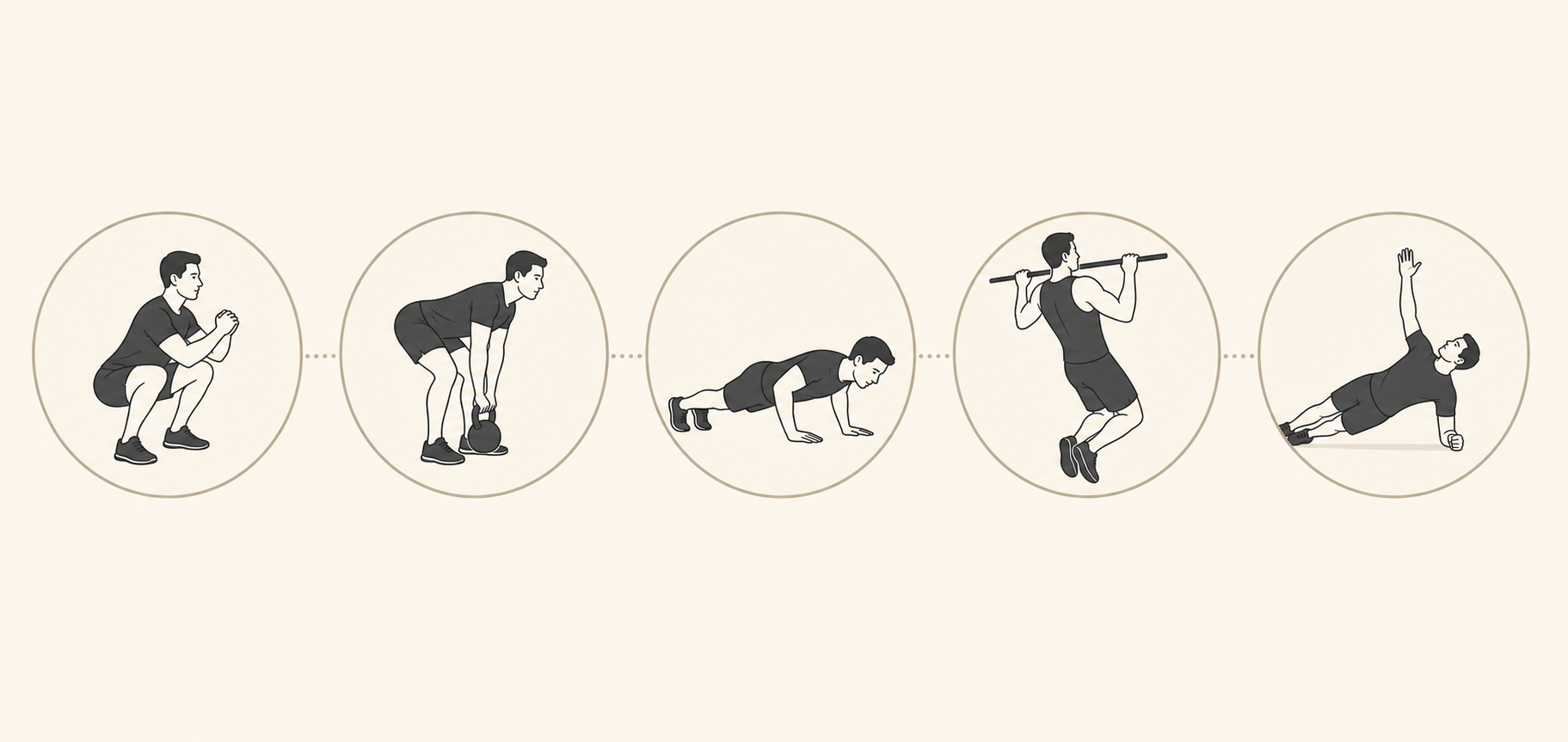
| Day 1 | Full-body strength A | 20-30 min | Squat, incline push-up, glute bridge, towel row, dead bug | Goblet squat, floor press, Romanian deadlift, one-arm row, dead bug |
| Day 2 | Low-impact cardio + mobility | 20-30 min | Indoor walk, step touches, mobility | Same, no dumbbells needed |
| Day 3 | Full-body strength B | 20-30 min | Reverse lunge, hip hinge, wall push-up, prone pull, side plank | Reverse lunge, dumbbell Romanian deadlift, overhead press, row, suitcase hold |
| Day 4 | Rest, short walk, or nausea-day reset | 10-25 min | Easy walk or mobility only | Same |
| Day 5 | Strength + easy conditioning | 20-30 min | Sit-to-stand, push-up variation, bridge march, plank, low-impact circuit | Squat-to-press, row, deadlift, carry, low-impact circuit |
| Day 6 | Optional walk or gentle cardio | 20-40 min | Comfortable walk | Same |
| Day 7 | Rest | 0-20 min | Light mobility if wanted | Same |
This gives you 3 resistance-training days and 2 to 3 low-impact aerobic days. That lines up with common guidance for adults to do 2 to 3 strength sessions per week and work toward 150 minutes of moderate aerobic activity, though those targets are adapted from broader adult guidelines rather than a perfect GLP-1-specific exercise rulebook.[1][2]
How Hard Each Session Should Feel
Most sets should end with 2 to 3 good reps still available. That matters. If you train to exhaustion while eating less than usual, the workout may punish you more than it helps you. If you finish every set feeling as if you could do 10 more reps, the signal may be too quiet.
- Use a slow warm-up: 3 to 5 minutes of marching in place, shoulder circles, hip hinges without weight, and easy squats to a chair.
- Use a controlled pace: lower for about 2 seconds, pause briefly, then stand or press with control.
- Stop a set when form changes: knees collapse, back rounds, shoulders shrug, or breathing feels panicky.
- Keep water nearby, and avoid jumping or fast up-and-down transitions if nausea is active.
For the first month on a GLP-1, short sessions are not a compromise. Beginner guidance commonly starts with 10 to 15 minutes and builds from there because side effects and appetite changes can be most noticeable early.[3]
Day 1: Full-Body Strength A
Day 1 is your cleanest muscle-retention session: squat, push, hinge, pull, and core. Do 2 rounds the first week. Move to 3 rounds when you can finish without nausea, dizziness, or next-day soreness that changes how you walk.
| Pattern | Bodyweight option | Dumbbell option | Reps or time |
|---|---|---|---|
| Squat | Chair squat or sit-to-stand | Goblet squat | 8-12 reps |
| Push | Wall or counter push-up | Dumbbell floor press | 8-12 reps |
| Hinge | Glute bridge | Dumbbell Romanian deadlift | 8-12 reps |
| Pull | Towel row around a sturdy post or door-safe setup only | One-arm dumbbell row | 8-12 reps per side |
| Core | Dead bug | Dead bug holding one light dumbbell over chest | 6-10 reps per side |
A chair squat is not a lesser exercise. It gives you a consistent depth, keeps the session quiet for downstairs neighbors, and lets you train your legs when balance or low energy would otherwise turn squats into a negotiation. If the goblet squat makes you brace well and stand tall, use it. If it makes you hold your breath or feel reflux, set the weight down.
For the push movement, choose the version that lets your ribs stay down and your neck relaxed. Wall push-ups are fine. Counter push-ups are harder. Floor push-ups are optional, not required. If you have dumbbells, the floor press is apartment-friendly because the floor limits shoulder range and removes the need for a bench.
The hinge is the movement most beginners skip because it feels less obvious than a squat. Keep it. Hinging trains the glutes and hamstrings, which are large muscle groups worth preserving during weight loss. In a Romanian deadlift, slide the hips back as if closing a drawer behind you, keep the weights close to your thighs, and stop before your back wants to round.
Day 2: Low-Impact Cardio Without Turning It Into a Diet Punishment
Day 2 should feel easier than Day 1. The simplest version is a 20- to 30-minute walk. If weather, safety, or time makes that unrealistic, walk indoors in small loops, march in place, or alternate step touches with slow mobility.
- 5 minutes: easy walk or march in place
- 10-15 minutes: alternate 1 minute brisk walking with 1 minute easy walking
- 5 minutes: slow walking, calf raises, chest opener, and gentle hip flexor stretch
Moderate cardio means you can speak in short sentences, not sing comfortably. If you are nauseous, recently ate, or feel under-fueled, stay below that. A quiet walk still counts as keeping the week alive.
Day 3: Full-Body Strength B
Day 3 changes the angles without changing the purpose. You still train legs, hips, upper body, and trunk, but the movements challenge balance and posture differently. Do 2 to 3 rounds.
| Pattern | Bodyweight option | Dumbbell option | Reps or time |
|---|---|---|---|
| Single-leg squat pattern | Supported reverse lunge or split squat hold | Reverse lunge holding dumbbells at sides | 6-10 reps per side |
| Hinge | Hands-on-hips good morning | Dumbbell Romanian deadlift | 8-12 reps |
| Vertical or angled push | Wall push-up with slow lower | Seated or standing dumbbell overhead press | 6-10 reps |
| Pull | Prone W raise on the floor | One-arm dumbbell row | 8-12 reps per side |
| Core and carry | Side plank from knees | Suitcase hold or march | 15-30 seconds per side |
Reverse lunges are optional if they irritate your knees or feel wobbly. A split squat hold, with one hand on a wall or chair, can be the better small-space choice. You are not trying to prove balance; you are trying to load the legs safely enough to repeat the session later in the week.
For overhead pressing, sit down if standing makes you arch your back. If pressing overhead bothers your shoulders or increases nausea, use another round of floor presses instead. The program works because the pattern is trained consistently, not because every exercise is sacred.
Day 4: The Side-Effect Buffer Day
Day 4 is where this routine stays realistic. If you feel normal, take a 20- to 25-minute easy walk or do gentle mobility. If you feel nauseous, tired, constipated, lightheaded, or simply under-fed, this becomes a 10-minute reset.
| How you feel | Do this | Skip this |
|---|---|---|
| Mild nausea | Slow walk, seated breathing, gentle shoulder and hip mobility | Burpees, crunches, fast circuits, deep forward folds |
| Low energy | One easy round of Day 1 or a 10-minute walk | Heavy dumbbells, high-rep leg work, training to failure |
| Under-fueled | Mobility only or postpone strength to tomorrow | Intervals, long workouts, anything that makes you shaky |
| Normal | Easy cardio or full rest | Adding a hard workout just because you feel guilty |
A buffer day is not a loophole. It is how you avoid the all-or-nothing pattern that makes home routines disappear. One missed strength day can slide to the next day. Two bad days can become walking and mobility. You do not need to make up every skipped set.
Day 5: Strength Plus Easy Conditioning
Day 5 is the third resistance session, which is enough for most beginners to build a weekly muscle-preservation habit. Keep it simple: 2 rounds if the week has been rough, 3 rounds if you feel steady.
| Block | Bodyweight option | Dumbbell option | Dose |
|---|---|---|---|
| Strength 1 | Sit-to-stand | Squat-to-press with light dumbbells | 8-10 reps |
| Strength 2 | Incline push-up | One-arm row | 8-12 reps |
| Strength 3 | Bridge march | Dumbbell deadlift | 8-12 reps |
| Core | Forearm plank from knees or elevated hands | Suitcase carry or suitcase hold | 15-30 seconds |
| Conditioning | Step touch, march, or low step-up | Same without weights | 4-8 minutes easy |
The conditioning finisher should not hijack the workout. Stay low impact. No jumping is required. If you live above someone, step touches and marching work better than high knees. If you feel reflux when you move fast after eating, separate meals and workouts more generously or keep the finisher as a slow walk.
Days 6 and 7: Optional Cardio, Real Rest
Day 6 is optional because the rest of your life still counts. If you want the fifth training day, walk for 20 to 40 minutes at a comfortable pace. If you are trying to move closer to the general 150-minute weekly aerobic target, this is the easiest place to add time.[1]
Day 7 can be full rest. Stretch if it feels good. Do not turn it into another strength day unless you are recovering well, eating enough, and sleeping well. More work is not automatically better when appetite is suppressed.
The Five Movement Patterns That Make Short Workouts Work
Short home workouts are useful when they stop wasting slots. A 25-minute session cannot afford six tiny variations for the same muscle. It needs compound movements: exercises that train more than one joint or muscle group at a time.
| Pattern | Why it matters | Small-space examples |
|---|---|---|
| Squat | Trains quads, glutes, and everyday standing strength | Chair squat, goblet squat, sit-to-stand |
| Hinge | Trains glutes, hamstrings, and posterior-chain strength | Glute bridge, good morning, dumbbell Romanian deadlift |
| Push | Trains chest, shoulders, and triceps | Wall push-up, incline push-up, dumbbell floor press |
| Pull | Trains upper back and helps balance pushing work | Dumbbell row, prone W raise, safe towel row setup |
| Core | Trains bracing and trunk control without endless crunches | Dead bug, side plank, suitcase hold |
This is also why one pair of dumbbells is enough for a long time. You can make a movement harder by adding reps, slowing the lowering phase, pausing at the bottom, adding a round, or choosing the dumbbell version. If you want a longer progression after this week feels stable, use an 8-week GLP-1 strength training plan at home instead of improvising harder workouts every few days.
How to Modify on Nausea, Low-Appetite, or Low-Energy Days
The mistake is waiting for a perfect day. The other mistake is forcing a normal workout when your body is giving you obvious stop signs. Use a smaller menu.
If You Are Nauseous
Keep your head above your heart, move slowly, and avoid exercises that fold or compress your abdomen. That usually means skipping crunches, burpees, mountain climbers, fast squats, and quick floor-to-standing transitions. Choose walking, wall push-ups, chair squats, seated dumbbell presses, or mobility.
If You Are Under-Fueled
Reduce the workout before your form falls apart. Do one round instead of three. Use bodyweight instead of dumbbells. Turn the day into a walk. If you feel shaky, faint, or unusually weak, stop the session and treat that as information, not a character flaw.
If You Miss a Day
Do not restart the week. Move the missed strength session to the next available day and drop the optional cardio if needed. The priority order is simple: get 2 strength sessions in during a rough week, 3 during a normal week, and add walks where they fit.
If Dumbbells Feel Like Too Much
Use the bodyweight tier for the whole week. If you want a softer equipment option later, a beginner resistance band workout for GLP-1 users can bridge the gap between bodyweight and weights.
Why This Modest Routine Is Enough to Start
During weight loss, resistance training acts like a signal. It tells the body that muscle is still being used. Clinical and fitness guidance for people taking GLP-1 medications commonly emphasizes 2 to 3 weekly strength sessions for that reason.[1][2] This routine gives you three, without assuming a squat rack, machines, or a room large enough for lunging across the floor.
The cardio in this plan has a different job. It supports heart health, daily movement, and weight-maintenance habits, but it should not replace strength work. A walk-only plan may feel easier to start, and walking is useful, but it does not load the major muscle groups the same way squats, hinges, presses, rows, and carries do.
Protein matters too, especially when appetite drops. A commonly cited target for people using GLP-1 medications is about 1.0 to 1.5 grams of protein per kilogram of body weight per day, though the right amount can vary with body size, medical conditions, and clinician guidance.[4] In practice, that means strength training and protein should support each other: train the muscle, then give your body enough building material to maintain it.
Exercise may also matter beyond muscle. In one 2024 report discussed by Healthline, people using liraglutide who did not exercise lost hip and spine bone density, while those who combined cardio and resistance training maintained it.[5] Another 2024 Danish randomized trial, as reported by several health outlets, found that supervised exercise while using GLP-1 medication improved weight-loss maintenance one year after stopping the drug.[5] Those findings do not mean this exact apartment plan has been proven to produce the same outcomes. They do support the larger point: movement is part of protecting the body that is losing the weight.
For more background on the muscle-preservation side, read how to do strength training on Ozempic to prevent muscle loss. If you are planning for life after tapering or stopping medication, the home workout plan after weight-loss medication is the better next step.
A Simple Progression for the Next Four Weeks
Keep the exercises mostly the same for at least four weeks. Beginners often change workouts right when the body is starting to learn them. Progress should look boring from the outside.
| Week | Strength sessions | What to progress | What to keep easy |
|---|---|---|---|
| Week 1 | 2-3 sessions | Learn the movements; use 1-2 rounds if needed | Cardio stays comfortable |
| Week 2 | 3 sessions if recovery is good | Add reps within the listed range | No hard intervals |
| Week 3 | 3 sessions | Add a third round to one or two workouts | Keep Day 4 as a buffer |
| Week 4 | 3 sessions | Use slightly heavier dumbbells or slower tempo if ready | Do not chase soreness |
Progress only one thing at a time. Add reps before weight. Add a round before making every movement harder. If medication dose changes bring side effects back, return to the previous week’s version.
What Counts as a Good Week
A good week is not the one with the most sweat. It is the one you can repeat.
- Minimum week: 2 strength sessions plus 1 or 2 easy walks
- Standard week: 3 strength sessions plus 2 walks or low-impact cardio sessions
- High-energy week: 3 strength sessions plus 3 cardio or walking sessions
- Bad side-effect week: 1 short strength session, mobility, walking as tolerated, then resume
Preserving muscle on GLP-1s is not about becoming a gym person. It is about repeating a small, compound, side-effect-aware week often enough that weight loss does not mean becoming weaker.
References
- Why Exercise Is Important While Taking GLP-1s — Cleveland Clinic
- Fitness for People Taking GLP-1 Agonists — Mass General
- A Beginner Strength Training Workout for People on GLP-1s — SELF
- Diet, exercise still important when taking weight-loss medication — Harvard T.H. Chan School of Public Health
- GLP-1s and exercise: Why it's essential and how to do it — Healthline
Don't have the gear this routine assumes? Find the build that covers it.
Wondering how much rest you need after this? Read our ACSM-cited recovery reference.
Questions about form, substitutions, or a correction? Leave it below.
Comments
Join the discussion with an anonymous comment.