
In a small apartment, the question is not only whether adjustable dumbbells or resistance bands can build strength. Both can. The harder question is what happens around the set: the sound when a handle touches the floor, the vibration that travels through joists, the mat you have to leave out, the rack beside the couch, and the roommate or downstairs neighbor who did not sign up for your last heavy set.
That is why the usual “adjustable dumbbells vs resistance bands” debate often starts in the wrong place. For a garage gym, load progression may dominate the decision. For a dorm, wood-frame apartment, or shared-wall unit, livability belongs in the first paragraph. A tool that is theoretically better but practically annoying at 9:30 p.m. is not better for the person who actually has to live with it.
The strength question is less dramatic than equipment marketing makes it sound. A 2019 meta-analysis in SAGE Open Medicine reviewed 8 randomized controlled trials with 224 participants and found statistically indistinguishable strength gains between elastic resistance and conventional resistance. For upper limbs, the standardized mean difference was −0.11 with p = 0.48; for lower limbs, it was 0.09 with p = 0.52.[1] That does not mean bands and dumbbells feel the same, load the same, or fit every exercise equally well. It does mean small-space buyers can stop treating bands as the “less serious” option by default.
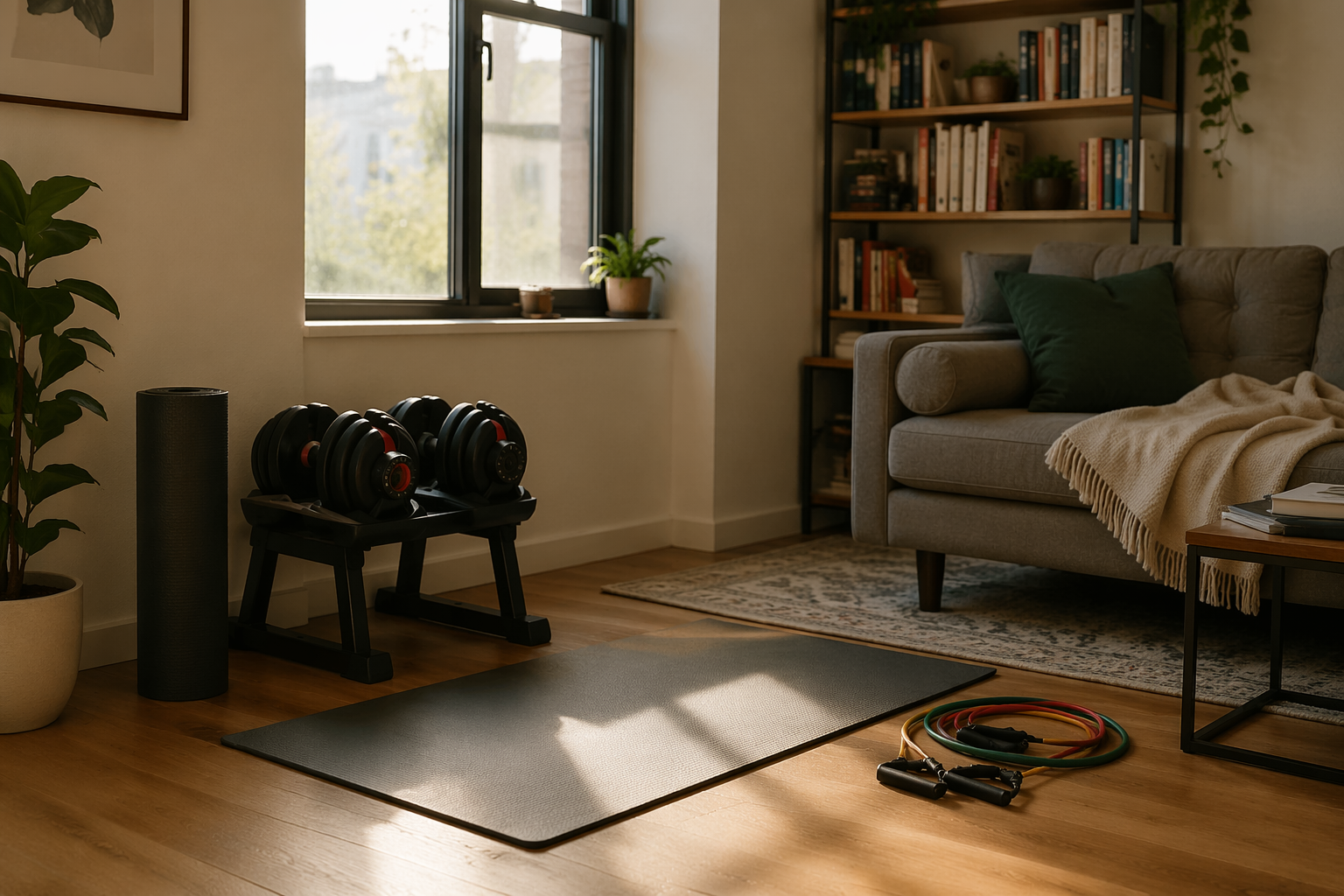
Once strength is not the tiebreaker, the apartment decides
Adjustable dumbbells are wonderfully clear. You choose a load, press or pull it, and the next jump is visible. That certainty matters. It is especially useful for heavy compounds, simple progression, and exercises where a stable external load feels easier to standardize than band tension.
But the dumbbell is never only the dumbbell in a small room. It is the pair of handles, the plates or adjustment mechanism, the stand or rack, the rubber mat, the path from rack to exercise spot, and the rule you silently make for yourself: never lose control of this thing near the floor. That rule is easy to respect when you are fresh. It feels more important at the end of a hard set, when your grip is tired and the person below you is probably trying to sleep.
Resistance bands ask for a different kind of attention. They do not give the same neat weight number, and their resistance changes through the range of motion. Anchors, handles, and band angle matter. Heavy lower-body loading can become awkward sooner than it does with dumbbells. Still, their apartment behavior is hard to ignore: they take little space, do not need a rack, and do not send a hard object into the floor when a set ends.
Noise is where the comparison stops being theoretical
Airborne sound is the sound people hear directly: a selector clicking, a handle tapping, a band snapping back against a door anchor, a metal sleeve shifting. Structure-borne vibration is different. That is the low, traveling impact from weight meeting floor, and in apartments it can feel louder downstairs than it sounds in the room where it happened.
QuietStrengthLab reports that dumbbells dropped from shoulder height can exceed 75 dB, roughly a vacuum-cleaner-level warning point, while bands operate around 30–40 dB, quieter than normal conversation.[2] That dumbbell figure should be treated as illustrative rather than a universal lab measurement. The exact sound depends on flooring, mat thickness, dumbbell design, drop height, and building construction. Still, anyone who has trained above another unit knows the basic pattern: the problem is rarely a controlled curl. It is the accidental contact, the rushed re-rack, or the exhausted set-down.
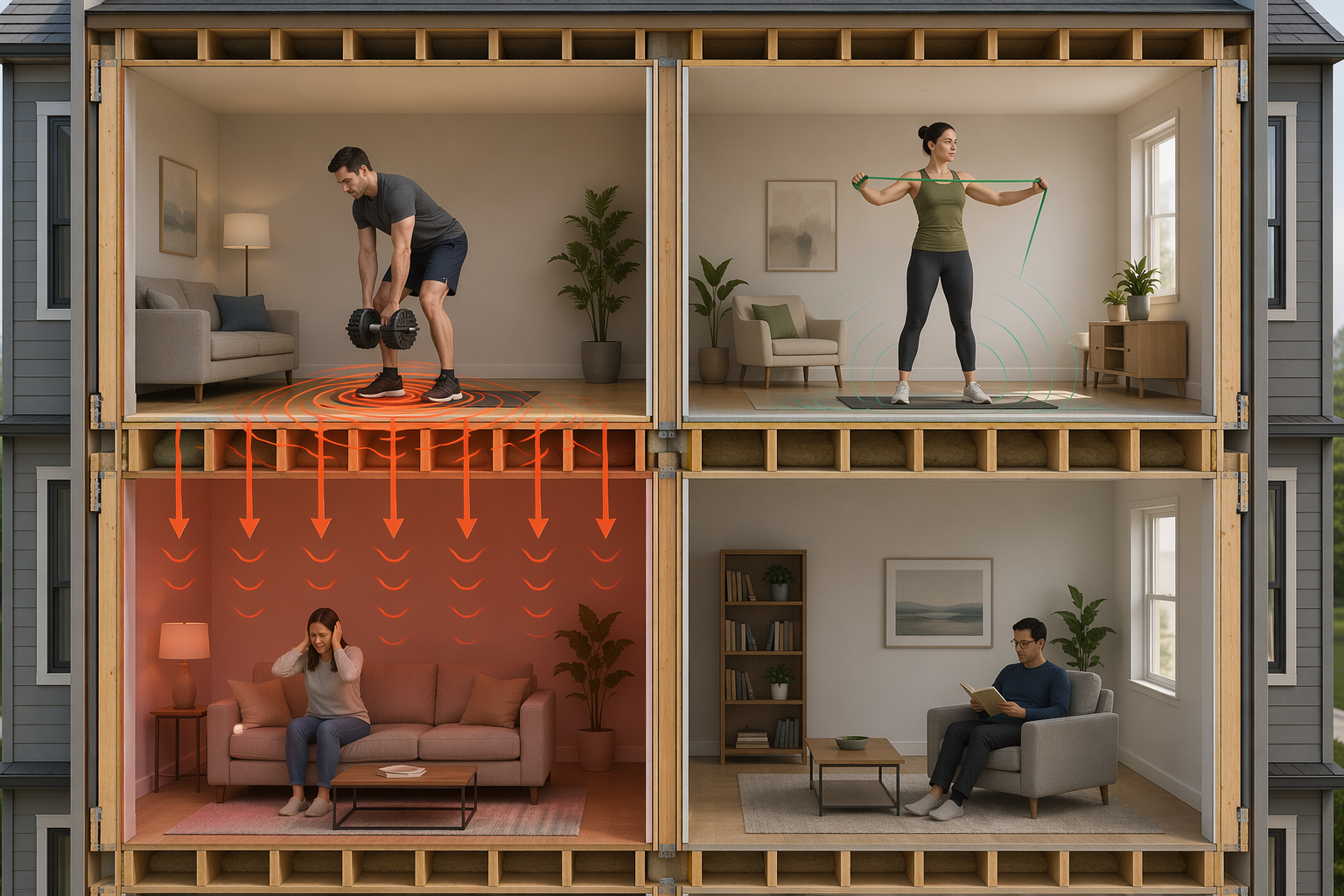
Bands are not magically silent. A band can slap against a door, a carabiner can click, and a poorly placed anchor can creak. Cheap handles can squeak under tension. But these are mostly small, correctable noises. Move the anchor, control the return, wrap contact points, or change the angle. With dumbbells, the main risk is mass meeting the building.
That distinction matters most during quiet hours. A late band session can still be inconsiderate if you let the hardware snap around, but it can be made genuinely low-profile. A late dumbbell session requires more trust: trust in your grip, your mat, your floor, and your ability to stay careful when the set gets hard.
Floor risk is not just about scratches
Renters tend to think about visible damage first: dents in vinyl plank, scuffs in hardwood, cracked tile, marks where a rack sat for a year. Those are real concerns. A 50-lb adjustable dumbbell set with a rack can occupy about 5–6 square feet, and dumbbell setups commonly need rubber matting that adds roughly $200–400 in floor-protection cost.[2] Bands, by contrast, can fold down to paperback-book size and do not require floor protection for ordinary use.[2]
The less visible issue is vibration transmission. A rubber mat can soften contact and protect the surface, but it does not turn a wood-frame apartment into a concrete slab. Heavy dumbbells still carry mass, and a careless set-down can travel through the structure. Bands produce no structure-borne vibration in the same way because the resistance comes from stretched elastic tension rather than a falling or shifting load.[2]
This is where building type changes the verdict. In a wood-frame apartment, especially an older one with bouncy floors, dumbbells demand caution. You can train with them, but the setup needs rules: thick matting, no drops, controlled transitions, and neighbor-friendly hours. In a concrete building, the same dumbbells become easier to justify. The floor may still need protection from dents and scuffs, but vibration is less likely to become the main event.
| Living situation | Better default | Why |
|---|---|---|
| Wood-frame apartment | Resistance bands | Lower vibration risk and no floor-protection requirement |
| Concrete building | Adjustable dumbbells or hybrid | Heavier loading is easier to manage when vibration is less of a concern |
| Dorm or shared bedroom | Resistance bands | Paperback-size storage and easier quiet-hour use |
| Daytime-only training with tolerant neighbors | Adjustable dumbbells or hybrid | Noise risk is easier to manage when the building is awake |
| Early morning or late-night training | Resistance bands | Lower sound profile and no heavy set-downs |
Storage is obvious, but daily friction is not
The storage comparison is almost unfair. A complete band system can disappear into a drawer, backpack, closet bin, or the corner of a bookshelf. Adjustable dumbbells are compact compared with a full rack of fixed dumbbells, but they are still furniture-adjacent. If they sit on a rack, that rack becomes part of the room. If they sit on the floor, the floor becomes a small obstacle course.
What matters more than the square footage is whether you resent the setup. A living room workout has to reverse itself. The mat rolls back up. The coffee table moves back. The dumbbells return to the stand without a clank. The band anchor comes out of the door before someone opens it. Small frictions decide whether the equipment gets used on a busy Tuesday.
Bands win the reset test. They are fast to put away and easy to keep out of sight. Dumbbells win the readiness test if you have a dedicated corner: no anchor setup, no band selection puzzle, no angle adjustment. You walk over, choose a load, and lift. In a small apartment, that dedicated corner is the luxury.
Training feel: clean load jumps versus elastic tension
Adjustable dumbbells feel familiar because gravity is consistent. A 35-lb dumbbell is 35 lb whether you are tired, annoyed, or trying to finish before dinner. That makes progression easy to record. It also makes certain movements simpler to coach yourself through: presses, rows, split squats, Romanian deadlifts, lateral raises, curls, and loaded carries if the room allows them.
Bands change resistance as they stretch. That can be useful: many movements become hardest near lockout, and bands are excellent for warmups, pull-aparts, rows, presses, assisted mobility work, and accessory training. It can also complicate comparisons from week to week. Standing an inch farther from the anchor changes the set. So does grip width, band age, and the point where tension begins.
For heavy lower-body work, dumbbells are usually more straightforward. For quiet upper-body volume, joint-friendly accessories, travel-like storage, and sessions where the main goal is to train without announcing it to the building, bands are difficult to beat. The research says both can build strength; the room decides which one you will use consistently.
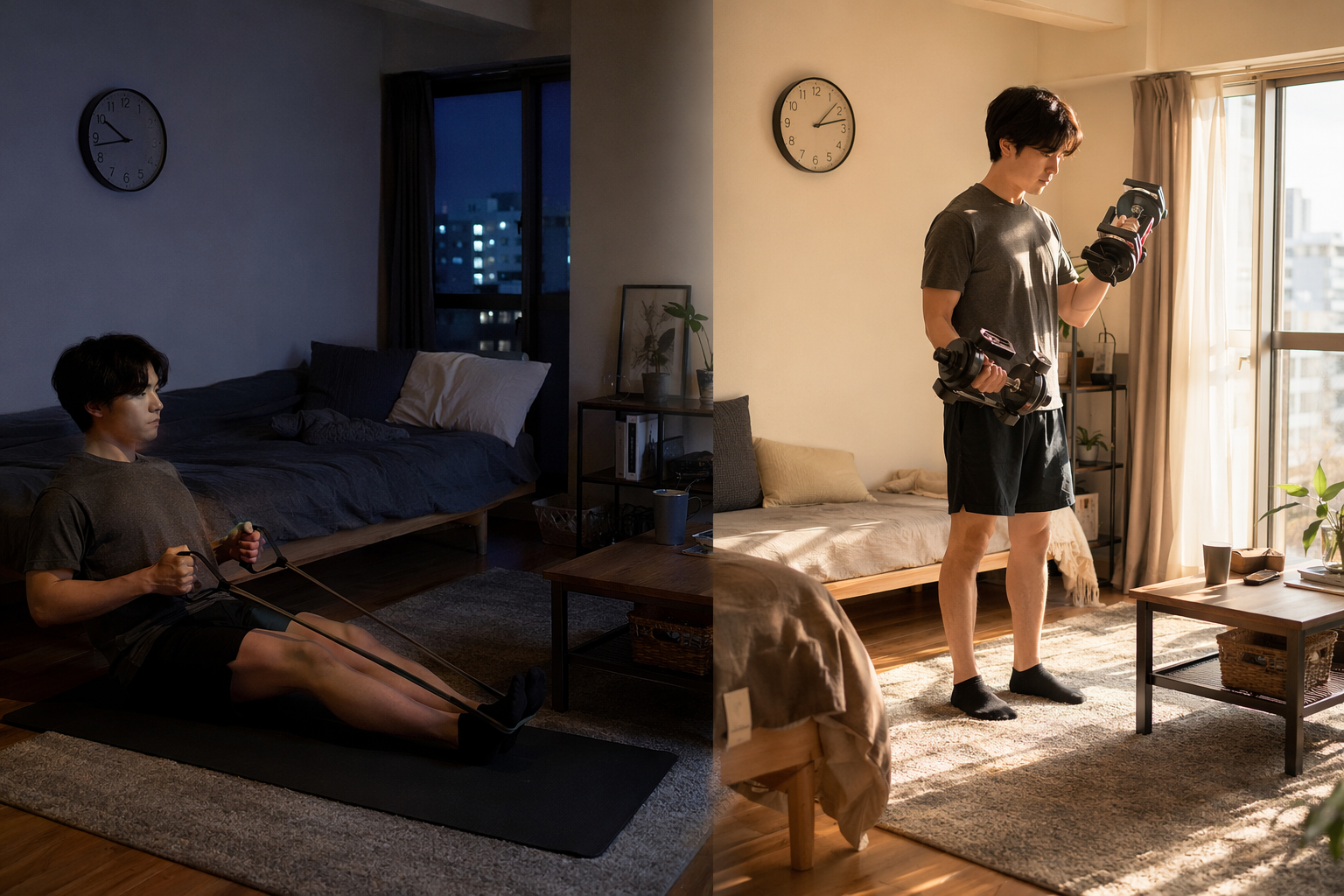
The hybrid setup is often the most livable answer
The best small-space setup is not always a single-tool identity. Bands and adjustable dumbbells solve different apartment problems, and using both can be cleaner than forcing one tool to do everything.
A practical hybrid looks like this: bands handle early mornings, late evenings, warmups, shoulder work, high-rep accessories, travel days, and any session where noise is the limiting factor. Adjustable dumbbells handle heavier compounds during neighbor-friendly hours, preferably on proper matting and in a spot where the floor can tolerate repeated use.
- Use bands when someone is sleeping, working nearby, or living below a wood floor.
- Use dumbbells when you need simple load progression and can set them down under control.
- Keep dumbbell work away from quiet hours unless the building is sturdy and the floor is protected.
- Let bands cover the exercises that would otherwise make you rush, clank, or rearrange the room.
- Treat matting as part of the dumbbell purchase, not an optional accessory.
This is not a compromise for people who cannot choose. It is a way to match the tool to the hour, the floor, and the exercise. In apartment training, that kind of flexibility matters more than owning the theoretically perfect piece of equipment.
Which one should you buy first?
Start with resistance bands if you live in a dorm, rent above another unit, train early or late, share walls with noise-sensitive neighbors, or have no dedicated workout corner. They are also the cleaner first choice if your budget does not comfortably include dumbbells plus matting. The smaller the room and the more fragile the peace, the more sense bands make.
Start with adjustable dumbbells if your building is sturdier, your training happens during normal waking hours, and you value direct load jumps enough to give the equipment a permanent place. They make sense when the rack will not annoy you, the floor can be protected, and you are willing to train with the discipline that shared housing requires: no drops, no casual set-downs, no pretending impact noise disappears because a mat is underneath it.
If you can afford and store both, buy for the constraint you face most often. For many apartment lifters, that means bands first, then adjustable dumbbells once there is a protected lifting spot and a reliable window for heavier work. If your constraints are mild, dumbbells can come first and bands can fill the quiet-hour gaps.
The verdict is practical rather than universal. Resistance bands are the cleaner choice for dorms, wood-frame apartments, shared-wall spaces, tight budgets, and quiet-hour training. Adjustable dumbbells make more sense in sturdier buildings, during neighbor-friendly hours, and for lifters who want heavier compounds with clear load progression. Since strength gains can be comparable, the better small-space equipment is the one that lets you train without creating noise complaints, floor-damage anxiety, or a setup you get tired of living around.
References
- Effects of training with elastic resistance versus conventional resistance on muscular strength: A systematic review and meta-analysis, SAGE Open Medicine, 2019.
- Adjustable dumbbells vs resistance bands decibel comparison data, QuietStrengthLab.
Comments
Join the discussion with an anonymous comment.