The fastest way to buy the wrong compact home gym equipment is to compare everything that claims to be “space-saving” in one pile. A folding bike, adjustable dumbbells, a wall-mounted smart gym, a no-bolt rack, and a compact elliptical are not competing for the same room. They ask different things from your floor, your lease, your neighbors, and your patience.
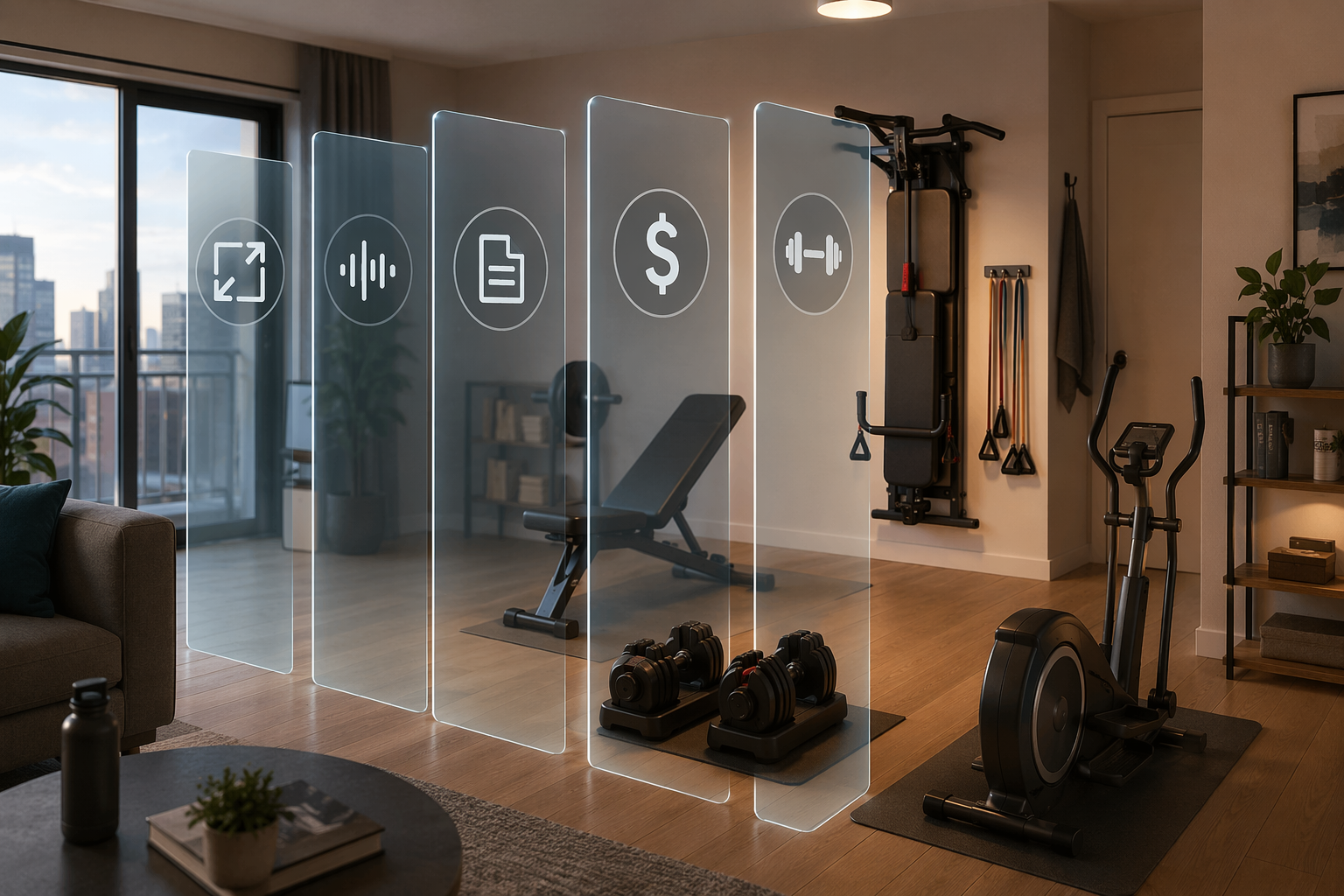
So start one step earlier. Before brands, specs, or “best overall” lists, run the equipment through five filters: space in use, noise, renter restrictions, budget, and training priority. If you live upstairs with thin floors and cannot mount anything, your search should not begin with plate-loaded racks or clanking stacks. That is not being picky. That is preventing a large, expensive object from becoming furniture.
| Your limiting constraint | Start with | Be careful with | Usually avoid first |
|---|---|---|---|
| Very little open floor space | Adjustable dumbbells, bands, folding bench, compact digital resistance | Folded cardio equipment that needs a much larger use area | Full racks, long stride machines, equipment that blocks walkways |
| Downstairs-neighbor noise | Digital resistance, magnetic resistance cardio, controlled dumbbell work | Weight stacks and selectorized machines | Plate-loaded lifting with any chance of drops |
| Rental with no drilling | Free-standing benches, dumbbells, bands, removable flooring, no-bolt options | Wall-mounted systems and bolted racks | Anything that depends on anchors, permanent mats, or garage assumptions |
| Under $800 | Adjustable dumbbells, resistance bands, mat, folding bench | Single-purpose cardio machines that consume most of the budget | $2,000+ smart gyms unless noise and space make them worth it |
| Strength priority | Dumbbell-bench setup, compact rack if space and lease allow, digital resistance | Light cable-style systems that cap out too soon | Cardio-first machines pretending to replace strength training |
| Cardio priority | Folding bike, compact elliptical, walking pad if ceiling and storage work | Machines with tiny folded footprints but awkward operating zones | Impact-heavy equipment in noise-sensitive apartments |
Measure the Space You Train In, Not the Space You Store In
Most compact-equipment shopping goes sideways at the tape-measure stage. The product folds to a tidy rectangle, fits behind a couch, or slides under a bed. Fine. But the question that matters is whether you can actually squat, press, hinge, pedal, step on, step off, adjust weights, and bail out safely in the space where you plan to use it.
A wall-mounted digital system can need about 3 by 4 feet of operating space, while a power rack setup can require closer to 8 by 10 feet once the rack, bar path, loading area, and user movement are counted.[1] That difference is not a style preference. In a small apartment, it is the difference between training in a room and rearranging the room every time you want to train.
For many small-space strength setups, a realistic minimum starts around 6 by 6 feet; for mobility-focused work, 6 by 4 feet may be enough.[2] Those numbers are useful because they include human movement, not just product dimensions. A bench takes more room when it is flat than when it is leaning behind a door. Dumbbells need room beside the bench so you are not twisting awkwardly to pick them up. A folding bike still needs clearance around the pedals and enough space to climb on without scraping a wall.
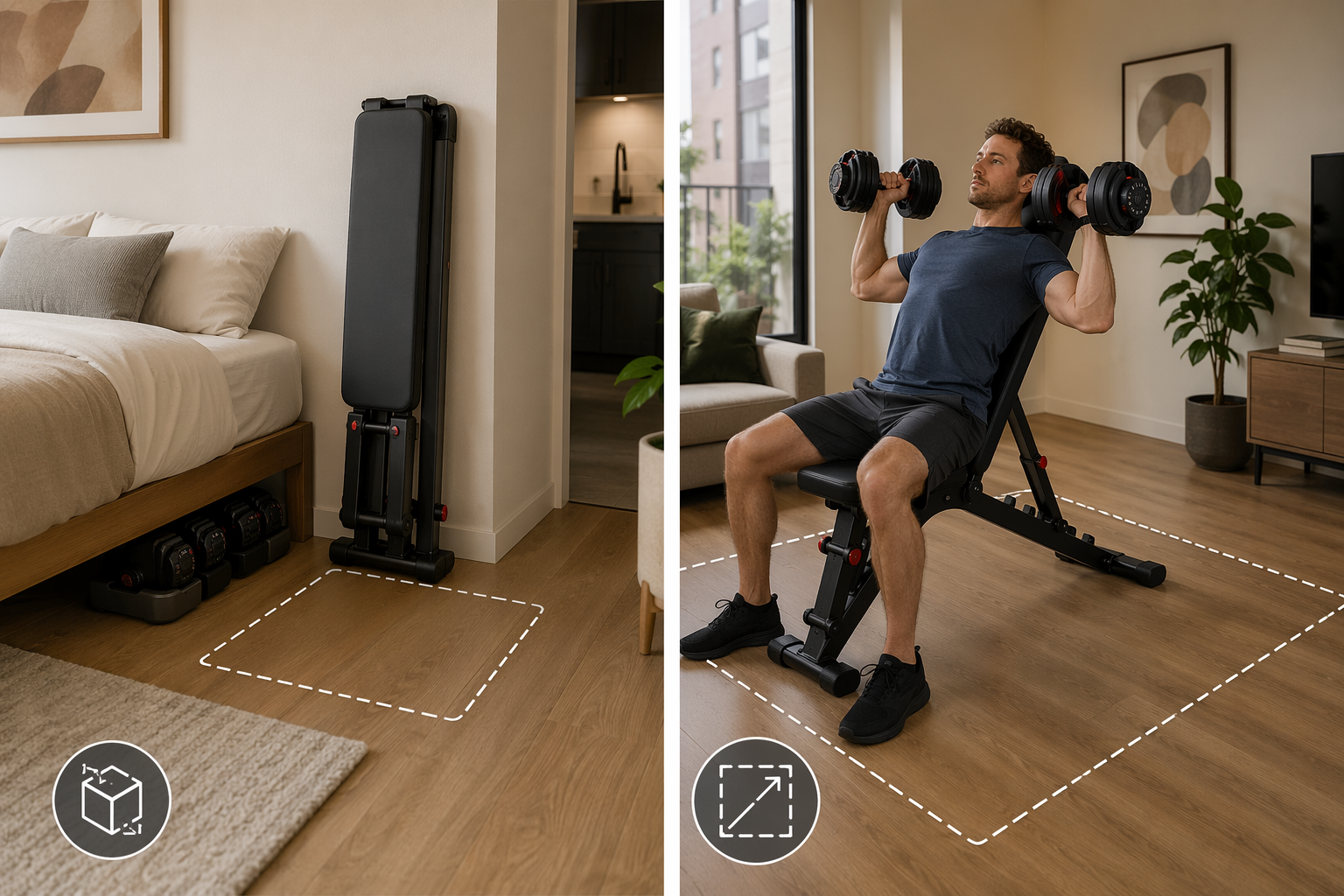
The practical move is simple: mark the use footprint on the floor before you shop. Use painter’s tape, books, towels, whatever you have. Then go through the movements you expect the equipment to support. If your elbows hit a wall on presses, your knees crowd the coffee table on lunges, or the bench blocks the only path through the room, the equipment is too big even if the folded dimensions look heroic.
This is where compact cardio equipment needs a little suspicion. The LEIKE X Bike, for example, folds to 46 by 16 by 9 inches and weighs 38.5 pounds, which makes it plausible behind a couch or in a closet.[3] That folded measurement is genuinely helpful. It still does not tell you whether your preferred training spot has enough clearance, ventilation, screen angle, and access to unfold it without making the living room unusable.
Noise Is a Buying Constraint, Not a Courtesy Note
In a detached garage, noise is annoying. In an upstairs apartment, it can decide the entire equipment category. The issue is not only loudness in the room. It is vibration through the floor, sudden impact, repeated clanks, and the hour you train because that is when work and childcare finally stop competing with your life.
Independent testing across 17 equipment types in four New York City apartments found digital resistance systems such as Tonal and Speediance in the 42–57 dB range, weight stack machines at 78–88 dB, and plate drops from free weights at 98–112 dB.[4] That apartment test is a strong practical signal, not a guarantee for every building. A concrete high-rise and an old wood-frame walk-up do not transmit sound the same way.
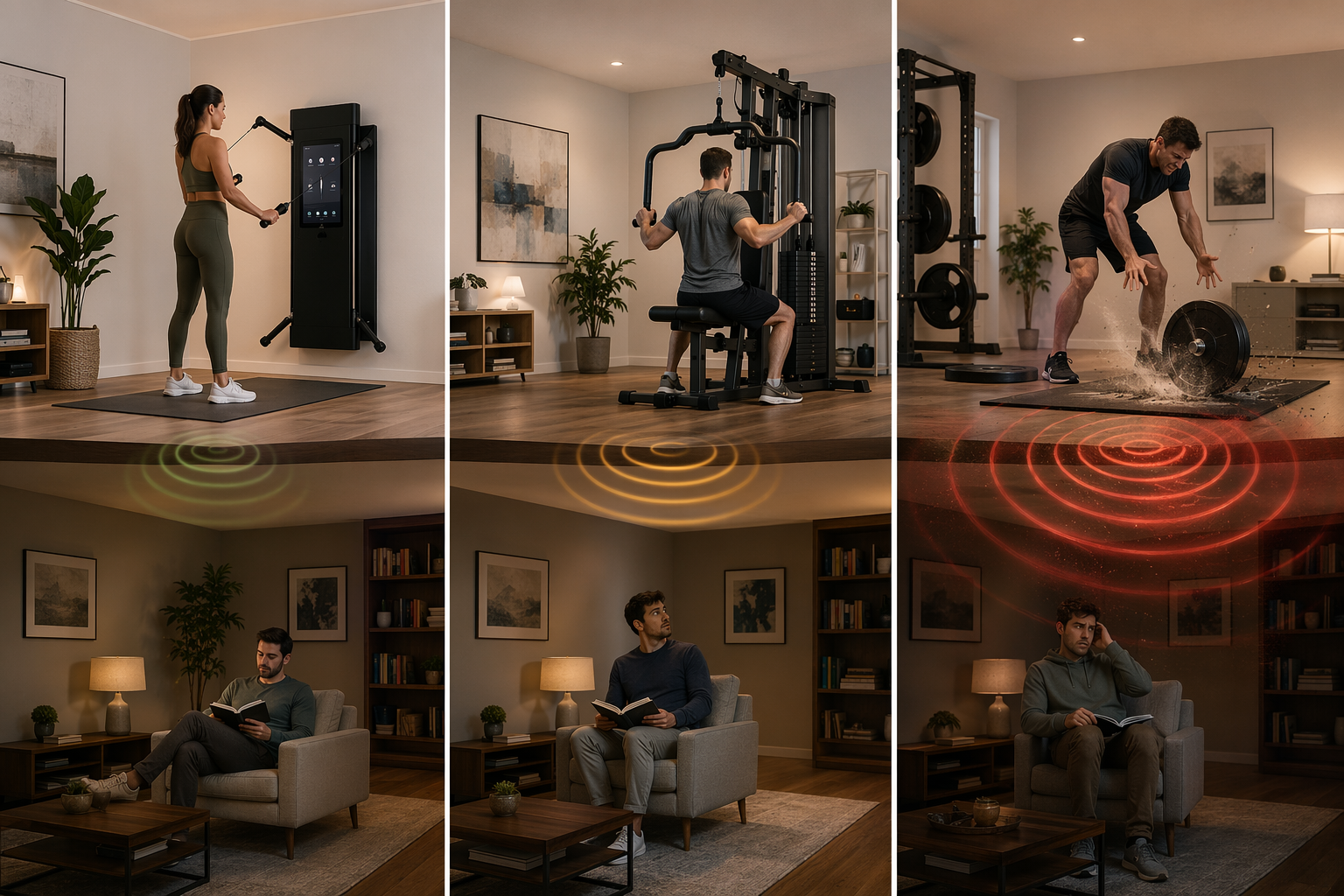
Still, the categories separate cleanly enough to guide buying. Digital resistance and magnetic resistance cardio are usually easier to live with because resistance changes without plates hitting, stacks clanking, or metal sleeves rattling. A compact elliptical such as the Niceday model tested by Garage Gym Reviews uses magnetic resistance, weighs 106 pounds, and has transport wheels, which makes it a more plausible upstairs-apartment cardio choice than many impact-heavy options.[3]
Free weights are not automatically wrong for apartments. Controlled dumbbell training on a mat can be quiet enough for many households. The problem is the failure mode. A dropped dumbbell or plate is a very different event from a quiet set of rows. If you know you want heavy barbell work, Olympic lifts, or training where missed reps may hit the floor, your real constraint is no longer “compact.” It is impact control.
Flooring helps, but it does not repeal physics. Removable interlocking foam tiles can be inexpensive — Garage Gym Reviews cites Amazon Basics tiles at about $25 for 24 square feet — and they are useful for light floor protection and comfort.[3] They are not a license to drop heavy weights above someone’s bedroom. For that decision, use a dedicated flooring guide such as how to choose home gym flooring or an apartment-specific guide like home gym flooring for apartments and small spaces.
Read the Lease Before You Fall in Love With a Wall
Wall-mounted systems solve real layout problems. They pull resistance off the floor, keep the room cleaner, and can give a small apartment a training station that feels far more organized than a pile of loose gear. The catch is obvious and often underplayed: a renter may not be allowed to mount it, may not be allowed to drill into studs, or may have to remove it without leaving damage that costs part of a deposit.
That restriction should appear before the product recommendation, not after. If a machine depends on wall anchors, ceiling clearance, bolting, permanent platform construction, or heavy equipment delivery through tight stairs, it belongs in a different category from a bench-and-dumbbell setup that can leave with you on moving day.
There are exceptions worth noticing. Bells of Steel describes the Hydra Collegiate Rack as a no-bolt rack option, which is exactly the sort of detail that matters for apartment lifters who want rack-based training without drilling into the floor.[5] But an exception is not the same as a general rule. A rack still needs operating space, safe loading behavior, ceiling clearance, and a noise plan.
Renter-friendly usually means removable, free-standing, and easy to store without turning the entryway into a warehouse. Adjustable dumbbells plus a folding bench work so often because they ask for very little from the building. No anchors. No bolts. No dedicated garage bay. If you move, they move.
Budget Routes You Into Categories
Budget is not a moral ranking. It is a routing layer. A $2,000-plus smart system can be a sensible purchase if it solves noise, space, and programming problems in a home where wall mounting is allowed. It is not the same buying decision as a renter trying to build a quiet starter setup under $800.
Garage Gym Reviews puts the average home gym machine at $1,855, while also describing a renter-friendly starter setup — adjustable dumbbells, bands, a mat, and a folding bench — as possible under $800.[3] Prices and subscription fees move, and these figures are current to June 2026 in the source material. Treat them as a live budgeting checkpoint, not a permanent price promise.
| Budget tier | Most sensible category search | What to check before buying |
|---|---|---|
| Under $800 | Adjustable dumbbells, resistance bands, mat, folding bench, simple storage | Weight range, bench folded and open dimensions, floor protection, noise habits |
| $800–$2,000 | Specialized cardio, better adjustable dumbbells, compact cable-style options, hybrid setups | Whether one machine crowds out everything else you need |
| $2,000+ | Smart compact systems, premium digital resistance, higher-end all-in-one packages | Subscription cost, mounting rules, serviceability, operating footprint |
This is also where affiliate enthusiasm needs a hard look. A review can be useful and still be commercially tilted toward products that participate in affiliate programs. The useful parts are the measurements, noise notes, delivery realities, subscription costs, and what testers could or could not do in a normal room. The less useful part is the glow around anything labeled “compact” without a clear distinction between stored size and training size.
Training Goal Comes After the Room Has Veto Power
Once space, noise, lease, and budget have ruled out the obvious mismatches, training priority can do its job. Starting with the goal too early is how people buy impressive equipment that makes no sense in the room.
If strength is the priority
Begin with adjustable dumbbells, a folding bench, and bands unless your space and lease clearly support more. This setup gives a renter a large exercise menu with a small storage burden, and it is much easier to control than plate-loaded lifting in a noise-sensitive apartment. If you have a ground-floor room, more space, and a serious barbell goal, then compact racks and no-bolt rack options can enter the conversation.
If cardio is the priority
Look at folding bikes, compact ellipticals, walking pads, or other low-impact machines before impact-heavy choices. The deciding questions are operating clearance, storage path, machine weight, and noise through the floor. A bike that folds small but is irritating to drag out will not get used. An elliptical that stays accessible but blocks the only open corner will eventually become a coat rack.
If general fitness is the priority
Use modular equipment first: dumbbells, bands, a mat, a bench if you have the room, and one cardio option only if you know where it lives while open. General fitness does not require a single machine that claims to do everything. It needs equipment you can reach, set up quickly, and put away without bargaining with the furniture.
If quiet guided training is the priority
Digital resistance systems deserve a real look when quiet operation and a compact working zone matter more than the lowest upfront price. Their strength is not that they are magically better for everyone. Their strength is that they can replace a spread-out equipment collection with one controlled station. The deal gets worse if you cannot mount the system, dislike subscriptions, or need training that exceeds what the resistance system can provide.
A Practical Constraint-to-Category Map
Use this as a first-pass sorter, not a final product list. The goal is to stop comparing categories that should never have been in the same cart.
| Your profile | Best category to research first | Categories to delay or rule out |
|---|---|---|
| Upstairs renter, thin floors, no drilling | Adjustable dumbbells, bands, folding bench, removable mat, magnetic resistance bike or elliptical | Plate-loaded racks, wall-mounted systems, loud stacks, anything requiring anchors |
| Small room but wall mounting allowed | Digital resistance system, compact cable-style system, modular dumbbell setup | Large racks and machines that need broad approach space |
| Ground-floor renter with 6x6 feet available | Dumbbell-bench setup, compact rack only if no-bolt and noise-controlled, bands | Heavy plate drops, permanent flooring, bolted equipment |
| Space-first buyer with flexible budget | Wall-mounted or compact digital resistance, high-quality adjustable dumbbells, foldable bench | Cheap single-purpose machines that waste the only open zone |
| Budget-first beginner under $800 | Adjustable dumbbells, bands, mat, folding bench | Subscription-heavy smart systems, large machines bought before habits exist |
| Cardio-first apartment buyer | Folding bike, compact elliptical, walking pad if storage and noise work | Impact-heavy cardio, machines with misleading folded-only dimensions |
| Serious barbell lifter with room and tolerant building | Compact rack, bench, barbell, plates, real flooring plan | Light all-in-one machines that cannot support the training goal |
Nearly 39 million Americans live in apartments, according to NAAHQ data cited by Garage Gym Reviews.[3] The useful part of that number is not its size. It is the reminder that generic garage-gym advice skips a huge group of buyers who cannot bolt, drop, expand, or store equipment the way a garage owner can.
Shared space also means shared risk. Home exercise equipment sends more than 12,000 children to U.S. emergency departments each year, according to Nationwide Children’s Hospital.[6] In a small apartment, storage is part of the equipment choice. A folding bench behind a door is useful only if it cannot fall. Adjustable dumbbells are compact only if children cannot access the adjustment mechanism or pull them from an unstable shelf.
Where to Go Next
If you already know your biggest constraint, go deeper there instead of reopening the whole market. Renters should start with an apartment-dweller compact home gym setup or an apartment-focused compact equipment comparison. Space-first buyers should use compact home gym footprint tiers. If you want a package after the filtering is done, compare compact home gym systems or a $1,000 compact home gym system. If space is solved and the question is training style, use a compact home gym by training goal filter.
The best compact home gym equipment is the category that survives your real constraints before it ever reaches a cart.
References
- Best Home Gym for Small Spaces, Home Gym Layouts.
- Renter-friendly guide, FitnessVolt.
- Garage Gym Reviews testing and compact equipment guidance, Garage Gym Reviews.
- Home Gym Noise Comparison, Home Gym Layouts.
- Bells of Steel guide, Bells of Steel.
- Home exercise equipment safety note, Nationwide Children’s Hospital.
Comments
Join the discussion with an anonymous comment.