
Before shopping for an under desk walking pad for a small apartment, do the unglamorous part first: get a tape measure under the couch, look at the floor, and decide who shares the vibration path with you. A walking pad that looks compact in a product photo can still become a 50-pound black plank that has to be stepped over every time you cross the room.
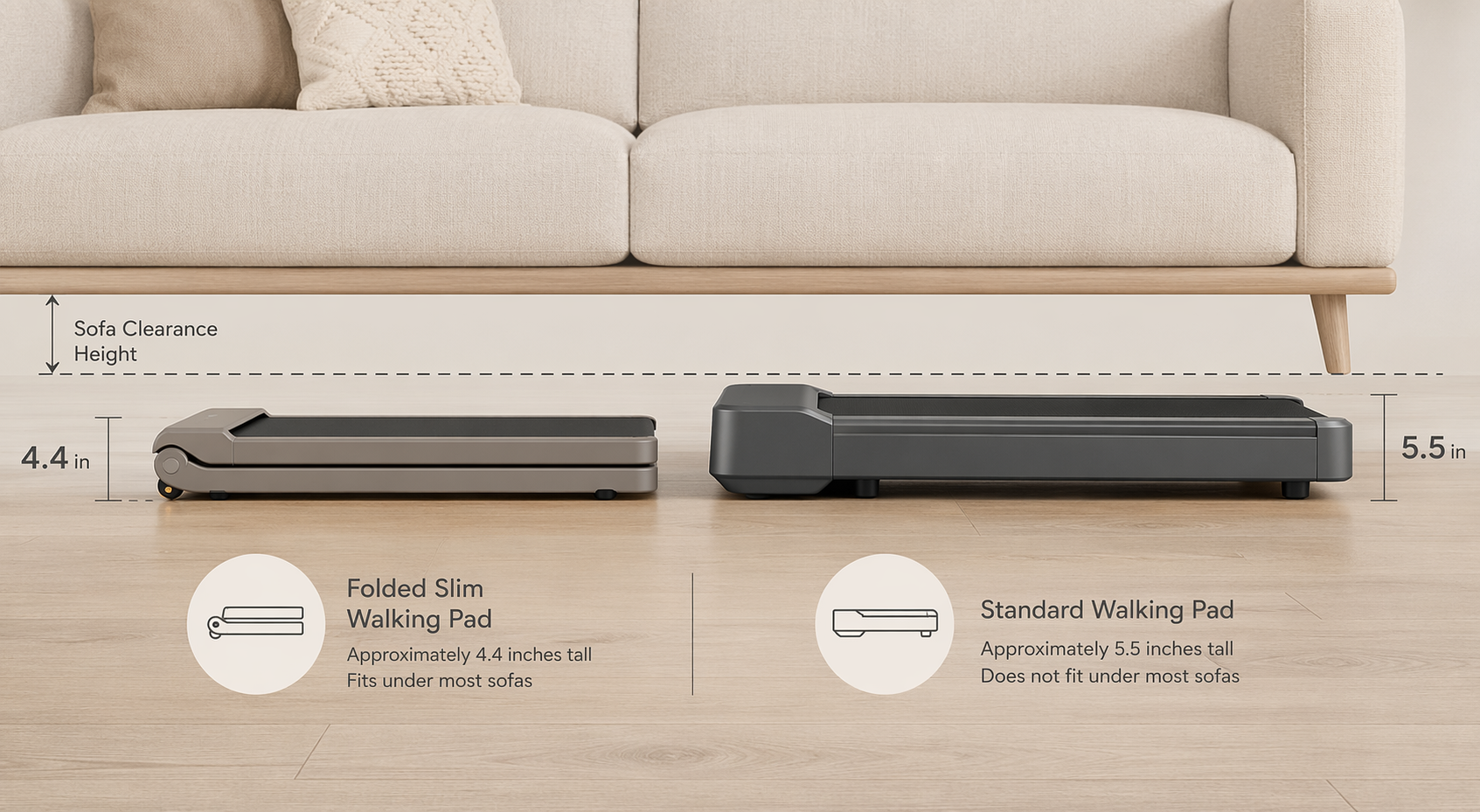
The three checks that matter most are simple enough to do before comparing models: storage clearance, floor material, and neighbor proximity. Most walking pads are about 5 to 6 inches thick when flat, while the WalkingPad Z1 folds to 4.4 inches; that difference can decide whether it fits under furniture with roughly 5 to 7 inches of clearance or sits permanently in the open.[1][2]
Start With the Storage Gate
Measure the place where the walking pad will live when you are not using it. Not the place where it looks nice in a listing photo. The actual gap under the couch, the bed frame, the media console, or the one wall beside the desk where it can stand without blocking a closet door.
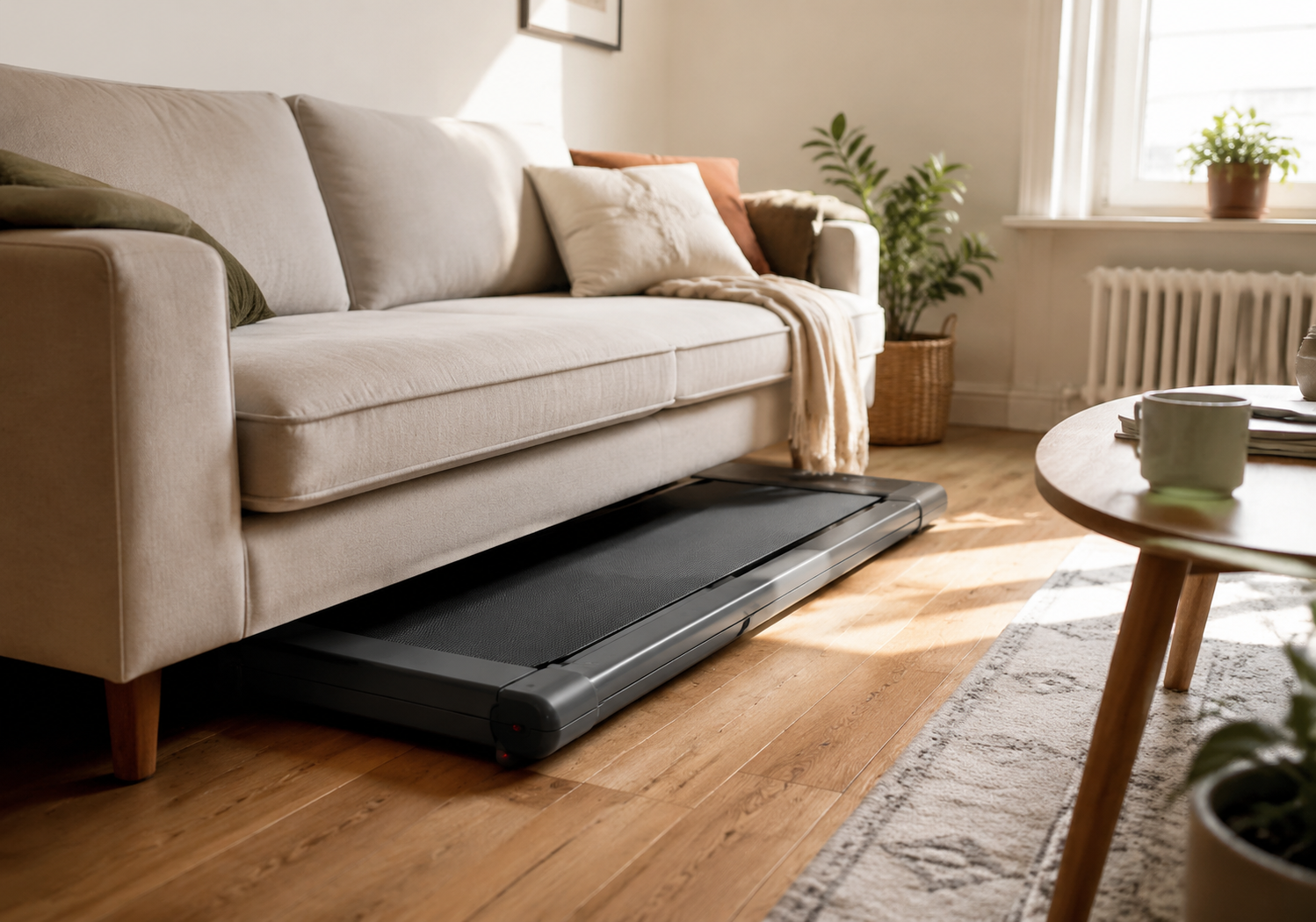
For under-furniture storage, measure from the floor to the lowest fixed obstruction, not to the cushion edge. Couch legs, center support rails, dust covers, bed slats, and low crossbars are the parts that usually ruin the plan. Leave handling room too. A 4.4-inch folded walking pad going into a 4.5-inch opening is not a storage solution; it is a weekly argument with your furniture.
| Apartment constraint | What to measure | Why it matters |
|---|---|---|
| Under-couch or under-bed storage | Lowest clearance in inches | Most flat walking pads are about 5 to 6 inches thick; a lower folded profile can be the difference between stored and exposed. |
| Daily setup path | Distance from storage spot to desk | If it has to be dragged around a coffee table every day, it may not get used. |
| Floor protection | Floor type and mat space | Hardwood and laminate need more help with vibration and scuff control than carpet or concrete. |
| Neighbor exposure | Wall, floor, and quiet-hour proximity | A quiet motor still produces footfall vibration, especially in upstairs units. |
This is why the WalkingPad Z1 has become the storage-first apartment pick in current recommendations. At about $299, it folds to 4.4 inches and has a reported 40 dB noise level in review-source rankings.[2][3] That does not make it invisible or weightless. It makes one specific apartment problem measurable: if your couch or bed has enough real clearance, the Z1 has a plausible place to disappear.
The older KingSmith A1 Pro used to appear often in apartment walking pad recommendations, but it was reported out of stock as of June 2026 with no confirmed restock date.[3][4] That matters because stale buying guides can send small-apartment shoppers toward a model they cannot actually buy. The Z1 is not a perfect heir to every A1 Pro recommendation, and it has less long-term durability history in the available material, but it is the current default if low folded storage is the hard requirement.
Then Check the Floor, Not Just the Motor
Apartment noise is not just the hum of the motor. On hardwood and laminate, the more irritating sound often travels through footsteps: belt impact, heel strike, and the small repeated vibration that passes into the floor. UREVO’s apartment noise guidance and user reports both point to floor transmission as a major issue, especially on hard surfaces; a rubber mat of at least 6 mm is the simplest meaningful mitigation step.[5]
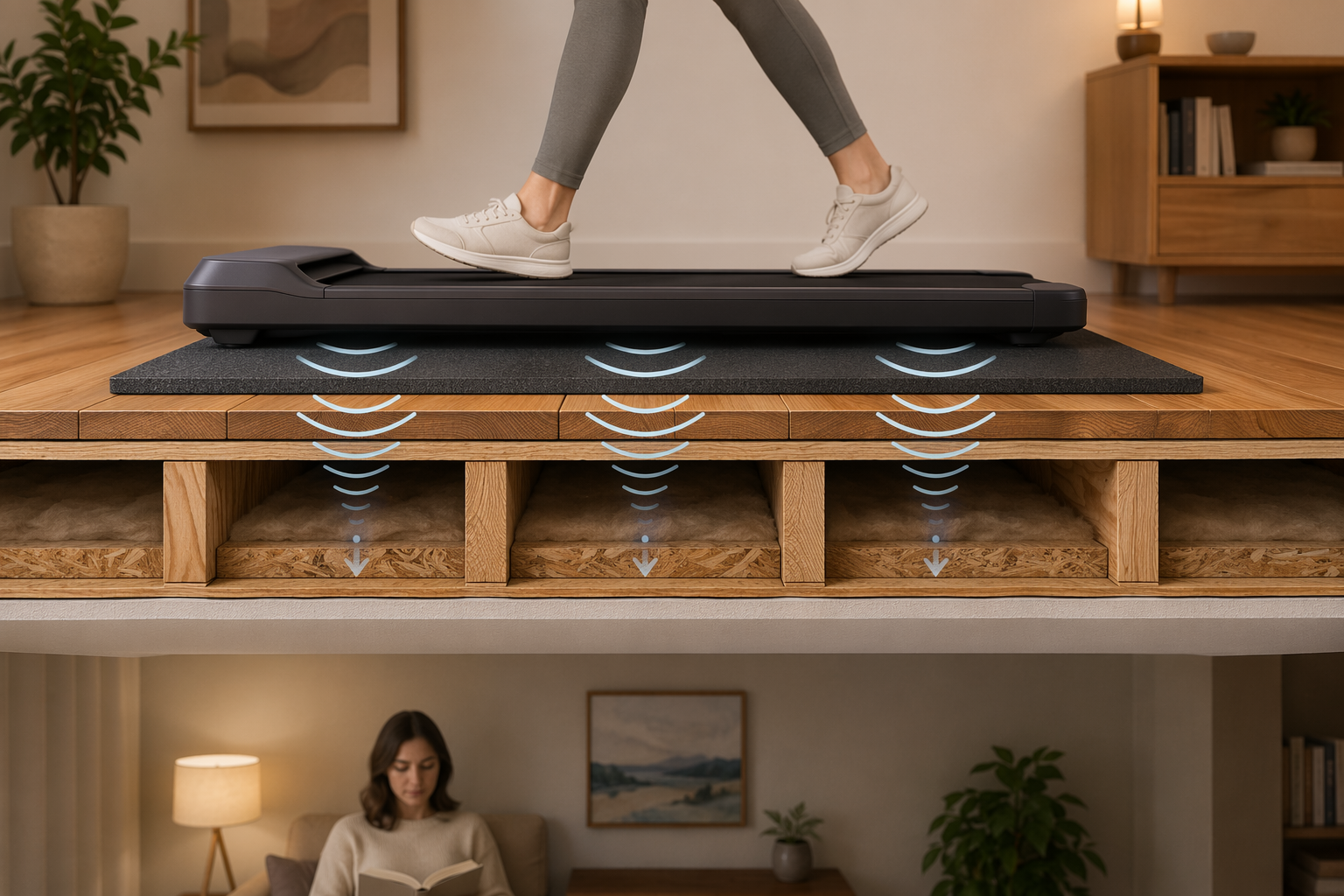
This is the part many treadmill-style comparisons underplay. A model can test quietly in open air and still annoy someone below you if it sits directly on laminate over a wood-frame structure. Concrete-core buildings are more forgiving. Thick carpet can damp some vibration, though it may create stability or ventilation concerns depending on the machine. Typical U.S. wood-frame multifamily construction is the scenario where a mat is least optional.
The mat should extend under the full walking pad and the area where your feet land, not just under the motor housing. If you are in an upstairs unit, also think about placement: over a hallway or your own storage area is usually less risky than directly above a downstairs bedroom or home office. That placement choice can matter more than a small difference between published dB figures.
Z1 vs. CyberPad: The Real Apartment Trade-Off
The cleanest 2026 apartment comparison is not “best overall.” It is WalkingPad Z1 versus UREVO CyberPad, because they solve different apartment problems. The Z1 prioritizes storage with its 4.4-inch folded profile and reported 40 dB level.[2][3] The CyberPad is reported under 35 dB and includes a 14% incline, but it does not fold.[3][5]
| Model | Best fit | Apartment problem it solves | Trade-off |
|---|---|---|---|
| WalkingPad Z1 | Storage-first apartments | Folds to 4.4 inches for under-furniture storage | Reported 40 dB is quiet, but not the lowest figure available |
| UREVO CyberPad | Noise-first apartments with dedicated floor space | Reported under 35 dB and offers incline | Does not fold, so it needs a permanent or semi-permanent spot |
Treat those dB numbers as decision signals, not promises. The under-35 dB CyberPad figure and 40 dB Z1 figure come from manufacturer-verified or review-source reporting, not from one independent lab test repeated in every apartment layout.[3][5] Your floor, mat, stride, desk position, and building construction can change what a neighbor hears.
If the walking pad must vanish after work, the Z1 is the more apartment-literate choice. If you have a dedicated desk zone, live over concrete, or can keep the unit out without turning the room into an obstacle course, the CyberPad’s quieter reported level is compelling. The non-folding design is not a footnote; it is the purchase decision.
When the Apartment Is Truly Tiny
Micro-space models have a place, but it is a narrow place. The LifePro PacerMini Pro is listed at 40 pounds, 32.7 inches long, and about $300; the Egofit Walker Pro-M1 is listed at 38.4 inches long, 48.5 pounds, and about $479.[1][6][7] Those dimensions are useful when the only available storage is a short studio corner, a low loveseat gap, or a tight space beside a standing desk.
The compromise is belt length and speed. Shorter machines can feel choppy for taller users or anyone with a longer stride, and they are not the right answer just because the apartment is small. They are the right answer when the alternative is buying a longer walking pad that has nowhere honest to go.
Only Pay for Running If You Will Actually Run
The WalkingPad R3 Hybrid+ changes the category because it supports running up to 7.5 mph and offers double-fold upright storage, but it costs about $799.[4][8] That price and size only make sense if running capability is part of the real use case. For walking during desk work, the extra capability does not solve the basic apartment problems of storage clearance, floor vibration, and setup friction.
There is also a neighbor question hiding inside the running feature. Running creates more impact than walking. If you are upstairs on hardwood or laminate, the R3 Hybrid+ may be technically more capable while being less compatible with the people below you.
Apartment-Specific Shortlist
- Choose the WalkingPad Z1 if storage clearance is the hard constraint and you need a machine that can plausibly fit under a couch or bed.
- Choose the UREVO CyberPad if noise is the hard constraint, you can leave a non-folding unit in place, and the reported under-35 dB figure matters more than storage.
- Consider the LifePro PacerMini Pro or Egofit Walker Pro-M1 only when length is the problem and you accept the shorter-belt compromise.
- Consider the WalkingPad R3 Hybrid+ only if you genuinely want running capability and can justify the higher price, larger setup, and greater impact.
- Buy a 6 mm or thicker rubber mat before judging whether any walking pad is apartment-quiet on hardwood or laminate.
The safest final test is physical rather than theoretical: mark the walking pad’s footprint on the floor with painter’s tape, walk the setup path from storage to desk, and check whether the taped shape blocks a drawer, door swing, coffee table route, or neighbor-sensitive area. If the outline is already annoying, the real machine will not become less annoying after delivery.
References
- How to Choose the Right Small Treadmill for Your Apartment — WalkingPad
- Everything You Want to Know About Apartment Treadmill — WalkingPad
- Quietest Walking Pads for Apartments 2026: Ranked by dB — TheBestWalkingPads
- Best Walking Pads for Working From Home (2026) — WIRED
- Are Walking Pads Loud in Apartments? Noise Levels Explained — UREVO
- The 2 Best Under-Desk Treadmills of 2026 — Wirecutter
- The 11 Best Walking Pads of 2026 — Shape
- The 7 Best Walking Pads in 2026 — Runner's World
Comments
Join the discussion with an anonymous comment.