
3 Compact Home Gym Archetypes Compared: All-in-One, Wall-Mounted, or Component-Based?
Not all compact home gyms are the same. This article breaks down the three main archetypes—all-in-one machines, wall-mounted foldable systems, and component-based setups—to help small-space buyers choose based on their space, budget, and fitness goals.
- Space type
- apartment
Items included: —
I bought a wall-mounted rack without measuring my wall space. I had the ceiling height (84 inches), but the barbell needed 6 feet of clearance in front, and the wall I wanted to mount it on had a window. The rack sat in the box for three weeks while I figured out a different room. That mistake cost me a return shipping fee and a weekend of frustration—small compared to what some people lose when they commit to a subscription they didn’t budget for.
You search for “compact home gym” and get a list of machines. Wall-mounted, all-in-one, component—prices from $300 to $4,000, footprints from 9 inches to 40 square feet. The list treats them all as options for the same problem. They are not. The category hides three fundamentally different solutions, and each one demands different things from you—your space, your budget over three years, your tolerance for daily friction, your neighbors’ patience with noise. Pick the wrong archetype and you don’t just waste money; you waste the very space you were trying to save.
All-in-one: The subscription you didn’t budget for
An all-in-one machine like the Tonal 2 costs $4,295 and needs a $59.95/month membership. Over three years, that’s $2,158 in fees on top of the hardware total: $6,453. I’ve seen people buy a Tonal thinking they’re done spending, then balk at the $720 annual fee. The Bowflex Xtreme 2 SE costs $1,499 and charges nothing monthly—but it uses a weight stack that hits 78–88 dB on the pull, versus the Tonal’s 38–57 dB for digital resistance. Those numbers come from a single independent tester (17 pieces of equipment across four NYC apartments over 18 months), so treat them as indicative, not gospel. But the difference is big enough that if you live above someone, the weight stack will be heard.
The Speediance Gym Monster ($2,199 MSRP, no subscription) uses digital resistance up to 220 lbs and folds to 14.96" deep by 28.34" wide. Its unfolded footprint is 49.21" x 28.34". Digital resistance systems run quiet—38–57 dB, about a quiet conversation. Weight stack machines hit 78–88 dB, more like a vacuum cleaner in the next room. For apartment dwellers with shared walls, that difference can determine whether your neighbor files a complaint or not.
| Machine | Hardware cost | Monthly fee | 3-year total | Max resistance |
|---|---|---|---|---|
| Tonal 2 | $4,295 | $59.95 | $6,453 | 250 lbs digital |
| Speediance Gym Monster | $2,199 | $0 | $2,199 | 220 lbs digital |
| Bowflex Xtreme 2 SE | $1,499 | $0 | $1,499 | 210 lbs (410 lbs optional) |
Wall-mounted: “Folds to 9 inches” – and then what?
A 9" folded depth is remarkable. That number is true for storage. But when you deploy a rack like the PRx Profile PRO ($1,099.99, 1,000 lb capacity, 3x3 11-gauge steel, ten-year warranty) for a bench press, you need 6–7 feet of clearance in front. An 8×10 room can handle this if the rack goes against the short wall, but you’ll have to move furniture every session. The folded depth is for storage, not for working out.
Wall-mounted racks have a real advantage in apartments: they transmit 45–52 dB less vibration through floor joists than freestanding weight stack machines. That’s from the same Home Gym Layouts test—again, a single data source, but consistent with what you’d expect from a bolted structure. If noise is your primary constraint, this archetype should be high on your list.
But you need a wall that can take the load. Landlord permission? Patchability of holes? If you’re renting, a wall-mounted system is not a no-questions-asked option. You’ll also need to buy a barbell, plates, and a bench separately—adding $500–1,000 to the base cost. A basic Rogue setup (rack, bench, bar, 500 lbs of plates) comes to $3,243 shipped. The break‑even against a $1,620/year commercial membership is about two years. This archetype suits you if you have wall space, permission to drill, a ceiling height of at least 84", and you want to lift heavy. It does not disappear when stored—it just shrinks.
Component setups: The cheapest on paper, the costliest in habit
Component setups are the most flexible—on paper. A real build: REP QuickDraw adjustable dumbbells (5–60 lbs, $336) plus the Ironmaster Super Bench Pro V2 ($499) and a Living.Fit resistance band set ($129) totals about $964. Under $1,000 for a setup that can handle most resistance exercises. The average home gym machine across all types costs $1,855—so component setups look like a bargain. But what you don’t see in the price tag is the daily ritual: pulling the dumbbells out of the stand, setting up the bench, hanging the bands, then reversing it all. If your living room doubles as a gym, that means moving furniture twice a day.
I’ve been there. The first week, you do the setup with enthusiasm. The second week, it’s a chore. By week three, you skip workouts because 'it's just a hassle.' The daily friction is the real cost, and it’s not on any spec sheet.
A component setup can cover an estimated 80%+ of common resistance exercises in under 8 sq ft of floor space when stored. That’s a reasoned approximation based on exercise variety from adjustable dumbbells and a bench—not a verified study. For the remaining 20% (heavy deadlifts, pull-ups, advanced barbell work), you’ll need a rack or a different archetype. The progression ceiling depends on the dumbbells: 60 lbs per hand is enough for many lifters, but if you’re an experienced strength athlete, you’ll outgrow them fast.
This archetype is for you if you have minimal space, no tolerance for subscriptions, and—honestly—a high tolerance for daily setup. It’s also a great starter setup because you can add a rack later without replacing everything.
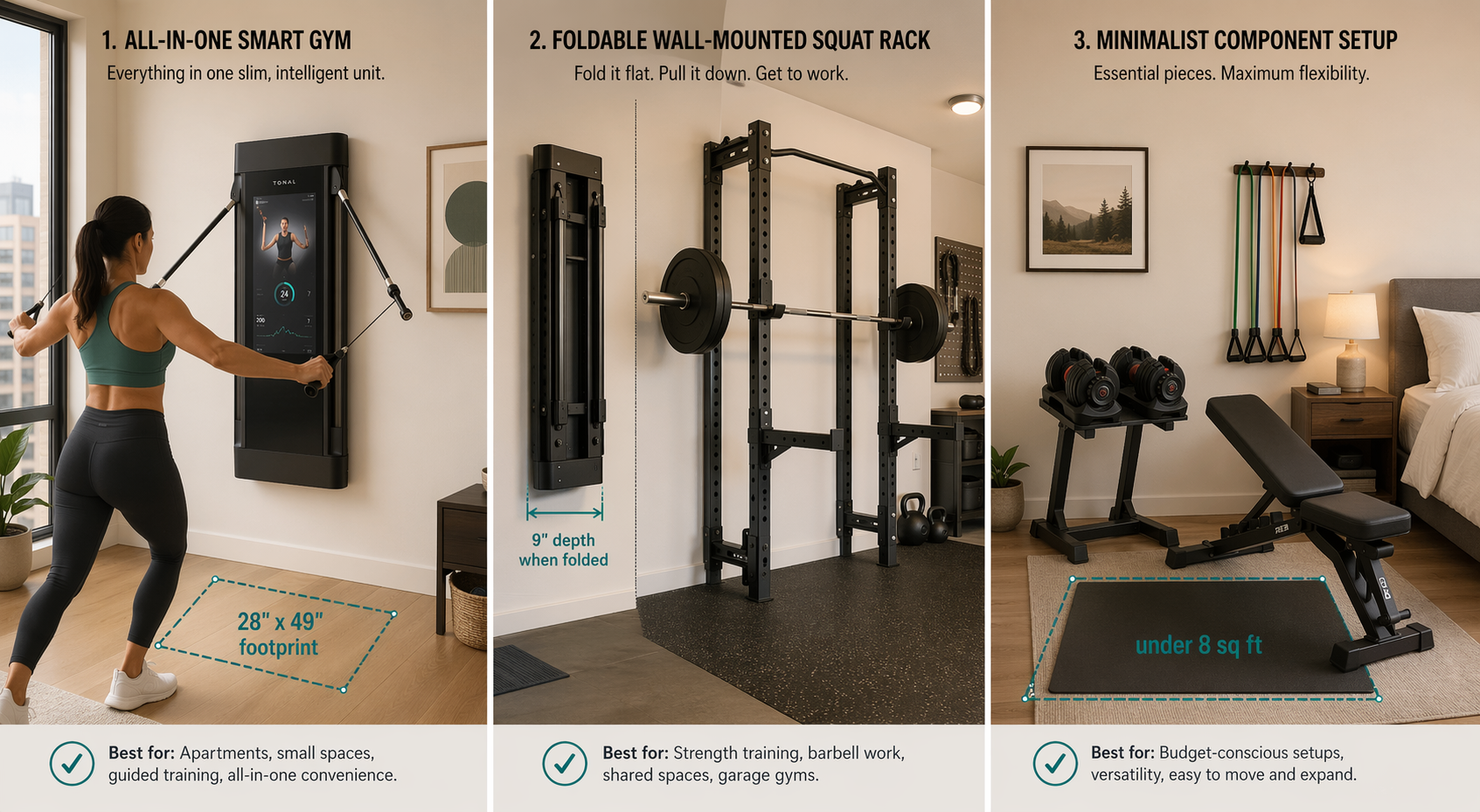
Decision matrix: Which column do you land in?
Don’t treat the three archetypes as interchangeable. Pick your primary constraint first, then see which column you land in.
| Consideration | All-in-one | Wall-mounted | Component |
|---|---|---|---|
| Floor space needed | ~10 sq ft (deployed) | 9" folded + 6-7 ft clearance | Under 8 sq ft (stored) |
| 3-year total cost | $1,500–$6,453 | $1,100–$4,000 | $964 + minimal extras |
| Best fitness goal | Guided programs, moderate strength | Full barbell training | General fitness, moderate strength |
| Noise for neighbors | 38–57 dB (digital) / 78–88 dB (weight stack) | 45–52 dB less vibration | Low (bands) to moderate (dumbbell drops) |
| Installation required | Wall mount + electrical (some) | Drilling wall, ceiling height ≥84" | None (just floor space) |
If noise is your dominant constraint and you want guided programming, go all-in-one with a digital machine. If you have wall space and want to lift barbells, wall-mounted is the only path to heavy loads without a large footprint. If your space is under 30 sq ft and you have no budget for subscriptions, a component setup is the practical choice—just be honest with yourself about the daily friction.
Floor plans for an 8×10 room: stored vs. deployed
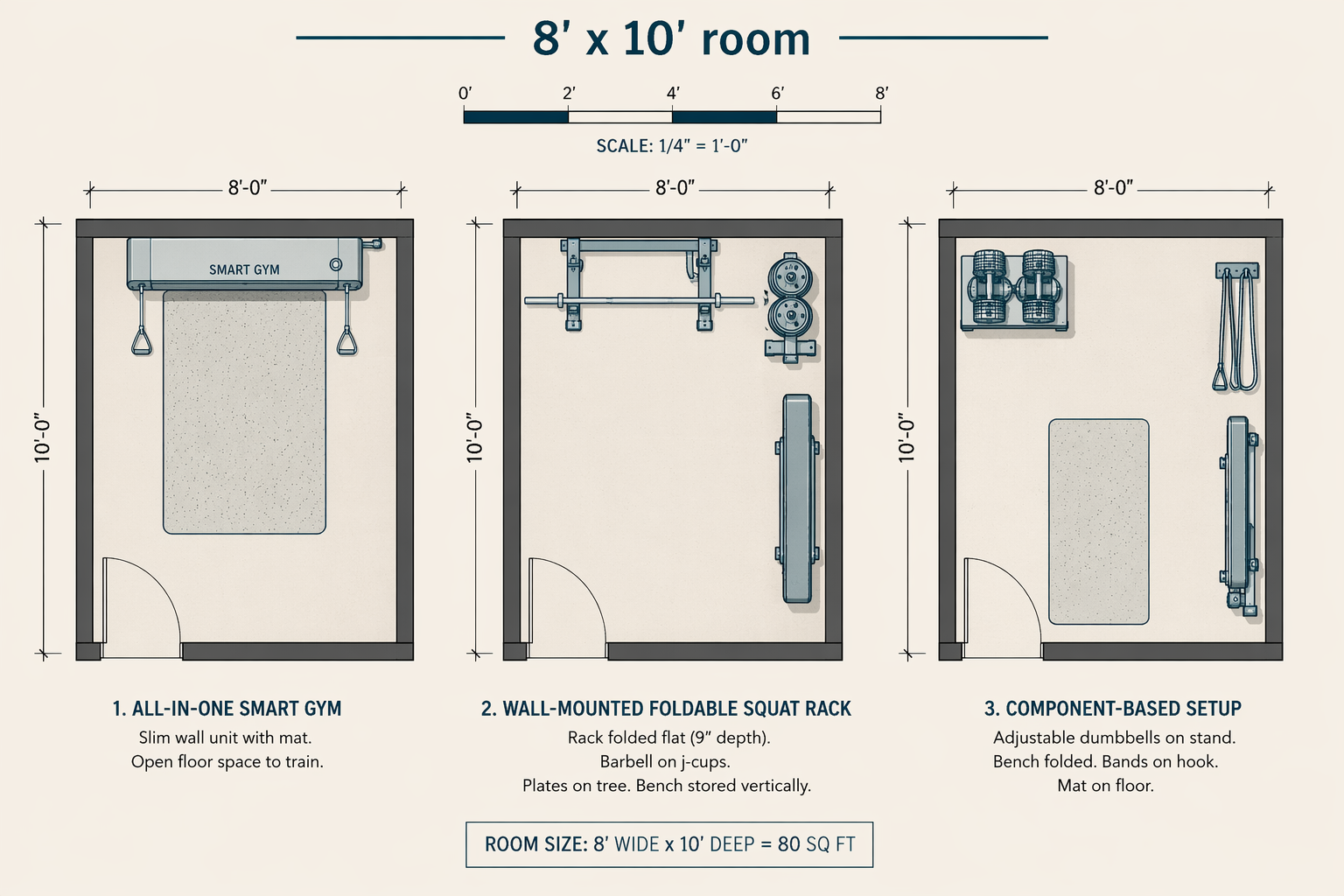
The all-in-one layout keeps the machine against a wall and leaves the rest of the room available. The wall-mounted layout needs the entire 8 ft width for the barbell and bench—you’ll have to move a desk or couch to the other end. The component layout is the most flexible: all items store under 8 sq ft, and the rest of the room stays free.
Quick answers on ceilings, rentals, and noise
What ceiling height do I need? At least 84 inches for pull-up stations and overhead cable systems. Taller users (6'2"+) may need 90 inches to avoid hitting the ceiling during a pull-up or overhead press.
Can I install a wall-mounted rack in a rental? It depends on your lease. You’ll need to drill into studs, so you either get landlord permission or accept that you’ll have to patch and paint before moving out. Some renters use freestanding racks that don’t require drilling, but those have larger footprints.
Are component setups noisy for neighbors? Generally quiet. Dumbbells on a mat produce a muffled thud. Resistance bands make no noise at all—unless one snaps, which can be loud. For heavy deadlifts with a barbell, the component archetype isn’t great anyway, so noise isn’t the main concern.
Can two people use an all-in-one machine? Most are single-user. Some, like the Tonal, support multiple profiles with individual resistance settings, but only one person can exercise at a time. If you and a partner work out together, a wall-mounted rack with a second barbell station or separate adjustable dumbbells may be more practical.
Pick your constraint first
The three archetypes are not interchangeable. All-in-one machines demand a subscription and limited resistance. Wall-mounted systems demand wall space and clearance. Component setups demand daily setup effort. None is universally better; each is better for a specific set of constraints.
Before you look at a single product, write down your constraints: square footage, ceiling height, budget over three years, noise tolerance, and how often you’re willing to move furniture. Then pick the column in the decision matrix that matches. You’ll save money, space, and frustration.
Some links on this page are affiliate links — they may earn us a commission at no extra cost to you. Our tier and tests are decided before we ever check which links pay; see our full affiliate disclosure.
Spot something off?
Noise and floor-damage claims carry real deposit-risk consequences if we get them wrong — tell us if your experience with this build didn't match what's above.