
Compact Home Gym by Room Size: What Fits in Under 50, 100, and 150 Square Feet
A guide that helps apartment dwellers and small-home residents choose equipment and plan a layout based on their actual room dimensions, so they avoid buying gear that leaves too little space to train safely.
- Space type
- apartment
Items included: —
The fastest way to ruin a compact home gym is to shop for the machine first and the room second. A rack that “fits” in a product photo may still leave no room to load plates. A treadmill may fit along the wall and still be unsafe because there is no landing space behind it. A smart gym may have a tidy footprint and still need enough open floor for lunges, rows, hinges, and stepping around the screen.
Start with the square footage you can actually train in, not the square footage the equipment occupies while parked. Tape that rectangle on the floor. Open the closet door. Walk the normal route through the room. Then decide whether you are building a sub-50 sq ft setup, a 50–100 sq ft setup, a 100–150 sq ft setup, or something larger.
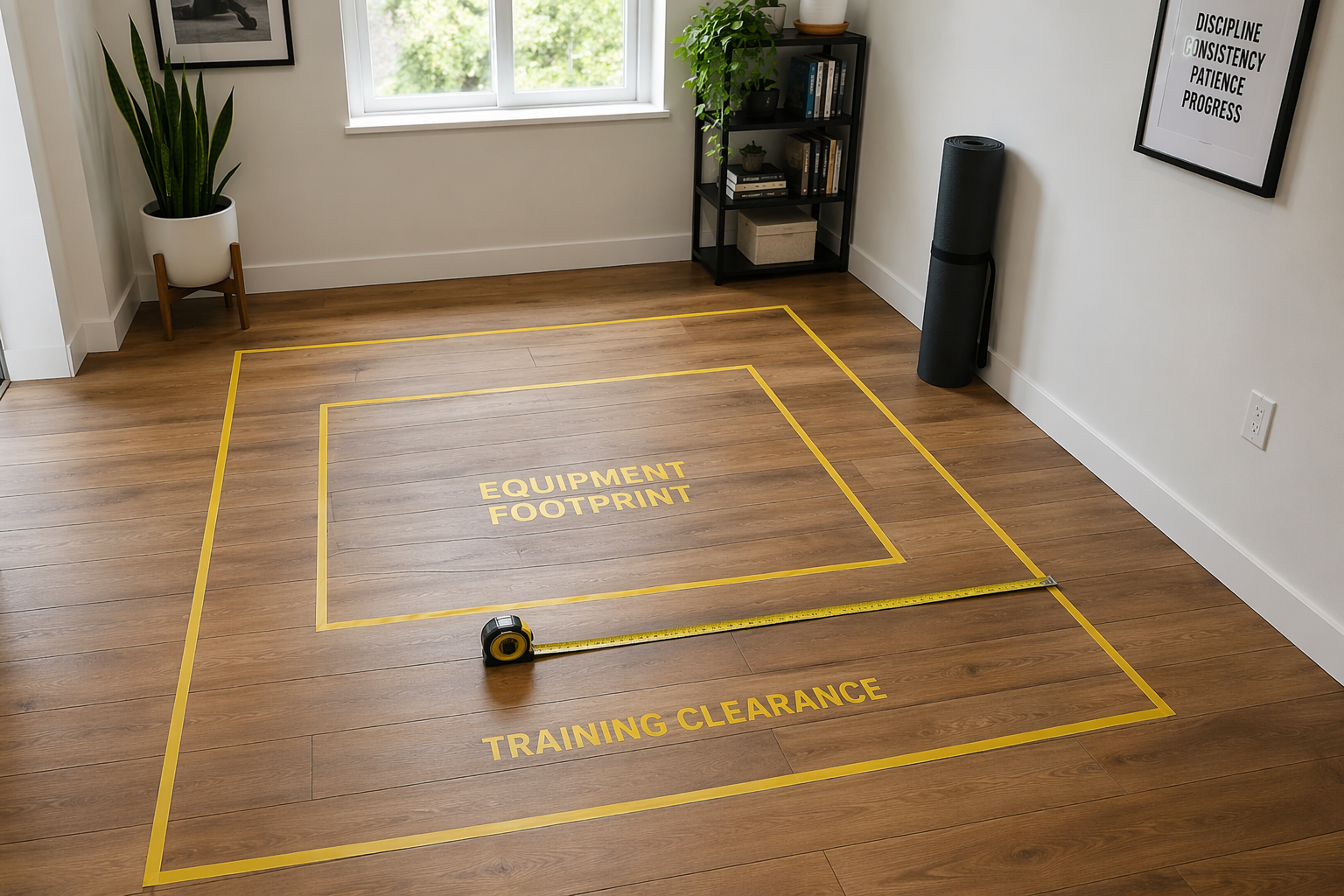
Measure the workout zone, not just the footprint
A published footprint tells you how much floor an item covers when it is sitting still. Training space is different. It includes the path of your body, the swing of a bar, the rear clearance behind cardio equipment, the room to fold and unfold gear, and the small but very real strip of floor you need so the room still functions when the workout is over.
RitFit’s home gym size guide is useful because it frames gym planning by room sizes such as 6×8 ft, 8×10 ft, 10×10 ft, and 12×12 ft rather than by a loose promise that something is “compact” [1]. PowerliftingTechnique takes a similar planning-first approach with floor plans from 100 to 500 sq ft, though its guide was published in 2021, so the layouts are more useful than any dated product references inside them [2].
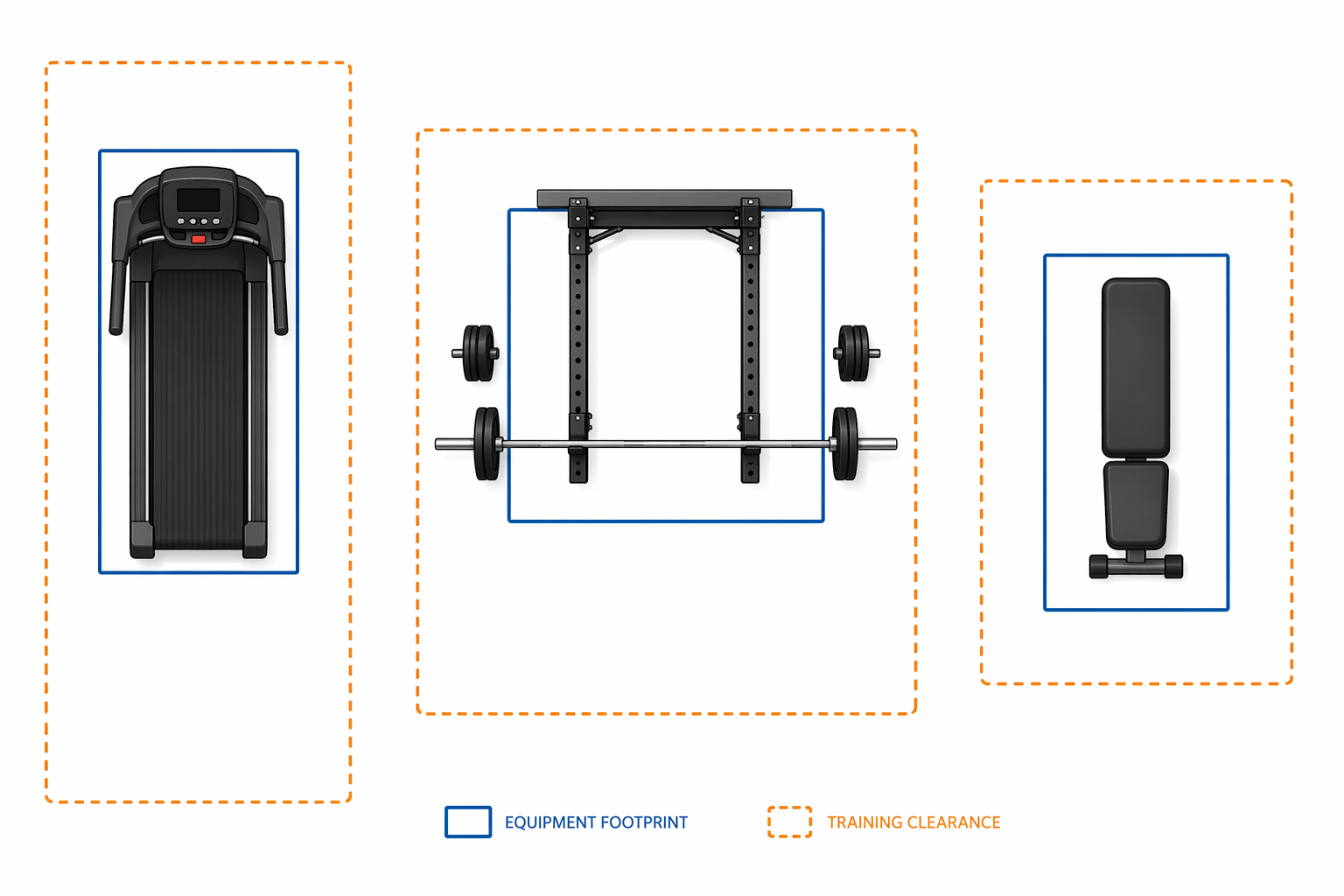
For a compact home gym, the first measurement should be the largest rectangle you can keep open during a workout. If that rectangle crosses a doorway, blocks a hallway, traps a desk chair, or requires moving five objects every session, it is not really available space. It is a negotiation you will eventually lose.
| Usable training space | What usually fits | What needs caution |
|---|---|---|
| Under 50 sq ft | Fold-away strength gear, suspension training, adjustable dumbbells, compact smart gyms, yoga or mobility work | Bench work, treadmill use, wall racks, and any setup that claims to fit because it folds |
| 50–100 sq ft | A bench and dumbbells, a folding rack, compact cable or smart gym, some cardio options | Traffic flow, storage, treadmill rear clearance, and plate loading room |
| 100–150 sq ft | More traditional strength layouts, rack-and-bench setups, dumbbell storage, some cardio plus strength combinations | 7 ft barbell clearance, ceiling height, and whether the room shape wastes usable area |
| 150+ sq ft | Dedicated home gym layouts, larger racks, multiple stations, garage-style organization | Overfilling the room because the square footage finally feels generous |
Under 50 sq ft: build around clearance, not ambition
Under 50 sq ft is where compact home gym advice gets sloppy. Product pages love this tier because nearly everything looks plausible when photographed alone. Real rooms are less forgiving. A 6×8 ft area, which equals 48 sq ft, can support useful training, but it cannot absorb much wasted motion, storage clutter, or setup time.
The better options here are the ones that give the floor back when you are finished: adjustable dumbbells, resistance bands, suspension trainers, fold-away benches, very compact smart gyms, and wall-adjacent strength systems if the wall and lease allow them. Apartment renters should be especially cautious with anything that requires drilling, permanent anchoring, or loud weight changes; the more specific apartment constraints belong in an apartment compact home gym setup rather than in a generic equipment list.
The PRx Profile PRO is a good example of why a promising dimension still needs context. Garage Gym Reviews lists the rack at a 6.7-inch folded depth, which is genuinely useful in a tight room because the rack does not keep claiming the floor when stored [3]. But folded depth is not workout depth. Once the rack is down, you still need space for the bench or squat stance, space to move around the uprights, and room at the sides if you are using a barbell.
The same caution applies to compact smart gyms. Garage Gym Reviews and CNET list the Speediance Gym Monster at 49.2×28.3 inches, a small footprint for an all-in-one strength machine [3][4]. That footprint helps, but the workouts still happen outside the rectangle. If a movement asks you to step back, hinge, row, lunge, or lie down, the floor in front of the machine becomes part of the gym.
In this tier, a treadmill is usually the item to question first. The machine itself may fit against a wall, but a treadmill also needs 3–5 ft of clearance behind it. That rear zone is not decorative. It is the space you want available if you step off awkwardly or lose rhythm. In a sub-50 sq ft room, that requirement can consume the same floor you were counting on for strength work [1].
A realistic sub-50 sq ft shortlist
- Adjustable dumbbells plus a foldable or easily stored bench, if the bench can be used without blocking a door or walkway.
- A compact smart gym, if the open floor in front of it supports the movements you actually plan to do.
- A folding wall rack, only if mounting is allowed, ceiling height works, and the workout zone remains open when the rack is unfolded.
- Bands, suspension training, a mat, and small accessories when noise, storage, and lease restrictions matter more than max loading.
If your usable rectangle is closer to 10, 30, or 50 sq ft than to a full room, compare it against a narrower space-tier guide for 10, 30, 50, and 100 square feet. The smaller the space, the more every inch depends on the exact room shape.
50–100 sq ft: the first useful jump in options
A 50–100 sq ft room is where a compact home gym starts to feel less like a kit you unpack and more like a small training area. An 8×10 ft room gives you 80 sq ft, which sits in the middle of this range and lines up with one of RitFit’s documented size tiers [1]. That does not make the space large. It means you can usually choose one main training identity without turning every session into furniture Tetris.
The most sensible version is often one anchor plus movable tools. The anchor might be a foldable rack, a smart strength machine, a compact cable trainer, or a cardio machine. The movable tools are the bench, dumbbells, kettlebell, mat, bands, and storage pieces that can shift without requiring a full room reset.
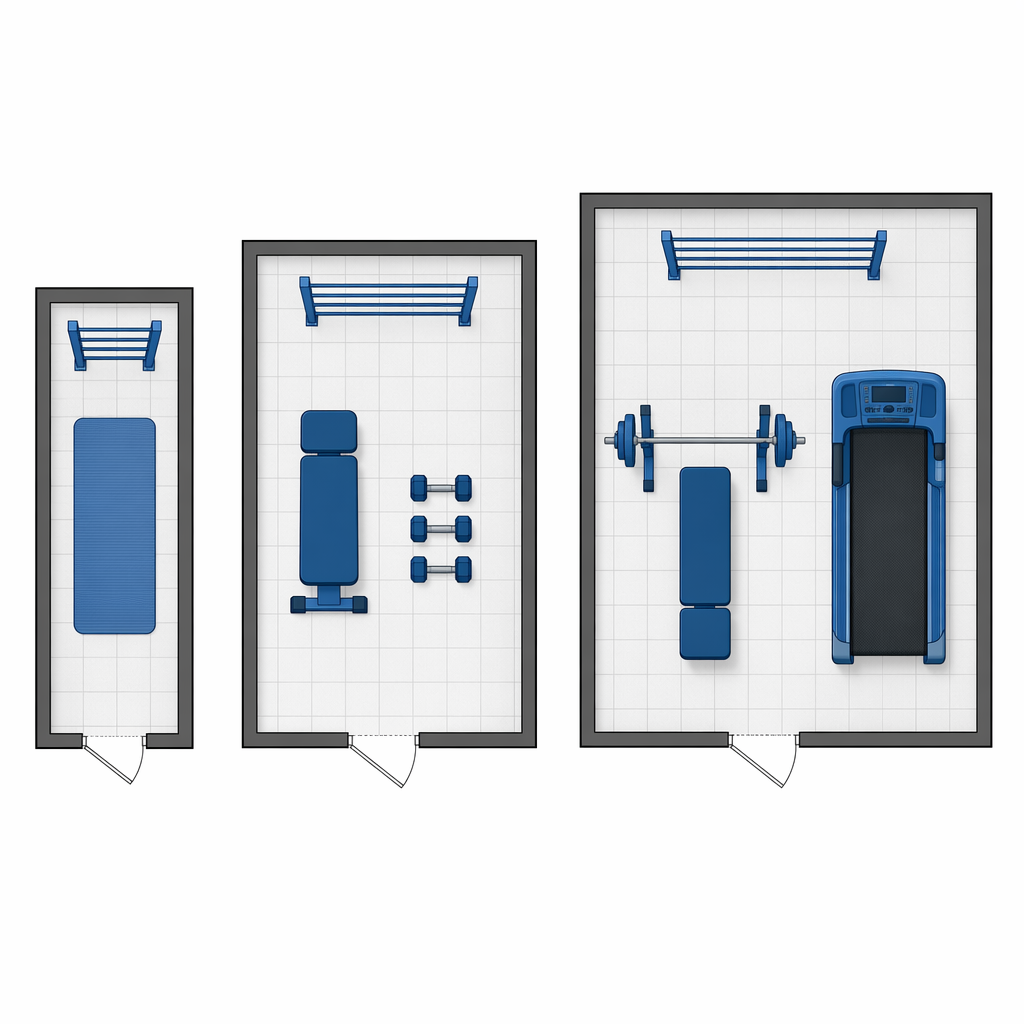
This is also the range where people overestimate how much barbell training will fit. A rack footprint can look manageable, but a 7 ft Olympic bar changes the room. You need the width of the bar, enough side space to load plates, and enough open area to bail out of a movement or move around the bench. If the bar nearly touches a wall on each side, the setup may technically assemble but still be miserable to use.
Cardio has the same problem from another direction. A folding treadmill can reduce stored depth, but the running position still needs rear clearance. If the only way to create that space is to block the room entrance, the treadmill is borrowing safety from the walkway. That is not a layout; it is a trip hazard waiting for a tired day.
What this tier can comfortably support
- Dumbbell-focused strength training with a bench, provided the bench can be used flat and inclined without colliding with storage.
- A folding rack or compact rack setup for controlled strength work, if barbell loading room is included in the plan.
- A compact smart gym or cable-style trainer with enough open floor for full-body movements.
- One primary cardio machine, if it does not consume the only safe open rectangle in the room.
Healthline’s compact home gym roundup shows why this tier can cover very different budgets and formats: the listed compact gym options span from $165 to $3,999 and include dimension specs rather than only product claims [5]. Price does not solve the room. A cheaper dumbbell setup may fit better than a premium all-in-one machine if the machine forces awkward movement, and an expensive folding system is still wrong if the folded position blocks the closet you use every day.
100–150 sq ft: traditional strength becomes plausible, not automatic
At 100–150 sq ft, the room can begin to support equipment that feels closer to a dedicated gym: a rack, bench, barbell, plates, dumbbell storage, and possibly a cardio machine. RitFit’s 10×10 ft and 12×12 ft tiers fall into this planning conversation, and PowerliftingTechnique’s floor-plan examples begin at 100 sq ft [1][2].
This is the point where a tape measure should get less forgiving, not more. A 10×10 ft room sounds simple until the door swings inward, the radiator steals a wall, the ceiling fan sits over the only pressing area, or a closet breaks up the storage run. A 12×12 ft room gives more options, but the same rules still apply: bar path, plate loading, rear treadmill clearance, storage access, and a normal walking route through the space.
Ceiling height is the quiet deal-breaker. Square footage guides often do not address it, but overhead work depends on lifter height, arm length, equipment height, and the lift itself. If the ceiling is below 8 ft, overhead pressing, pull-ups, some cable movements, and tall racks may become impractical even in a room with 150 sq ft of floor. That is not a small detail to discover after delivery.
For many small-home owners, this tier is best treated as a choice between a strength-first room and a mixed room. A strength-first version might dedicate the best wall to a rack and keep dumbbells stored tightly. A mixed version might use a compact rack or smart gym plus one cardio machine. Trying to include full barbell training, generous dumbbell work, cable training, and cardio in the same 100–150 sq ft room usually forces at least one station into an annoying position.
If you are comparing specific machines at this point, move from room planning to a real-world compact home gym footprint comparison. That is where manufacturer dimensions, folded positions, accessories, and workout clearance should be checked side by side.
150+ sq ft: more room, more temptation
Once you have more than 150 sq ft, the question shifts. You are no longer trying to make every tool disappear after use. You are deciding how much of the room should remain open so training feels repeatable. This is where garage-style thinking can help, especially if the space is a basement, spare room, or one side of a garage.
The mistake here is assuming the extra square footage means every wishlist item belongs. A rack with a 7 ft bar, a treadmill with 3–5 ft behind it, dumbbell storage, a bench, plate trees, and a cable station can quickly turn a generous room into a narrow aisle. More equipment also means more transitions: walking around the bench, moving plates, changing attachments, and keeping the path to the exit clear.
Readers planning a garage or garage-like room should use a dedicated single-car garage gym layout guide rather than treating a larger compact home gym as an oversized apartment setup. Storage, vehicles, doors, and wall systems change the layout math.
A quick way to test a layout before buying
Before ordering anything heavy, make the room prove it can handle the workout. Tape the equipment footprint first, then tape the larger clearance zone around it. Stand where the bench would go. Pretend to load the bar. Step off the back of the treadmill. Open the door. Fold the rack away and see what remains blocked.
- Measure the largest rectangle that can stay open during training.
- Subtract door swings, closet access, traffic paths, and permanent furniture.
- Add movement clearance around the equipment, not just the stored footprint.
- Check ceiling height for pressing, pull-ups, racks, and tall users.
- Shortlist only equipment that leaves a usable training zone after storage is included.
Manufacturer dimensions are still worth reading, but treat them as the beginning of the layout, not the answer. Usable space changes with room shape, lifter height, ceiling height, accessories, and how the equipment is used. A compact home gym should fit the workout and the room you still have to live in afterward.
References
- Best Home Gym Size Guide, RitFit, https://www.ritfitsports.com/blogs/article/best-home-gym-size-guide
- Small Home Gym Setup, PowerliftingTechnique, https://powerliftingtechnique.com/small-home-gym-setup/
- Best Home Gyms, Garage Gym Reviews, https://www.garagegymreviews.com/best-home-gyms
- Best Smart Home Gym, CNET, https://www.cnet.com/health/fitness/best-smart-home-gym/
- Compact Home Gym, Healthline, https://www.healthline.com/health/fitness/compact-home-gym
Some links on this page are affiliate links — they may earn us a commission at no extra cost to you. Our tier and tests are decided before we ever check which links pay; see our full affiliate disclosure.
Spot something off?
Noise and floor-damage claims carry real deposit-risk consequences if we get them wrong — tell us if your experience with this build didn't match what's above.