If you want home fitness equipment under 500 dollars for a small apartment, the cleanest starting receipt is not a giant rack, a bench, or a cable tower. It is a foldable cardio piece, adjustable dumbbells, resistance bands, a mat, and one boring storage item that keeps the whole thing from becoming living-room clutter.
A concrete under-$500 version looks like this: a foldable treadmill around $247, adjustable dumbbells around $125, resistance bands around $30, a workout mat around $40, and a small storage hack around $48, for a total of $490.[1] That is the right shape of the answer. The caveat is that this receipt comes from Acezoe, a brand selling its own treadmill, so it is useful as a buyable blueprint rather than a neutral verdict on one specific machine.
| Build | Best for | What you buy | Where it goes after |
|---|---|---|---|
| Foldable treadmill corner | Walkers who want indoor cardio without leaving the apartment | Foldable treadmill, adjustable dumbbells, bands, mat, storage bin or hook | Treadmill folds flat or upright; dumbbells and bands sit in a caddy; mat rolls under furniture or hangs |
| Foldable rower corner | People who want harder cardio and more full-body work from one machine | Foldable rower, adjustable dumbbells, bands, mat, small storage bin | Rower folds vertically; small gear stacks in one corner |
| Under-bed build | Studios with no permanent workout zone | Adjustable dumbbells, bands, mat, jump rope if your floor and neighbors allow it | Everything slides under the bed or into a low bin |
| Closet build | Renters with a usable closet door, sturdy door frame, or approved wall anchor | Suspension trainer, pull-up bar where appropriate, adjustable dumbbells, bands, mat | Soft gear hangs behind the door; weights stay low in the closet |
The Best Overall $500 Small-Space Build
For most renters with one usable corner, the best build is the $490 formula with one important choice at the top: foldable treadmill or foldable rower. Everything else stays the same because it earns its storage space.
- Cardio: foldable treadmill around $247 or foldable rower around $268.
- Strength: adjustable dumbbells around $125.
- Accessory work: resistance bands around $30.
- Floor protection and mobility: workout mat around $40.
- Storage: wall hook, under-bed bin, narrow cart, or basket around $48.
This setup can live in a 6-by-6-foot workout square if the cardio piece folds away and the weights do not sprawl. In practice, that means you work out on the mat, keep the dumbbells close enough for strength circuits, then put the mat and bands away before the room turns back into a living room.
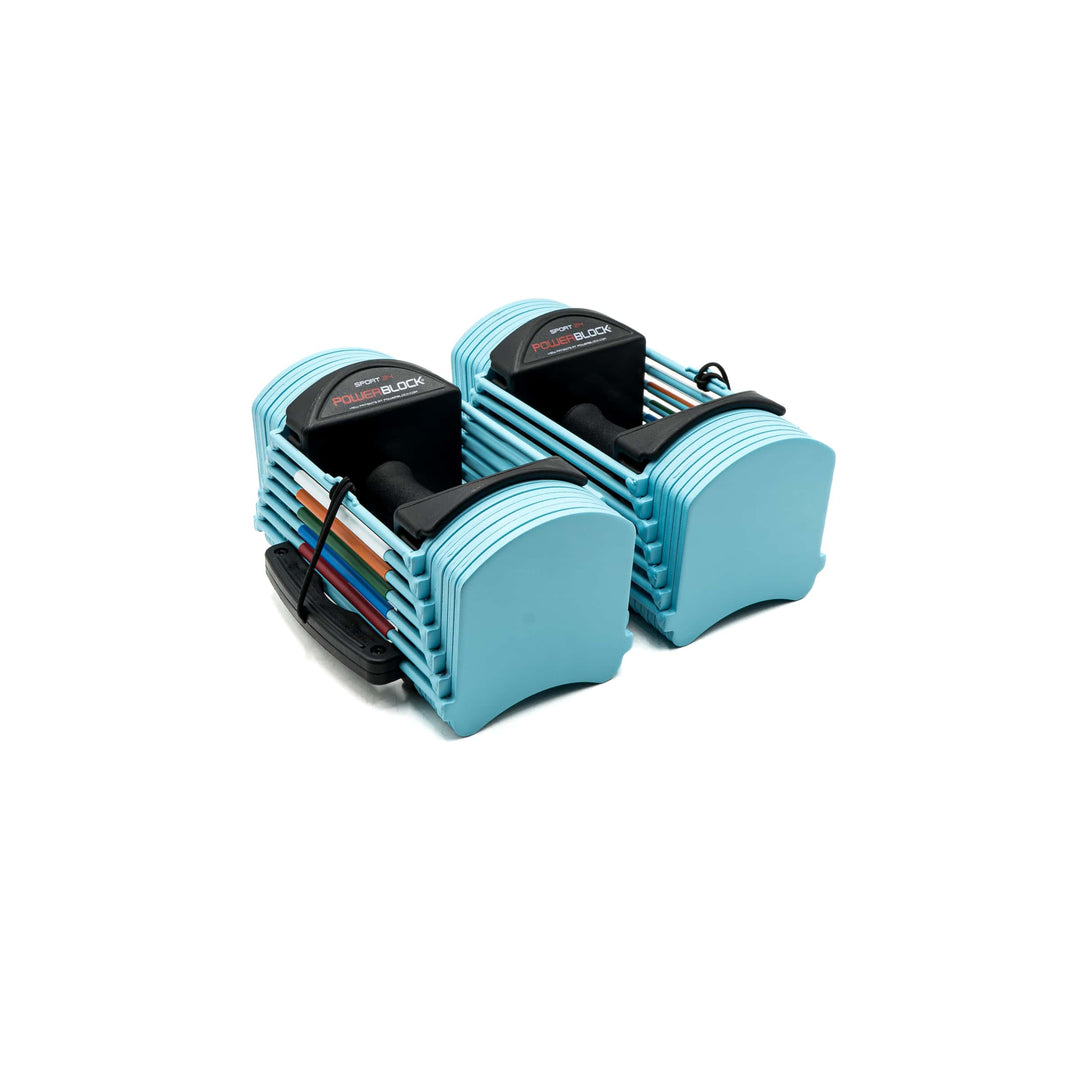
The adjustable dumbbells are the item most likely to save the apartment. Garage Gym Reviews describes compact adjustable dumbbells such as the PowerBlock Sport as having a 12-inch by 6.5-inch footprint and replacing 12 or more pairs of fixed dumbbells in roughly the space of two coffee mugs.[2] That is the difference between a strength setup and a pile of rubber hex weights permanently guarding the TV stand.
The bands are not the exciting purchase, but they cover warm-ups, mobility, assisted movements, rows, pull-aparts, and lighter accessory work. More importantly, they disappear into a drawer. The mat gives you a defined workout surface, keeps sweat off the floor, and gives the dumbbells somewhere softer to land when you are careful rather than heroic.
The $490 total also has a useful mental comparison. At an average $60 per month, a gym membership costs $720 per year, so a $490 home setup pays for itself in under 8 months if it actually replaces that membership.[2][3] That last condition matters. A cheaper setup you hate using is not savings; it is storage guilt with handles.
Treadmill or Rower: The Choice That Decides the Build
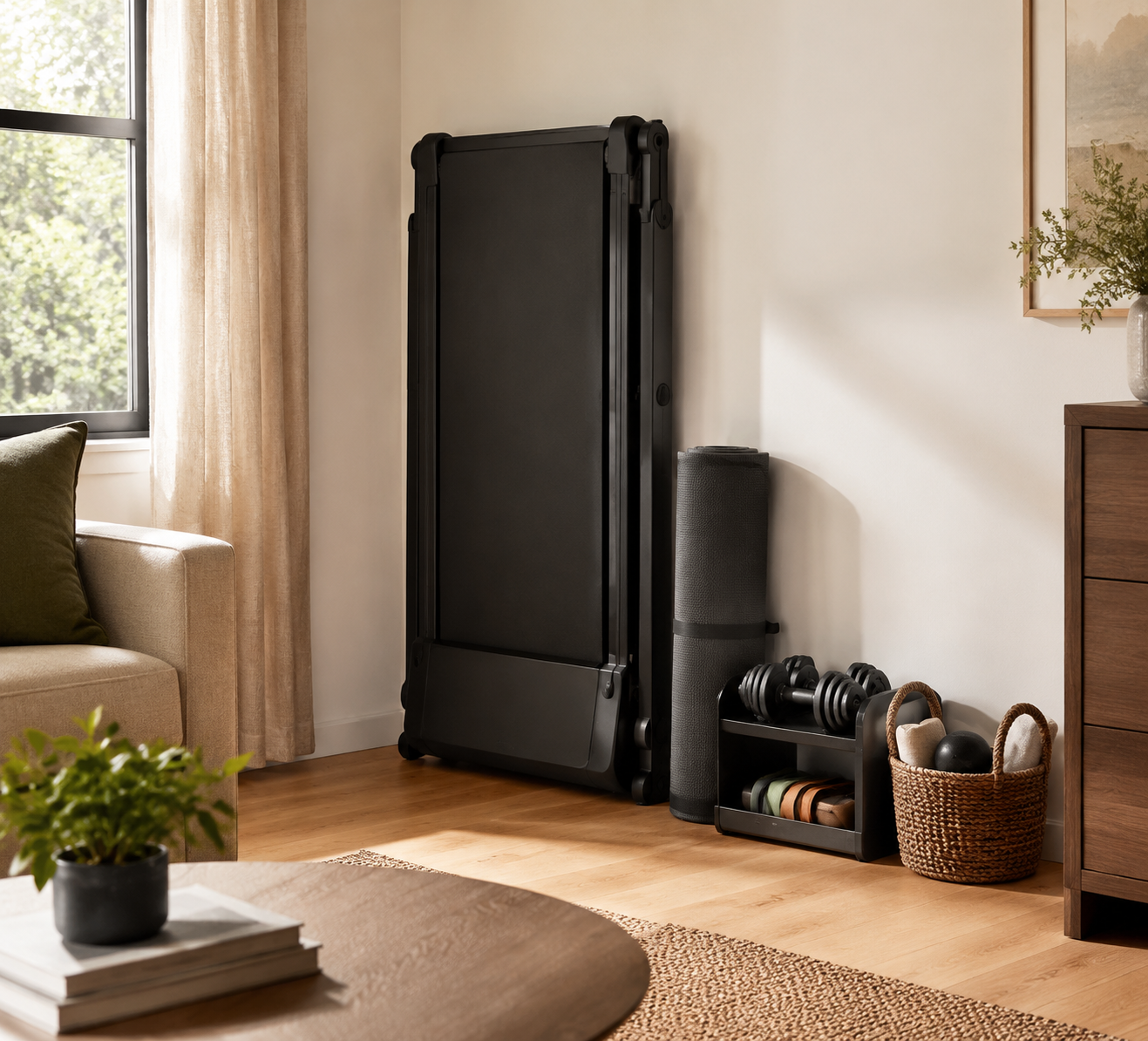
A foldable treadmill is the obvious apartment cardio centerpiece because walking is familiar, quiet enough for many buildings when paired with the right mat, and easy to use while half-watching a show. Acezoe’s sample build uses a P11 Pro treadmill at about $247 and says it stores flat under furniture.[1] For a renter whose real goal is indoor walking during bad weather, that can be exactly the right compromise.
The warning is durability. Fitness Outlet’s Summer 2026 guide says budget treadmills under $500 are “almost universally built to standards not designed for consistent daily use.”[4] Fitness Outlet sells higher-priced equipment, so the warning is not bias-free, but the underlying issue is reasonable: cheap treadmill motors, belts, and decks are usually not built for heavy, repeated pounding.
That does not make a budget treadmill a bad buy. It makes it a specific buy. Choose it if your use case is walking, light jogging within the machine’s stated limits, and easy storage under a bed, sofa, or against a wall. Be more cautious if you expect hard daily running, multiple users, or long sessions where the belt and motor never get a break.
A foldable rower is the less glamorous but often sturdier-feeling alternative under the same budget. Garage Gym Reviews lists the Fitness Reality 1000 Plus rower at $268 and notes that it folds for vertical storage.[2] It also gives you legs, back, arms, and conditioning in one piece, which matters when every item has to justify the square footage it borrows.
| Choose the treadmill if... | Choose the rower if... |
|---|---|
| You mainly want walking cardio indoors. | You want one machine to feel like cardio and strength conditioning. |
| You need something that can store flat under furniture. | You have a corner where vertical folded storage is acceptable. |
| You prefer low-skill, start-and-go workouts. | You are willing to learn rowing form. |
| Your sessions are light to moderate. | You are wary of sub-$500 treadmill durability. |
| Your apartment layout favors long, flat storage. | Your apartment layout favors upright corner storage. |
Build 1: The 6-by-6-Foot Corner Setup
This is the build to choose if you can leave one corner mentally assigned to exercise, even if the equipment itself gets put away. You need enough clear floor for a mat, enough clearance to step on and off the treadmill or rower, and one storage spot that does not require moving five unrelated things before every workout.
- Buy either a foldable treadmill or foldable rower.
- Add adjustable dumbbells instead of fixed pairs.
- Keep bands in a pouch, drawer, or the same caddy as the dumbbells.
- Use a mat that rolls tightly or can hang from a wall hook.
- Give the whole setup one destination when the workout ends.
The corner setup works because no single item needs to stay in the middle of the room. The cardio machine folds, the dumbbells occupy one compact footprint, the bands vanish, and the mat either rolls behind a door or slides under furniture. If one of those statements is not true for the product you are considering, it is probably too big for this build.
For floor noise and impact, especially with a treadmill, do not treat the mat as decoration. If your main worry is downstairs neighbors, use this article with a floor-specific guide such as How to Soundproof Your Apartment Home Gym Floor or a mat comparison such as Workout Mats for a Small Home Gym before buying the cardio piece.
Build 2: The Under-Bed Setup for No Permanent Workout Zone
Some apartments do not have a corner to donate. In that case, skip the cardio machine first, not the storage plan. The under-bed build is adjustable dumbbells, resistance bands, a mat, and possibly a jump rope if your floor, ceiling height, and neighbors make that realistic.
This build gives up the convenience of machine cardio, but it also avoids the most awkward object in the room. Conditioning comes from circuits: squats, rows, presses, hinges, carries in place, band work, and bodyweight intervals. If jumping is a bad idea in your building, do not buy a rope just because it is cheap. Cheap equipment that annoys the person below you is not compact; it is a complaint waiting to happen.
The storage test is simple: all equipment should fit in one low bin that slides under the bed without removing plates, folding metal arms, or stacking pieces like a puzzle. If the dumbbells are too tall for the bin, place them under a nightstand or at the back of a closet and keep the mat and bands in the bin.
Build 3: The Closet-Based Strength Setup
A closet build makes sense when you have a door, wall, or frame that can safely support pulling work, and when your lease or building rules allow the hardware. The equipment list shifts away from machine cardio and toward bodyweight strength: a suspension trainer, a pull-up bar where appropriate, adjustable dumbbells, bands, and a mat.
A TRX-style suspension trainer can cost around $229, which is not tiny inside a $500 budget, but it stores well and opens up rows, presses, assisted squats, lunges, core work, and stretching. The reason to choose it is not that it is magical. It is that soft straps hanging behind a closet door are easier to live with than another metal frame on the floor.
Be conservative with door-frame equipment. A pull-up bar that is technically removable still needs a suitable frame, enough clearance, and a user who checks it instead of assuming it is fine forever. If any of those conditions are shaky, bands and suspension rows are the better apartment compromise.
Build 4: The Heavy-on-Weights Budget Build, With a Warning
There is another tempting route: loadable dumbbells, plates, a flat bench, a pull-up bar, and bands. Goimu’s receipt-style example totals $450 with $40 loadable dumbbells, $180 for 160 pounds of plates, a $150 flat bench, a $35 pull-up bar, and $45 bands.[5] On paper, that is a lot of load for the money.
For a small apartment, the problem is not only the total weight. It is the handling. Plates need somewhere to live, a bench needs a parking spot, and changing loads in a tight room becomes one more step between you and the workout. The Goimu-style build also uses 1-inch standard plates, not Olympic plates, which can limit future barbell compatibility if you later want to upgrade.[5]
Choose this build only if strength load matters more than fast setup, you have a real closet or storage wall for plates, and you are comfortable with the upgrade path. For most studio renters, compact adjustable dumbbells are less annoying to own even when they offer less total load.
What to Check Before You Click Buy
Prices shift, especially around sales, so treat the exact dollar amounts as a 2026 snapshot rather than a guarantee. The better buying rule is stable: every item needs a workout job and a storage job. If it only does one of those, it is competing against your floor space.
- Measure the storage position first, not just the workout position.
- Check folded dimensions for treadmills and rowers, including height when upright.
- Choose adjustable dumbbells only if the increments match how you train.
- Buy the mat for your floor problem: sweat, impact, sliding, or noise.
- Avoid benches, racks, and plate piles unless you already know where they will live.
If your space is even tighter than a normal apartment corner, read How to Build a Home Gym in Under 50 Square Feet before choosing a cardio machine. If you are not ready to spend the full $500 at once, A Phased Approach to Your Small Apartment Home Gym on a Budget is the more forgiving route. If you still want to compare compact gear beyond this exact receipt, use Home Exercise Equipment for Small Spaces: Compact, Quiet, and Stowable Options for Apartments.
A home gym under $500 works in a small apartment when the equipment folds, stacks, hangs, or fits in a drawer. The moment it needs a permanent lane through the living room, it stops being a small-space gym and becomes another thing to step around.
References
- How to Set Up a Home Gym in a Small Apartment (Under $500) — Acezoe
- Best Home Gyms Under $500 2026 — Garage Gym Reviews
- Best Home Gym Equipment Under $500 — RitFit
- Summer 2026 Home Gym Buying Guide — Fitness Outlet
- I Built the Best Home Gym Under 500 (And Here Is the Receipt) — Goimu
Comments
Join the discussion with an anonymous comment.