
We Tested the Best Hoka Recovery Slides for Runners
Hoka's three recovery slides aren't interchangeable. We tested the Ora 3, Ora Luxe, and Ora Primo for fit, durability, and apartment-floor wear to help runners choose the right one for their feet and their home.
- Test space profile
- Small apartment; tested on sealed hardwood, tile, low-pile carpet, carpeted stairs, entry mat, deck boards, dry outdoor concrete, and wet bathroom floor.
- Floor damage risk
- low
- No-drill compatible
- ✓
- Test date

The useful question with Hoka recovery slides is not which one looks newest by the door. It is which one you can step into after a hot run, wear across hardwood before coffee, trust on tile, leave near the entry mat without hating the clutter, and still want to use weeks later.
We tested Hoka’s three recovery options in Q3 2026 as small-space runner shoes: the Ora Recovery Slide 3, the Ora Luxe, and the Ora Primo. The test was deliberately ordinary. They were worn after runs, barefoot and with socks, on sealed hardwood, tile, low-pile carpet, carpeted stairs, an entry mat, deck boards, dry outdoor concrete, and a wet bathroom floor. We checked fit, step-in ease, rocker feel, noise, scuffing, grip, strap or collar pressure, and visible outsole wear. This was not a lab recovery study, and it does not claim that any slide treats an injury.
The working verdict came quickly, then became more specific with wear: the Ora 3 is the pure post-run pick; the Ora Luxe is the adjustable, firmer all-day option if you can find it and fit it correctly; the Ora Primo is the closed-toe recovery mule for warmth, security, and casual indoor-outdoor crossover. None of the three is simply “the better Hoka.” They solve different annoyances.
| Model | Best use | What stood out in our apartment test | Main buying risk |
|---|---|---|---|
| Hoka Ora Recovery Slide 3 | Post-run slide by the door | Easy step-in, stable rocker, good barefoot comfort, least fussy for swollen feet | Sizing is inconsistent across reviewers; many find it long, while others call it true to size |
| Hoka Ora Luxe | Adjustable recovery slide for longer wear | Strap control helps when foot volume changes; firmer platform felt less sloppy for chores and stairs | A too-small fit can make the raised footbed edge uncomfortable; availability should be checked before buying |
| Hoka Ora Primo | Closed-toe recovery mule for warmth and secure crossover use | Warmer, more protective, and more shoe-like; lugged outsole felt more outdoor-capable | Runs small in outside reviews, and the heel collar makes slip-on ease less automatic |
Outside testing lines up with the broad shape of that verdict. Runner’s World named the Ora 3 its best overall recovery slide, Outside put it in a “For Active Recovery” role, and OutdoorGearLab named it “Best for Rest Days.”[1][2][3] That does not make the Ora 3 the best Hoka for every apartment, every foot, or every season. It makes it the reference point.
What makes Hoka’s recovery slides feel different
Hoka’s recovery line leans firmer and more guided than the marshmallow-soft idea many runners bring to recovery footwear. The Ora 3 uses dual-density sugarcane EVA, a 6 mm drop, and Hoka’s early-stage Meta-Rocker; Road Trail Run listed it at 221 g, or about 7.8 oz, for a US men’s 9.[4] OutdoorGearLab also notes the APMA Seal of Acceptance and describes the feel as supportive rather than mushy.[3]
That firmer feel is the split. If your dream recovery slide is a deep sink, Hoka may feel less luxurious at first step. If you dislike slides that wobble under a tired foot, Hoka’s platform starts to make more sense when you are carrying laundry, turning on carpeted stairs, or walking from a wet bathroom tile patch back onto wood.
The rocker is just as divisive. Outside describes the Ora 3’s rocker as a mechanical aid that helps you walk it out, while also noting that one buyer disliked how it changed his gait.[2] OutdoorGearLab calls the rocker a gentle mid-foot massage, and Runner’s World describes the stride as smooth.[3][1] In our indoor test, the rocker felt helpful on straight-line walking—kitchen to couch, hallway to laundry—but more noticeable when pivoting in small rooms. That is not a defect. It is a deciding factor.
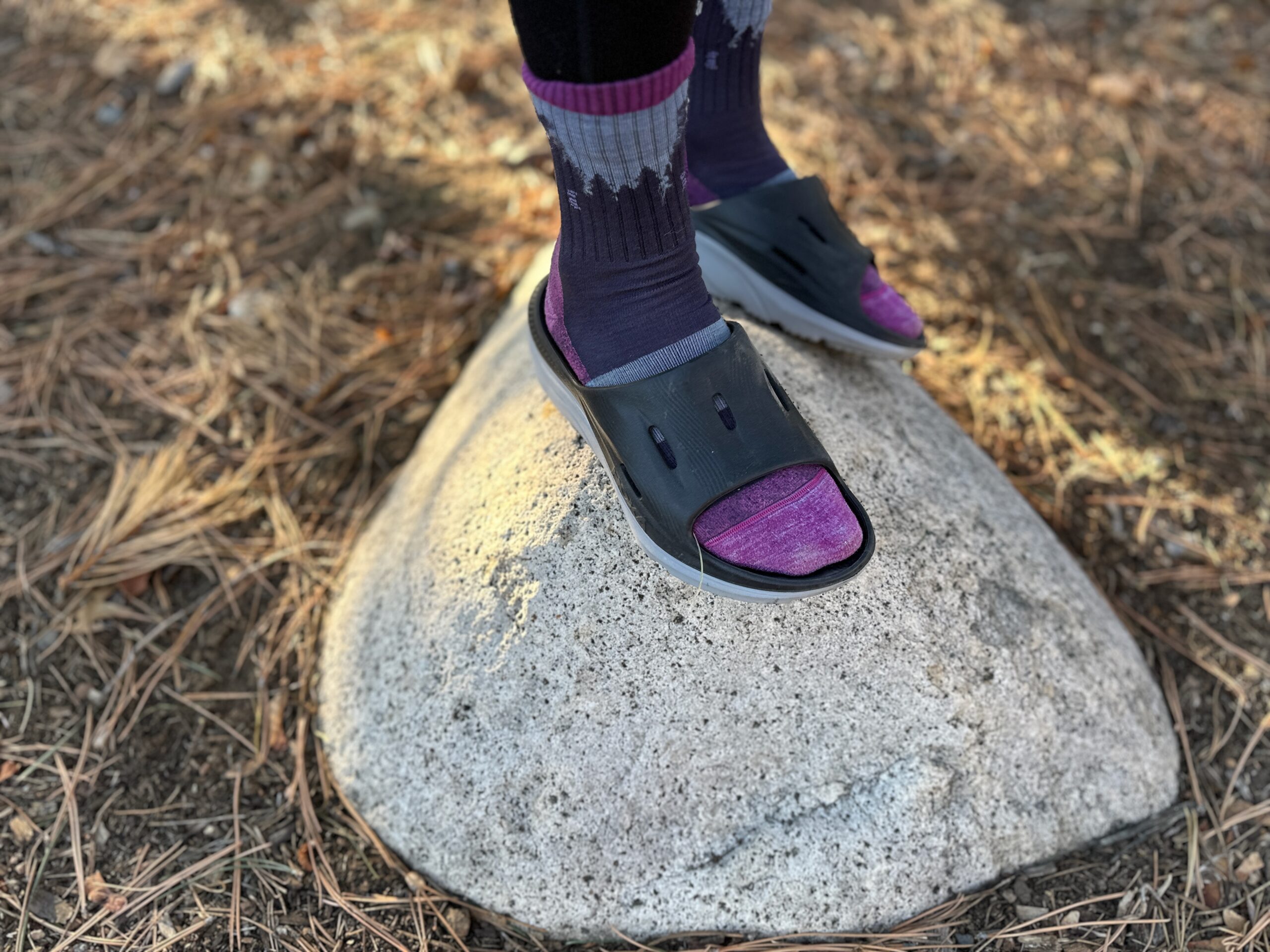
Ora Recovery Slide 3: the one most runners should try first
The Ora 3 is the cleanest answer for the runner who wants a recovery slide, not a house slipper with a training-shoe resume. It is open, easy to step into, roomy enough to forgive some post-run swelling, and structured enough that the foot does not smear sideways when you walk on hard floors.
In the apartment, it was the least demanding of the three. Barefoot on hardwood, the underfoot feel was cushioned but not bouncy. On tile, the rocker made short post-run pacing feel smoother than a flat sandal. On carpeted stairs, the slide shape still requires normal slide caution—you do not get heel retention—but the platform felt broad and predictable. On a deck and entryway concrete, the outsole felt protective enough for quick outdoor tasks, though it is still best understood as a recovery slide rather than a walking sandal.
Other testers’ long-term notes are unusually useful here because they are not all trailhead glamour shots. Runner’s World’s Ora 3 reviewer wears the slide daily as an apartment house shoe and backyard slide.[5] Road Trail Run tested it on flat carpet, steep carpeted stairs, wet and dry hardwood, tile, decks, flagstone, cement, and pavement, reporting full confidence and no outsole wear after weeks.[4] WeeViews’ six-month owner review is more personal but still relevant to the use case: the reviewer says barefoot hardwood walking caused foot pain that the Ora slides relieved.[6]
The one place we would not oversell the Ora 3 is wet bathroom tile. OutdoorGearLab cautions that the EVA outsole can be slicker on wet shower tile as the foam wears.[3] Our test did not turn that into a dramatic hazard, but the difference between dry tile and wet tile was obvious enough that these would not be my first choice as a shower sandal or pool-deck shoe.
Who should buy the Ora 3
- Runners who want a dedicated post-run slide that lives near the door.
- People whose feet swell after long or hot runs and who dislike tight straps.
- Apartment dwellers who want a stable house slide for hardwood, tile, carpet, and quick outdoor steps.
- Anyone who prefers guided, firm cushioning over deep sink.
Who should skip it
- Runners who want a plush, squishy recovery feel above all else.
- People who hate rocker geometry indoors.
- Anyone who needs secure heel hold for long errands, fast stairs, or uneven outdoor walking.

Ora Luxe: better when fit changes during the day
The Ora Luxe makes the most sense if your recovery slide turns into an all-day apartment shoe. The adjustable strap is not a decorative upgrade. It changes how the slide behaves when your foot volume changes after a run, when you switch from barefoot to socks, or when you want more hold on stairs.
WearTesters measured the Ora Luxe at 7.4 oz with a 6 mm drop and a 31 mm heel / 25 mm forefoot stack, and reported that its firmer footbed held up through months of daily wear.[7] That matches our impression: this is the least cloud-like of the three, but also the one that felt most willing to become a general home shoe. The firmer platform was useful on hard kitchen tile and while carrying things up carpeted stairs, where an over-soft slide can feel sloppy.
The drawback is that the Luxe is less forgiving when the length is wrong. The raised bumper around the footbed is pleasant when your foot sits inside it. If your toes or heel fight the edge, the same feature becomes irritating. This is the Hoka I would least want to buy too small.
There is also a practical buying caveat for Q3 2026: confirm Ora Luxe availability before treating it as an easy buy. Available reviews support how it performs, but not a clean current-stock picture. If it is available in your size, it is the Hoka recovery slide to consider when adjustability and longer-wearing support matter more than instant softness.

Ora Primo: odd-looking, warm, and more secure than a slide
The Ora Primo is the one that stops behaving like a slide. It is a closed-toe recovery mule with a chunkier, more protective personality and a lugged outsole. Field Mag found it secure, arch-supporting, and warm, with enough outsole bite to feel more outdoor-capable than a normal recovery slide.[8] Highsnobiety documented the model’s 2024 restock and $120 launch context, but current US pricing should be rechecked before buying.[9]
Indoors, the Primo made the most sense on cold mornings, on quick trash runs, and anywhere an open slide felt too bare. The closed toe gives it a slipper-meets-recovery-shoe role that the Ora 3 and Luxe do not try to fill. It also feels more secure when stepping outside onto a deck or walking over uneven pavers.
But the Primo also asks more of you at exactly the moment a recovery shoe should ask very little. Both Field Mag and Highsnobiety report that it runs small, and both note the heel collar can be tricky to slip into.[8][9] We found the same general friction point in use: once on, it feels more protective; getting it on is less brainless than stepping into the Ora 3. If your post-run routine involves swollen feet and zero patience, that matters.
The sizing problem is real
Hoka’s no-half-size reality turns a small mismatch into a buying problem. The annoying part is that the outside record does not reduce to one easy rule.
For the Ora 3, Road Trail Run needed a full size down and called it “a good one full size big.”[4] WeeViews’ reviewer, normally a 7.5, ordered a 7.[6] Runner’s World says the Ora 3 runs a bit big but treats that roominess as useful for swollen post-run feet.[5] CleverHiker, however, found it true to size and recommends sizing up if you are between sizes because there are no half sizes.[10]
That conflict sounds messy because feet are messy. A narrow, low-volume foot that wants a tidy slide fit may experience the Ora 3 as too long or too loose. A runner whose feet swell after summer mileage may experience the same room as relief. A between-size buyer who normally sizes down in sandals may be happy in the smaller whole size; a between-size buyer with a high instep or wide forefoot may regret losing the volume.
| Your fit situation | Most likely starting point | Why |
|---|---|---|
| You are between sizes and have narrow or low-volume feet | Try the smaller whole size first in the Ora 3, if returns are easy | Several reviewers found the Ora 3 long, and extra length can feel sloppy indoors |
| You are between sizes and have wide feet, a high instep, or heavy post-run swelling | Do not automatically size down in the Ora 3 | The extra room that bothers one runner may be the feature that helps another after a hot run |
| You are buying the Ora Luxe | Avoid a too-small fit | The raised footbed bumper can punish toes or heels that sit on the edge |
| You are buying the Ora Primo | Expect to consider sizing up | Outside reviewers report that it runs small and has a less effortless heel collar |
| You need medical orthotic-level precision | Skip blind buying | These are molded recovery shoes, not custom devices |
The safest practical move is boring: buy from somewhere with returns, test them late in the day or after a run, and walk the surfaces you actually have at home before deciding. Stand still, then walk stairs, then pivot in the kitchen. A recovery slide that feels plush for ten seconds can still be wrong if your toes grip to keep it on.
How they behaved on apartment floors
Hardwood was where Hoka’s firmer platform made the strongest case. None of the three felt like a soft foam blob collapsing into each step. The Ora 3 had the easiest barefoot rhythm. The Luxe felt more planted when its strap was snugged down. The Primo was warmer and quieter in a slipper-like way, though its lugged sole felt like more shoe than necessary for slow indoor pacing.
On tile, the difference between dry and wet mattered more than the difference between models. Dry kitchen and bathroom tile were fine. Wet bathroom tile made us slow down, especially in the open slides. OutdoorGearLab’s warning about the Ora 3’s EVA outsole becoming slicker on wet shower tile as foam wears is worth taking literally.[3] These are recovery slides first, not bath sandals.
On carpeted stairs, the Luxe’s adjustable strap helped most. The Ora 3 was acceptable when walking normally but still had the open-slide limitation: no heel, no real lockdown. The Primo felt the most secure once on, though the heel collar friction makes it less appealing for quick half-awake trips.
Noise was low across the group on hardwood and tile, with no sharp heel clap unless we walked carelessly. We did not see obvious scuffing in our home test, but floor finishes vary. If you rent and worry about marks, wipe outdoor grit off the outsole before turning any recovery shoe into an indoor shoe. The slide itself is rarely the whole problem; the grit it carries is.
Outsole wear is harder to judge from a short home test, so the outside record matters. Road Trail Run reported no outsole wear after weeks of mixed-surface use on the Ora 3.[4] WearTesters reported the Ora Luxe footbed held up through months of daily wear.[7] Those are not controlled durability trials, but they support the same practical read: Hoka’s recovery line favors stable, longer-wearing foam over instant squish.
What the APMA Seal and podiatrist praise do—and do not—mean
The Ora 3’s APMA Seal is a useful signal, but it is not a treatment claim. The American Podiatric Medical Association language cited by reviewers means a product “contributes to foot health,” not that it cures plantar fasciitis, heel pain, or any other condition.[3][11]
There is legitimate clinical interest in this kind of shoe shape. Travel + Leisure reports that podiatrist Dr. Bobby Pourziaee recommends the Ora 3 for plantar fasciitis, heel pain, metatarsalgia, tired arches, and foot fatigue.[12] City Step Podiatry’s Dr. Alison Young writes that rocker soles can meaningfully help heel pain and plantar fasciitis, while warning that too much cushion without structure can be problematic for significant overpronation.[11]
That supports a careful conclusion, not a miracle one. A Hoka recovery slide can be a useful post-run or house-shoe supplement, especially if barefoot hard-floor walking makes your feet ache. It should not replace diagnosis, rehab, strength work, load management, or medical care when pain is persistent.
A note on specs before you compare stack heights
We would not make a buying decision here from stack-height numbers alone. The available secondary specs conflict: Road Trail Run records the Ora 3 at 40 mm / 34 mm, while Outside lists 33 mm / 27 mm for the same model.[4][2] Weight numbers also vary by shoe size and whether the source reports per shoe or per pair. For this comparison, the more dependable difference is how the shoes fit and behave underfoot, not which spec table looks tallest.
Which Hoka recovery slide should runners buy?
Buy the Ora Recovery Slide 3 if you want the best Hoka recovery slide for most runners after runs. It is the easiest to live with by the door, the least fussy to step into, and the one with the strongest outside-review consensus. Manage the sizing risk, especially if you are between sizes.
Buy the Ora Luxe if your recovery slide becomes an all-day home shoe and you value adjustability, firmer support, and longer-wearing structure. Do not buy it too small. Also check current availability before falling in love with it.
Buy the Ora Primo if you want warmth, a closed toe, a more secure mule feel, and casual outdoor crossover. Skip it if easy step-in is the whole reason you are buying recovery footwear, or if you refuse to deal with sizing uncertainty.
Skip all three if you want maximum plush sink, a waterproof shower slide, or a medical solution for foot pain. Hoka’s recovery slides are at their best when treated as stable, purposeful tools for tired feet and hard floors—not as magic foam.
References
- I Wear Recovery Slides After Every Run—These Are the Best Ones to Buy — Runner's World
- Best Recovery Sandals and Slides of 2026, Tested and Reviewed — Outside Online
- Hoka Ora Recovery Slide 3 Review | Tested & Rated — OutdoorGearLab
- Hoka Ora 3 Recovery Slide Review — Road Trail Run
- Hoka Ora 3 Slides Understand Post-Run Misery Better Than Most People — Runner's World
- HOKA Ora Recovery Slide Review (6-month durability) — WeeViews
- Hoka Ora Luxe Review — WearTesters
- Hoka Ora Primo Review: Weird, Ugly, Yet Deeply Lovable — Field Mag
- HOKA's Ora Primo Mule Is Finally Restocking: Where to Buy — Highsnobiety
- HOKA ORA Recovery 3 Slide Review — CleverHiker
- Footwear Focus—A Podiatrist Reviews the Hoka Ora Recovery Slide — City Step Podiatry
- A Podiatrist Told Me He Wishes His Patients Would Pack This One Surprising Shoe Style on Every Trip — Travel + Leisure, Aug 2026
This result comes from one real apartment under the stated conditions — it is a strong signal, not a guarantee your space will measure identically.
Builds this evidence supports
Can insect protein build muscle at home?
Insect protein from crickets and mealworms produces a muscle protein synthesis response comparable to milk protein in acute trials, but the only training study in young men found no extra strength or size gain. This verdict sorts out what the human research actually supports so home lifters can decide if insect protein is worth buying.
Swimming Pool Under $5? The Real Price Ladder
No swimming pool under $5 can support home exercise — that budget buys a resistance band or one community-pool day pass. The verified price ladder runs from $125 inflatables to $25,999+ swim spas, with a depth rule that separates pool toys from real training.
What a Cargo Container Pool Really Costs vs. a Home Gym
A cargo container pool's base price hides a much larger all-in cost: $50,000–$85,000+ installed, plus $500–$7,340 a year to run. This cost reality-check benchmarks the container pool against container gyms and in-home builds so you can judge which delivers more training value per dollar.
Spot something off?
If this result didn't match your own space, let us know — floor-damage and noise claims carry real deposit-risk consequences if we get them wrong.