Postpartum exercise to tighten loose skin has to start with an honest distinction: exercise can improve the way loose belly skin looks by rebuilding the muscle and control underneath it, and resistance training may support skin elasticity, but exercise cannot cut away extra skin that has stretched beyond its elastic limit. That matters because the first few weeks after birth are not the time to chase a flatter stomach with crunches, planks, or sweaty “bounce back” challenges. They are the time to restore pressure control, reconnect with the pelvic floor, and teach the abdominal wall to work again without bulging, leaking, heaviness, or pain.
Before starting, get clearance from your OB-GYN, midwife, pelvic floor physical therapist, or other healthcare provider. ACOG says that after an uncomplicated vaginal delivery, some people can begin gentle exercise within a few days, but the actual starting line changes with C-section healing, tearing, hemorrhage, prolapse symptoms, diastasis recti, infection, pain, or any complication that made recovery less straightforward.[1]
Stop or scale back if you feel pelvic pressure or heaviness, leaking, sharp pain, pulling at a C-section scar, dizziness, increased bleeding, abdominal coning or doming, or symptoms that are worse later that day or the next morning. Those are not signs that your core is “weak and needs more.” They are signs the exercise is currently too much, too soon, or not matched to your recovery.
The 12-Week Map
This plan is written for someone who has been cleared for postpartum movement and wants a practical route from early reconnection to real strength work. The weeks are not a race. If you had a C-section, significant tearing, pelvic floor symptoms, or unresolved pain, a “week 5” exercise may belong much later. If you are 10 or 16 weeks postpartum but never rebuilt the early layer, start at the beginning anyway.
| Timing | Main job | Exercises | Progress when |
|---|---|---|---|
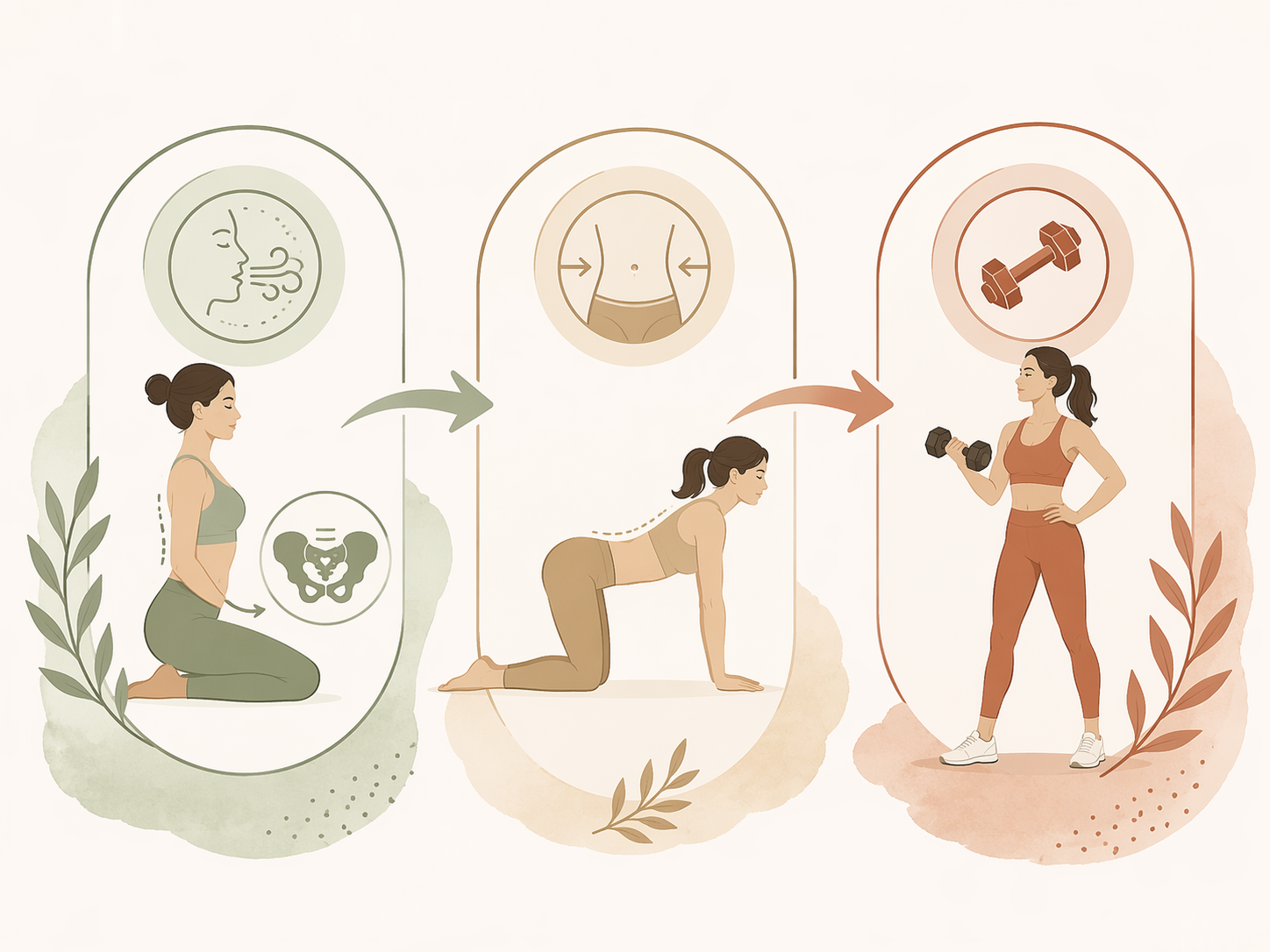
| Weeks 0–2, or your first cleared movement window | Breathing, pelvic floor awareness, gentle abdominal reconnection | 360 breathing, pelvic floor relax-contract, pelvic tilts, supported heel slides | You can breathe without bracing and move without pain, heaviness, leaking, or coning |
| Weeks 3–4 | Deep core control in easy positions | Pelvic tilts, heel slides, bent-knee fallouts, supported marches, side-lying breathing | You can keep the belly from bulging and symptoms stay quiet for 24 hours |
| Weeks 5–8 | Core stabilization with more limb movement | Dead bug arms or legs, glute bridges, bird dog prep, side plank from knees, sit-to-stand | You can control pressure while breathing and daily tasks feel easier |
| Weeks 7–12 | Bodyweight loading and basic strength | Squats to a chair, hip hinges, step-ups, elevated push-ups, carries, rows with a band | You can add sets or resistance without pelvic floor symptoms or abdominal doming |
| Week 13+ | Progressive resistance training | Goblet squats, Romanian deadlifts, split squats, rows, presses, loaded carries | You are cleared for heavier loading and can recover well between sessions |
ACOG’s general postpartum activity target is 150 minutes of moderate-intensity aerobic activity per week, with muscle-strengthening activity on 2 days per week.[1] That is useful background, but this routine does not begin by filling a calendar with workouts. It begins by making sure the core and pelvic floor can handle pressure again.
Weeks 0–4: Reconnect Before You Load
Late pregnancy and birth ask a lot from the abdominal wall and pelvic floor. One postpartum rehabilitation review notes that abdominal muscles lengthen to 115% of resting length by 38 weeks of pregnancy, while the pelvic floor can stretch to 250% during delivery.[2] That does not mean the body is broken. It means the early work should look almost embarrassingly gentle from the outside.
This phase is where many people get impatient, especially when the visible issue is loose skin. But if the belly pushes outward every time you sit up, lift the baby, or roll out of bed, harder abdominal work only teaches the same pressure pattern under more load. The goal is to make the exhale, pelvic floor, and deep abdominal wall cooperate before you ask them to stabilize a squat, plank, or dumbbell.
Daily base routine, 5 to 10 minutes
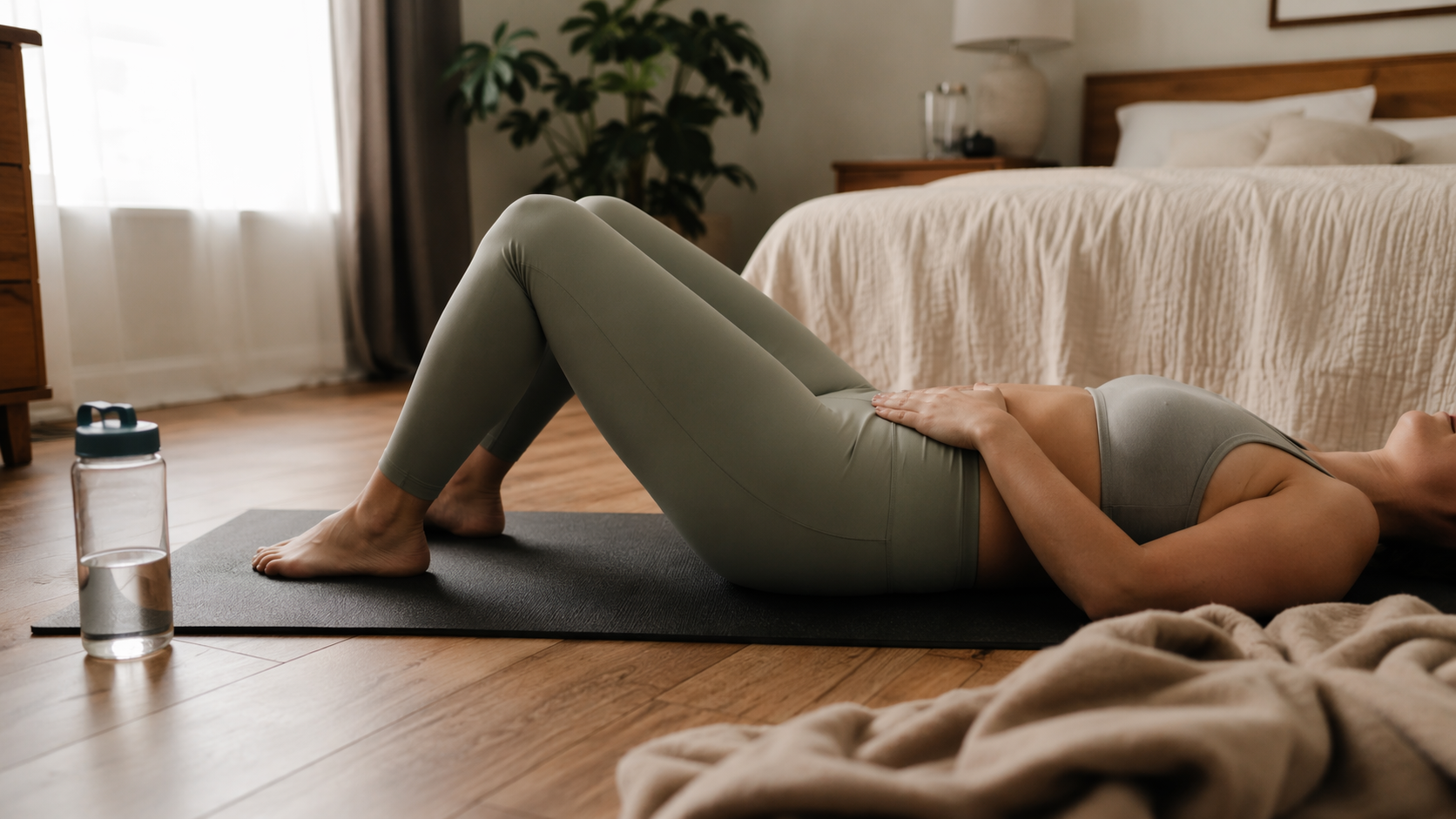
- 360 breathing: Lie on your back with knees bent, or rest on your side if lying flat is uncomfortable. Inhale into the ribs, back, and low belly without forcing the stomach upward. Exhale slowly as if fogging a mirror. Do 5 to 8 breaths.
- Pelvic floor relax-contract: On the inhale, let the pelvic floor soften. On the exhale, gently lift as if picking up a blueberry, not clenching a fist. Do 5 to 8 gentle reps, then fully relax.
- Pelvic tilts: On an exhale, lightly draw the low belly inward and tip the pelvis so the low back softens toward the floor. Inhale to return to neutral. Do 8 to 10 reps.
- Supported heel slides: Exhale, lightly engage the deep core, and slide one heel away only as far as you can without the belly doming or the pelvis rocking. Inhale to return. Do 5 to 8 reps per side.
Keep the effort low. A good early rep feels coordinated, not impressive. If your shoulders grip, your glutes clench, your breath stops, or your abdomen forms a ridge down the midline, shorten the movement. If shortening the movement does not help, return to breathing only and get assessed.
The deep-core approach is not just a cautious habit. In a reported pilot presented through ACOG, 63 women did 10 minutes a day of targeted deep core work, and diastasis recti resolved in all participants after 12 weeks.[3] That is encouraging because 10 minutes is something a sleep-deprived person can actually imagine doing. It is also preliminary: the report was not a peer-reviewed randomized trial, so it should not be treated as a guaranteed fix for every postpartum abdomen.
Add these once the base routine is quiet
- Bent-knee fallout: Lie on your back with knees bent. Exhale and let one knee open a few inches to the side while the pelvis stays still. Return and switch sides. Do 5 to 8 reps per side.
- Supported march: Exhale and lift one foot a few inches, keeping the ribs heavy and the belly flat rather than braced hard. Lower and switch. Do 5 to 8 reps per side.
- Side-lying rib breathing: Lie on one side with a pillow between the knees. Breathe into the back and side ribs for 5 slow breaths, then add a gentle pelvic floor lift on the exhale for 5 reps.
For the first month, frequency matters more than variety. Three perfect exercises done most days will usually serve you better than a long “postpartum abs” video that leaves you guessing whether pressure, heaviness, or doming is acceptable. It is not.
Weeks 5–8: Stabilize the Core While the Arms and Legs Move
At this point, the routine starts to look more like exercise, but the standard is still pressure control. Your belly does not have to be flat. Your skin does not have to look different yet. What should change is your ability to move an arm or leg while the ribs, pelvis, breath, and pelvic floor stay organized.
| Exercise | Dose | Form cue | Make it easier if |
|---|---|---|---|
| Dead bug arms only | 2 sets of 6 to 8 reps per side | Exhale as one arm reaches overhead; keep ribs from flaring | The low back arches or the belly domes |
| Dead bug heel taps | 2 sets of 5 to 8 reps per side | Lift one foot, exhale, tap the heel down, then return | You cannot keep the pelvis still |
| Glute bridge | 2 sets of 8 to 10 reps | Exhale to lift; keep the ribs soft and avoid pushing the belly upward | You feel pelvic pressure or low-back gripping |
| Bird dog prep | 2 sets of 5 reps per side | Start on hands and knees; slide one foot back before lifting it | Hands-and-knees position causes wrist, scar, or pelvic discomfort |
| Side plank from knees | 2 to 3 holds of 8 to 15 seconds per side | Exhale before lifting; keep the waist gently lifted | You hold your breath or feel bearing down |
Rest 30 to 60 seconds between sets. Do this routine 3 days per week, with your shorter breathing and pelvic tilt routine on the other days if it still feels useful. Add walking as tolerated, but do not use long walks to force recovery faster. If bleeding increases, heaviness appears, or symptoms show up later, reduce the distance or intensity.
This is also the phase where daily life becomes part of training. Exhale before lifting the car seat. Roll to your side before getting out of bed. When you pick the baby up from the crib, hinge at the hips instead of rounding and bearing down. These tiny choices are not glamorous, but they keep you from practicing the exact pressure pattern your workout is trying to clean up.
Weeks 7–12: Move Into Bodyweight Strength
Weeks 7 and 8 overlap on purpose. If stabilization is going well, you can begin bodyweight strength while continuing the core work. If symptoms are not quiet, wait. Returning to sport and higher-intensity exercise is often messy in real life; one postpartum rehabilitation review noted that 75% of postpartum runners return within 8 weeks, even though there is no standard return-to-sport protocol.[2] That gap is exactly why progression rules matter more than calendar confidence.
Do the following routine 2 to 3 days per week. Start with one set of each exercise for the first session. If symptoms stay quiet for 24 hours, move to two sets. If two sets feel easy and controlled for a full week, add a third set or a light band.
| Exercise | Starting dose | What to watch |
|---|---|---|
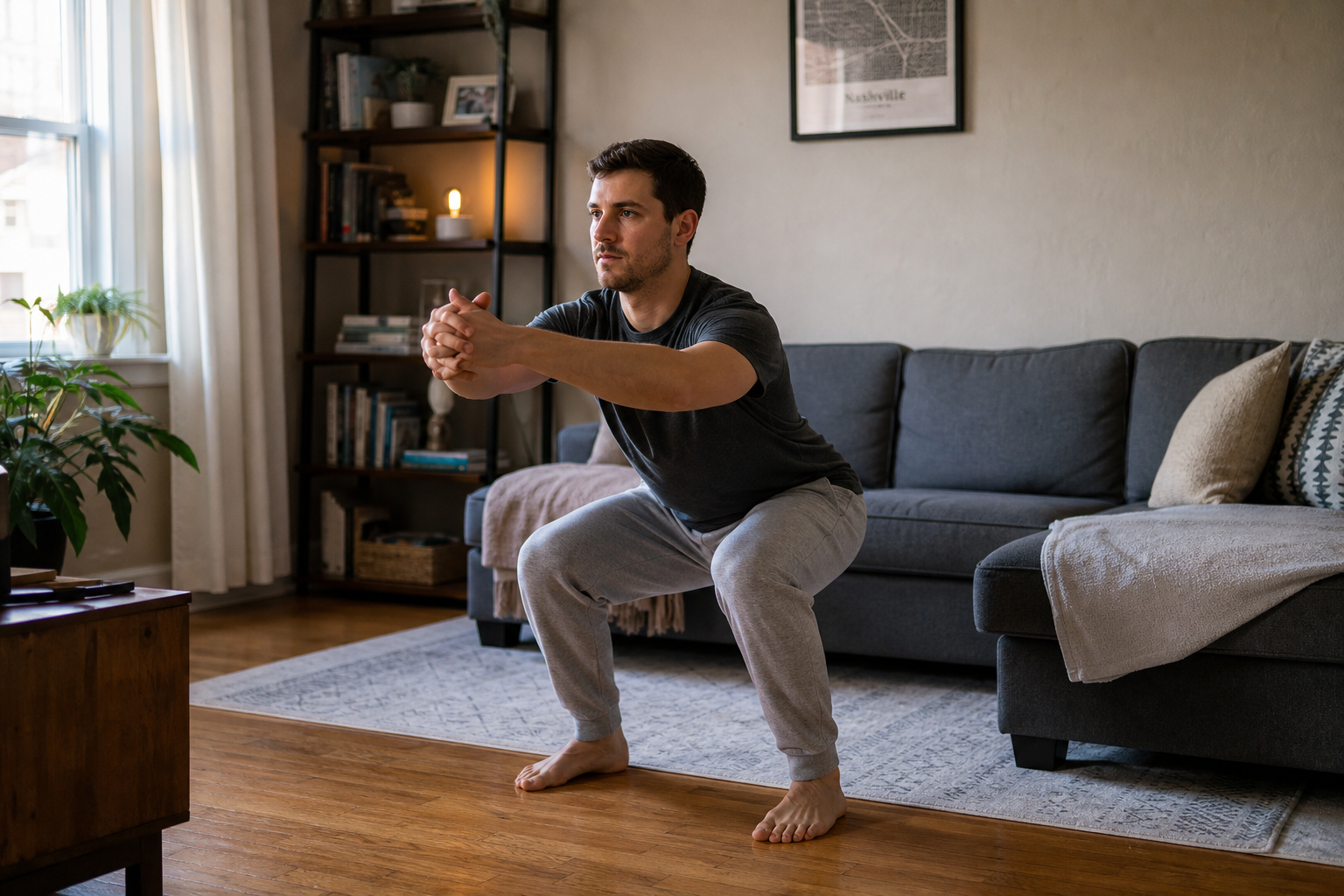
| Sit-to-stand or squat to a chair | 1 to 3 sets of 8 to 10 reps | Exhale as you stand; avoid pushing the belly forward at the top |
| Hip hinge to wall | 1 to 3 sets of 8 reps | Send hips back to touch the wall; keep ribs stacked over pelvis |
| Step-up to a low step | 1 to 2 sets of 6 to 8 reps per side | Use a low height; stop if pelvic heaviness appears |
| Elevated push-up | 1 to 3 sets of 6 to 10 reps | Use a wall, counter, or bench; choose a height that prevents doming |
| Band row | 1 to 3 sets of 8 to 12 reps | Pull shoulder blades back without flaring the ribs |
| Farmer carry with light weights | 2 to 4 carries of 20 to 40 seconds | Walk tall, breathe normally, and stop before grip or posture fails |
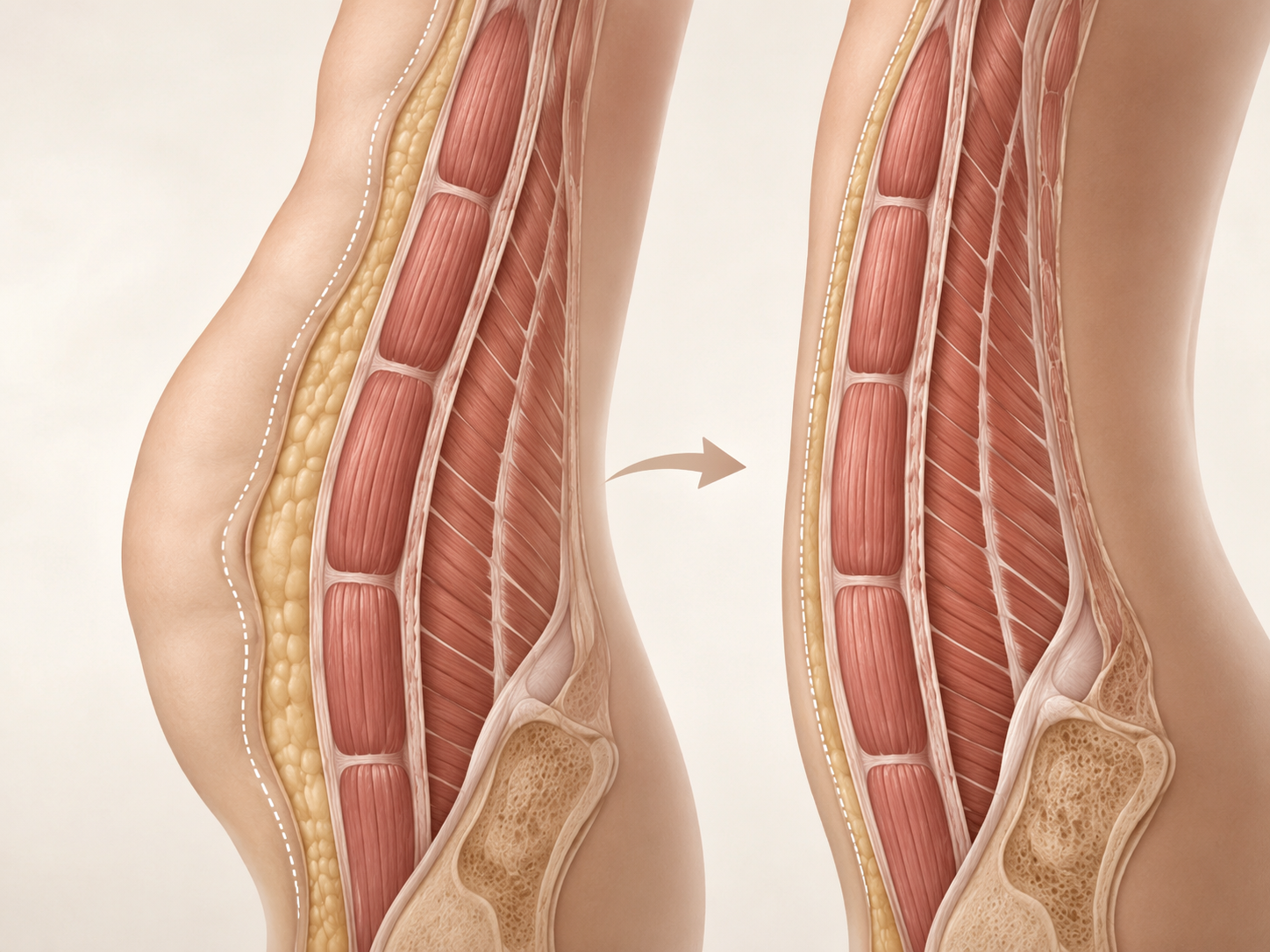
This is where the appearance piece begins to make more sense. Loose skin sits over a changing abdominal wall. When the muscle layer underneath is weak, stretched, or poorly coordinated, the skin may look more collapsed because the structure beneath it is not giving much support. Strengthening does not remove skin, but it can improve the contour that the skin rests on.
Week 13 and Beyond: Add Progressive Resistance
Once bodyweight work is controlled and you are cleared for heavier exercise, resistance training becomes the main long-term tool. Start with two full-body sessions per week. Use a weight that lets you finish each set with 2 to 3 good reps still available, not a weight that makes you brace, hold your breath, or bear down.
| Movement | Beginner option | Dose |
|---|---|---|
| Squat pattern | Goblet squat to a box or chair | 2 to 3 sets of 6 to 10 reps |
| Hinge pattern | Dumbbell Romanian deadlift | 2 to 3 sets of 6 to 10 reps |
| Single-leg pattern | Supported split squat or reverse lunge | 2 sets of 6 to 8 reps per side |
| Pull | Band row, cable row, or dumbbell row | 2 to 3 sets of 8 to 12 reps |
| Push | Incline push-up or light dumbbell press | 2 sets of 6 to 10 reps |
| Carry | Farmer carry or suitcase carry | 3 to 5 carries of 20 to 45 seconds |
Progress one variable at a time. Add a few reps before adding weight. Add weight before adding intensity tricks. Keep breathing through the hard part of the lift. If a heavier set brings back leaking, pressure, coning, scar pulling, or next-day pelvic heaviness, return to the previous load and rebuild from there.
The skin-related case for resistance training is stronger than the old advice to “just tone up,” but it still needs a careful label. In a 2023 randomized trial in Scientific Reports, 16 weeks of resistance training significantly improved skin elasticity, with Ur/Uf increasing from 0.32 to 0.38, and increased dermal thickness; aerobic training did not show the same skin changes.[4] The researchers also reported changes linked to dermal extracellular matrix remodeling, including reduced circulating inflammatory factors and increased biglycan expression.[4]
That study was done in women aged 41 to 59, not postpartum women.[4] So it does not prove that lifting weights tightens postpartum belly skin after pregnancy. What it does support is a reasonable mechanism: progressive resistance may improve the tissue environment of the skin while also rebuilding the muscle shape underneath it. For a postpartum plan, that is enough to justify lifting later; it is not enough to promise skin removal.
If you want guided sessions instead of building your own routine, choose a program that respects postpartum progression rather than one that simply labels regular ab workouts as “mom-friendly.” A good app should ask about delivery type, symptoms, core pressure, pelvic floor concerns, and available equipment. Our guide to prenatal and postpartum fitness apps is a practical place to compare options, and the broader fitness app comparison for women can help if you are deciding between postpartum, strength, and general training platforms.
How to Know You Are Ready to Progress
Do not progress because the calendar says it is time. Progress because your body is tolerating the current work. The most useful test is not whether you can complete the workout once; it is whether you can complete it, breathe normally, avoid pressure symptoms, and feel no worse later.
- Move forward when you can complete every rep without coning, doming, pelvic heaviness, leaking, sharp pain, or breath-holding.
- Stay at the same level when form gets messy only near the end of a set; reduce reps and build consistency.
- Move backward when symptoms appear during the workout or within the next 24 hours.
- Get evaluated if you feel a persistent vaginal bulge, ongoing leaking, worsening diastasis symptoms, C-section scar pain, or pain that changes how you walk, lift, or breathe.
For abdominal separation, watch the quality of the midline rather than obsessing over a single finger-width measurement. A belly that can generate tension well during a heel slide or bridge is different from one that sinks, bulges, or forms a hard ridge under load. If you are unsure, a pelvic floor physical therapist can assess both the gap and the way your abdominal wall manages pressure.
What Results Are Realistic for Loose Skin?
In 12 weeks, the most realistic wins are better core control, less belly pushing during movement, improved posture, stronger lifting mechanics, and a firmer-looking contour as the abdominal and hip muscles regain capacity. Some people also notice that the skin looks less folded or slack because the tissue underneath has more shape. That is a real improvement, even if it is not the same as removing skin.
The limit is important. Plastic surgery practices commonly make one clinically accurate point, even when the surrounding message may be designed to funnel readers toward procedures: exercise cannot remove excess skin.[5] If skin has stretched past its ability to recoil, especially after multiple pregnancies or larger changes in abdominal size, training can improve strength, function, and contour, but it cannot make extra skin disappear.
That does not make the work pointless. It just keeps the promise in the right place. Start with breathing and pelvic floor reconnection, earn core stabilization, add bodyweight strength, then build into progressive resistance. If your loose skin improves, it will be because the body underneath it is becoming more reliable. If extra skin remains, that is not a failure of discipline.
References
- Exercise After Pregnancy, ACOG
- Maximizing Recovery in the Postpartum Period: A Timeline for Rehabilitation from Pregnancy through Return to Sport, International Journal of Sports Physical Therapy, 2022
- Flattening The 'Mummy Tummy' With 1 Exercise, 10 Minutes A Day, NPR
- Resistance training rejuvenates aging skin by reducing circulating inflammatory factors and enhancing dermal extracellular matrices, Scientific Reports, 2023
- How To Tighten Stomach Skin After Baby, Dr. Adrian Lo
Comments
Join the discussion with an anonymous comment.