
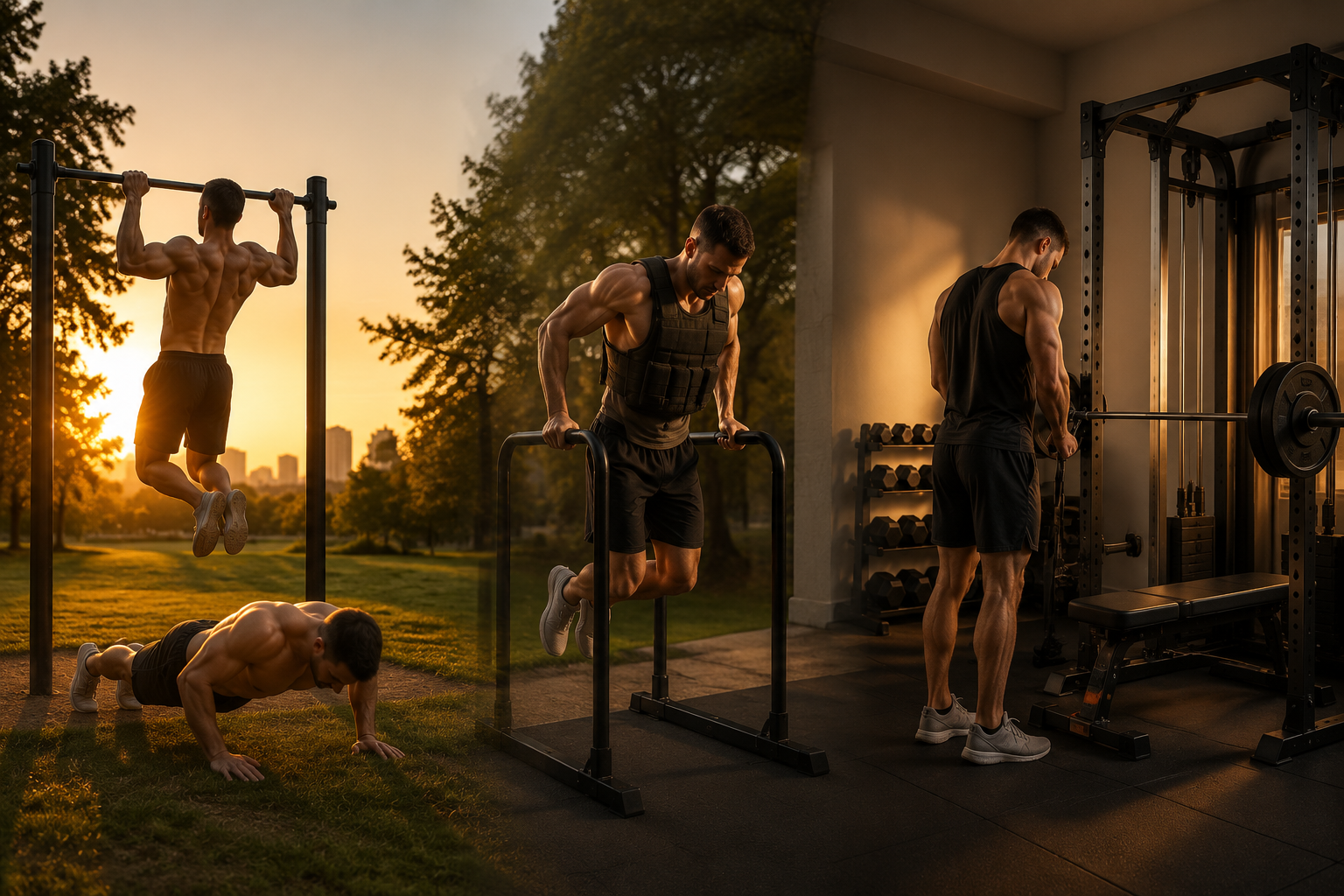
Most versions of the Alan Ritchson workout routine for movies start too late. They begin with the home gym: cable machine, Smith machine, EZ bar, dumbbells, weighted vest. That is the shiny part, and it is real enough. But before the Reacher build became a barbell story, it was a doorway-bar-and-park story stretched across roughly two decades.
The less glamorous prequel is the useful part for home trainees. Ritchson has described a long bodyweight routine built around running to a park, doing 100 reps each of pushups, pullups, dips, and situps, sprinting between sets, then running home, repeated 3–5 days per week.[1][2] That is not a celebrity secret. It is volume, repetition, joints learning to tolerate repetition, and a person becoming very hard to discourage.
That matters because the Reacher jump is impressive enough to make people impatient. Reporting around the role commonly places him at roughly 205 pounds before adding about 30 pounds for the character, landing in the 235–240 pound range over about eight months.[3][4] If a beginner hears only that part, the wrong lesson is easy: buy the vest, buy the bars, chase the actor template. The better lesson is slower and more useful: the added load made sense because the base was already there.
The Base Was Not Built by Access
A park workout can look primitive from the outside. No app. No calibrated plates. No elegant exercise selection. But the template Ritchson used solves several beginner problems at once: it gives you a place to go, a repeatable target, enough pulling and pushing to expose weaknesses, and enough running to make the session feel like training rather than exercise sampling.
The reported structure was blunt: run there, accumulate the reps, sprint between sets, run home.[1][2] It does not mean a new trainee should open with 100 pullups. Most people would turn that into elbow pain by week two. The useful idea is the order: first learn to show up, then learn to accumulate quality reps, then increase density, then add load.
| Training Layer | What It Builds | Home Version |
|---|---|---|
| Plain bodyweight | Skill, consistency, basic joint tolerance | Pushups, assisted pullups or rows, squats, situps, short runs or brisk walks |
| Higher-volume bodyweight | Work capacity and repeatable rep quality | Multiple submaximal sets, tighter rest periods, simple circuits |
| Weighted calisthenics | Strength without abandoning body control | Weighted vest pushups, weighted dips, weighted pullups only after clean unweighted volume |
| Minimal home gym | More loading options and easier progression | Dumbbells, EZ bar, cable or pulley work, Smith or rack-based pressing and rowing |
The table is tidy; the real work is not. A person who cannot yet do pullups may spend months on hangs, negatives, band assistance, rows under a sturdy table, or a doorway bar. A person who can do 10 pushups may spend a long time turning that into 5 clean sets of 15 before any vest is worth wearing. That is not a delay. That is the training.
What the Park Routine Actually Prepared
A high-volume bodyweight routine is often treated as the beginner chapter before the “real” lifting starts. That sells it short. Years of pushups, pullups, dips, situps, running, and sprinting prepare specific things that later make heavier training less chaotic.
- Shoulders and elbows learn repeated pushing and pulling patterns before extra external load enters.
- The trunk learns to brace under fatigue, not only in perfect fresh sets.
- Pulling strength becomes a weekly habit rather than a neglected accessory.
- Conditioning is built into the session instead of being postponed to a separate day that never happens.
- Training density improves because the body gets used to doing more work in a fixed window.
That is why Ritchson’s later use of equipment reads less like a replacement and more like an extension. If you already have years of dips, a weighted vest is not a gimmick. If you already have years of pullups, a weighted pullup is not a random stunt. If your shoulders have never tolerated basic volume, the same tools become a fast way to find out what you skipped.
The Reacher Inflection Point
The Reacher role changed the problem. A lean, athletic bodyweight base was no longer the whole assignment. The character needed size that read immediately on screen. Reports describe Ritchson moving from around 205 pounds toward the 235–240 pound range, with the gain usually summarized as approximately 30 pounds over about eight months.[3][4]
This is where weights enter the story honestly. Not as magic. As leverage. When the goal shifts from being extremely fit to adding visible mass under a production deadline, bodyweight alone becomes harder to scale. You can add reps, shorten rest, slow tempo, change angles, and train more frequently, but loading the muscles more directly becomes useful.
The caveat is important. That eight-month transformation belonged to a roughly 6-foot-2 to 6-foot-3 actor preparing for a major physical role, with professional pressure and unusually favorable motivation around the process. The reported numbers are also not perfectly uniform across coverage: pre-role weight is usually framed around 205 pounds, while the gain is variously described as about 30 pounds or a little more.[3][4] A home trainee should not expect to copy the visible result on the same calendar, but the progression still makes sense: heavier loading became the next logical layer after a very long bodyweight foundation.
When Weighted Calisthenics Starts Making Sense
Weighted calisthenics sits between the park and the home gym. It keeps the exercises familiar while making progression easier to measure. A weighted vest can turn pushups, dips, pullups, lunges, stepups, and carries into a harder version of training you already understand. Gravity Fitness has described weighted vests as a way to increase intensity in bodyweight movements, but that usefulness depends on the trainee already controlling the unweighted version.[5]
A practical threshold is not glamorous: add load when your bodyweight reps are clean, repeatable, and boring. If pushups still collapse at the hips, load fixes nothing. If dips irritate the front of the shoulder, load amplifies the problem. If pullups are all chin craning and half reps, the vest is just decoration with consequences.
- Add a vest to pushups only after you can keep the same body line from first rep to last rep.
- Add weight to dips only after deep, controlled bodyweight reps feel stable in the shoulder.
- Add weight to pullups only after you can pause briefly at the top and lower under control.
- Add weight in small jumps and reduce volume first; do not keep the old rep target and simply make it heavier.
For a home trainee, this is the sweet spot where one piece of equipment can buy a lot of runway. A vest does not require a garage. It does not ask you to learn six machines at once. It only asks whether your current reps deserve to be made heavier.
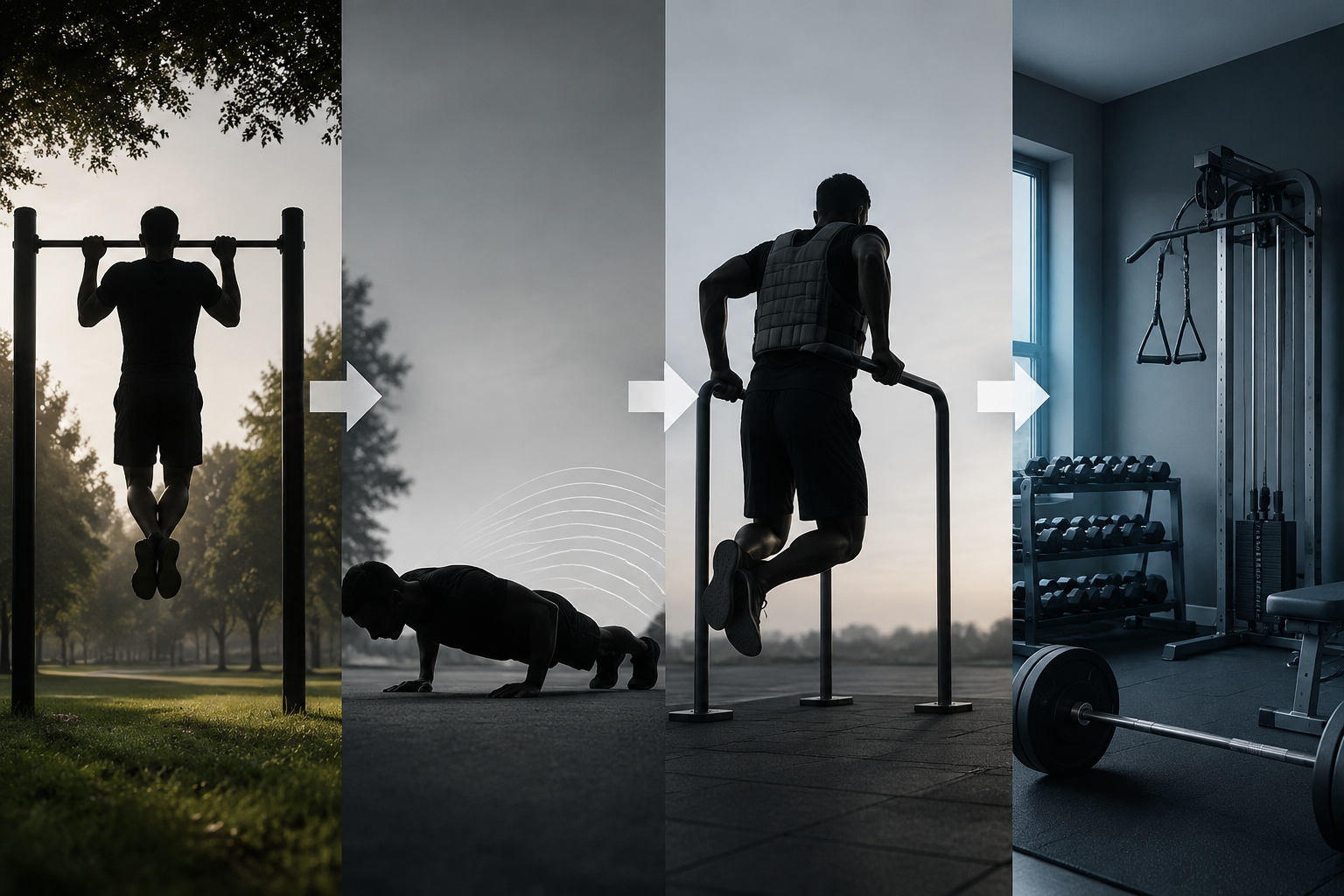
What the Home Gym Added
Ritchson’s residential setup, shown in a Men’s Health Gym & Fridge feature, included a cable machine, Smith machine, EZ bar, dumbbells, and a weighted vest.[6] That list sounds big if your current gym is a pullup bar and a yoga mat. It is also still home training. The point is not that every reader needs the same room. The point is that each tool solves a specific loading problem once bodyweight has taken you far.
| Tool | What It Adds | What It Does Not Replace |
|---|---|---|
| Weighted vest | Progressive load for familiar calisthenics | Clean pushups, dips, pullups, and lower-body control |
| Dumbbells | Unilateral work, pressing, rowing, curls, carries, adjustable loading | Bodyweight strength and conditioning |
| EZ bar | Arm, shoulder, and hinge variations with a joint-friendlier grip for some lifters | Pullups, dips, and trunk work |
| Cable machine | Constant tension, rows, pulldowns, flyes, triceps work, rehab-friendly angles | The need to build basic pushing and pulling capacity |
| Smith machine | Guided pressing, squatting, rowing, and controlled overload options | General athleticism or free movement skill |
The best detail is that the bodyweight work did not disappear. Coverage of Ritchson’s training has continued to mention bodyweight finishers such as dips to failure and pushup drop sets even after the heavier equipment entered the picture.[6] That continuity is the part worth stealing. The old work became a finisher, a density tool, a conditioning check, and a reminder that the body still has to move itself.
A Home-Trainee Progression That Respects the Order
A beginner does not need to recreate Ritchson’s volume. The better move is to recreate the sequence. Start with movements you can repeat several days per week without your joints filing a complaint. Then raise the volume. Then make the same movements heavier. Then add equipment where your bodyweight options stop progressing cleanly.
Layer 1: Floor, Bar, Repeatable Reps
The first layer can be brutally simple: pushups or elevated pushups, rows or assisted pullups, squats, lunges, situps or dead bugs, and walking or easy running. The target is not exhaustion. It is repeatability. If you can train again in two days, the session did its job.
Layer 2: More Work in the Same Space
Once the exercises stop feeling fragile, build volume. That can mean more total reps, more sets, shorter rests, or pairing movements. A hypothetical home session might move from 3 sets of pushups and rows to a circuit of pushups, rows, split squats, and situps repeated several times. The exact numbers matter less than whether rep quality survives the added work.
Layer 3: Add Load Without Changing the Whole System
This is where a weighted vest, backpack, or small set of dumbbells becomes useful. Keep the exercises recognizable. Vest pushups. Goblet squats. Weighted stepups. Dumbbell rows. If everything changes at once, you will not know whether you adapted to load or just survived novelty.
Layer 4: Build the Home Gym Around Bottlenecks
Do not buy equipment to feel advanced. Buy it when the current layer is holding back a specific adaptation. If legs have outgrown bodyweight squats, dumbbells or a bar setup help. If your back needs more rowing angles, a cable or pulley option helps. If pressing needs safer progressive loading at home, a rack, Smith machine, or adjustable dumbbells may be the next answer. The equipment should solve a training problem you can name.
Food, Supplements, and the Parts That Get Overstated
The training story is incomplete without food, but the available details are less direct than the bodyweight template and equipment reveal. Secondary fitness coverage has described Ritchson’s approach as broadly 80/20-style eating and has mentioned supplements such as BCAAs, creatine, and a multivitamin.[7][8] Those are context details, not proof that a particular supplement stack produced the Reacher physique.
For a home trainee, the diet translation is plain: gaining muscle requires enough food, enough protein, and enough consistency to support the training. Supplements can support gaps, but they do not explain a 20-year calisthenics base or an eight-month role-specific bulk. Treat them as the least mysterious part of the story, not the hidden key.
The Routine Kept Moving After the Transformation
The most reassuring sign is that Ritchson’s training did not freeze at the original Reacher transformation. Men’s Health UK reported in June 2025 on a more longevity-oriented evolution in his training, including an EZ bar giant set built from 3 moves, 4 rounds, and roughly 240 total reps.[9] That is still a lot of work, but the emphasis is different from a simple “get huge fast” headline.
That later phase matters because it keeps the whole arc honest. The bodyweight base did not vanish. The weights did not become the whole identity. The routine adapted to the job, the season, and the body doing the work. Reporting in 2025 also indicated that Reacher Season 4 had started filming in June 2025 and was expected in 2026; without a newer source here, the safest reading as of July 2026 is that the training discussion belongs to an ongoing screen-role context rather than a closed transformation story.[9]
The Practical Judgment
The usable lesson from Alan Ritchson’s movie training is not a secret exercise list. It is the order of operations. Earn bodyweight volume. Make the work repeatable. Add load when the reps are clean enough to deserve it. Keep calisthenics in the program even after dumbbells, cables, and bars arrive. Build the home gym when the floor and pullup bar have been outgrown, not because a celebrity routine made the empty space look unfinished.
References
- 5 Bodyweight Exercises: Alan Ritchson Workout — Men’s Health UK
- Alan Ritchson Workout — Kyle Hunt Fitness
- Alan Ritchson Workout Routine and Diet Plan — Superhero Jacked
- Alan Ritchson Reacher Workout — Men’s Fitness
- Weighted Vest Training — Gravity Fitness
- Gym & Fridge: Alan Ritchson — Men’s Health
- Alan Ritchson Diet and Workout — BarBend
- Alan Ritchson Workout Routine and Diet Plan — Steel Supplements
- Alan Ritchson’s Longevity Workout — Men’s Health UK, June 2025
Comments
Join the discussion with an anonymous comment.