
Anthony Joshua's 9-Move Home Workout Circuit
Anthony Joshua's actual 9-move home circuit, adapted for household items and small spaces. Train like a heavyweight champion without leaving your living room.
- Equipment tier required
- none
- Duration
- 20 min
- Difficulty
- beginner
- Target area
- full body
- Noise level
- low
Anthony Joshua’s home workout routine is not a mystery montage of tire flips and private-gym footage. The most useful version is a nine-move circuit published around his pre-Usyk camp work with Lucozade Sport: rotational medicine ball wall tosses, weighted press-ups, Bulgarian split squats, side-to-side jumps, wall sits, stair crawls, shadow boxing, step-ups, and double-unders.[1][2]
That sourcing matters. This is an AJ-associated home circuit, not proof that he does these exact nine moves every day, year-round, in this order. It came through a sports-drink campaign and was covered as a home workout, which makes it practical enough to use and also worth treating with normal skepticism.[1][2]
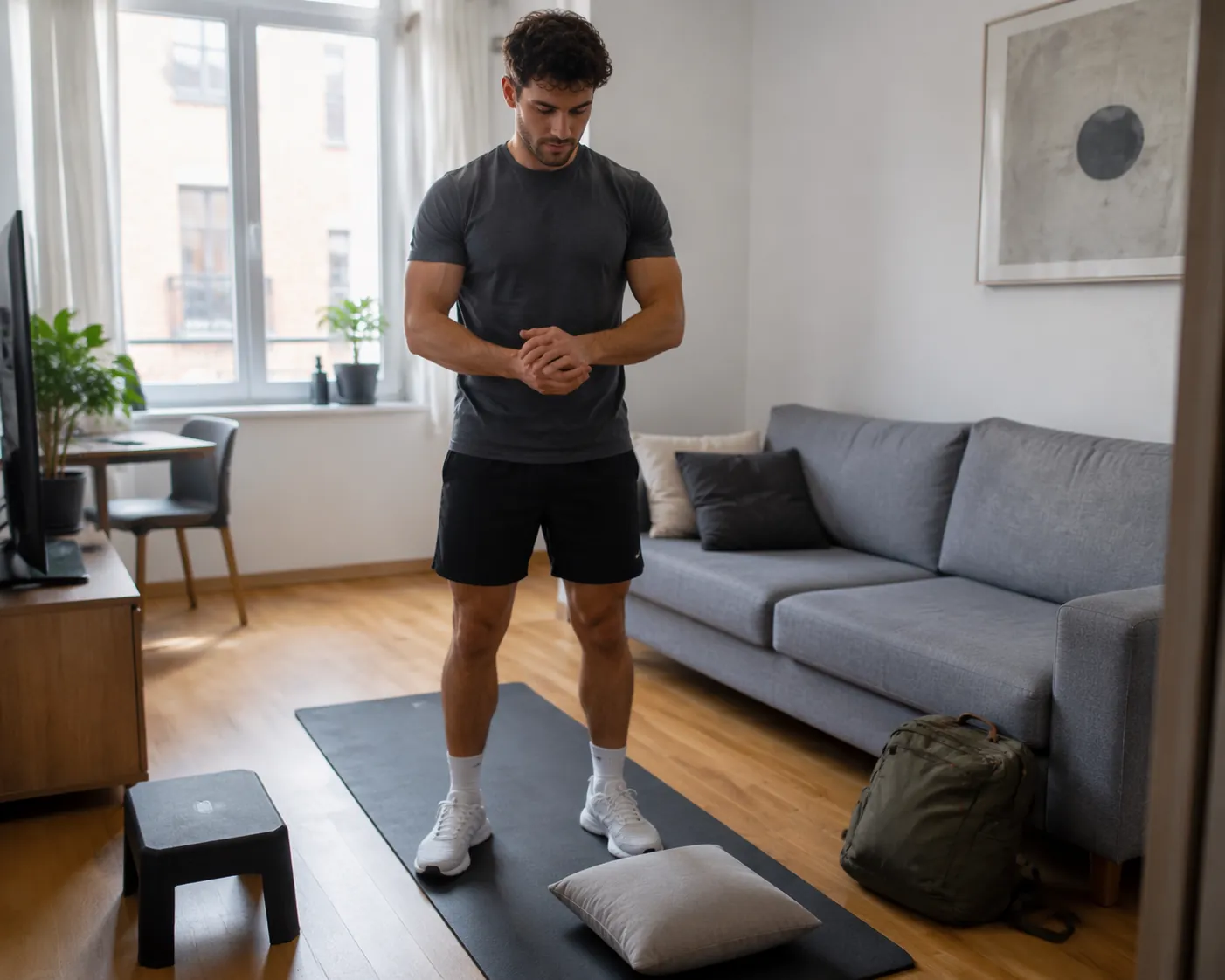
The 9-Move Circuit, Translated for a Small Apartment
Scan this first. If you have a rucksack, a sofa or chair, a low step, a pillow, and enough floor space to lie down, you can start without buying anything.
| Move | Original tool or setup | Household version | Apartment note |
|---|---|---|---|
| Rotational medicine ball wall toss | Slam ball or medicine ball against a wall | Pillow, cushion, or deflated ball; rotate and press or toss gently | Do not throw hard at a shared wall |
| Weighted press-up | Rucksack filled with books | Backpack with books, towels, or water bottles | Keep the load flat so it does not slide into your neck |
| Bulgarian split squat | Sofa, bench, or step | Sofa, sturdy chair, or low step stool | Put the sofa against a wall if it shifts |
| Side-to-side jumps | Bodyweight lateral jumps | Step-over or quiet lateral shuffle | Use soft landings; remove the jump if neighbors are below |
| Wall sit | Wall | Any clear wall section | Low noise, high burn |
| Stair crawl | Stairs | Low step, sofa edge, or floor bear crawl | Avoid unstable furniture and keep hands quiet |
| Shadow boxing | Open floor space | Mat-sized boxing rounds | Stay light on the feet; no stomping pivots |
| Step-ups | Stairs or step | Low step stool, bottom stair, or firm box | Lower the step if knees or balance complain |
| Double-unders | Skipping rope | Imaginary rope, single-unders, or calf-bounce march | The imaginary rope is the quietest version |
Joshua’s strength and conditioning coach has also described a bodyweight-heavy approach, saying, “I do much more bodyweight training. It gives me an opportunity to work on my cardio as well with explosive jumps.”[3] That does not turn a living-room circuit into heavyweight camp. It does make the home angle feel less like a gimmick.
How to Run It
Use the nine moves as a conditioning circuit rather than a strength session where every set needs full recovery. The simplest format is:
- Beginner: 30 seconds per move, 30 seconds rest between moves, 1-2 rounds
- Intermediate: 40 seconds per move, 20 seconds rest between moves, 2-3 rounds
- Hard version: 45 seconds per move, 15 seconds rest between moves, 3 rounds
- Rest 2-3 minutes between rounds, especially if the jumps and press-ups start getting ugly
You can also count reps instead of time, but time works better in a small apartment because you do not have to keep checking a notebook while a backpack is trying to slide off your shoulders. Keep one rule: stop a set when the movement turns into furniture wrestling.
Move by Move: What to Actually Do at Home
Rotational Wall Toss
This is the move most likely to be misunderstood in an apartment. The original circuit uses a medicine ball or slam ball pattern, rotating through the trunk and throwing into a wall.[1][2] In a real home, the wall may belong to a neighbor, the ball may not exist, and the plasterboard is not impressed by your fighting spirit.
Use a pillow, cushion, or deflated ball. Stand side-on to a wall, hold the object near your outside hip, rotate through your feet, hips, and ribs, then press or softly toss it toward the wall and catch it. If that still feels too loud, remove the release: rotate, squeeze the pillow, stop just before the wall, and return under control.
The point is not to destroy the wall. It is to practice transferring force from the lower body through the trunk, which is why a slow, controlled pillow version beats a reckless throw in a rented flat.
Weighted Press-Up
The documented version uses a rucksack filled with books.[1][2] That is one of the rare “celebrity workout” substitutions that is already normal-person friendly. Pack the bag flat, cinch the straps, and place the weight across the upper back rather than high on the neck.
If the rucksack shifts, use fewer books or skip the load. A clean bodyweight press-up is better than a lopsided weighted one. In a small room, set your hands just wider than shoulder width and keep your elbows tracking diagonally back. If full press-ups fade, move to knees or hands on the sofa rather than grinding half-reps into the floor.
Bulgarian Split Squat
Put the back foot on a sofa, chair, or low step. Before adding speed or a rucksack, test whether the furniture moves. Sofas have a way of sliding backward right when your front thigh is already negotiating with gravity.
Keep most of your weight through the front foot, lower under control, and let the back leg assist rather than dominate. If your hip flexor cramps or balance turns this into a circus trick, switch to a rear-foot-down split squat. You still get single-leg work without asking your living room to behave like a gym bench.
Side-to-Side Jumps
Lateral jumps fit the boxing theme: move, brace, land, move again. They are also the move most likely to annoy the downstairs neighbor if you treat every rep like a long jump.
Draw an imaginary line on the floor or place a rolled towel down. Jump side to side with soft knees and quiet feet. If impact is a problem, make it a lateral step-over: step across the line, bring the second foot in, then step back. Keep the pace high enough to breathe hard without losing control of the landing.
Wall Sit
Find a clear section of wall, slide down until your thighs are near parallel to the floor, and hold. This one needs almost no translation. Keep your feet far enough forward that your knees are not jammed over your toes, press your back into the wall, and breathe through the burn.
Stair Crawl
The stair crawl is useful if you have stairs and awkward if you do not. The source circuit includes stairs as part of the home setup.[1][2] If you live in a flat with no safe stair access, do not force it with a wobbly chair.
Use one of three versions. With stairs, crawl up on hands and feet, then walk back down carefully. With a low step, place both hands on the step, move the feet in and out like a slow mountain climber, and keep the shoulders stacked. With no step, use a bear crawl forward and backward across the mat. Quiet hands matter here; dropping your palms into the floor every rep turns conditioning into percussion.
Shadow Boxing
This is the easiest move to fake badly. Do not just flap punches for time. Set your stance, keep the guard up, and throw simple combinations: jab-cross, jab-cross-hook, cross-hook-cross. Move your head after combinations and reset your feet without stomping.
In a small room, imagine you are boxing inside a square the size of a yoga mat. You can still pivot, slip, and step off without drifting into a coffee table.
Step-Ups
Use a bottom stair, low step stool, or firm box. Step up with the whole foot, stand tall, then step down under control. Alternate legs or do half the interval on one side and half on the other. If your step is high enough that you have to shove off the back foot, lower the height.
Double-Unders
Double-unders are the other apartment problem. They are fast, skilled, and noisy if the rope slaps the floor. The documented circuit includes them, with an imaginary rope offered as a no-rope option.[1][2]
If you can already skip, use single-unders or double-under attempts. If you cannot, use an imaginary rope: elbows tucked, wrists turning, ankles bouncing lightly. For the quietest version, turn it into a calf-bounce march: rise onto the balls of the feet, alternate a quick knee lift, and keep the rhythm without leaving the floor much.
Small-Space Rules That Matter More Than Looking Like AJ
The circuit is specific, but your room decides the final version. A heavyweight can train hard without asking a sofa, hallway wall, or downstairs ceiling to absorb heavyweight impact.
- Load: Start the rucksack light. Books are dense, and a shifting bag ruins press-up mechanics fast.
- Noise: Replace double-unders and side-to-side jumps with imaginary-rope bounces and lateral steps if you train above someone.
- Walls: Use a pillow press instead of a true wall throw if the wall is shared, thin, or decorated.
- Furniture: Test the sofa or chair before Bulgarian split squats. If it slides, move it against a wall or use a lower step.
- Space: Keep shadow boxing inside a mat-sized box. Footwork should be sharp, not wide.
If you want a broader weekly setup around boxing rounds, bag-free conditioning, and recovery days, use this home boxing training plan after you have tested the circuit once. If this routine feels good but you want a longer progression, the 6-week no-equipment home MMA workout program is the more structured next step.
Make It Easier, Harder, or Quieter
| Problem | Change |
|---|---|
| Press-ups collapse early | Use bodyweight only, hands elevated on the sofa, or shorter work intervals |
| Knees dislike jumping | Use lateral step-overs and imaginary-rope marches |
| No stairs | Use a low step for crawls and step-ups, or switch stair crawls to bear crawls |
| No safe wall for throws | Use a pillow rotation without releasing the object |
| Circuit feels too easy | Add rucksack load to split squats, increase work time, or reduce rest |
| Room is tiny | Keep every movement inside a mat-sized rectangle and use step-based versions |
Do not upgrade everything at once. If you add weight to the press-ups, keep the jumps quiet. If you shorten the rest, do not also raise the step height. The goal is a hard circuit you can repeat, not a one-time audition for sore knees.
For more minimal-kit circuits in the same spirit, the Chris Hemsworth Extraction 3 home workout has another celebrity-session adaptation, while these rainy day home workout ideas are better when you just need a no-gym option without the fighter theme.
Recovery Is Part of the Routine
The temptation with an Anthony Joshua home workout routine is to make every round feel like camp. That is a quick way to turn a good circuit into a recovery problem.
Joshua has spoken about sleeping 8-10 hours and using cycling and swimming as recovery work in a 2017 Sky Sports interview.[4] Those details are older and should not be treated as his current daily schedule. The principle still travels well: recover seriously, keep some conditioning low-impact, and do not make every session a test of maximum damage.
Done with sensible substitutions, this is a real, specific AJ-associated home circuit that can fit into a small apartment. Treat it as a hard conditioning session, not a magical champion blueprint, and it becomes much more useful.
References
- Anthony Joshua Workout to Become a Boxing Champ, Muscle & Fitness
- Are You Fit Enough For Anthony Joshua’s Home Workout?, Coach Web
- Anthony Joshua's Strength Coach, Men’s Health UK
- Anthony Joshua reveals sleep secrets before Wladimir Klitschko fight, Sky Sports, 2017
What a small equipment investment adds
We don't have a build tagged to this exact tier yet. Browse all builds.
How often should you repeat this?
See our recovery and rest reference for citation-anchored rest-interval guidance.
Spot something off?
Tell us if a movement, tier assumption, or duration didn't match your experience.