
How to Set Up a Kids Indoor Playground in a Small Apartment
Parents in small apartments and rented homes can build an indoor active-play zone for their kids without a dedicated room or a large budget. This guide provides a tiered, noise-aware framework for creating a safe, space-efficient play area at three budget levels.
- Equipment tier required
- none
- Duration
- 15 min
- Difficulty
- beginner
- Target area
- full body
- Space footprint needed
- 6x6 ft
- Noise level
- low
A small-apartment indoor playground starts with a fairly unglamorous problem: your child needs movement, but the same floor has to survive toys, work calls, dinner, bedtime, and probably a downstairs neighbor who hears every jump. The goal is not to turn the living room into a play gym. It is to create repeatable indoor exercise activities for kids that fit the room when they are being used and disappear when they are not.
The movement target is real. The CDC recommends that children ages 6 to 17 get at least 60 minutes of moderate-to-vigorous physical activity each day; for younger children, the better framing is being active throughout the day rather than hitting a school-age minute target.[1] That does not mean every apartment needs a jungle gym. It means the setup has to make active minutes easier to collect without creating a new household problem.
That distinction matters because even older kids are not consistently reaching the mark. CDC QuickStats reported in 2024 that 61% of children ages 12 to 17 said they got 60 minutes of physical activity on most days.[2] Parents already know kids need to move. The harder question is where the movement goes when the weather, schedule, or apartment layout says no.
This is the same constraint-first logic behind our small apartment home gym tiered framework, applied to kids: start with the quietest workable tier, then add height, hardware, and cost only if the room can absorb them.
| Budget tier | Best fit | What it looks like | Apartment risk |
|---|---|---|---|
| $0-100 | Renters, very small rooms, noise-sensitive buildings | Household-item movement circuit, tape lines, pillows, animal walks, pop-up tent or ball pit | Lowest: little storage, no installation, easy to stop before bedtime |
| $100-300 | Families who want real climbing without giving up the room | Foldable Pikler-style triangle plus foam mats | Moderate: needs clear floor space, mat storage, and no-jump rules |
| $300-800 | Families with suitable walls, ceilings, storage, and supervision | Wall-mounted climbing panel or foldable indoor jungle gym | Highest: installation, rental rules, safety buffer, and impact noise all matter |
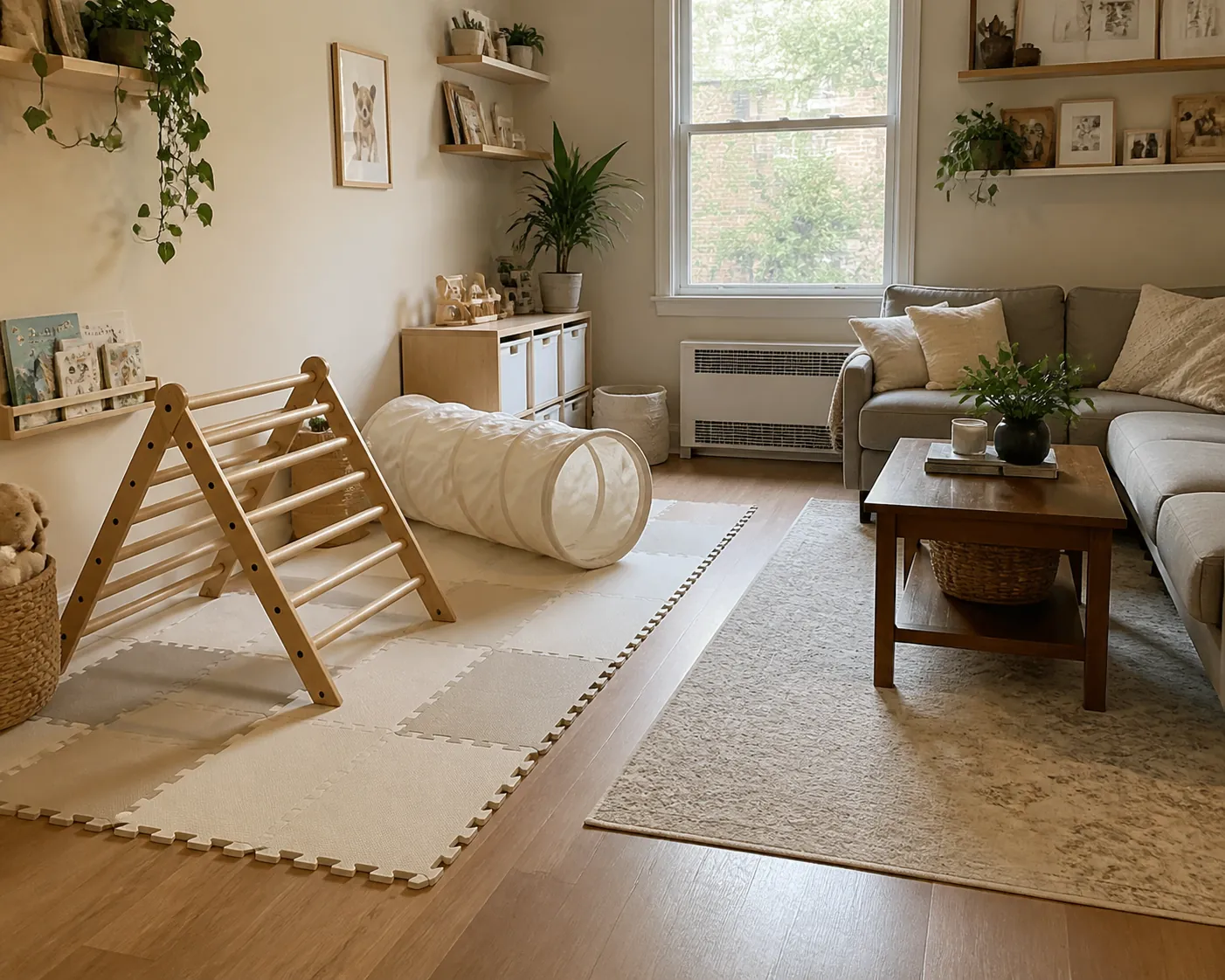
Run the Apartment Test Before You Buy Anything
Before looking at equipment, clear the exact patch of floor where play would happen and measure it as if the child is already moving. The advertised footprint is only the object. The real footprint includes the child stepping off, falling sideways, dragging a mat, or deciding that the safe climbing toy is also a launchpad.
A useful apartment test has four parts: clear space, floor protection, storage path, and noise ceiling. If a setup cannot pass all four, it is not a bargain, even if the product itself is small.
- Clear space: measure the equipment plus a safety buffer, not just the product dimensions.
- Floor protection: decide where mats live before deciding how tall the equipment can be.
- Storage path: make sure the folded item can actually move behind the couch, under a bed, or into a closet.
- Noise ceiling: choose movements that sound acceptable below you, not only in your own room.
- Rental rules: treat wall anchors, ceiling mounts, and permanent hardware as landlord-permission items.
The kids' indoor equipment market is projected at $3.21 billion in 2026, with urban families named as part of the demand for apartment-friendly options; that is useful as a signal, not a shopping instruction.[3] A growing market can produce clever fold-flat gear. It can also produce beautiful product photos that skip the part where someone trips over the mat at 9 p.m.
$0-100: Build a Circuit, Not a Mini Gym
The lowest tier deserves more respect than it usually gets. For many apartments, it is not the temporary version before the real setup. It is the version that actually survives daily use because it does not need tools, storage negotiations, or a lecture about not jumping from the top bar.
Children's Health Dallas notes that indoor bodyweight exercises can work in a 6-by-6-foot area, which is about the kind of living-room square many families can create by shifting a coffee table or pushing a chair to the wall.[4] That space can become a short circuit: crawl under a chair, bear-walk to a taped line, balance along painter's tape, step over pillows, toss soft socks into a basket, then return to the start.
For younger children, animal walks are especially useful because they turn strength, coordination, and imagination into the same activity. Active For Life includes animal-style movements among indoor physical activities for kids, and the format adapts well to tight rooms because the parent can scale speed, distance, and noise without changing the game.[5]
| Station | What the child does | Apartment adjustment |
|---|---|---|
| Tape line | Heel-to-toe walk, side steps, or one-foot balance | Use painter's tape and keep it away from rugs that slide |
| Pillow path | Step over or around cushions | No jumping from furniture; cushions stay on the floor |
| Animal walk lane | Bear crawl, crab walk, frog squat, or inchworm | Slow version for upstairs units; no stomping races |
| Laundry basket target | Toss rolled socks or soft balls | Place against a wall only if the wall is not shared or noise-sensitive |
| Pop-up tent pause | Crawl in, breathe, read, or reset | Use as the quiet station between higher-energy rounds |
A pop-up tent or collapsible ball pit can belong in this tier if it folds small and does not encourage impact. The best use is not nonstop chaos; it is giving the room a visible play boundary that can vanish before dinner. Kidz Forts describes pop-up-style indoor play options as easy to store and low-installation, which is exactly the right direction for noise-sensitive rentals.[3]
This tier works best when the circuit has a repeatable beginning and end. A child can do three rounds before lunch, two rounds after school, and one quiet version before bath. The adult does not have to invent a new activity every time; they only have to reset tape, pillows, socks, and a basket.
$100-300: The Foldable Pikler-and-Mat Middle Ground
The middle tier is where a small apartment can start to feel like it has a real indoor playground without permanently becoming one. A foldable Pikler-style triangle gives climbing, stepping, crawling, and imaginative play, while mats define the active zone and soften the inevitable off-balance moments.
Manufacturer and retailer specs cited in 2026 buying guides list some Pikler-style setups as needing as little as 6 by 4 feet of floor space, before adding the practical safety buffer a family should leave around the equipment.[6] In an apartment, that buffer is not optional decoration. It is the difference between a controlled climb and a child stepping backward into a coffee table.
This tier makes the most sense when the triangle can be unfolded quickly, used on a mat, then folded and stored without blocking the adult room. Behind a couch, under a bed, or flat against a wall can work. A hallway closet that requires removing a vacuum, stroller, and winter coats every time probably will not.
- Choose a foldable frame before a fixed frame unless you have a dedicated play corner.
- Budget for mats at the same time as the climbing piece, not as an optional later purchase.
- Set a climb-only rule if you live above someone; jumping off the top turns a quiet toy into an impact problem.
- Check the folded dimensions against the real storage spot, including baseboards, couch legs, and closet doors.
- Match the setup to the child's readiness, not only the manufacturer's age label.
Foam climbers can be an even gentler version of this tier for toddlers. Industry summaries describe soft foam climbers as lightweight, often under 15 pounds, and much lower impact than hard climbing frames.[3] They still take floor space, but they create fewer neighbor and deposit worries than a rigid structure with a child dropping from height.
The hidden cost in this tier is not usually the triangle. It is the full landing zone. A $180 climbing frame that needs $80 of mats and a clear 3-foot buffer on the usable sides is no longer a tiny purchase or a tiny footprint. That does not make it a bad choice; it makes measuring the room part of the purchase.
$300-800: Wall Panels and Foldable Jungle Gyms Are Conditional Upgrades
The upper tier can be worth it for the right family, but it should not be treated as the natural finish line. Wall-mounted climbing panels and foldable indoor jungle gyms solve some apartment problems while creating others. They can free floor space or deliver more challenging play, but they also ask more from the room, the lease, and the supervising adult.
Climbing-wall buying guides list some wall-mounted panels around the $200-400 range and support ratings up to 175 pounds, depending on the product.[7] Those numbers are product specs, not a guarantee that a rental wall is appropriate. Drywall, studs, masonry, baseboards, old plaster, and landlord rules all matter before the first hold goes up.
A wall panel's promise is seductive because it uses little floor space when no one is climbing. The catch is that the landing zone still needs to exist every time the child uses it. If the mat has to be dragged from a closet and placed over a walkway, the setup may be technically compact and practically annoying.
Foldable jungle gyms sit in a different part of the same tier. Moogco Baby's 2026 guide lists indoor jungle gym options in the several-hundred-dollar range, and foldable models can store flatter than fixed play structures.[6] That makes them viable for some shared spaces, especially where a family has a consistent storage wall or a garage-adjacent nook. In a narrow apartment living room, the folded shape still has to go somewhere that does not become tomorrow's trip hazard.
| Upper-tier option | Why it can work | Why it can fail in an apartment |
|---|---|---|
| Wall-mounted climbing panel | Leaves the floor open when not in use | Needs suitable wall structure, landlord approval, mats, and close supervision |
| Foldable jungle gym | Offers varied climbing and crawling in one setup | Still needs a large open zone during use and a realistic storage spot after |
| Larger foam climbing set | Soft, movable, and lower impact than hard frames | Can spread across the room and become furniture unless storage is planned |
The fair version of this tier is simple: it is not wrong to buy bigger gear if the conditions are right. The conditions are just stricter. You need a wall or floor area that can handle the setup, a landing zone that stays clear, supervision that matches the height, storage that does not steal the room, and rental permission where hardware is involved.
Noise Is a Design Constraint, Not an Afterthought
Noise control in a kids' indoor playground is mostly about impact. A child laughing in a tent is not the same problem as repeated heel drops through a ceiling. Mats help, but they do not make every activity apartment-safe.
Norsk-Stor reports that thick foam gym tiles can reduce impact noise to downstairs neighbors by 65-75%, but that figure should be treated as vendor-reported flooring data, not an independent lab result.[8] It is still directionally useful: thicker, softer flooring is likely to be kinder to the apartment below than bare hardwood or thin puzzle mats. It is not permission to add jumping from height.
The quietest setups keep the child's center of gravity low: crawling, rolling, balancing, tossing soft objects, stepping over cushions, and climbing only when the descent is controlled. The loudest setups combine height, speed, and repetition. If the activity includes jumping down, running starts, or landing on heels, the mat is doing damage control after the real decision has already been made.
- Quietest: tents, tunnels, animal walks, balance lines, soft tossing games.
- Moderate: foam climbers, low Pikler climbing, obstacle paths over pillows.
- Noisiest: jumping off equipment, running circuits, hard landings, ball games against shared walls.
If you live above someone, build the play zone from the floor up: mat first, low movement second, climbing third. For more detail on applying noise-aware constraints to home movement, the same principle shows up in our quiet apartment conditioning guide. The child version is less about formal training and more about preventing the game from becoming a ceiling-thump pattern.
How to Choose the Right Tier
Start with the tier that solves today's movement problem with the least permanent footprint. If a $0-100 circuit gets used five days a week, it is doing more for the household than a folded jungle gym that everyone is tired of moving.
Move to the $100-300 tier when the child is clearly seeking climbing, the room can hold the equipment plus mats, and the storage routine is realistic. That is the sweet spot for many small homes: enough physical challenge to feel different from ordinary play, but still soft and movable enough for a room that has other jobs.
Consider the $300-800 tier only after the boring checks pass. Wall suitability, lease rules, safety buffer, storage, supervision, and downstairs noise all have to survive the decision. If one of those fails, the upgrade is not really an upgrade; it is a new household negotiation.
- Clear a real play square and measure it with the furniture in its normal daily position.
- Choose the quietest activity tier that your child will actually repeat.
- Buy or assign floor protection before adding height.
- Confirm where every mat, frame, tent, or panel accessory goes after play ends.
- Move up a tier only if noise, storage, supervision, and rental rules still hold.
The best small-apartment indoor playground is the one your family can use daily without losing the room, annoying the neighbors, or gambling with the deposit.
References
- CDC Child Activity Guidelines — CDC.
- CDC QuickStats (2024) on kids' physical activity levels — CDC, 2024.
- Kidz Forts indoor play equipment — Kidz Forts.
- Indoor exercises for kids — Children's Health.
- 50 indoor physical activities for kids — Active For Life.
- Best Indoor Jungle Gyms 2026 — Moogco Baby, 2026.
- Best Indoor Climbing Walls for Kids (2026) — ComfyBumpy, 2026.
- Apartment gym flooring — Norsk-Stor.
What a small equipment investment adds
We don't have a build tagged to this exact tier yet. Browse all builds.
How often should you repeat this?
See our recovery and rest reference for citation-anchored rest-interval guidance.
Spot something off?
Tell us if a movement, tier assumption, or duration didn't match your experience.