
What Steven Asplund's Weight Loss Plan Looks Like at Home
Steven Asplund never published an official home workout plan, but his documented method — cut soda and sweets, walk more every day, and strength train 3–6 days a week — can be rebuilt into an honest plan for apartments and small budgets with evidence-based targets.
- Equipment tier required
- none
- Duration
- 20-30 min
- Difficulty
- beginner
- Target area
- full body
- Noise level
- low
There is no official Steven Asplund weight loss home workout plan. What exists is better than that, if you are trying to start in a living room instead of copy a fighter: Asplund has described the plain behavior changes that began the loss. In UFC.com’s feature, he talked about noticing “48 grams of sugar in one Mountain Dew,” cutting soda and sweets, and starting with walking — “even if it’s around the block” — with the rule that “it’s got to be more every day.” He also said that after his first UFC loss he bought “a ton of dumbbells in my garage, and an Airdyne bike, and a squat rack.” [1]
So the honest answer is not a secret heavyweight circuit. The documented pattern is: remove the easy sugar first, walk daily, make the walking progress, train hard several days per week, and eventually build a simple strength-and-conditioning setup. FOX 9 reported that Asplund trained three to six days per week and that his driver’s license listed him at 498 pounds, while he said he was likely heavier than that. [2] Other profiles put his peak at 520 or 525 pounds, and Fightomic lists a UFC weigh-in at 261 pounds. [3][4] Because those numbers conflict, his loss is best treated as roughly 260 to 300 pounds, not as one perfectly settled figure.

What is documented, and what has to be reconstructed
The line matters. A useful home plan can be built from Asplund’s pattern, but it should not be sold as his personal program, his endorsement, or the exact schedule he used on every week of the cut. Fighter training changes by camp, opponent, injury, coach, and phase. A person starting at home needs the transferable pieces, not the theatrical version.
| Item | What the record supports | How this article uses it |
|---|---|---|
| Soda and sweets | Asplund said he cut soda and sweets immediately, including noticing 48 grams of sugar in one Mountain Dew. [1] | This becomes the first food lever, especially for readers drinking calories every day. |
| Walking | Asplund said to start walking, even around the block, and make it more every day. [1] | This becomes a walking progression, adjusted so beginners do not turn one motivated week into knee pain. |
| Training frequency | FOX 9 reported training three to six days per week. [2] | This supports regular strength and conditioning, but not a claim that every beginner should train like a fighter. |
| Home equipment | Asplund said he later bought dumbbells, an Airdyne bike, and a squat rack for his garage. [1] | This supports a garage tier, plus cheaper apartment and dumbbell versions for people who are not buying a rack. |
| Total weight loss | Reports differ: 498-plus, 520, 525, about 260 pounds lost, and a 261-pound UFC weigh-in all appear across coverage. [2][3][4] | The article uses a range, roughly 260 to 300 pounds, instead of forcing a clean number. |
Intermittent fasting should not be treated as the center of this plan. It appears in a secondary profile, but not in the first-person UFC account that gives the clearest description of Asplund’s own early changes. [1][4] If fasting helps someone control calories, fine. It is not the confirmed engine of the story.
The food lever comes first: remove the calories you will not miss later
The most copyable part of Asplund’s story is not brutal. It is annoying, visible, and effective: stop drinking sugar and stop keeping sweets as the default snack. That is not a complete diet, but for a person who has been drinking soda daily, it can be the first big calorie cut that does not require meal-prep perfection.
The math explains why this deserves more attention than a fancy circuit. CDC’s “Rethink Your Drink” guidance gives a simple example: two regular sodas per day can add up to about 2,100 calories per week. [5] WHO’s commentary on sugar-sweetened beverages describes a typical 12-ounce serving as roughly 140 to 150 calories and 35 to 37.5 grams of sugar. [6] Asplund’s own Mountain Dew example was even higher in sugar, at 48 grams. [1]
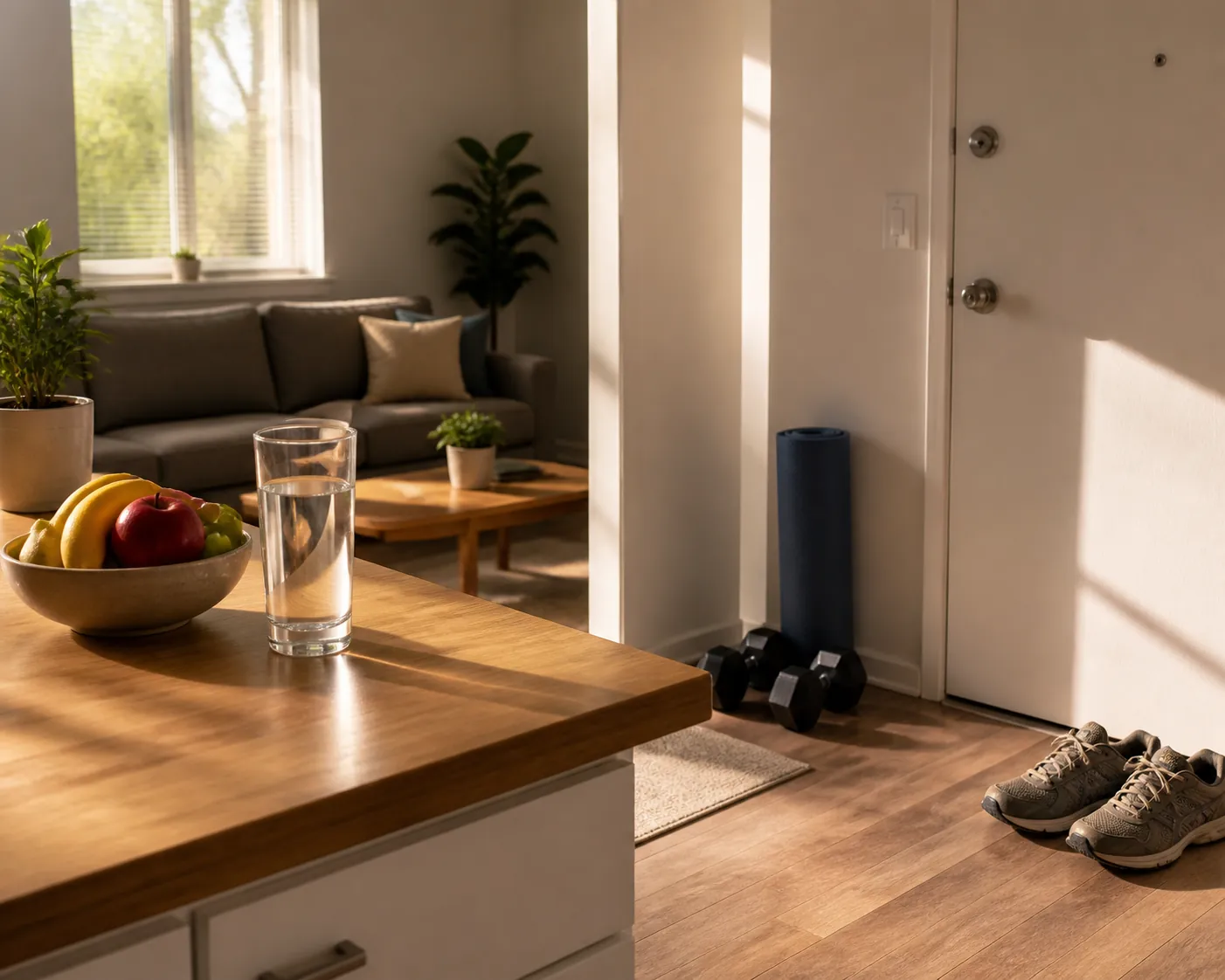
For a home plan, that turns into a simple rule before any workout is written: pick the sugary drink you use most, remove it from the house, and replace the ritual. Water, diet soda, unsweetened tea, seltzer, black coffee, or a low-calorie drink can all be stepping-stones. The first job is not to become a clean-eating monk. The first job is to stop paying a daily calorie tax that does not make dinner better.
Then do the same with sweets, but do it practically. If the problem is a nightly sleeve of cookies, do not make the opening plan depend on heroic restraint at 10 p.m. Buy single servings, move sweets out of the house, or make fruit and higher-protein snacks the easier reach. The person doing this at 300, 400, or 500 pounds needs fewer ambushes, not more character tests.
The walking rule: start embarrassingly small, then make it measurable
Asplund’s walking advice is the part many people skip because it sounds too small. That is exactly why it works as a starting point. “Around the block” is not a fitness identity. It is a task you can complete before you have confidence.
At home, “more every day” should mean progressive, not reckless. If you have been sedentary, have joint pain, use mobility aids, or are starting at a very high body weight, the win is building tolerance. A five-minute walk that you repeat all week is more useful than one heroic 40-minute walk that makes stairs miserable for three days.
| Current starting point | First target | Progression that usually makes sense |
|---|---|---|
| Walking to the mailbox feels like work | Two to five minutes, once or twice per day | Add a minute to one walk when the current dose feels repeatable. |
| One block is doable | One block daily | Add distance on two or three days per week before trying to walk faster. |
| Ten minutes is comfortable | Ten to fifteen minutes most days | Build toward twenty to thirty minutes while keeping one easier day. |
| Thirty minutes is comfortable | Thirty minutes most days | Add a second short walk, hills, or a bike session if joints tolerate it. |
You do not need a treadmill for this. Hallway laps, parking-lot loops, a quiet sidewalk, a mall, a school track, or a stationary bike can all serve the same early purpose: low-skill movement you can repeat. If outdoor access is the problem, the same logic behind walking as real cardio still applies indoors. The route is less important than the repeatable dose.
Strength training: three home versions of the same idea
FOX 9’s three-to-six-day training report tells us Asplund was not only walking. [2] But that number has to be handled carefully. A heavyweight athlete training for MMA is not the right template for someone whose knees hurt standing up from the couch. The transferable piece is regular resistance work: squat or sit-to-stand, hinge, push, pull, carry or brace, then recover and repeat.
Two strength days per week is the public-health floor for adults, paired with aerobic activity. [7] For beginners at home, that is enough to start. Add days only when soreness, sleep, joints, and appetite are staying under control.
$0 apartment version
Use this if you have no gear, neighbors below you, or a body that needs a quiet start.
- Sit-to-stand from a chair or box: 2 sets of 5 to 10
- Wall push-up or counter push-up: 2 sets of 6 to 12
- Hip hinge practice or glute bridge: 2 sets of 8 to 12
- Towel row against a sturdy post, band row if you own a band, or slow shoulder-blade squeezes: 2 sets of 8 to 12
- Dead bug, side plank from knees, or standing suitcase hold with a backpack: 2 short sets
Run it twice per week at first. Keep every rep quiet and controlled. If getting down to the floor is hard, skip floor work and do the standing version. A plan that requires you to fight the floor before you are ready is not more serious; it is just poorly matched.
Low-budget dumbbell version
Once you can repeat the apartment version without big soreness, a pair of adjustable dumbbells or two fixed dumbbells makes progression easier. This is also where many people do better than they expect, because the workout stops being a random list of bodyweight moves and starts having load you can track.
- Goblet squat to a box or chair
- Dumbbell Romanian deadlift
- Incline push-up or dumbbell floor press
- One-arm dumbbell row
- Farmer carry in a hallway, or suitcase march in place
Do two or three sets per movement. Stop each set with a couple of good reps still in reserve. When every set feels controlled, add reps before you add weight. If you live in a small space, the equipment limits matter: floor protection, storage, and noise are often more important than the brand stamped on the handle. Our small-space exercise equipment testing is more useful here than copying a fighter’s gym.
Garage version: dumbbells, bike, rack
This is the tier that most closely matches what Asplund later described buying: dumbbells, an Airdyne bike, and a squat rack. [1] It is not necessary at the beginning, and it is not magic. It simply gives you more loading options and a conditioning tool that does not require pounding your joints.
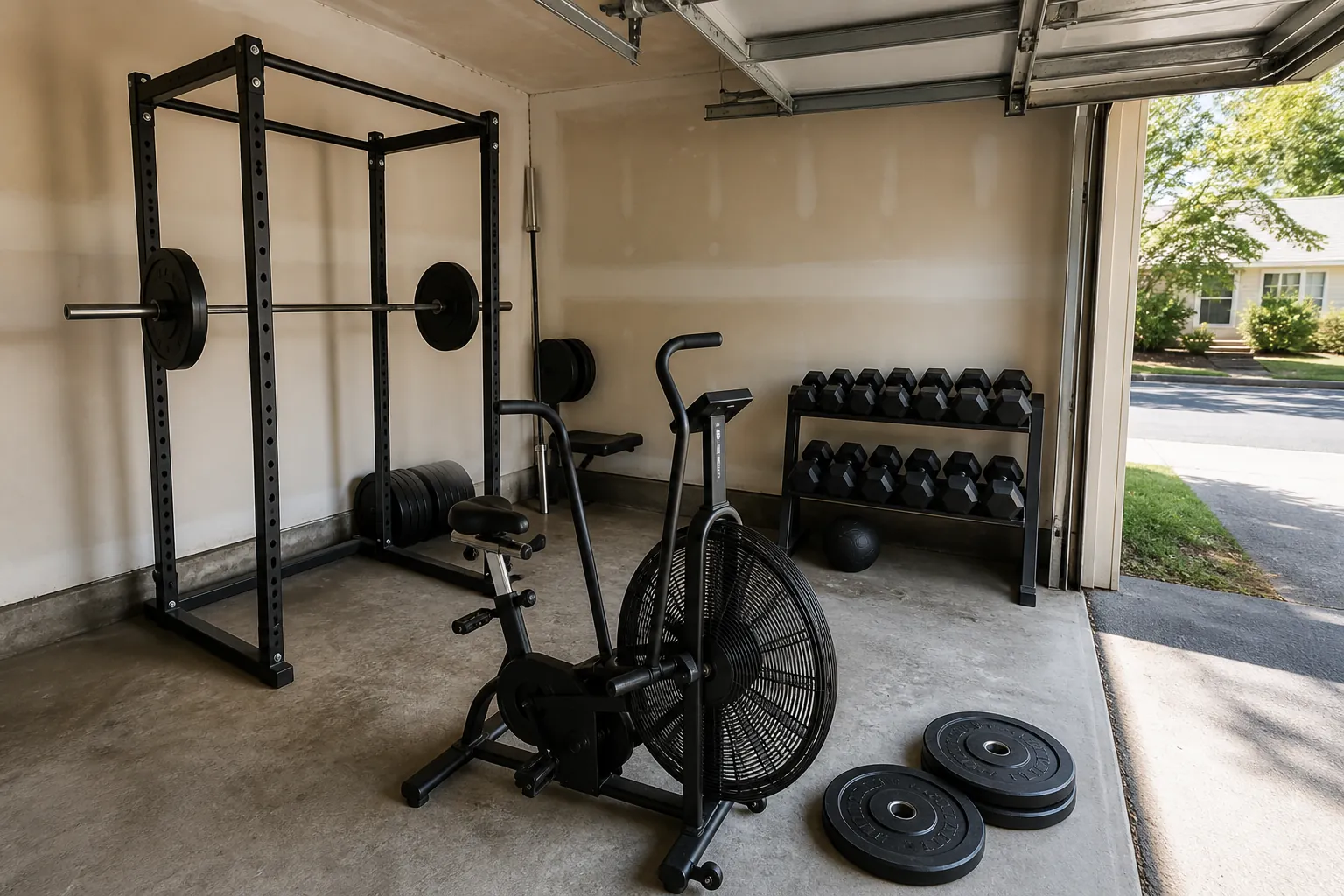
A garage week can stay simple: two full-body strength sessions, one optional lighter strength session, and two or three bike or walking sessions. The rack can support box squats and presses. Dumbbells cover rows, hinges, carries, and lighter accessory work. The Airdyne or other fan bike can replace some walks when weather, joints, or time get in the way. If you are deciding whether a rack or compact machine even fits, compare the footprint and storage constraints before buying; an all-in-one home gym for a small space is only useful if you can actually move around it.
A realistic week built from Asplund’s pattern
This is a reconstruction, not an Asplund-published routine. It keeps the logic of his documented changes and scales it down for a normal home.
| Day | Main work | Minimum version if you are starting heavy or deconditioned |
|---|---|---|
| Monday | Walk plus full-body strength | Five to ten minutes walking, then one round of chair squats, wall push-ups, and rows or band pulls |
| Tuesday | Walk only | Same route as Monday, or one extra minute if joints feel fine |
| Wednesday | Walk plus full-body strength | Repeat Monday without adding exercises |
| Thursday | Easy walk or bike | Short, easy movement; no need to chase sweat |
| Friday | Optional third strength day | Only add this if Monday and Wednesday are recovering well |
| Saturday | Longer walk, bike, or outdoor loop | Add distance slowly; keep the pace conversational |
| Sunday | Rest or very easy walk | Use this to protect the next week |
The mistake is trying to make week one look like the middle of a fight camp. If two strength sessions and daily short walks are already a major change, that is the plan. Build the habit first, then the volume.
If you want a separate quiet circuit to plug into the strength days, use a routine built for small spaces rather than jumping movements. The elimination workout at home has $0 and dumbbell versions with quieter substitutions, which fits this situation better than burpees in an upstairs apartment.
What the activity targets can and cannot promise
For health, CDC’s adult guideline is at least 150 minutes per week of moderate-intensity aerobic activity plus muscle-strengthening activity on two or more days per week. [7] That is a clean starting floor for this plan: walk or bike toward 150 minutes, and lift twice.
For weight loss, the expectations need to be stricter. The American College of Sports Medicine position stand concluded that 150 to 250 minutes per week of moderate-intensity physical activity is associated with only modest weight loss, while more than 250 minutes per week is associated with clinically significant weight loss. It also describes resistance training as useful for improving strength and fat-free mass, but not as the main driver of scale loss by itself. [8]
CDC makes the same practical point from the food side: calorie reduction is the larger driver of weight loss, while physical activity helps create the deficit and is important for keeping weight off. [9] That is why the soda-and-sweets section is not a warm-up act. It is the part that makes the walking and lifting add up.
| Weekly activity level | What it means for this plan |
|---|---|
| Under 150 minutes | Still useful if you are coming from almost nothing, but build gradually toward the public-health floor. |
| Around 150 minutes plus two strength days | A solid starting target for health and consistency. Do not expect dramatic scale loss from exercise alone. |
| 150 to 250 minutes | A realistic middle zone where weight loss may be modest unless food changes are strong. |
| More than 250 minutes | More consistent with clinically significant weight-loss activity doses, if recovery and joints tolerate it. |
Walking alone is not a guarantee, either. The Obesity Medicine Association’s review notes that walking by itself is not consistently associated with weight change, which is another reason this plan pairs walking with calorie control and strength training. [10] If you want a broader look at the same 150-to-300-minute weekly target in home routines, see our evidence-based home workout targets.
When to scale down instead of push harder
Asplund’s story has combat-sports intensity sitting in the background, and that can distort the lesson. If you are starting at a very high body weight, have chest pain, dizziness, uncontrolled blood pressure, diabetes complications, severe sleep apnea, or major joint pain, get medical guidance before turning this into a high-volume plan. Large weight loss changes medication needs, recovery, hydration, and orthopedic stress.
Scale down when your next walk is being negotiated with pain, when soreness changes how you move, or when the plan makes you so hungry that the food side collapses. The right progression is the one you can repeat next week. That may be one block, a chair squat, and no soda today. For some readers, that is not a symbolic beginning; it is the hard part.
The honest takeaway
Steven Asplund’s weight-loss story is useful because it does not require a hidden method. The confirmed pieces are blunt: cut soda and sweets, start walking, make the walking progress, train several days per week, and later use basic home-gym tools. The home version should stay that plain.
If you came looking for the Steven Asplund weight loss home workout plan, the best version is not a fake fighter template. It is a calorie-control plan led by soda and sweets, a walking progression you can start small, two or more strength days, and enough weekly activity to move from basic health targets toward weight-loss doses over time. For another walking-first celebrity plan, the Jelly Roll weight loss routine is a useful comparison, but Asplund’s case is broader because strength training and the later garage setup are part of the documented pattern.
The starting point can be small without being unserious. Replace the soda. Walk the block. Do the chair squats. Then make tomorrow slightly more, if you can still repeat it.
References
- Steven Asplund Is Pulling Out All The Stops — UFC.com
- Minnesota man weight loss MMA championship — FOX 9
- Heavyweight who once weighed 520lbs admits arrogance led to massive cut before first UFC loss — Bloody Elbow — August 6, 2026
- Steven Asplund Profile — Fightomic
- Rethink Your Drink — Centers for Disease Control and Prevention
- Sugar-sweetened beverages and body weight in adults — World Health Organization
- Adult Activity: An Overview — Centers for Disease Control and Prevention
- Appropriate Physical Activity Intervention Strategies for Weight Loss and Prevention of Weight Regain for Adults — Medicine & Science in Sports & Exercise — 2009
- Physical Activity and Your Weight — Centers for Disease Control and Prevention
- How Much Physical Activity Is Needed for Weight Loss, Weight Loss Maintenance, and Weight Gain Prevention? — Obesity Medicine Association
What a small equipment investment adds
We don't have a build tagged to this exact tier yet. Browse all builds.
How often should you repeat this?
See our recovery and rest reference for citation-anchored rest-interval guidance.
Spot something off?
Tell us if a movement, tier assumption, or duration didn't match your experience.