
Best Country Workout Songs for Home, by BPM
Most country songs sit in a 75–115 BPM range, which is too slow to pace cardio at home. This guide sorts the best country workout songs into BPM bands matched to warm-up, steady-state cardio, HIIT, strength, and cool-down, and includes a sample 30–45 minute at-home session sequence.
- Equipment tier required
- $0-100
- Duration
- 30-45 min
- Difficulty
- beginner
- Target area
- Full body
- Space footprint needed
- Mat + two side steps
- Noise level
- Low (no jumping)
Country can absolutely work for a home workout playlist. It just cannot be “favorite songs in a row” and hope for the best. That is how a decent living-room session turns into a tempo pothole: one song has you moving, the next drops into a comfortable singalong, and now your warm-up, cardio, and strength work are all fighting the playlist.
The practical way to build a country workout playlist at home is to give each song a job. Warm-up songs can be slower. Steady cardio needs enough pulse to carry step-touches, shadowboxing, marching, or low-impact skaters. HIIT needs sharper tempo, but only in short doses if you have downstairs neighbors. Strength can use a moderate beat for squats, hinges, presses, and rows. Cool-down songs should stop asking your feet to chase anything.
That approach also keeps the evidence honest. A 2020 meta-analysis of 139 studies, 3,599 participants, and 598 effect sizes found that music improved affective valence, physical performance, and perceived exertion, with fast-tempo music outperforming slow-to-medium music for performance outcomes. It did not find a significant effect on heart rate. So the claim here is not that country music magically upgrades your physiology. The useful claim is simpler: tempo-matched music can make the session feel better, pace movement more cleanly, and prevent awful transitions from derailing the work. [1]
The BPM map before the song list
BPM ranges are not universal laws. Different workout-music guides draw the lines differently: Blue Cross Blue Shield of Michigan’s A Healthier Michigan places warm-up and cool-down songs around 80–90 BPM and intense work around 120–150 BPM, while Brain.fm points to 120–140 BPM for moderate aerobic exercise and 140–180 BPM for HIIT or sprint work. Slowchathealth, citing Kelly McGonigal and Costas Karageorghis, frames warm-up and cool-down closer to 90–110 BPM and cardio peaks around 120–140 BPM. [2][3][4]
For a home workout, those disagreements matter less than the job each band performs. You are not programming a spin class with a leaderboard. You are trying to keep movement continuous on a mat-sized patch of floor without turning the apartment into a stomp box.
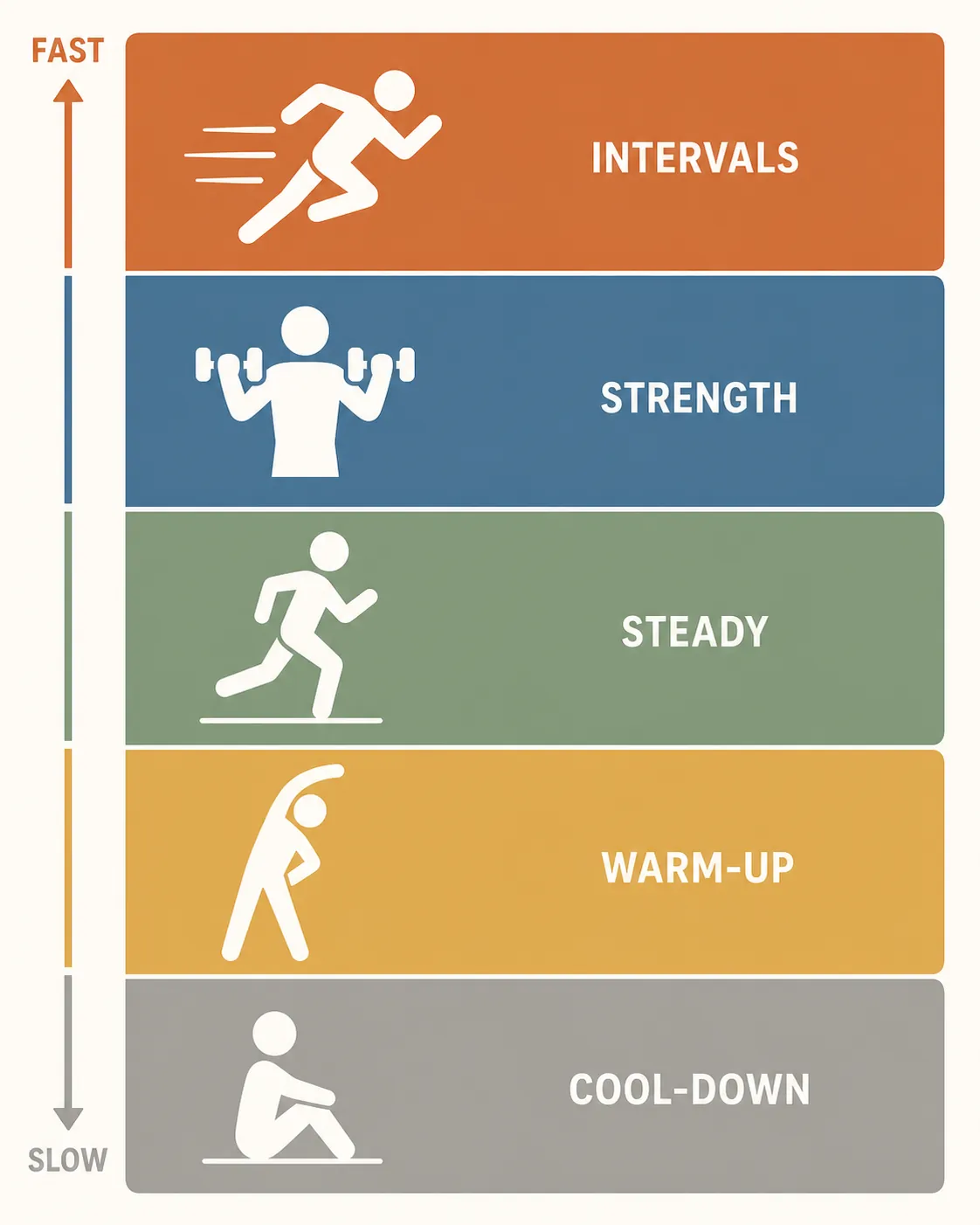
| Workout phase | Practical BPM band for home use | What it should do | Good low-impact movement match |
|---|---|---|---|
| Warm-up | About 80–110 BPM, depending on the source and the song version [2][4] | Raise temperature without rushing footwork | March in place, step-touch, hip openers, bodyweight good mornings, slow shadowboxing |
| Steady-state cardio | About 120–140 BPM, with some guides extending intense work toward 150 BPM [2][3][4] | Keep a repeatable rhythm for 5–15 minutes | Step jacks without jumping, boxer shuffle without bounce, low-impact skaters, alternating knee drives |
| HIIT or sprint intervals | About 140–180 BPM [3] | Create urgency for short bursts, not a whole-session grind | Fast marches, squat-to-reach, mountain climber taps, shadowboxing flurries, low-impact lateral taps |
| Strength pacing | Usually 120–140 BPM, or slower songs used half-time | Keep reps controlled instead of frantic | Squats, reverse lunges, Romanian deadlifts, rows, push-ups, carries, dead bugs |
| Cool-down | Often 80–110 BPM in the cited ranges, though some cooldown guidance goes slower [2][4] | Let breathing settle and stop the beat from pulling you back into work | Easy walking, hamstring stretch, quad stretch, child’s pose, breathing reset |
Country songs that actually have a workout job
Per-song BPM is approximate. Live versions, remasters, radio edits, and streaming-platform metadata can shift the number enough to matter, so treat the values below as “check the exact version you use,” not permanent facts carved into the barn door. The country BPM values cited here come from an instructor-curated indoor cycling list, which is useful for workout programming but still secondary song data. [5]
| Song | Artist | Approx. BPM | Best workout phase | How to use it at home |
|---|---|---|---|---|
| Boot Scootin’ Boogie | Brooks & Dunn | 130 BPM [5] | Steady-state cardio or upbeat strength | Use it for low-impact cardio that needs bounce without actual jumping: step-touch, heel digs, march-and-punch, or simple boxing footwork. It also works for a squat/hinge/row circuit if you move on every other beat. |
| The Devil Went Down to Georgia | Charlie Daniels Band | 140 BPM [5] | Fast steady cardio or controlled threshold work | This is the top edge of steady cardio for most living-room sessions. Keep the feet quiet: fast step-backs, shadowboxing combinations, alternating knee drives, or low-impact skaters. If your form gets noisy, halve the foot speed and keep the arms active. |
| Fastest Girl in Town | Miranda Lambert | 145 BPM [5] | HIIT intervals or short cardio surges | Use the chorus or a 20–30 second block for harder work, then step back down. Good matches are fast marches, squat-to-reach, punch flurries, or mountain climber taps with sliders or socks instead of pounding. |
| Ain’t Goin’ Down ’Til the Sun Comes Up | Garth Brooks | 170 BPM [5] | Sprint-style intervals or half-time strength | Do not try to chase every beat for a full song unless your conditioning and floor situation allow it. Better uses: 15–20 second bursts, half-time squats and lunges, or a finisher where the upper body moves fast and the feet stay planted. |
| A slower country favorite you already like | Any artist | Check for roughly 80–110 BPM | Warm-up or cool-down | This is where the slower favorites belong. Use them for mobility, easy marching, breathing, and stretching rather than forcing them into cardio just because they are good songs. |
| A confirmed 120–140 BPM country track from your own library | Any artist | Verify the exact version | Steady cardio, boxing drills, or strength pacing | Once you have checked the BPM, place it between warm-up and HIIT songs. This is the safest expansion slot for home workouts because it gives you movement without demanding jumps. |
The main lesson from that table is not that only four country songs can work. It is that the usable workout songs tend to live in the faster bands. If a country playlist is packed with 75–115 BPM favorites, it may still be a great playlist, but it will usually need help before it can carry at-home cardio. That “most country is slower than workout pace” idea should be treated as a practical warning from instructor lists and playlist testing, not as a verified genre-wide database claim.
If you want more candidates, use big pools as hunting grounds, then sort them yourself. Spotify’s editorial “Country Workout” playlist is a useful discovery anchor, but a saved playlist is not the same thing as a programmed workout. Jog.fm’s country workout listings, GetSongBPM’s country tempo pages, and Holler’s country workout playlist can all help you find candidates; the final decision still comes down to BPM, song version, and where the track sits in the session. [6][7][8][9]
A 30–45 minute country workout sequence for a small room
Here is the difference between a song list and a workout playlist: the order does some coaching for you. The sequence below assumes no treadmill, no jumping requirement, and enough space for a mat, a pair of dumbbells, and two side steps. If you are building from scratch, it pairs well with the general framing in Why 20-Minute Home Workouts Work for Beginners, then extends the same idea into a longer country-paced session.
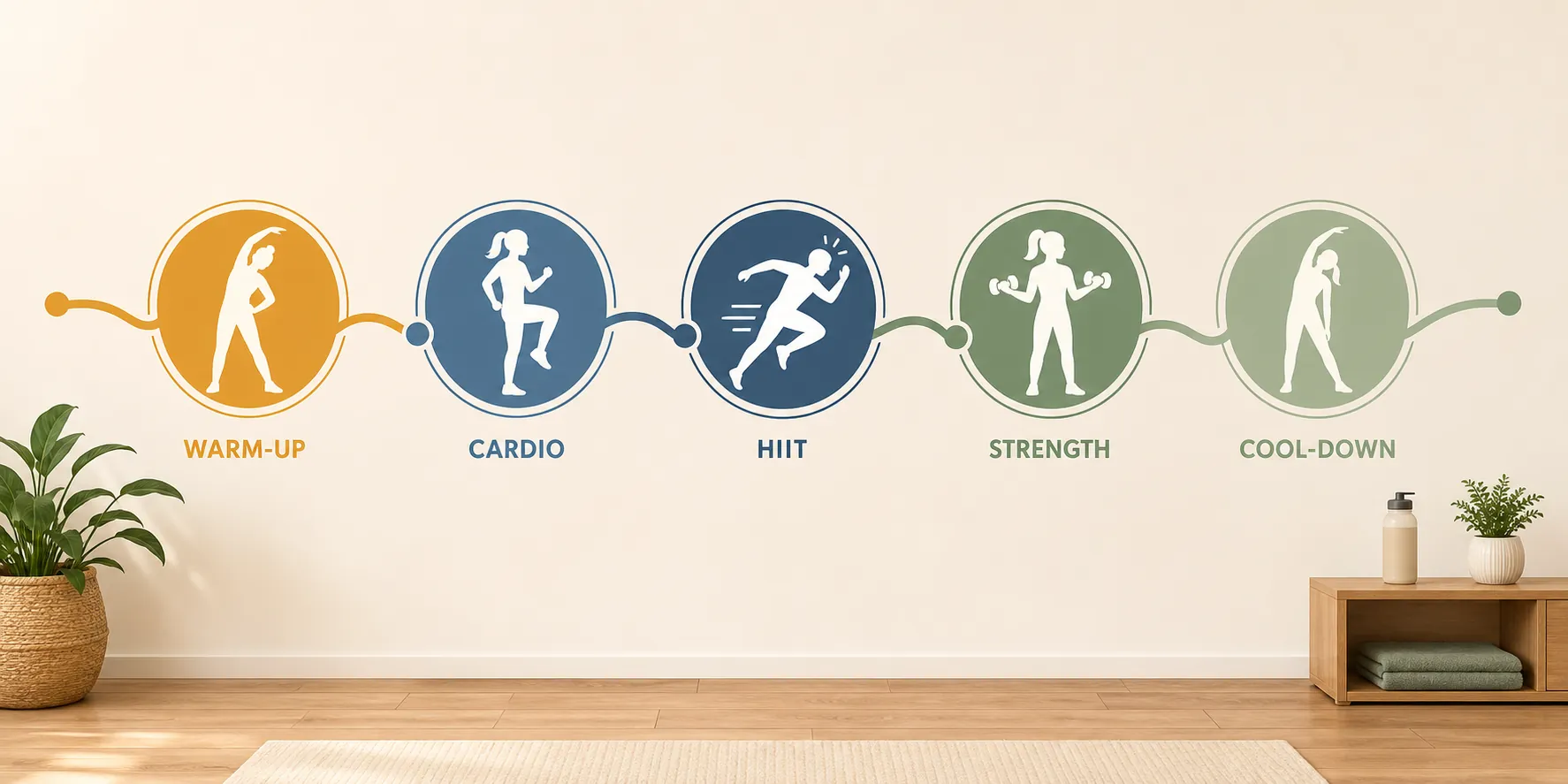
| Time | Playlist slot | Movement focus | Home-friendly execution |
|---|---|---|---|
| 0:00–5:00 | Slower country warm-up, about 80–110 BPM | Mobility and temperature | March in place, shoulder rolls, hip circles, slow hinges, step-touch. Keep this deliberately easy. |
| 5:00–10:00 | Boot Scootin’ Boogie — about 130 BPM [5] | Steady cardio | Step-touch, heel digs, alternating punches, light knee drives. If you are following a boxing-style cardio day, this is where a plan like Learn Boxing at Home With a 4-Week Drill Plan fits naturally. |
| 10:00–15:00 | The Devil Went Down to Georgia — about 140 BPM [5] | Fast steady cardio | Shadowbox, march fast, or use low-impact skaters. Avoid chasing the fiddle with loud feet; let the arms carry some of the speed. |
| 15:00–22:00 | Fastest Girl in Town — about 145 BPM [5] | Intervals | Alternate 30 seconds hard and 30–45 seconds easy. Hard options: squat-to-reach, punch flurries, fast marches, mountain climber taps. Easy option: step-touch and breathe. |
| 22:00–32:00 | A confirmed 120–140 BPM country track, or repeat Boot Scootin’ Boogie half-time | Strength circuit | Do 2–3 rounds of squats, push-ups, dumbbell rows, reverse lunges, and dead bugs. For quieter strength ideas, use Build Muscle Without Making Noise — A Small Space Workout Plan or The Home Leg Workout Progression Guide. |
| 32:00–36:00 | Ain’t Goin’ Down ’Til the Sun Comes Up — about 170 BPM [5] | Optional finisher | Use 15–20 second bursts only: fast punches, high-knee marches without stomping, or planted-feet speed work. Skip this slot if your form is getting sloppy. |
| 36:00–42:00 | Slower country cool-down | Downshift | Walk, stretch calves and hamstrings, open the hips, and slow nasal breathing. This is where the sentimental favorite belongs. |
For a 30-minute version, cut the optional 170 BPM finisher and keep the strength block to two rounds. For a 45-minute version, add another 120–140 BPM cardio song after the first steady block and add one more strength round before the cool-down.
The HIIT section is the only part that should feel impatient. If you want a more formal interval structure, borrow the work/rest discipline from The 20-Minute Beginner Kettlebell Workout at Home or the scaled timing from 7-Minute Workout for Complete Beginners. Just keep the country playlist doing its own job: warm up, build, push briefly, settle into strength, then cool down.
How to keep adding country songs without breaking the workout
The fastest way to ruin the playlist is to add songs by mood only. A loud chorus does not make a song fast. A favorite lyric does not make it useful for intervals. Before a track goes into the middle of the workout, check the BPM of the exact version you stream and place it in the right slot.
- Put 80–110 BPM songs at the edges. They are for warm-up, cool-down, and slow mobility unless you are intentionally using them half-time for strength.
- Use 120–140 BPM as the main home-cardio lane. This is where low-impact boxing, step patterns, and weight-loss circuits are easiest to pace. If you need movement ideas, pair this band with Learn Boxing at Home With a 4-Week Drill Plan or Oba Femi’s No-Equipment Workout for Weight Loss.
- Save 140–180 BPM for intervals, not background noise. Brain.fm’s synthesis notes that HIIT and sprint work benefit from this faster band, but also that above roughly 75% of aerobic capacity, fatigue signals can overwhelm music’s motivational effect. [3]
- For strength, let the beat organize reps instead of speeding them up. A 130 BPM song can work beautifully if you squat on a controlled count, hinge without bouncing, and row without yanking.
- Test the transition, not just the song. If a 145 BPM track drops straight into a 95 BPM ballad before your cardio block is done, move the ballad to the cool-down.
Apartment workouts need one extra filter: noise. A fast song does not require jumping. At 130–170 BPM, you can get plenty of work from planted punches, step-backs, fast marches, squat reaches, slider mountain climbers, and controlled dumbbell circuits. If floor noise is the limiter, use the same quiet-strength logic as Build Muscle Without Making Noise — A Small Space Workout Plan and keep the faster songs for upper-body speed or short intervals rather than repeated landings.
That is the clean standard for country workout music at home: the song earns its place by tempo and task. The faster 120–170 BPM tracks carry the demanding phases. The slower favorites still belong, just not in the middle of the cardio block.
References
- Effects of music in exercise and sport: A meta-analytic review — PubMed, 2020
- The Science Behind the Perfect Workout Playlist — A Healthier Michigan
- Best Workout Music: Pomodoro Technique — Brain.fm
- The Perfect Workout Playlist — slowchathealth, 2025-08-18
- Best Country Workout Songs for Indoor Cycling Class — GroupX Fitness Tips
- Country Workout — Spotify
- Country Workout Songs — jog.fm
- 130 BPM Country Songs — GetSongBPM
- The Best Country Workout Songs — Holler
What a small equipment investment adds
Cable Machine Alternatives That Save Space and Money
Compare the best cable machine alternatives for home gyms – from resistance bands and pulley systems to suspension trainers and compact digital units – and find the right option for your space and budget.
Small Treadmill Buying Guide: 7 Critical Specs to Check Before You Buy
A cross-category spec primer for apartment and small-space dwellers comparing walking pads, ultra-compact folding treadmills, and full-size folding treadmills. Learn the concrete thresholds for motor HP, deck length, noise, warranty, and subscription lock-in so you can compare apples to apples.
How to Practice Basketball at Home Without Noise Complaints
Learn how to run a full basketball workout in a small apartment without noise complaints. This guide covers no-dribble handling drills, wall form shooting, and silent ball options that let you train without disturbing neighbors.
How often should you repeat this?
See our recovery and rest reference for citation-anchored rest-interval guidance.
Spot something off?
Tell us if a movement, tier assumption, or duration didn't match your experience.