If you have one kettlebell, a little floor space, and no coach standing next to you, your first beginner kettlebell workout at home should not start with a swing. It should start with learning how to pick the bell up, put it down, brace your trunk, and keep your lower back out of the job.
That is not a timid way to train. It is the fastest way to make the workout repeatable. A kettlebell can give you squats, pulls, presses, carries, core work, and conditioning in about 20 minutes, but only if the order protects the movement pattern that beginners most often rush: the hip hinge.
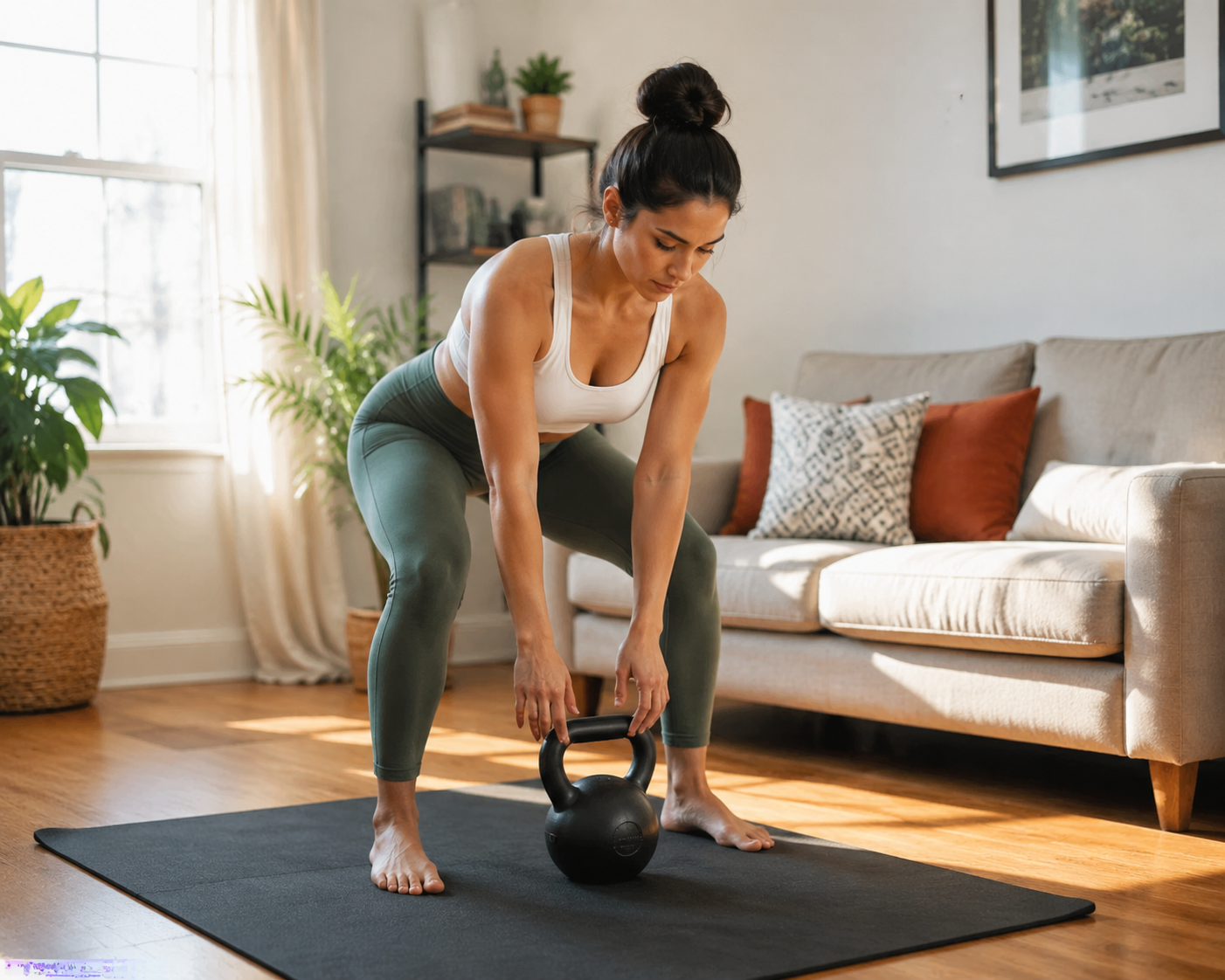
The 20-Minute Beginner Kettlebell Workout
Use this as your first-session structure. If you are brand new, do the version without swings for at least the first few workouts. The swing progression is included, but it is earned by a clean deadlift and Romanian deadlift pattern, not added because a timer says it is time to be more exciting.
| Time | What to Do | Goal |
|---|---|---|
| 0:00–3:00 | Warm up without the bell | Wake up hips, ankles, shoulders, and trunk |
| 3:00–7:00 | Hip-hinge primer with kettlebell deadlifts or RDLs | Learn the pattern before adding speed |
| 7:00–17:00 | Main circuit: goblet squat, row, press, halo, deadlift or optional swing | Train the full body with controlled repetitions |
| 17:00–20:00 | Cooldown and reset | Let your breathing come down and check how your back feels |
Keep one rule over the whole session: stop a set while your last rep still looks like the first good rep. For a beginner training alone, that is more useful than squeezing out a messy final repetition.
Choose a Weight You Can Control, Not One You Can Survive
Common beginner starting ranges are 8–12 kg for many women and 12–16 kg for many men, and those ranges appear across several beginner kettlebell resources, including Nerd Fitness, Onnit, and Kettlebell Workouts.[1][2][3] Treat them as a starting conversation, not a rule. Prior strength, body size, injury history, shoulder mobility, grip strength, and coordination can all move you up or down.
A good first kettlebell lets you perform a two-hand deadlift with a flat back, a goblet squat without folding forward, a two-hand halo without yanking your neck around, and a one-arm row without twisting your torso. If the bell is too heavy for the press, you can still keep it for lower-body work and skip or modify the press. If it pulls your hinge out of shape, it is too heavy for this workout.
For buying your first bell, do not turn the decision into a full equipment project. A cast-iron or competition-style bell with a smooth handle is enough. If you are still comparing home gear, use a broader home exercise equipment decision guide before you buy, or check what a single kettlebell means inside a larger home fitness budget.
Warm Up: Three Minutes Before You Touch the Bell
Set the kettlebell in front of your mat and leave it there for a few minutes. The warm-up is not filler; it tells you whether your hips, back, and shoulders are ready to cooperate today.
- 30 seconds: March in place or step side to side, letting your arms swing naturally.
- 30 seconds: Bodyweight good mornings with hands on ribs, pushing hips back and standing tall.
- 30 seconds: Hip circles, slow enough that you can feel both feet stay planted.
- 30 seconds: Bodyweight squats to a comfortable depth.
- 30 seconds: Shoulder circles and gentle arm reaches.
- 30 seconds: Standing plank practice: squeeze glutes lightly, brace as if someone is about to tap your ribs, then breathe without losing that shape.
The Hinge Primer Comes First
The kettlebell deadlift is your first real exercise because it teaches the same hip-hinge pattern a swing will later need. NASM describes the swing as a hinge-dominant movement that requires hip drive and core bracing, not a squatty arm lift.[4] Fit&Well also flags the kettlebell swing as an exercise beginners should avoid until they have learned the hip hinge.[5]
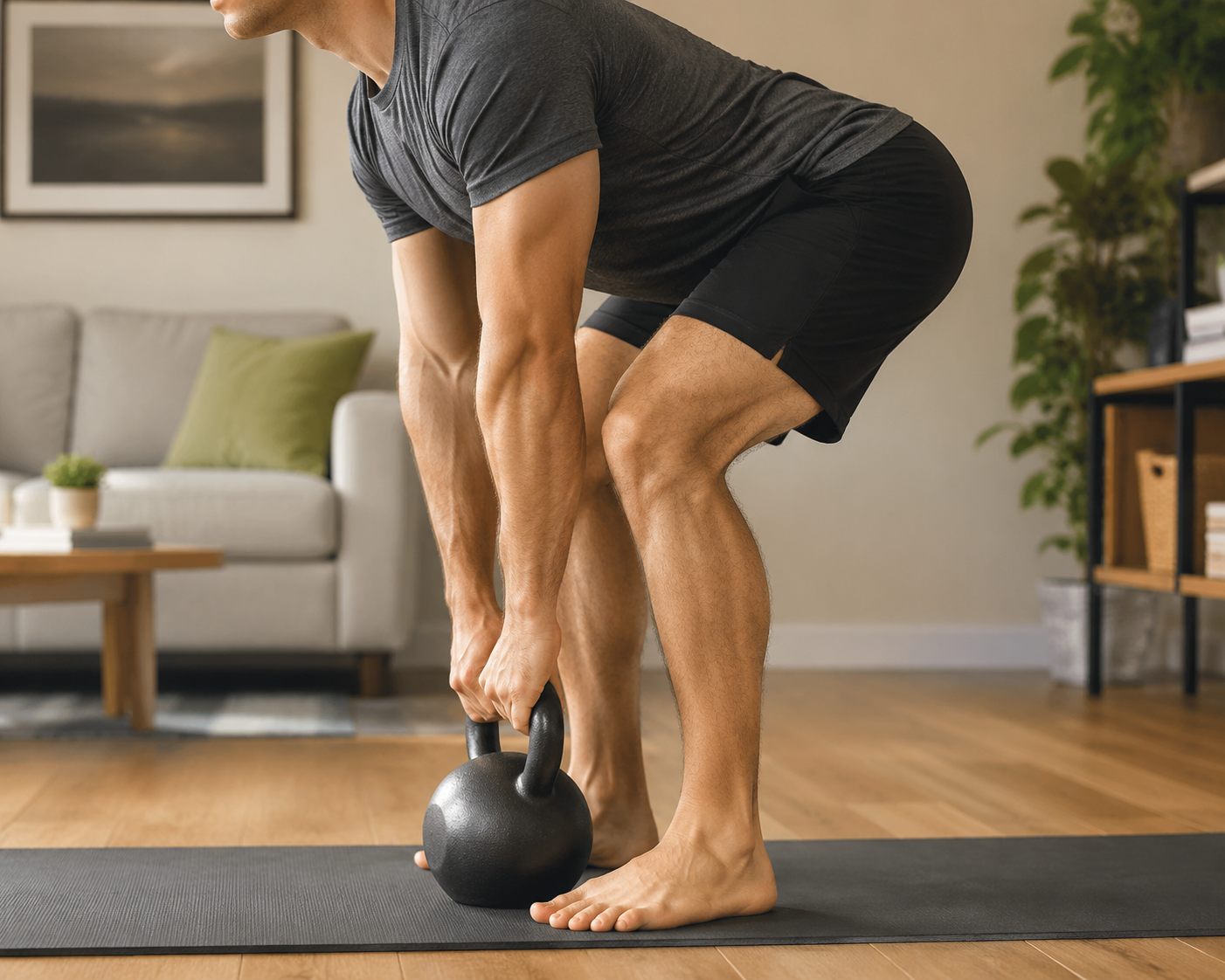
Kettlebell Deadlift
Place the bell between your feet, handle lined up with your shoelaces. Stand with feet about hip-width apart. Push your hips back as if you are closing a car door with your hips. Let your knees bend, but do not turn it into a squat. Grip the handle with both hands, pull your shoulders away from your ears, brace your middle, and stand up by driving the floor away.
- Do 2 sets of 6 slow reps.
- Pause for one breath at the top of each rep.
- Put the bell down quietly; a loud drop usually means you lost tension.
- If your lower back feels pinchy or sharp, stop and switch to bodyweight hinge practice.
Kettlebell Romanian Deadlift
After the deadlift feels steady, hold the bell in both hands in front of your thighs. Soften your knees, push your hips back, and let the bell travel down close to your legs. Stop when your hamstrings say, “that is enough,” or when your back wants to round. Stand tall again by squeezing your glutes, not by leaning back.
Do 1–2 sets of 6 reps. This is the part of the workout where many people discover the difference between feeling the back muscles work and letting the spine take over. Mild muscular effort along the back can happen. A sharp, grabby, or one-sided feeling is a stop sign.
The Main Circuit
Set a timer for 10 minutes. Move through the circuit at a pace that lets you breathe and keep your form. Rest whenever your technique starts to fray. Most beginners will get through 2–3 rounds.
| Exercise | Reps | Beginner Cue |
|---|---|---|
| Goblet squat | 6–8 | Hold the bell close; knees track over toes |
| One-arm row | 6 each side | Pull elbow toward hip; do not twist open |
| Kettlebell deadlift or RDL | 6 | Keep the hinge slow and clean |
| Half-kneeling or standing press | 4–6 each side | Ribs down; wrist stacked over elbow |
| Halo | 3 each direction | Move slowly around the head; neck stays quiet |
If you are not pressing safely yet, skip the press and repeat the row. If the squat bothers your knees, reduce the depth and sit back to a chair or couch cushion. The workout still works when you modify it; it stops working when every rep becomes a negotiation.
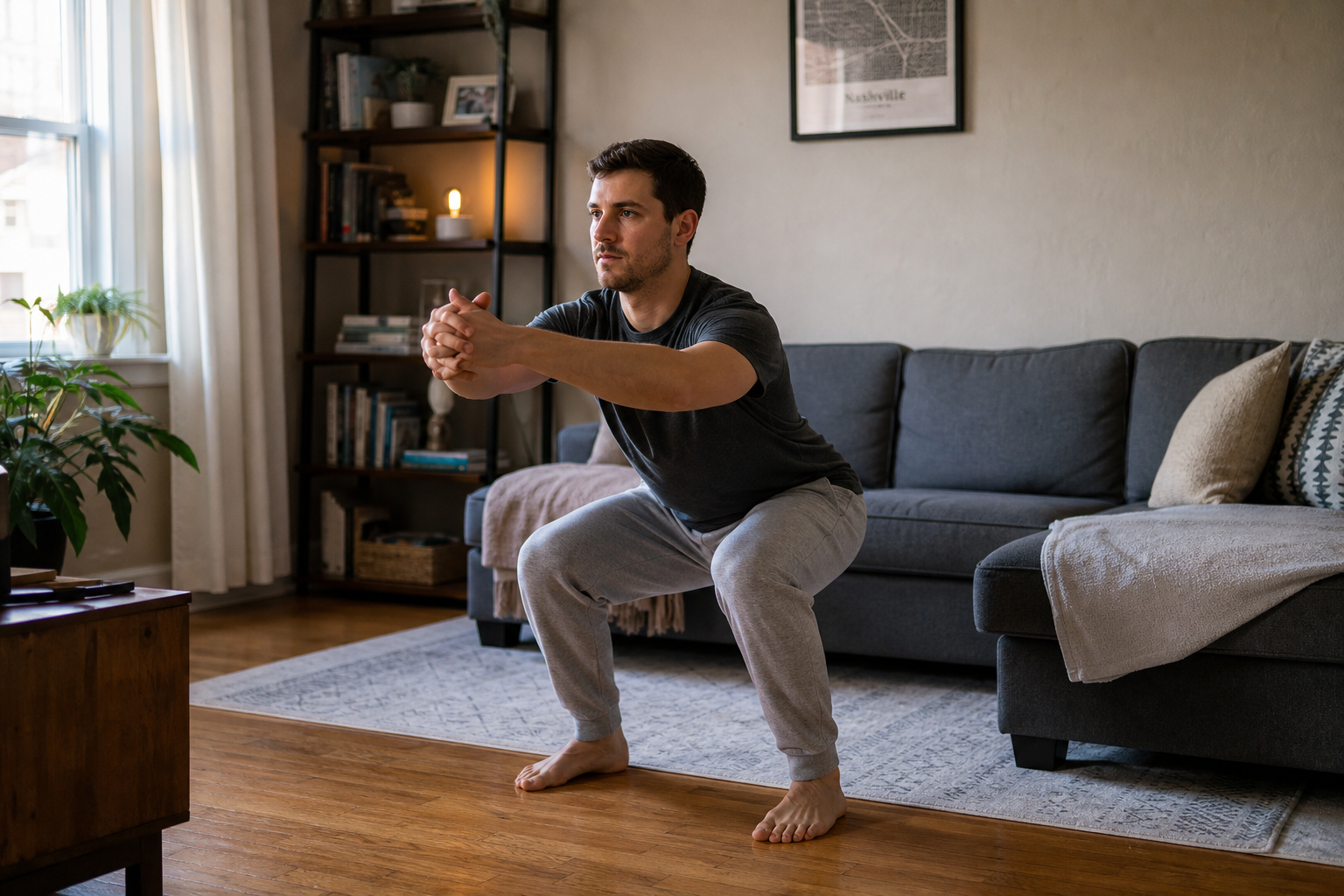
Goblet Squat
Hold the kettlebell by the horns or at the sides of the handle, close to your chest. Stand with feet about shoulder-width apart. Sit down between your feet, not onto your toes. Your elbows can travel inside your knees if that feels natural, but do not pry aggressively in your first workout.
The bell should help you counterbalance. If you feel yourself tipping forward, lighten the bell, reduce depth, or squat to a target behind you. A beginner squat that is two inches shallower and stable is more useful than a deep squat that collapses at the bottom.
One-Arm Row
Take a staggered stance or support one hand on a sturdy chair, bench, or couch arm. Hinge slightly, keep your back long, and row the bell toward your hip. Think of sliding your shoulder blade into your back pocket rather than shrugging the bell toward your ear.
Rows are useful in a home kettlebell workout because they give the upper back real work without needing a pull-up bar. Keep the non-working side steady. If your whole torso rotates to move the bell, the weight is too heavy or the set is finished.
Press
For many beginners, the press is the first exercise where the recommended starting bell suddenly feels too heavy. That is normal. Try a half-kneeling press first: one knee down, opposite foot forward, glutes lightly squeezed, ribs stacked over pelvis. Start with the bell at shoulder height. Press up without leaning sideways, then lower with control.
If the bell yanks your wrist backward or you have to arch your back to finish the rep, skip presses for now. You can substitute a two-hand floor press if you can get down and up comfortably, or you can do extra rows and halos until you own a lighter bell.
Halo
Hold the kettlebell by the horns, bottom facing up or down depending on what feels secure. Move it slowly around your head like you are tracing a small circle. Your head should not chase the bell. Your ribs should not flare. Keep the circle small enough that your shoulders, not your lower back, are doing the work.
Halos show up in beginner kettlebell routines from Onnit and Nerd Fitness because they train shoulder control and trunk stability without needing much space.[1][2] They are also a good reality check: if a halo feels chaotic, your shoulders may not be ready for a lot of overhead pressing today.
When to Add the Swing
A swing is not a deadlift done quickly with your arms. It is a ballistic hinge. That means the bell moves because your hips snap, your trunk braces, and your arms guide rather than lift. Harvard Health warns that kettlebells can cause injury when people use them without proper instruction, which is exactly why the swing should wait until the slower hinge is reliable.[6]
Before you add swings to this workout, you should be able to do all of the following:
- Perform 10 kettlebell deadlifts with the bell close to your body and no back rounding.
- Perform 8 Romanian deadlifts while feeling most of the stretch in your hamstrings, not your lower back.
- Stand tall at the top without leaning backward.
- Brace and breathe at the same time.
- Stop a set as soon as the bell starts pulling you out of position.
Optional Swing Progression
If those boxes are checked, replace the deadlift or RDL in the circuit with 5–8 two-hand swings. Start with one round only. Park the bell between sets. Do not keep swinging just because you still have breath left.
- Set the bell about a foot in front of you.
- Hinge back and grip the handle with both hands.
- Tip the bell slightly toward you, like hiking a football.
- Hike it back high between your thighs, then snap your hips forward.
- Let the bell float to about chest height; do not lift it with your shoulders.
- Finish in a standing plank: glutes on, ribs down, abs braced, eyes forward.
McGill and Marshall documented posterior shear at L4-L5 during kettlebell swings, which does not mean swings are forbidden, but it does make bracing and hinge mechanics more than decorative cues.[7] If your back feels like it is catching the bell at the bottom, go back to deadlifts for another few sessions.
Cooldown: Check the Signal Before You Celebrate the Sweat
Use the last three minutes to bring the workout down. Walk slowly around the room for a minute, then do a gentle hip-flexor stretch on each side and a relaxed child’s pose or supported forward fold if those positions feel comfortable.
Then notice what your body is telling you. Warm legs, tired glutes, worked upper back, and heavy breathing are expected. Sharp lower-back pain, tingling, pain traveling down a leg, or a feeling that your back “took over” the whole session means the next workout should be lighter, slower, and hinge-only—or paused until you can get qualified help.
Why One Kettlebell Can Be Enough
The reason a single kettlebell can carry a short home workout is that the exercises ask several systems to work at once. Squats and deadlifts train the legs and hips. Rows and presses train the upper body. Halos and swings ask the trunk to transfer force rather than just hold a pose. The circuit format keeps the heart rate involved because you are moving between patterns instead of resting after every isolated muscle group.
The research supports that possibility, with limits. In an ACE-sponsored 2013 study from the University of Wisconsin-La Crosse, an 8-week kettlebell program was associated with a 13.8% improvement in aerobic capacity, a 70% increase in core plank time from 1:05 to 1:50, and significant dynamic balance gains.[8] The important caveat is the study population: fit 19–25-year-olds with some training experience, not older sedentary beginners starting alone in a living room.[8]
Lake and Lauder’s 2012 study found that twice-weekly kettlebell swing training improved 1RM half-squat and vertical jump, which supports the idea that kettlebells can contribute to strength and power development.[9] A 2024 narrative review also describes kettlebell training as useful across strength, power, endurance, and explosive-power contexts, though a narrative review is less definitive than a meta-analysis.[10]
None of that turns a 20-minute beginner workout into a guaranteed transformation. The ACE study also found no significant fat-loss effect from kettlebell training alone.[8] If body composition is the goal, nutrition, total activity, sleep, and consistency still matter. The better promise for this routine is simpler: it gives you a realistic way to practice full-body strength and conditioning with one tool.
Common Beginner Mistakes and the Fixes That Actually Help
Swinging With the Shoulders
Kettlebell Workouts lists shoulder-dominant swinging as a common mistake, and it is easy to spot: the bell rises because the arms yank it up, while the hips barely move.[3] The fix is to remove the swing for the day. Go back to deadlifts, then hike passes if you know how to do them safely. Your arms should feel like straps; your hips create the bell’s float.
Leaning Back at the Top
Lumbar over-extension is another common kettlebell error noted by Kettlebell Workouts.[3] Beginners often finish a deadlift or swing by thrusting the hips forward and throwing the ribs back. That can make the rep feel powerful while dumping the finish into the lower back.
Fix it with the standing plank cue. At the top, your ears, shoulders, ribs, hips, knees, and ankles should stack. Glutes lightly on. Ribs down. Belt-buckle area pulled slightly up. If you cannot hold that shape for one breath, the rep is not finished well enough to speed up.
Choosing the Wrong Bell
Too heavy is obvious when the bell drags you forward, bends your wrist back, or makes your back round. Too light can be a problem too, especially in swings, because some beginners start muscling the bell instead of hinging. The right bell gives you feedback without stealing your shape.
For the first workout, choose the weight that lets you perform the hinge primer cleanly, even if that means the goblet squat feels modest. You can make a light bell harder with slower tempo, pauses, and better positions. You cannot make an unsafe heavy bell safer by hoping the next rep improves.
Forgetting to Brace Before the Bell Moves
Bracing is not sucking in your stomach. It is the 360-degree tension you would create if someone were about to bump into you. Practice it before each deadlift, row, press, and swing. In a quiet home workout, the breath before the rep is often where the rep is won.
How Often to Repeat This Workout
Start with 2–3 nonconsecutive days per week. Keep the hinge-first version until the deadlift and RDL feel boring in the best way: predictable, controlled, and free of back drama. Then add a small number of swings to one round, not every round.
Progress by changing one thing at a time. Add a round, add a few reps, slow the lowering phase, or use the optional swing slot. Do not increase weight, volume, and speed in the same week. A beginner routine should leave you with enough confidence to come back, not enough soreness to avoid the bell in the corner.
When this workout feels steady, it can become the kettlebell entry point inside a broader home gym workout plan that grows with your equipment. One kettlebell is enough for a real home workout. The order is what makes it beginner-safe.
References
- The 20-Minute Beginner Kettlebell Workout, Nerd Fitness.
- Full-Body Kettlebell Workout For Beginners, Onnit.
- 15 Common Mistakes To Avoid When Kettlebell Training, Kettlebell Workouts.
- How Kettlebell Workouts Can Take Your Fitness to the Next Level, NASM.
- I’m a personal trainer and this is the one kettlebell exercise beginners should avoid, Fit&Well.
- Should You Try Kettlebells?, Harvard Health Publishing, 2019.
- Kettlebell Swing, Snatch, and Bottoms-Up Carry: Back and Hip Muscle Activation, Motion, and Low Back Loads, Journal of Strength and Conditioning Research, 2012.
- Exclusive ACE research examines the benefits of kettlebells, American Council on Exercise, 2013.
- Kettlebell Swing Training Improves Maximal and Explosive Strength, Journal of Strength and Conditioning Research, 2012.
- Exploring the Benefits and Applications of Kettlebell Training: A Comprehensive Review, Cureus, 2024.
Comments
Join the discussion with an anonymous comment.