
Progressive Bodyweight Leg Training: A 6-Week Program Backed by Research
Skeptical that bodyweight-only leg workouts can build real strength? New research shows progressive bodyweight squat training produces gains comparable to barbell training. This article breaks down the science and provides a complete 6-week program with beginner to advanced tracks, all without any equipment.
- Duration
- 20 min
Bodyweight Legs? I Was Skeptical Too.
I know the feeling. You knock out 50 bodyweight squats and wake up feeling nothing. No soreness, no pump. The voice in your head says you are just bending your knees — not training. That voice is not entirely wrong. Most people outgrow bodyweight squats within weeks because they repeat the same movement with no plan to make it harder. The problem is not bodyweight training. It is the lack of progression.
I have coached enough beginners to know that the first instinct is to add weight. Add more plates, buy dumbbells, find a gym. But what if you could get legitimately stronger — measurably stronger, with bigger muscles — without adding a single pound of external load? That claim sounds like marketing. It is not.
What the Study Actually Compared
A 2023 study in Nature Scientific Reports put this question to a controlled test. I checked the protocol: sedentary young women, mean age 19.8, untrained. Researchers split them into two groups. One group performed a progressive bodyweight squat program. The other trained the barbell back squat at 60–80% of their one-rep max. Both groups trained twice a week for six weeks, doing six sets per session.
The result? Knee extensor strength, knee flexor strength, and muscle thickness of the gluteus maximus and gastrocnemius increased significantly in both groups, with no statistically significant difference between them. In plain language: the bodyweight group got about as strong and built about as much muscle as the barbell group — over six weeks, twice a week, using nothing but squats.
One more detail the headlines miss: the study found no significant change in body fat percentage in the bodyweight group, while the barbell group did lose fat. That does not mean bodyweight training cannot help you lean out — but it is not automatic. The hypertrophy gains are real; the metabolic effect of a bodyweight program versus a barbell program is not identical.
Let me be precise about what "comparable" means. The study measured isometric knee extension and flexion strength — not a one-rep max barbell squat. So the headline is not "bodyweight squats let you squat 300 pounds." It is "bodyweight squats, when structured properly, stimulate the same relative strength gains in the muscles that extend and flex your knee." That distinction matters, but it does not diminish the practical takeaway: for someone starting from scratch, a well-designed bodyweight program can produce real, measurable lower-body strength and size.
Additional support comes from Harvard Health, which reported that a 10-week bodyweight exercise program improved aerobic capacity by 33%, core endurance by 11%, and lower-body power by 6% in young women. A separate study of active people in their 60s saw muscle strength and power improve by about 15% after ten months of performing eight simple lower-body exercises six times per month. The principle is consistent across age groups: bodyweight training, done systematically, drives adaptation.
How the 10-Level Ladder Works
The secret is not the squat itself. It is the ladder. The study used a progression of ten movement levels — labeled A through J — that moved from bilateral squats (both feet on the ground) all the way to full unilateral squats (one leg, no support). Each step increases mechanical demand by reducing the base of support, increasing the range of motion, or adding a pause at the bottom.
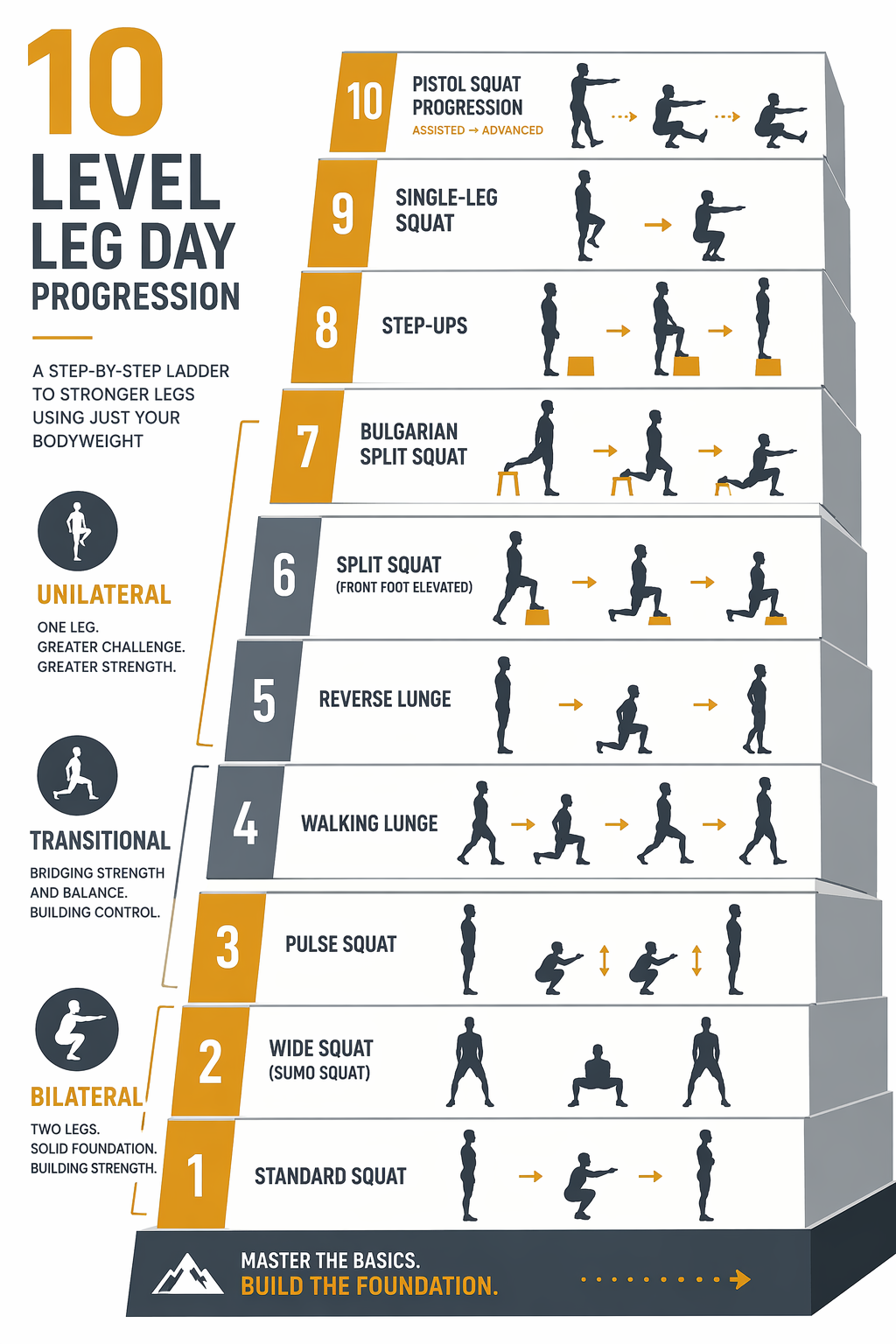
At the lower rungs, you do bodyweight squats with a wide stance, then narrow stance, then a squat to a chair (to increase range of motion and time under tension). As you climb, you transition to split squats, Bulgarian split squats, and eventually the single-leg squat, also called the pistol squat. Each level builds on the previous one, ensuring the muscles are exposed to a progressively higher stimulus even though the external weight never changes.
Beyond the movement pattern, you can also manipulate tempo, volume, and rest. Slowing down the eccentric (lowering) phase from two seconds to four seconds dramatically increases time under tension. Adding more sets or reducing the rest interval between them also increases the training stimulus. These are the same principles that drive progress with barbells — progressive overload — applied without a single plate.
The 6-Week Program: Pick Your Track
Below is a six-week program built on the same principles as the Nature study. It offers three tracks based on your current ability. Pick the track where you can complete the first week's prescribed reps with good form but not easily. If you can knock out all reps without breaking a sweat, start one track higher.
| Week | Beginner Track | Intermediate Track | Advanced Track | Sets x Reps (all tracks) |
|---|---|---|---|---|
| 1 | Level 1–2: Wide & narrow squats | Level 3–4: Narrow squat & squat to chair | Level 5–6: Split squat & lunge | 3 x 10–12 |
| 2 | Level 2–3: Narrow squat, squat to chair | Level 4–5: Squat to chair, split squat | Level 6–7: Lunge, Bulgarian split squat | 3 x 10–12 |
| 3 | Level 3–4: Squat to chair, split squat | Level 5–6: Split squat, lunge | Level 7–8: Bulgarian split squat, single-leg squat (assisted) | 4 x 8–10 |
| 4 | Level 4–5: Split squat, lunge | Level 6–7: Lunge, Bulgarian split squat | Level 8: Single-leg squat (assisted) | 4 x 8–10 |
| 5 | Level 5–6: Lunge, Bulgarian split squat | Level 7–8: Bulgarian split squat, single-leg squat (assisted) | Level 9: Single-leg squat (unassisted) | 4 x 6–8 |
| 6 | Level 6–7: Bulgarian split squat, single-leg squat (assisted) | Level 8–9: Single-leg squat (assisted), unassisted | Level 10: Unassisted single-leg squat | 4 x 6–8 |
That is the program. It will not let you squat 300 pounds, but it will make you stronger than you were. And it starts with nothing but your bodyweight. If you are still skeptical, good. Use the program, track your reps, and see for yourself.
What a small equipment investment adds
We don't have a build tagged to this exact tier yet. Browse all builds.
How often should you repeat this?
See our recovery and rest reference for citation-anchored rest-interval guidance.
Spot something off?
Tell us if a movement, tier assumption, or duration didn't match your experience.