
Brandy Ledford's Fitness Secrets at 57 Without a Gym
Brandy Ledford's fitness secrets at 57 aren't a hidden formula — her routine is a doctor-directed pivot to heavy strength training layered on daily yoga and walking. This guide rebuilds that structure as a weekly at-home template for the $0-100, $100-300, or $300-800 budget tier, with evidence-backed reps and frequency plus apartment-noise and floor-protection notes.
- Equipment tier required
- $0-100
- Duration
- 30 min
- Difficulty
- beginner
- Target area
- full body
- Space footprint needed
- small footprint
- Noise level
- quiet
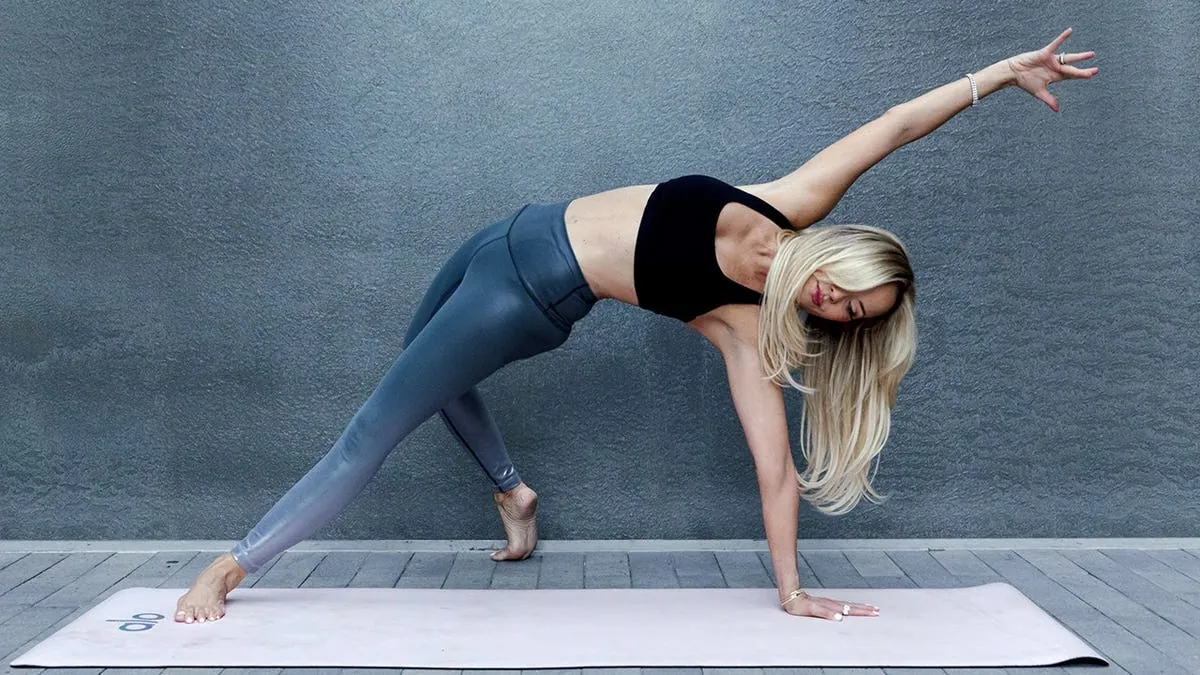
Search for Brandy Ledford fitness secrets at 57 workout routine and the useful truth shows up fast: the “secret” is not a hidden celebrity circuit. In her Aug. 1, 2026 Fox News Digital interview, Ledford said she had become “really, really, really focused on serious weight training” after her doctor pushed her to stop relying only on light yoga-sculpt work and take strength training seriously for bone density and longevity. She also described daily yoga and walking or hiking as part of her life at 57.[1]
That is a strong structure. It is not a published program. Ledford has not released her sets, reps, loads, exercise list, rest periods, or weekly schedule. So the plan below is not “Brandy Ledford’s exact workout.” It is a FitAtHome rebuild of the pattern she made public: heavy strength training, daily yoga, and regular walking, adapted for a living room instead of a gym.
The guardrails matter. ACSM’s 2026 resistance-training update summarizes evidence from 137 systematic reviews and more than 30,000 participants, with headline findings that all major muscle groups should be trained about twice per week, consistency beats complexity, and bands, bodyweight, and home-based routines can be highly effective.[2] CDC guidance gives adults a baseline of 150 minutes of moderate-intensity aerobic activity plus at least 2 days of muscle-strengthening work each week, with balance work becoming especially important in older adulthood.[3] An osteoporosis exercise position statement gives a useful loading window for bone-focused resistance work: 50% to 85% of 1-repetition maximum, 5 to 12 reps, 2 to 3 days per week, across 3 to 12 months, with compound loading that stresses the spine and hips.[4]
What Ledford actually made public
The important shift in Ledford’s interview is not that she does yoga. She had already been doing lighter yoga-sculpt-style training. The shift is that her doctor wanted more serious loading for bone density and longevity, and Ledford appears to have accepted that message rather than softening it into another mobility routine.[1]
The interview also came wrapped in familiar celebrity framing: the “Baywatch” reference, the bikini quote, and the fact that she is 14 years sober were all part of the story.[1] Those details may be why people clicked. They are not the training plan. The training lesson is simpler and more useful: a woman in her late 50s was told to put real load back into her routine, while keeping daily movement habits she could actually sustain.
TechTimes covered the same pivot as a move away from yoga sculpt toward heavier weights and added a science layer, including its reporting on a 2025 meta-analysis of resistance training and bone density with 40 studies and 2,230 participants. TechTimes reported standardized mean differences of 0.88 for lumbar spine bone mineral density and 0.89 for femoral neck bone mineral density, but those figures should be treated here as TechTimes’ reporting rather than as independently rechecked from the original journal articles.[5]
What “heavy” means when you train at home
Heavy does not have to mean a barbell, a squat rack, or a downstairs neighbor hearing a dumbbell hit the floor. At home, “heavy” means the working set is genuinely challenging for the target muscles while your form stays controlled. If a set of 10 goblet squats feels like you could casually do 10 more, it is not heavy for you. If reps 8 through 10 are slow, focused, and clean, you are much closer.
The bone-focused loading range from the osteoporosis position statement gives the broad idea: 50% to 85% of 1-rep max, usually for 5 to 12 reps, 2 to 3 days per week.[4] Most people training in an apartment will not test a true 1-rep max. They do not need to. Use the rep range as a practical filter: pick a version of the exercise where the final 2 or 3 reps demand attention, but you are not twisting, bouncing, or holding your breath to survive the set.
This is also where women get under-served by vague advice. “Stay active” is fine as a baseline. It does not tell you how to load the hips, spine, legs, back, and arms hard enough to keep strength moving. Harvard Health’s strength-training overview makes the same broader point: strength training builds more than visible muscle, supporting function, bone, balance, and metabolism as people age.[6] Mayo Clinic’s perimenopause and menopause weightlifting guidance also frames resistance training as valuable for bone health during the menopausal transition, when bone and muscle changes become harder to ignore.[7]
A doctor-and-DXA note before you load
If you have diagnosed osteoporosis, a history of fragility fracture, unexplained back or hip pain, long-term steroid use, cancer treatment history, medications that affect bone, or any medical uncertainty, do not treat a celebrity-inspired home template as clearance. Ask your clinician whether you need DXA screening, what loading is appropriate, and whether any spinal flexion, twisting, impact, or balance risks should be modified. The point is to train seriously, not to guess seriously.
The at-home weekly template
Ledford’s public pattern becomes usable when it is arranged around recovery. Two serious full-body strength days are the floor. A third can be added if joints, sleep, soreness, and schedule are cooperating. Yoga stays daily, but it changes job depending on the day: sometimes mobility, sometimes breath work, sometimes a short reset after walking. Walking fills the aerobic base without turning the living room into a jumping studio.
| Day | Main job | At-home version |
|---|---|---|
| Monday | Full-body strength A | Squat pattern, push pattern, pull pattern, and loaded carry. Use 2 to 3 hard work sets per move, mostly 5 to 12 reps for loaded lifts. Finish with 5 to 15 minutes of easy yoga. |
| Tuesday | Walk + daily yoga | Moderate walk. Yoga can be mobility-focused: hips, calves, thoracic rotation, gentle balance. No need to chase fatigue. |
| Wednesday | Full-body strength B | Hinge pattern, single-leg or step-up pattern, second pull, trunk anti-rotation, and optional carry. Keep reps controlled and quiet. |
| Thursday | Walk + daily yoga | Another walking day. If soreness is high, keep yoga restorative. If you feel good, add balance holds or slow transitions. |
| Friday | Optional strength C or recovery | If recovery is good, repeat the weakest patterns with slightly lower volume. If not, walk and do yoga only. This is the flex day, not a guilt day. |
| Saturday | Longer walk or hike | Use this as the main outdoor movement day when possible. Add short yoga afterward, especially calves, hips, and upper back. |
| Sunday | Recovery spacing | Gentle yoga, easy walk if desired, and no hard loading unless the whole week was shifted. |
The table is deliberately boring. That is its strength. ACSM’s headline message that consistency beats complexity fits this kind of week: train the major muscle groups, repeat the patterns, and progress what you can measure.[2] CDC’s aerobic baseline also fits naturally here; five 30-minute walks would already reach 150 minutes of moderate activity before counting any hiking or longer weekend walk.[3]
Strength Day A: squat, push, pull, carry
Start with a squat pattern that fits your joints and furniture: sit-to-stand from a sturdy chair, goblet squat, split squat holding support, or slow step-down. Then pair it with a push: wall push-up, incline push-up on a counter, floor push-up, or dumbbell floor press. The pull can be a band row, towel row setup if safely anchored, dumbbell row, or backpack row. Finish with a carry: suitcase carry in place, slow loaded march, or a farmer carry around the room.
For most readers, the carry is where “serious” becomes obvious without drama. Pick up something heavy enough that your posture wants to lean. Do not let it. Walk slowly, or march in place if space is tight. Put the load down quietly. That one choice trains grip, trunk, hips, and balance without a single jump.
Strength Day B: hinge, single-leg work, back, trunk
The hinge is the movement many home routines skip because it is harder to feel than a squat. Use a Romanian deadlift with dumbbells, a backpack deadlift from blocks, a banded good morning, or a hip hinge drill with a dowel until the pattern is clean. Then add single-leg work: supported split squats, step-ups on a stable low step, reverse lunges, or staggered-stance deadlifts. Keep the surface stable. A wobbly ottoman is not fitness equipment.
Back work belongs on both strength days because posture and pulling strength matter when the rest of life is chairs, screens, groceries, and laundry. Use rows, band pull-aparts, pulldown variations with a safe anchor, or prone floor raises if you have no equipment. Trunk work should resist movement more often than it creates movement: side planks, dead bugs, bird dogs, suitcase holds, and anti-rotation presses beat endless fast crunches for this purpose.
The optional third strength day
A third day is useful only if it improves the week rather than raids it. Keep it shorter than the first two. Repeat the patterns that need practice, add load to carries, or do one lower-body move, one upper-body push, one upper-body pull, and one trunk drill. If your knees are cranky, sleep is poor, or the Monday and Wednesday sessions are still sitting in your legs, Friday becomes walking and yoga.
If you want a more detailed progression built around the same home-friendly movement patterns, FitAtHome’s perimenopause strength training routine you can do at home is the closest continuation: squat, hinge, push, pull, carry, and controlled core work without assuming a gym membership.
How to build it on a $0–100 budget
This is the tier where people most often assume “heavy” is off the table. It is not. It just requires less romance about equipment and more attention to leverage, tempo, range of motion, unilateral work, and safe loading.
- Load: a sturdy backpack filled with books, water bottles, rice bags, or other dense household items; a tote bag for suitcase carries; or one inexpensive resistance-band set.
- Floor protection: a yoga mat is fine for yoga, but a folded towel or low-cost exercise mat under the load helps prevent scuffs when setting a bag down.
- Noise control: no dropping, no jumping, no fast mountain climbers if neighbors are below. Slow step-ups, split squats, hinges, carries, and floor presses are apartment-friendly.
- Progression: add books to the backpack, slow the lowering phase, pause at the hardest point, move from two-leg to staggered-stance versions, or add a second work set before buying more gear.
A $0–100 Strength Day A might look like this: backpack box squat, incline push-up, backpack row, suitcase carry with a loaded tote, and dead bug. A $0–100 Strength Day B might be backpack Romanian deadlift, supported split squat, band row or towel-assisted row if you have a safe anchor, side plank, and loaded march. The load is not glamorous. It is still load.
The main mistake at this tier is turning every set into high-rep endurance because the equipment is light. If 12 reps are easy, make the exercise mechanically harder before you add 30 more reps. A slow split squat with a backpack can become serious very quickly. So can a loaded carry done with posture strict enough that you cannot wander mentally.
How the same week changes at $100–300
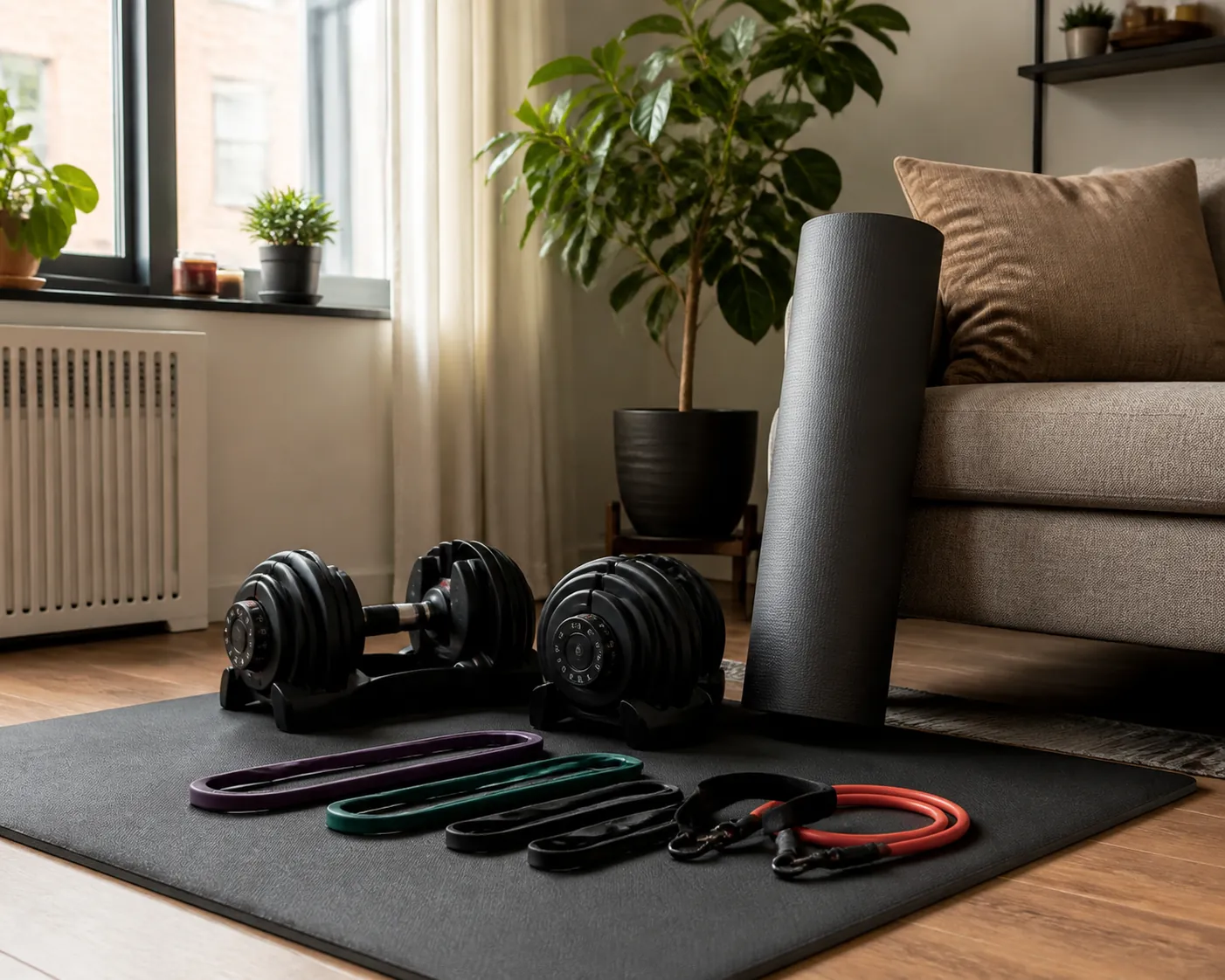
This is the sweet spot for many apartments. One or two pairs of dumbbells, a band set, and a better mat remove a lot of friction. You can load squats, hinges, floor presses, rows, carries, and split squats without rearranging the room or storing a bench in the hallway.
| Need | $100–300 choice | Why it helps |
|---|---|---|
| Lower-body loading | Medium-to-heavy dumbbell pair or kettlebell | Makes goblet squats, Romanian deadlifts, split squats, and carries easier to progress. |
| Pulling | Loop bands or tube bands with a safe door anchor | Adds rows, pulldown-style patterns, anti-rotation presses, and warm-up options without a machine. |
| Floor and noise | Dense exercise mat or interlocking tiles in the lifting zone | Protects floors and makes quiet set-downs easier, especially with dumbbells. |
| Yoga and recovery | Yoga mat, blocks if useful | Keeps daily yoga separate from the lifting surface so the space does not become a pile of gear. |
At this tier, progression becomes cleaner. Instead of making a backpack heavier and lopsided, you can move from 15-pound dumbbells to 20s, or from one band to a stronger band. The weekly structure does not change. The quality of the loading does.
What $300–800 buys you, and what it does not
The higher tier is not about making the routine fancier. It is about giving you enough load jumps to keep training hard for years. Adjustable dumbbells, a stable foldable bench, stronger bands, and better floor protection can make the same two or three strength days more durable.
- Adjustable dumbbells let one small corner cover rows, presses, squats, hinges, carries, and lunges without six fixed pairs on the floor.
- A stable bench expands pressing and rowing options, but it is optional. If it blocks a hallway or becomes a clothes rack, floor press and supported rows are better choices.
- Thicker rubber tiles or a lifting mat matter more in rentals than people admit. Quiet training is not just courtesy; it protects your floor and your lease.
- More equipment does not replace walking, daily yoga, recovery, or progressive effort. It only makes the loading easier to adjust.
A bench is the first thing I would cut in a tight apartment. Dumbbells and floor protection come first. A bench is useful only if it has a permanent, safe place to live or folds neatly without becoming an obstacle.
The walking and yoga are not filler
It would be easy to make this all about heavy weights because that is the newsworthy pivot. But Ledford did not describe abandoning yoga or outdoor movement. She described a life that still includes daily yoga and walking or hiking.[1] That combination matters for a home trainee because strength work asks for recovery, and walking gives you aerobic volume without pounding the floor.
Yoga’s role changes once serious lifting enters the week. It no longer has to be the main strength stimulus. On lifting days, it can be a short mobility cooldown. On walking days, it can be longer. On recovery days, it can be breathing, balance, and range of motion. If the yoga session leaves your shoulders and hips too tired for the next strength day, it is competing with the goal instead of supporting it.
For readers who like app structure, especially around midlife joint and bone-health considerations, the best workout apps for women over 40 guide can help with coaching cues. Just keep the filter strict: the app should support progressive strength, not bury you in random sweaty sessions.
Bone-density expectations: months, not a few impressive weeks
The honest timeline is slower than the headline cycle. The osteoporosis position statement discusses resistance-training interventions in the 3-to-12-month range, and DXA-visible bone-density change is typically something to think about over 6 months or longer, not after a few weeks of better workouts.[4] Strength, confidence, posture, and stair-climbing may improve earlier. Bone adaptation asks for patience.
That patience should not be mistaken for passivity. If you repeat the same easy band circuit for a year, you have been consistent, but you may not have trained hard enough to create the signal you wanted. The practical target is progressive: a little more load, a harder variation, better range, another controlled set, or the same load moved with more authority.
Track the boring things. Write down the exercise, load, reps, and how hard it felt. Note whether the next day’s walk was normal or miserable. If the plan is working, you should see some combination of heavier carries, cleaner squats, stronger rows, steadier balance, and less hesitation with daily tasks. DXA and medical interpretation belong with your clinician.
Where this fits in the celebrity-routine reality check
Celebrity routines can be useful when they reveal a principle instead of selling imitation. FitAtHome has treated Arnold Schwarzenegger’s home workouts, Bryan Johnson’s small-apartment routine, and Zion Williamson’s home workout reality check the same way: separate the public fact from the fantasy transcription, then rebuild what can actually be done at home.
Ledford’s visible lesson is worth copying: take the doctor-directed pivot toward serious strength seriously, keep the daily movement, and stop pretending light movement is the only acceptable aging strategy for women. What you should not copy is an imaginary private schedule. The exact Brandy Ledford workout routine is not public. The structure is.
References
- Baywatch star Brandy Ledford shares fitness secrets at 57: ‘Not ready to hang up the bikini yet’ — Fox News Digital, Aug. 1, 2026.
- Resistance Training Guidelines Update 2026 — American College of Sports Medicine, 2026.
- Older Adults: Physical Activity Basics — Centers for Disease Control and Prevention.
- Exercise Guidelines for Osteoporosis Management and Fall Prevention in Osteoporosis Patients: A Position Statement From the Korean Society for Bone and Mineral Research and the Korean Society of Exercise Physiology — Journal of Bone Metabolism, 2023.
- Baywatch Star Brandy Ledford Ditched Yoga Sculpt for Heavy Weights at Doctor's Urging — TechTimes, Aug. 1, 2026.
- Strength training builds more than muscles — Harvard Health.
- Perimenopause, menopause and weightlifting: Expert explains value for bone health — Mayo Clinic News Network.
What a small equipment investment adds
Cable Machine Alternatives That Save Space and Money
Compare the best cable machine alternatives for home gyms – from resistance bands and pulley systems to suspension trainers and compact digital units – and find the right option for your space and budget.
Small Treadmill Buying Guide: 7 Critical Specs to Check Before You Buy
A cross-category spec primer for apartment and small-space dwellers comparing walking pads, ultra-compact folding treadmills, and full-size folding treadmills. Learn the concrete thresholds for motor HP, deck length, noise, warranty, and subscription lock-in so you can compare apples to apples.
How to Practice Basketball at Home Without Noise Complaints
Learn how to run a full basketball workout in a small apartment without noise complaints. This guide covers no-dribble handling drills, wall form shooting, and silent ball options that let you train without disturbing neighbors.
How often should you repeat this?
See our recovery and rest reference for citation-anchored rest-interval guidance.
Spot something off?
Tell us if a movement, tier assumption, or duration didn't match your experience.