
How to Do Brett Goldstein's Heavy Superset Workout at Home
Brett Goldstein's three-day heavy superset method transfers to a home gym with adjustable dumbbells, a bench, and a pull-up bar. Here's the equipment tier it assumes, what superset research says about saving time, and the noise and floor notes to know before you start.
- Equipment tier required
- $300-800
- Duration
- 44 min
- Difficulty
- intermediate
- Target area
- full body
- Space footprint needed
- small (bench and dumbbell mat area)
- Noise level
- low (controlled reps, no jumping)
Yes: the Brett Goldstein heavy supersets workout at 46 can be translated to a home gym, as long as “home gym” means more than one lonely light dumbbell. The workable tier is adjustable dumbbells, a sturdy bench, a pull-up bar, and enough floor protection that the person below you does not become part of the program. What transfers is the structure: heavy paired work three days per week, with recovery treated as actual training infrastructure.
What should not transfer is the celebrity-routine cosplay. Men’s Health UK reports that Goldstein, 46, trains with “very heavy weights” in superset circuits on Monday, Wednesday, and Friday with trainer Victor Del Valle, while the rest of the week is built around recovery, daily walking or running, and weekly reformer Pilates.[1][2] No published source gives his exact exercises, loads, rep counts, rest periods, or full session order. So the sample workouts below are home adaptations of his reported method, not Brett Goldstein’s personal program.
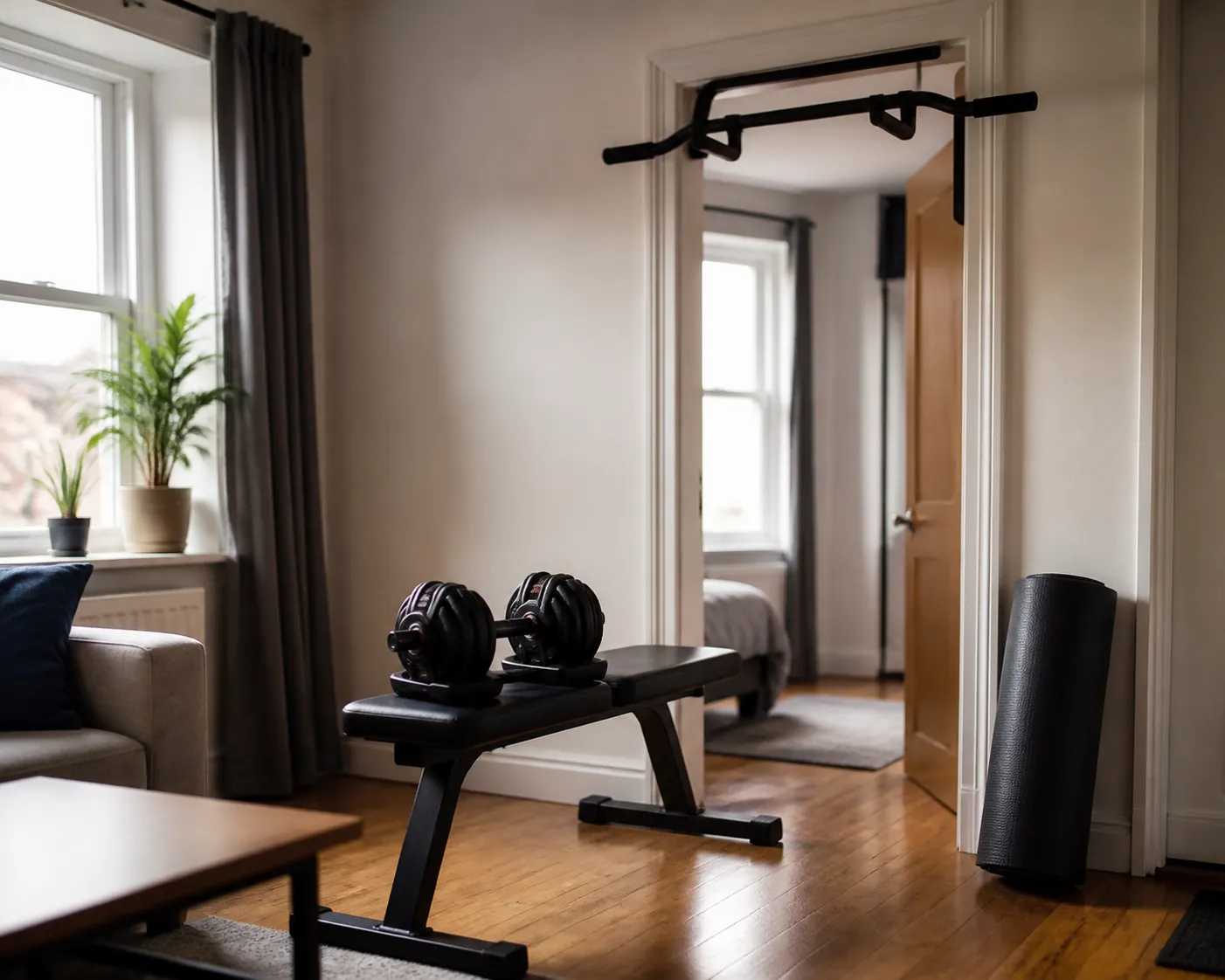
What Goldstein reportedly does
The useful part of the Goldstein story is not that an actor got lean for a photo shoot. It is that the reported plan is boring in the best way: three hard lifting days, repeated consistently, with the non-lifting days kept available for movement and recovery. Goldstein has said he started serious training roughly a decade ago for the superhero role in Superbob and kept it because exercise helped his mental health; his line to Men’s Health UK was blunt: “I have to exercise every day or I go mad.”[1]
That daily-exercise framing matters, but it needs translating. In his reported week, daily movement does not mean daily maximal lifting. It includes walking or running, with weekly reformer Pilates, while the heavy work sits on Monday, Wednesday, and Friday.[1][2] For a home lifter in their 40s, that distinction is the difference between a routine and a repair bill.
There is some celebrity color around the heavier-load pivot: Goldstein reportedly asked to train harder for a beach scene with Jennifer Lopez, and trainer Jeff Yahiro moved him toward heavier weights and more intensity after initially saying he was already in good enough shape.[3] Fine. But that still does not tell you whether you need a cable stack, a trap bar, or a rack. The reported method is the thing to adapt, not the mythology around it.
The home version lives or dies on pairing logic
A superset is simple on paper: do one exercise, then move quickly to another. At home, the trick is choosing pairings that do not require a room reset every round. If you need to drag the bench across the room, change both dumbbells by several plates, wedge the pull-up bar into place, and clear a rug before every second exercise, the “efficient” workout becomes a furniture-moving circuit.
The cleanest home supersets pair movements that share equipment but do not destroy the same pattern at the same time. A dumbbell bench press can pair with pull-ups because the bench and pull-up bar are already set. A split squat can pair with a chest-supported row because the dumbbells stay in your hands and the bench stays where it is. A dumbbell Romanian deadlift can pair with a shoulder press if you can change load safely without rushing.
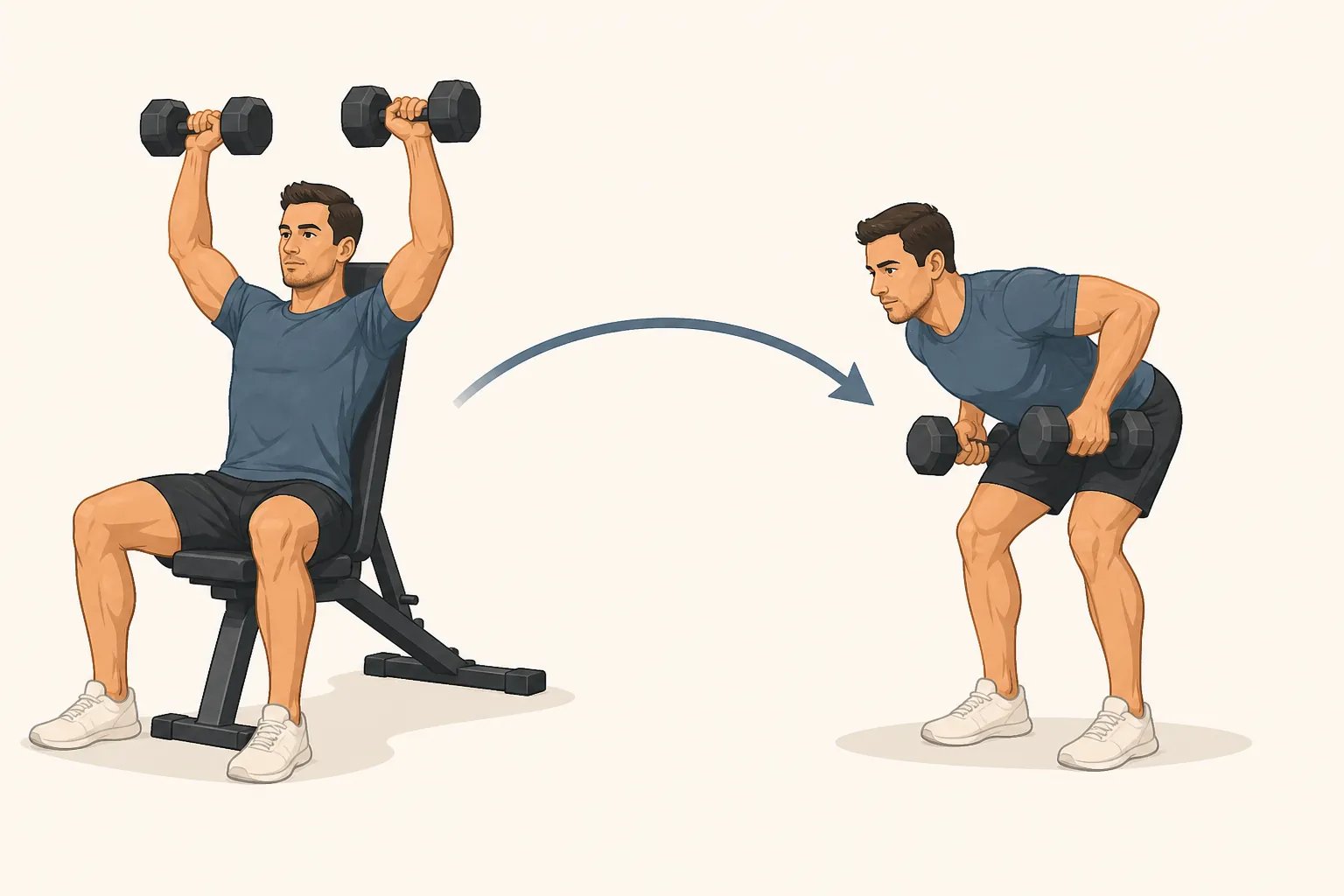
For the loading target, Goldstein’s “very heavy” does not need to become reckless. Harvard Health’s summary of resistance-training guidance for older adults points to 70–85% of one-rep max, two to three sessions per week, six to 12 reps, and multi-joint exercises, with the last two reps of a set feeling tough.[4] That makes heavy training at 46 feel less like a stunt and more like a bounded plan: challenging loads, controlled reps, and enough days between hard sessions to adapt.
The equipment tier: adjustable dumbbells, bench, pull-up bar
This routine assumes a compact mid-tier setup. If you are still building that setup, start with load adjustability and floor control before chasing specialty attachments. A heavy superset plan punishes cheap handles, wobbly benches, and thin yoga mats.
| Home-gym piece | What it unlocks | Apartment note |
|---|---|---|
| Adjustable dumbbells | Presses, rows, split squats, Romanian deadlifts, loaded carries or holds | Change weight before the round starts when possible; rushed plate changes are where dumbbells get dropped. |
| Flat or adjustable bench | Bench press, incline press, chest-supported rows, step-free split-squat setup | Check foot width and bench stability on the mat before loading heavy. |
| Doorway or freestanding pull-up bar | Vertical pulling without a cable machine | Door frames and leases matter; do not kip, swing, or use a bar you have not tested gradually. |
| Dense rubber mat or platform layer | Safer dumbbell parking, less vibration, clearer training boundary | It reduces impact and vibration; it does not make dropped weights silent. |
If you are shopping from scratch, the useful question is not “What would a celebrity gym have?” It is “What does this routine actually require?” The site’s adjustable-dumbbell deal guide is the more relevant cross-check than a full commercial-gym wish list, especially if you need tier fit, storage, and renter notes in one place.
Supersets save time by making the session denser
The best evidence angle for small-space lifters is not that supersets are exotic. It is that they can compress the work. Men’s Health UK cites a trained-lifters comparison in which supersets produced similar muscle growth, strength, and endurance to traditional sets while reducing session time from 69 minutes to 44 minutes, a saving of roughly 36%.[5] The ScienceDirect abstract for “Less time, same gains” points to the same time-efficiency comparison.[6]
That is strong enough to take seriously and too narrow to turn into a universal promise. It was a comparison in trained lifters, not a guarantee that every home lifter will cut a workout by the same amount. It also does not mean the workout feels easier. Shorter sessions can carry a higher internal load because the rests shrink, the breathing stays elevated, and the second movement starts before you feel fully fresh.
A 2025 PubMed-indexed systematic review and meta-analysis also reports that supersets are a time-efficient resistance-training alternative that can reduce session duration without compromising training volume or muscle activation, based on the abstract available in the research record.[7] That supports the general direction. It does not remove the need to manage fatigue, especially when the load is heavy and the room is small.
This is where Goldstein’s reported week becomes more useful than the average celebrity headline. The recovery-heavy rest of the week is not decorative. If Monday, Wednesday, and Friday are genuinely hard, the other days cannot all become extra dumbbell days just because the apartment setup is convenient.
A Monday/Wednesday/Friday home adaptation
The following is a sample adaptation of Goldstein’s reported heavy-superset structure. It is not his workout. Use the Harvard-style loading guardrail: choose loads that make the last two reps tough within a six-to-12-rep range, while keeping the movement controlled.[4] If your adjustable dumbbells cannot load an exercise heavily enough, slow the lowering phase, use a harder variation, or pick the bodyweight version that keeps the set honest.
| Day | Heavy superset pairings | Why this works at home |
|---|---|---|
| Monday | Dumbbell bench press + pull-up or chin-up; split squat + chest-supported dumbbell row | The bench stays in one place, the pull-up bar covers vertical pulling, and the dumbbells can remain close to the mat between movements. |
| Wednesday | Double-dumbbell front squat or goblet squat + one-arm dumbbell row; dumbbell Romanian deadlift + dumbbell shoulder press | Lower-body and upper-body work share the same small footprint, but the load changes need to be set up deliberately before each pair. |
| Friday | Incline dumbbell press + pull-up variation; Bulgarian split squat + dumbbell hip hinge or hip thrust | The bench gives you angle changes without adding machines, while unilateral leg work keeps the load challenging without requiring a barbell. |
Do not rush the transition so hard that the room becomes unsafe. A superset is back-to-back work, not a contest to see how quickly you can drop two heavy dumbbells beside a sofa. Park the weights under control, step around the bench the same way each round, and keep the pull-up bar path clear. If a load requires a dramatic heave to get into position, it is probably too heavy for an apartment superset.
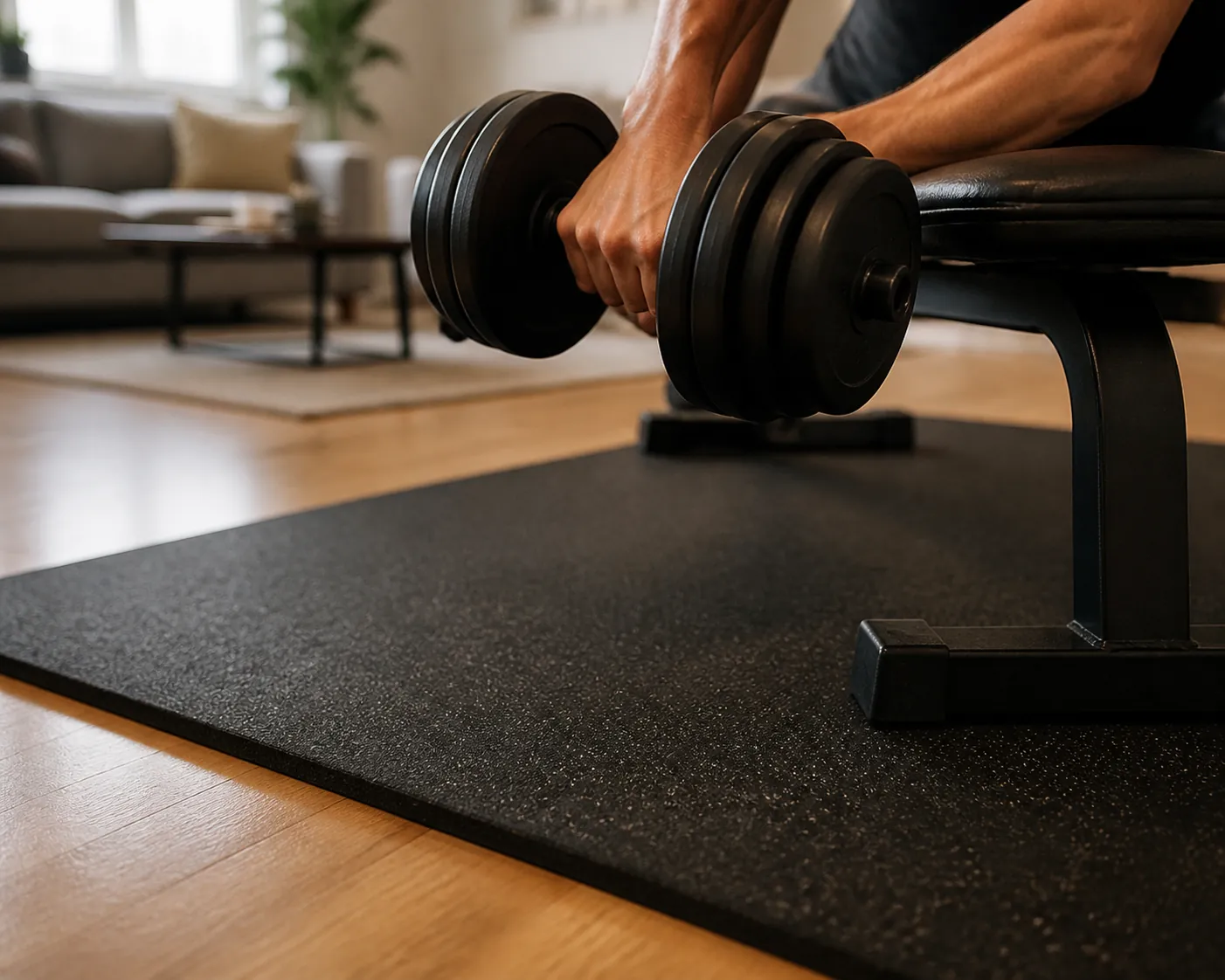
Pull-ups need the same restraint. Strict reps are apartment-friendly; swinging reps are not. If your bar is doorway-mounted, test the setup gradually, stay within the manufacturer’s intended use, and treat any creak from the frame as information rather than background music.
For the non-lifting days, copy the category, not the exact celebrity schedule. Goldstein reportedly uses walking or running daily and reformer Pilates weekly.[1] At home, that can mean easy walks, light mobility, a low-impact conditioning session, or a Pilates class if you already do one. What it should not become is four more days of hard presses and rows because the dumbbells are sitting there staring at you.
Noise and floor risk are part of the programming
Heavy home supersets create two kinds of fatigue: the kind in your muscles and the kind in your decision-making. The second one is what makes people set dumbbells down crooked, clip a bench leg, or let a pull-up bar take more swing than it should. In a commercial gym, that is annoying. In an apartment, it can be expensive.
- Use a dense mat under the bench and dumbbell parking area, not just under your feet.
- Lower dumbbells to the floor with both hands when needed; do not finish a hard set by letting gravity solve the problem.
- Keep the bench far enough from walls, lamps, and furniture that a tired step does not turn into a repair job.
- Avoid jumping transitions, kipping pull-ups, and any finisher built around impact unless your floor and neighbors have already passed that test.
- Stop a set before form turns into negotiation. Heavy supersets already raise fatigue; sloppy reps add nothing useful.
For a deeper pass on what equipment and floor setups behave well in rentals, use the site’s apartment home-fitness testing guide. The same small-space logic also shows up in routines like speed climbing strength at home and three-day home strength built around longevity habits: the routine is only as practical as the room it has to live in.
The useful verdict
Goldstein’s reported method transfers because the important parts are portable: heavy paired work, three hard lifting days, and serious recovery around them. Adjustable dumbbells, a bench, and a pull-up bar can reproduce that structure without pretending your living room is a private training facility.
Keep the labels honest. The sample sessions here are adaptations, not his program. The 69-to-44-minute comparison supports supersets as a time-efficient choice, not a universal stopwatch guarantee. The time saved comes with more fatigue, and a home gym does not erase noise, floor, or lease constraints. Account for those, and the method becomes usable instead of merely famous.
References
- Brett Goldstein's Second Act Is His Strongest Yet – Here's How He Got in Leading-Man Shape at 46, Men's Health UK
- How Brett Goldstein Uses Heavy Supersets to Build Muscle at 46, Men's Health UK
- Brett Goldstein, 46, Wanted More Muscle to Star Alongside J-Lo – So His Trainer Made Him Lift Heavier, Men's Health UK
- Resistance training by the numbers, Harvard Health
- What Is a Superset? Here's How to Gain More Muscle in Less Time, Men's Health UK
- Less time, same gains, ScienceDirect
- PubMed 39903375, PubMed, 2025
What a small equipment investment adds
We don't have a build tagged to this exact tier yet. Browse all builds.
How often should you repeat this?
See our recovery and rest reference for citation-anchored rest-interval guidance.
Spot something off?
Tell us if a movement, tier assumption, or duration didn't match your experience.