
Follow David Sinclair's Joe Rogan Exercise Tips at Home
David Sinclair's longevity exercise advice from his Joe Rogan appearances comes down to a small dose: about 10 minutes out of breath three times a week, plus regular strength work. You can do the whole protocol in a small apartment with little or no equipment — and the expensive longevity gear is optional.
- Equipment tier required
- none
- Duration
- 20 min
- Difficulty
- beginner
- Target area
- full body
- Space footprint needed
- about one yoga mat
- Noise level
- low noise
David Sinclair’s most usable Joe Rogan longevity exercise tip is not a gadget protocol. It is this: get genuinely out of breath for about 10 minutes, about three times a week, and pair that with regular strength work for the muscles that keep you standing, climbing, carrying, and not getting frail.
Sinclair’s Aug. 7, 2026 appearance on The Joe Rogan Experience #2537 is the reason a lot of people are searching for this now, but the exercise advice itself is not a brand-new JRE revelation. The same breathlessness idea shows up across his earlier public advice, including JRE #1670 and secondary summaries of his Lifespan-related routine from Hone Health, NAD.com, Moleqlar, and NMN.com.[1][2][3][4][5][6]
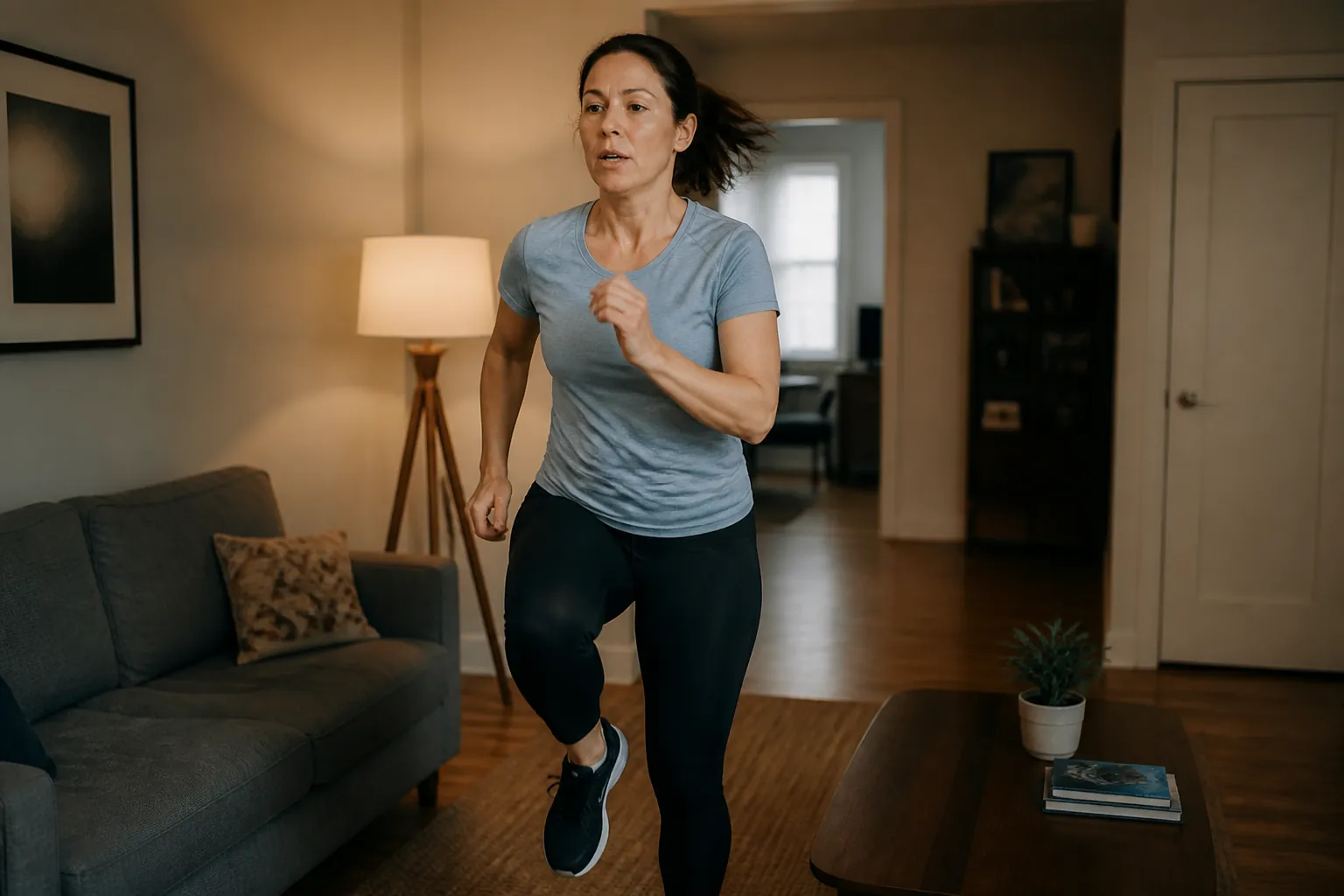
That matters because the home version should not turn into a shopping list. You can run the whole minimum dose in a living room, stairwell, hallway, or beside a sofa. A jump rope, mini stepper, dumbbell, kettlebell, or walking pad can help, but none of them is the point.
The distilled home protocol
For a beginner with 20 minutes and limited space, the plan is simple enough to write on a sticky note:
- Three times a week: do a short session that makes you breathe hard for roughly 10 total minutes.
- Two or three times a week: add basic strength work for legs, hips, back, pushing, and pulling.
- Most days: move at an easy pace when you can — walking, standing-desk breaks, stairs, chores, or a quiet stepper.
- Progress slowly enough that week two still happens.
Sinclair’s public routine has been reported as roughly 30 minutes of moderate daily movement, vigorous cardio a few times per week, and use of a standing desk or stepper when he cannot do a formal workout.[3] That is more lifestyle than strict prescription. For home training, the cleanest starting point is the repeatable minimum: breathless work plus strength.
| Day | Small-apartment version | What matters |
|---|---|---|
| Monday | Breathless intervals, 10 minutes of hard breathing total | You finish winded, not destroyed |
| Tuesday | Strength: squat, hinge, push, pull or row substitute, core | Back, hips, thighs, and upper body get loaded |
| Wednesday | Easy movement: walk, stairs at a normal pace, standing-desk breaks | Circulation and consistency |
| Thursday | Breathless intervals again | Same dose, slightly smoother |
| Friday | Strength again | Repeat the same basic patterns |
| Saturday | Breathless intervals or a brisk outdoor walk with hills | Third weekly hard-breathing exposure |
| Sunday | Easy movement or rest | Recover enough to keep going |
If that still looks like too much, shrink the first week. Rogan’s useful counterweight in #2537 was not “go crush yourself.” He described a gentle start: 10 push-ups, 10 sit-ups, 10 bodyweight squats, “nothing hard,” with easy kettlebell cleans and a slow ramp-up to avoid injury.[1] That is a better beginner interpretation of longevity training than pretending every apartment workout has to be a punishment video.
What “out of breath” should feel like
The breathless part should be hard enough that you cannot comfortably chat through it. You can get out a few words, but you are not holding a normal conversation. That is the practical home version of the stimulus Sinclair keeps pointing to when he talks about vigorous exercise and hypoxia-linked adaptation.
It does not have to be 10 uninterrupted minutes. In a rental, uninterrupted hard cardio often means noise, flailing, or quitting early. Use intervals instead. The goal is to accumulate the dose without turning your knees, floorboards, or downstairs neighbor into collateral damage.
| Option | How to do it quietly | Best for |
|---|---|---|
| Marching high knees | Drive arms, lift knees, stay on the balls of your feet without jumping | No equipment, low noise |
| Step-back burpee without the jump | Hands to floor or couch edge, step back, step in, stand tall | Small spaces, beginners |
| Stair intervals | Walk or jog up, come down slowly, hold the railing | Apartment buildings with safe stairs |
| Jump rope | Use only if your floor and neighbors can tolerate it | Garages, patios, ground-floor units |
| Mini stepper | Increase cadence until breathing gets hard | Tiny apartments and desk-adjacent training |
| Dumbbell or kettlebell swings or cleans | Use light loads and clean technique before adding speed | People with one weight and enough clearance |
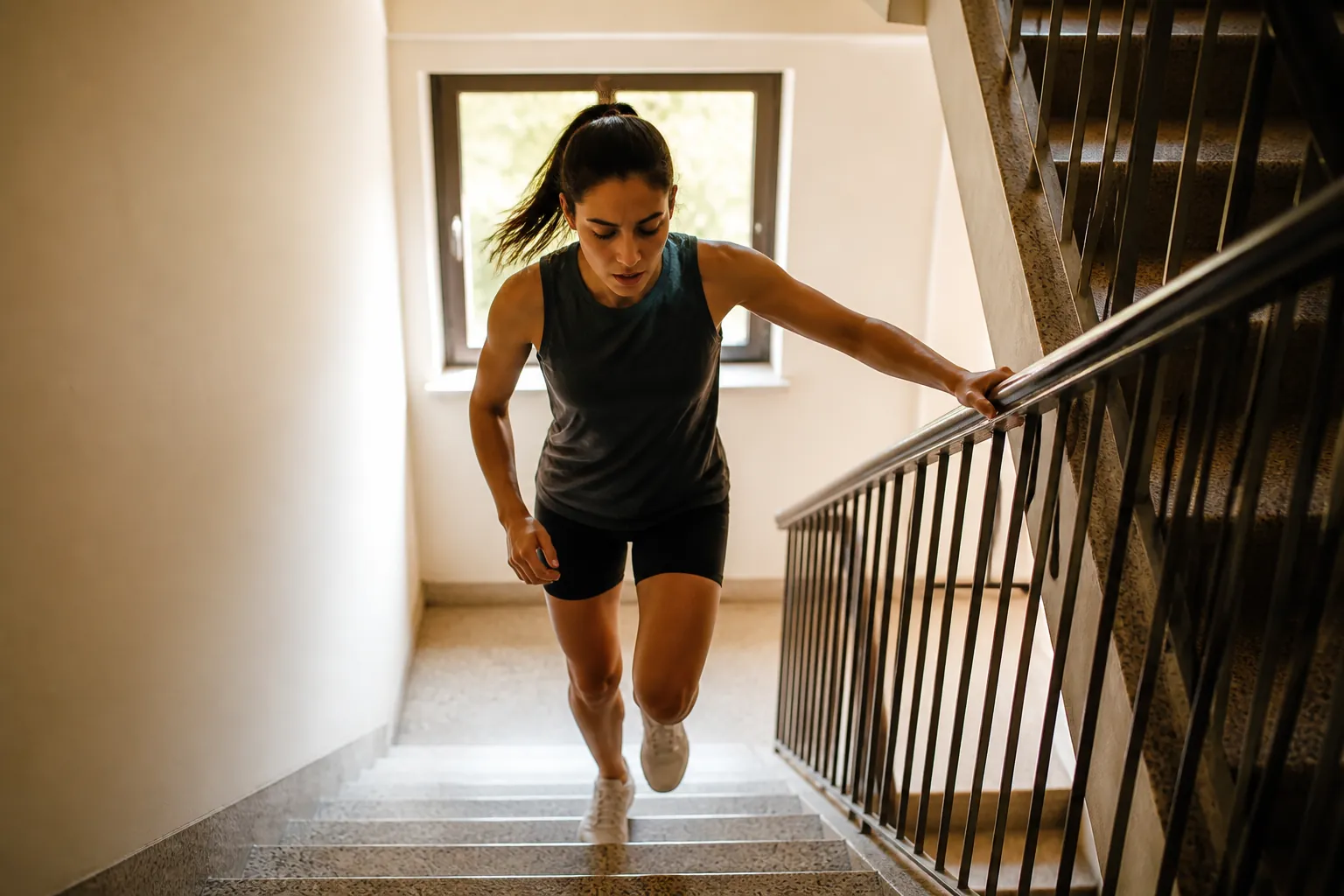
A clean first session could be this: warm up with easy marching and squats, then alternate 30 seconds hard and 60 to 90 seconds easy until you have collected about 10 minutes of hard-breathing work. If 30 seconds is too much, use 15 or 20. If you feel sharp pain, dizziness, chest pressure, or anything that feels wrong rather than challenging, stop.
Rogan’s own reset protocol is harder than most beginners need: the #2537 summary describes him pushing above 150 beats per minute for 15 to 20 minutes.[8] That is useful as contrast, not as a first-week assignment. Sinclair himself is candid in the same conversation that he does not train like Rogan.[1] For the person starting at home, the win is repeatability.
A no-equipment breathless session you can actually repeat
Clear a rectangle of floor about the size of a yoga mat. Move the coffee table if you have to. Put shoes on if your floor is slippery. Then use one of these two templates.
Quiet beginner version
- 2 minutes easy warm-up: marching, shoulder circles, slow squats.
- 20 seconds fast marching high knees.
- 70 seconds easy marching.
- Repeat until you have done 10 hard rounds.
- Cool down until your breathing is normal.
This is not glamorous, which is part of the appeal. If you drive your arms and pick up the cadence, marching can become real conditioning without jumping. If your breathing never changes, make the hard portions faster, lift the knees higher, or switch to step-back burpees.
Stronger living-room version
- 2 minutes easy warm-up.
- 30 seconds fast bodyweight squats or squat-to-reach.
- 30 seconds mountain climbers from the floor or hands elevated on the sofa.
- 60 to 90 seconds easy walking around the room.
- Repeat for 5 rounds.
- Cool down.
The elevated-hands version is often the better apartment choice. It reduces the scramble, gives you more control, and makes it less likely that the session ends because your wrists hate you rather than because your lungs worked.
The strength layer: back, hips, thighs, push, pull
The breathless work gets most of the attention because it sounds like a hack. The strength work is what makes the plan livable as you age. Sinclair and Rogan both emphasize strength, with secondary summaries of Sinclair’s advice calling out the back, hips, and upper thighs as especially important areas for longevity and fall prevention.[6]
This is where “strength training” needs to stop being abstract. At home, you are looking for movement patterns, not machines.
| Pattern | No-equipment choice | One-weight choice |
|---|---|---|
| Squat | Chair squat, split squat, wall-supported squat | Goblet squat |
| Hinge | Hip hinge drill, single-leg Romanian deadlift reach, glute bridge | Dumbbell or kettlebell Romanian deadlift |
| Push | Wall push-up, counter push-up, floor push-up | Dumbbell floor press |
| Pull | Towel isometric row, prone W raise, table row only if the table is sturdy | One-arm dumbbell row |
| Carry or core | Side plank, dead bug, suitcase hold with a bag | Suitcase carry or front-rack hold |
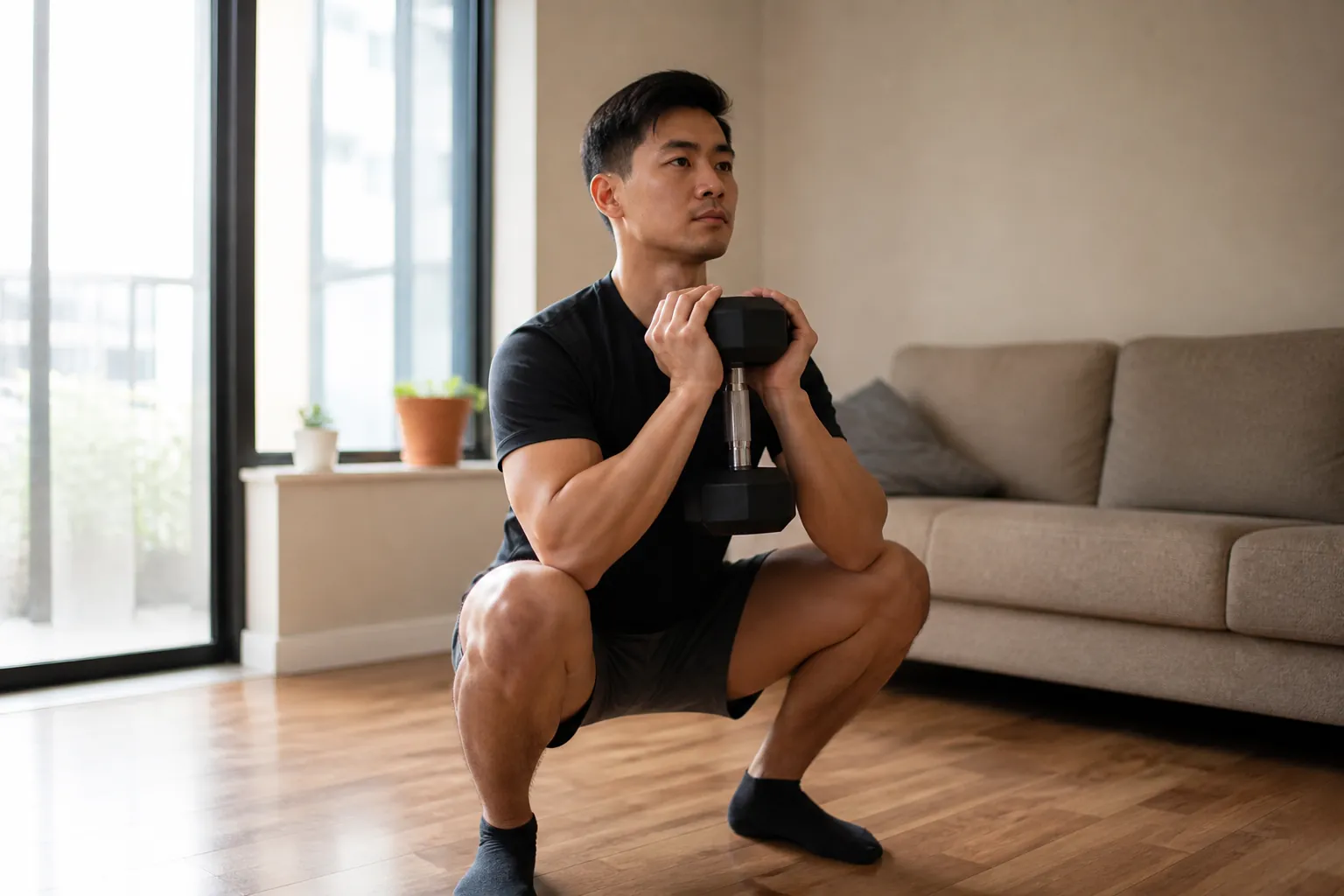
A basic two-day strength layer can be short:
- Chair squat or goblet squat: 2 to 3 easy-to-moderate sets.
- Glute bridge or Romanian deadlift: 2 to 3 sets.
- Incline push-up or floor press: 2 to 3 sets.
- Row variation or back-focused floor work: 2 to 3 sets.
- Side plank, dead bug, or loaded carry: 1 to 3 sets.
Stop each set with a little room left. You are trying to create a body that can train next week, not prove something to a podcast clip. Add repetitions first. Then add range of motion. Then add load.
If you want full exercise progressions rather than a quick sketch, use the no-equipment upper-body workout for push-and-pull options and the science-based home leg workout for squat, hinge, and lower-body programming.
Why the two pieces belong together
The breathless part points at cardiovascular capacity. The strength part protects the machinery that lets you use that capacity in real life: legs, hips, trunk, back, and shoulders.
The physiology case does not need to be mystical. VO2 max has been reported to decline about 10 percent per decade after age 25, and up to 15 percent per decade after 50; muscle mass has been reported to decline roughly 3 to 8 percent per decade after the 30s or 40s without strength training.[7] Those are population-level patterns, not your destiny on a calendar. They do explain why a plan that only chases sweat, or only does slow strength work, feels incomplete.
Sinclair also talks about blood flow as an underappreciated driver of age-related decline, and he has used his own father as a practical example, describing him as training two to three times per week at age 87.[1] That example is not proof that one routine causes one outcome. It is still a useful picture of the bar we are aiming for: repeatable work that a person can keep doing long after novelty wears off.
What to do if you have one piece of equipment
One good tool can make the plan smoother. It should not make it more complicated.
| If you own... | Use it for... | Skip it if... |
|---|---|---|
| One dumbbell | Goblet squats, floor presses, one-arm rows, Romanian deadlifts | It is so heavy that every rep changes your form |
| One kettlebell | Deadlifts, cleans, carries, goblet squats | You have not learned the hinge pattern yet |
| Resistance band | Rows, pull-aparts, assisted hinges, warm-ups | The anchor point is questionable |
| Mini stepper | Quiet breathless intervals or easy desk-side movement | Your knees dislike the fixed stepping path |
| Walking pad | Low-intensity daily movement while working or watching TV | You need vigorous intervals and the motor cannot safely support them |
For a full weekly plan that grows from bodyweight to dumbbells, kettlebells, and bands, see Home Gym Workout Plan: 5 Complete Weekly Programs by Equipment Tier or A Home Gym Workout Plan That Grows With Your Equipment. If your main problem is getting more easy movement during workdays, compare a mini stepper and a walking pad or a walking pad and treadmill for a home office.
The longevity claims deserve a smaller role than the workout
Sinclair’s broader anti-aging world includes biological-age claims, supplements, red-light anecdotes, hypoxia machines, and hyperbaric chambers. Some of it is interesting. Almost none of it is necessary for this home exercise plan.
Secondary reports describe Sinclair as saying he reduced his biological age by about a decade, and some summaries include a framing of roughly 30 percent lower disease rates. Treat those as Sinclair’s reported claims, not as proof that a 10-minute apartment interval session will produce the same result in you. The reported biological-age numbers also vary across summaries, which is another reason not to make them the center of a practical training plan.[3][4][5]
The expensive gear belongs even farther from the center. Hyperbaric chambers, hypoxia machines, and red-light vision anecdotes may sit inside the wider longevity conversation, but the recurring exercise advice does not depend on owning any of them. The floor is still breathless work, strength work, and enough ordinary movement that your day is not entirely seated.
A realistic first month
Do not start by asking how much exercise a longevity influencer can tolerate. Start by asking what you can repeat in a normal week.
| Week | Breathless work | Strength work |
|---|---|---|
| 1 | 2 sessions; short intervals; stop while you still feel coordinated | 1 or 2 easy sessions using chair squats, incline push-ups, glute bridges, and back work |
| 2 | 3 sessions if week 1 felt fine | 2 sessions; add a set or a few reps |
| 3 | Keep 3 sessions; make only one variable harder | Add hinge practice or a light loaded option if available |
| 4 | Hold steady rather than chasing exhaustion | Repeat the same exercises and notice what feels stronger |
The progression is intentionally boring. Boring is easier to recover from, easier to fit between meetings, and less likely to require ice packs, apologies to neighbors, or another online order.
If you are translating medical or cognitive-health guidance into a home week, the same small-space approach applies; this WHO dementia exercise guide for home is a useful parallel format. And if you have cardiovascular disease, metabolic disease, joint issues, dizziness, chest pain, a history of falls, or other risk factors, talk with a physician before changing your routine.
Sinclair’s most repeatable Joe Rogan-adjacent exercise advice is small, free, and achievable at home. It is also a floor, not a ceiling. Start with the quiet version. Add strength. Let the plan earn the right to get harder.
References
- #2537 - David Sinclair — The Joe Rogan Experience Transcript — Happy Scribe
- #1670 – David Sinclair | Joe Rogan Experience • Podcast Notes — Podcast Notes
- How David Sinclair Reversed His Biological Age By 10 Years — Hone Health
- Harvard Scientist David Sinclair's Techniques for Reducing His Biological Age by a Decade — NAD.com
- David Sinclair: Research, Routine & Supplements for Longevity — MOLEQLAR
- Tips from Harvard's David Sinclair: How to Eat and Build Muscle for Longevity — NMN.com
- Longevity Experts Share The Exercises They Do to Live Longer — Hone Health
- #2537 - David Sinclair Podcast Summary — Shortform
What a small equipment investment adds
We don't have a build tagged to this exact tier yet. Browse all builds.
How often should you repeat this?
See our recovery and rest reference for citation-anchored rest-interval guidance.
Spot something off?
Tell us if a movement, tier assumption, or duration didn't match your experience.