
How to Cool an Indoor Home Workout in Extreme Heat
Extreme heat puts a hard ceiling on indoor workouts: above 90°F, fans alone can make you hotter, not cooler. Learn what actually cools an AC-free workout space — ventilation moves, evaporative body-cooling tactics, and tested cooling towels worth about $11–14 — and when to stop because the room is too hot to train.
- Equipment tier required
- none
- Duration
- 30 min
- Difficulty
- beginner
- Target area
- full body
- Noise level
- Quiet-friendly
Start with the room temperature, not the towel. For an indoor home workout during extreme heat, the useful dividing line is 90°F: the CDC says fans can help only when indoor temperatures are below 90°F, and that when indoor temperatures are above 90°F, fan airflow can increase body temperature instead of cooling you down.[1]
That one number changes the whole setup. Under 90°F, the job is to move heat out, block new heat from coming in, and pick the least-awful corner of the apartment. At or above 90°F, a fan pointed at your body is no longer the brave little home-gym solution it looks like. You either cool your body with water-based tactics while reducing the session, move the workout somewhere cooler, or stop.
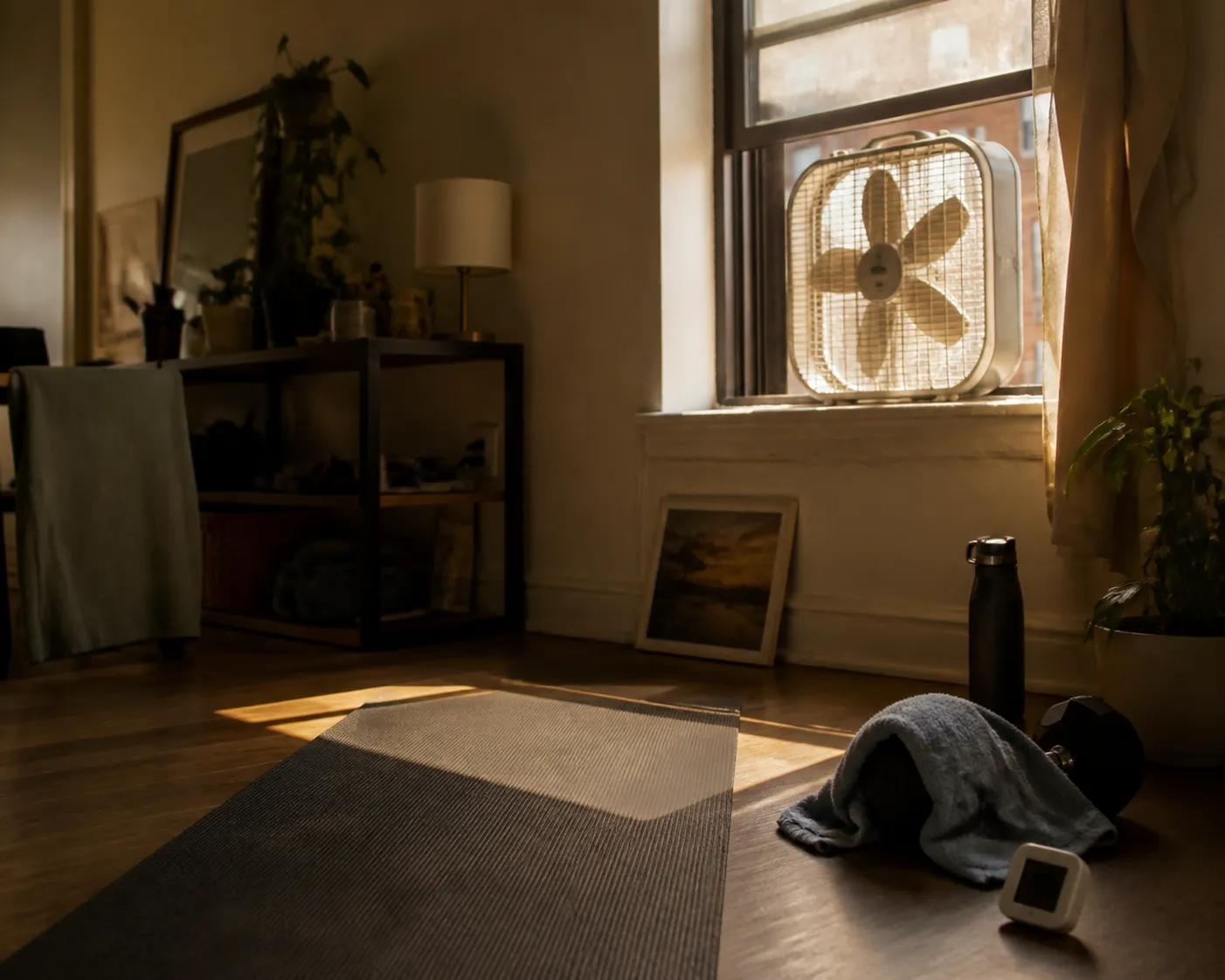
The 10-minute setup before you train
If the workout is already planned and the room feels like a laundry closet, do this before the warm-up. It is less glamorous than buying gear, but it decides whether the gear has any chance of helping.
| What you check | What to do |
|---|---|
| Indoor temperature is under 90°F | Use fans and window placement to exchange air; keep the session easier than normal. |
| Indoor temperature is 90°F or higher | Do not rely on a fan pointed at you. Switch to body-cooling tactics, shorten or cancel the workout, or move to a cooler place. |
| One room is hotter than another | Move the mat to the coolest corner, lowest floor, or shaded side before you start. |
| Sun is hitting windows | Close blinds or shades on the sun-facing side before the floor and walls heat up further. |
| Sweat is pooling on laminate, tile, or sealed concrete | Put a towel under the sweat zone or move to a less slippery surface. Heat is bad enough without turning split squats into a slip test. |
For a full go/no-go decision, use the extreme-heat warning guide. For the bigger no-AC protocol, the check-cool-scale method is the better place to start. This piece is the cooling step: what to do to the room, what to do to your body, and whether a towel is worth the drawer space.
Use fans to exchange air, not just shove hot air around
A fan feels productive because it is loud and visible. In a small apartment, that can fool you. If the room is still under 90°F, the better use of a window fan is to create a path for air to leave and enter, not to blast one sweaty spot until the floor gets slick.
Consumer Reports’ window-fan guidance is simple enough to use while annoyed: put an outward-facing fan on the warm side to exhaust hot air, and use an inward-facing fan on the cooler side to pull cooler air in.[2] In an apartment, that may mean one box fan wedged in the kitchen window blowing out, with a bedroom window cracked on the shaded side. It may also mean accepting the less elegant setup because the only outlet is in the wrong place.
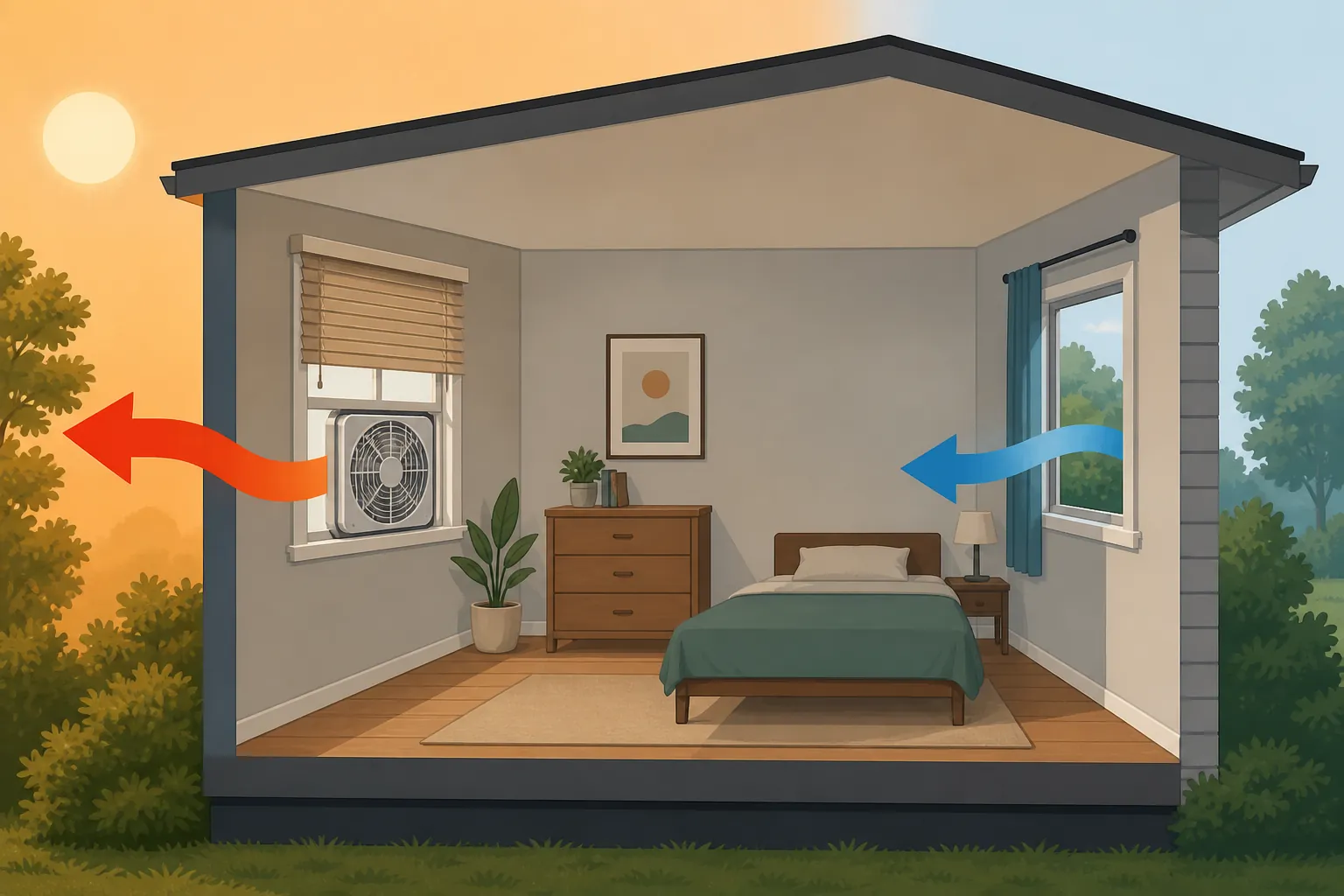
The usual apartment friction matters here. A fan that rattles against an aluminum window frame may be technically useful and still unusable at 10 p.m. Thin walls turn “high speed” into a neighbor problem. If you cannot mount anything permanently, use a no-drill arrangement: fan flat on the sill if it is stable, towel or foam gap-fillers around the sides, and a cord route that does not cross the workout area. If the setup adds a trip hazard, it failed the home-gym test.
Also, measure near the mat. The Conversation reported that uncooled homes can have indoor areas above 90°F even when a thermostat elsewhere reads 75°F, which is exactly the kind of false reassurance you get when the hallway is tolerable and the west-facing workout corner is not.[3] The same source notes that the lowest floor is usually coolest and that closing blinds on sun-facing windows helps reduce heat gain.[3] PBS NewsHour’s heat-safety guidance also points to finding a “cool corner” and treats overnight lows below 75°F as a useful signal for whether a home will get meaningful relief.[4]
If you want the longer zero-cost version — fan placement, shade, timing, and quiet apartment constraints — use the no-AC apartment cooling toolkit. The short version for today: exhaust hot air, bring in cooler air only if there is actually a cooler side, close the sunny blinds, and move the workout to the lowest, coolest usable spot.
When the room will not cool down, cool skin with water
Once the room is stubbornly hot, the useful tactics get less decorative. Water on skin can remove heat as it evaporates. A wet towel on the neck or wrists, forearms in cold water between sets, or water poured over exposed skin can all do more than standing in front of a fan and hoping.
BBC Future cited researchers Ollie Jay and Rebecca Stearns on this point: cold-water immersion of the hands and forearms and pouring water over the skin can cool faster than ice packs, partly because ice packs cover a small surface area. The same reporting notes that pre-cooling before heat exposure can add a buffer before body temperature climbs.[5]
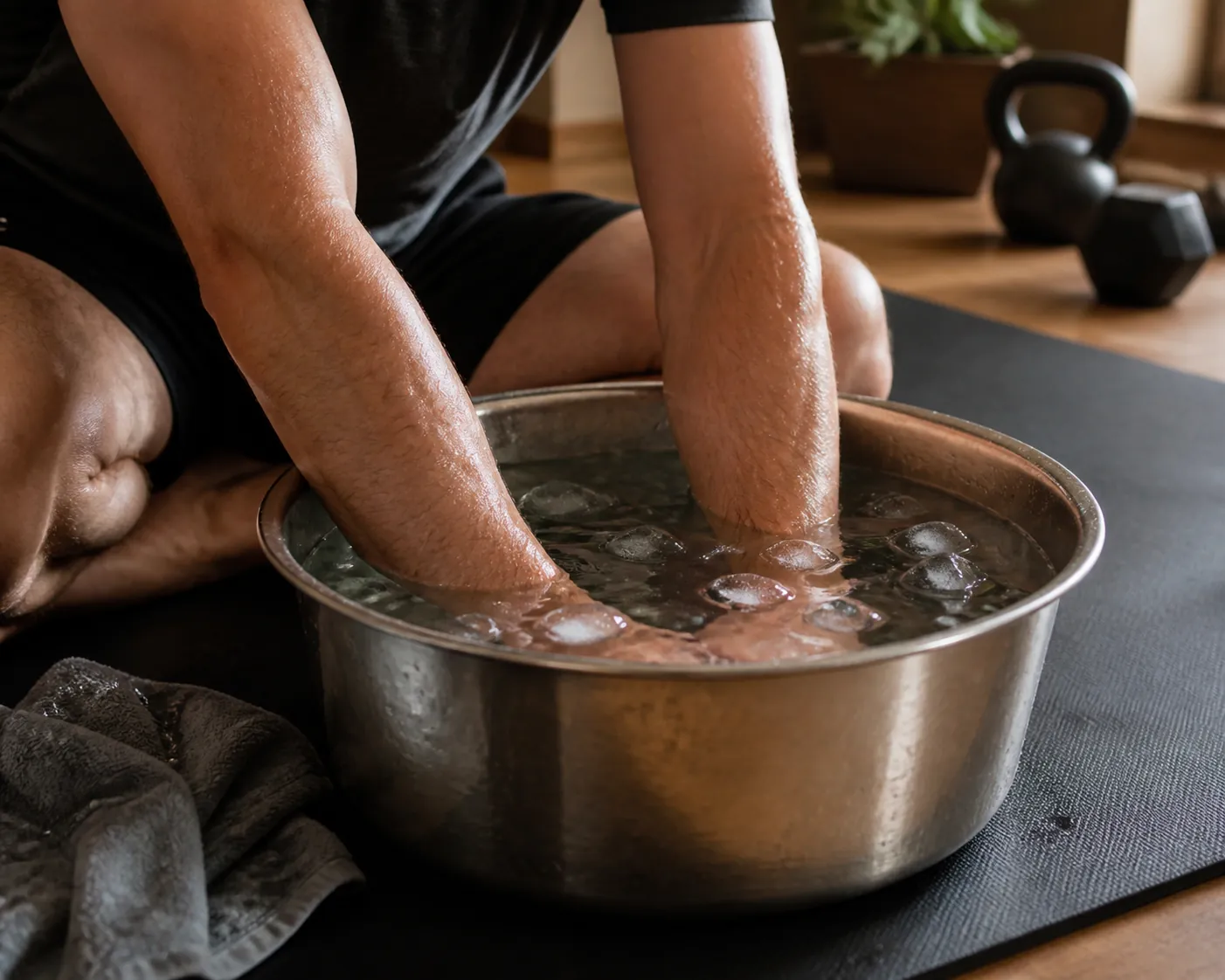
For a home workout, that turns into a very plain setup: a basin or sink of cool water for hands and forearms before the session or during longer rest breaks; a wet towel rotated between neck, wrists, and forehead; and a dry floor towel where sweat and drips land. If you are doing floor work, put the wet towel somewhere it cannot soak the mat and turn planks into a slide.
There is a reason these low-tech tools keep showing up in more serious settings. The Korey Stringer Institute’s heat-exhaustion protocol, written for athletic and sports-medicine contexts, includes fans, rotating ice towels, and fluids.[6] That does not make a hot living room a treatment area, and it does not mean you should manage heat illness yourself during a workout. It does show that water, airflow, towels, and rotation are not gimmicks. They are the basic tools.
The mistake is asking these tools to do the wrong job. A wet towel can make a rest break feel better. Hand immersion can make the next set less miserable. Neither one changes the CDC’s 90°F fan warning, and neither one turns a trapped, overheated room into a safe gym.
So, is a cooling towel worth buying?
Yes, but only in the narrow, unromantic sense: a decent cooling towel can give repeatable relief during rest breaks for roughly the length of a short home workout. It is not heat-illness protection. It is not permission to train in a room that has crossed the safety line. It is a wet object that should earn its place by staying useful after the first five minutes.

The best evidence here is hands-on editorial testing, not lab testing. CNN Underscored tested 11 cooling towels and named the Mission Original the best for instant relief, while noting that its cooling effect dissipated after about 40 minutes; CNN also lists UPF 50+ sun protection for that towel.[7] Today’s Shop tested 7 towels and picked the Sukeen 4-pack as best overall at about $13.99, reporting that it stayed damp for about 40 minutes and measured about 20°F below a 97.5°F ambient reading in a single infrared-thermometer check.[8] Today also named the Frogg Toggs Chilly Pad, about $11.88, best for sun protection and noted its UPF 50+ rating.[8]
| Towel or category | What the tests actually support | Useful home-workout role |
|---|---|---|
| Mission Original | CNN’s 11-towel editorial test found strong instant relief, with cooling fading after about 40 minutes; UPF 50+ was listed.[7] | Good rest-break towel when you want predictable cooling for part of a session. |
| Sukeen 4-pack | Today’s 7-towel test reported about 40 minutes of dampness and one infrared reading about 20°F below 97.5°F ambient; price was about $13.99.[8] | Useful if you want multiple towels to rotate without re-soaking the same one constantly. |
| Frogg Toggs Chilly Pad | Today listed it at about $11.88 and highlighted UPF 50+ sun protection.[8] | More relevant if the towel also needs to serve outdoor walks, balcony workouts, or sunny commutes. |
Those are small editorial tests: 11 towels in one case, 7 in the other, with single-day comfort impressions and, for Today, a single infrared-temperature measurement.[7][8] Treat them like useful hands-on buying notes, not a universal performance guarantee. A towel that feels cold in one apartment may feel merely damp in another if the air is humid, the room is still, or you forget to re-wet it.
The practical price band is the most persuasive part. Around $11–14, a towel does not need to be magic. It only needs to be more convenient than sacrificing a bath towel, wringing it into the sink, and draping a heavy wet strip around your neck until it turns warm. If you can rotate two or three light towels, keep one cooling while another is on you, and avoid dripping all over the mat, that is enough of a job.
What to look for before you buy
- A towel that stays damp for around a normal workout block, not one that feels dramatic for five minutes and then becomes a warm scarf.
- A size that fits your neck, wrists, or forehead without hanging into dumbbells, resistance bands, or push-up space.
- A texture you can tolerate when sweaty. If it feels scratchy dry, it will not become charming at minute 25.
- A way to rotate or re-wet it without making the floor slippery.
- No safety claims that imply the towel protects you from heat illness. That is a reason to trust it less, not more.
If you already own thin microfiber towels and are willing to re-soak them, try that first. Buying makes sense when the dedicated towel performs more repeatably, dries and packs more easily, or lets you rotate several without soaking your bath linens. For apartment gear more broadly, the same standard applies: the object has to work inside real constraints — noise, footprint, setup time, and storage — not just in product photos. That is the same lens used in the compact home-gym equipment guide.
Keep the workout smaller than the heat
Cooling the room buys you time only when the room is still in a range where fans and ventilation make sense. Cooling your body buys comfort only while you keep reapplying water, rotating towels, and taking real breaks. The workout still needs to shrink: fewer rounds, longer rests, lower intensity, less jumping, and no stubborn attempt to match last week’s numbers.
For a quiet option that already assumes heat-wave limits, use the no-equipment heat-wave routine. This is not the day for a loud HIIT session over a sweating laminate floor while the box fan hums against the window frame and the towel drips onto your only stable push-up space.
The clean stop rule is still the room thermometer. Below 90°F, try the ventilation sequence, shade the sunny windows, move to the coolest corner, and add water-based body cooling. At 90°F or higher, do not count on a fan to save the session. A cooling towel may make the next rest break feel better, but no fan, towel, or clever setup makes a too-hot room safe to train in.
References
- About Heat and Your Health, CDC
- Should Your Window Fan Face In or Out?, Consumer Reports
- Heat waves can leave homes dangerously hot even for young, healthy adults, The Conversation
- How to stay cool and safe in a heat wave, even without air conditioning, PBS NewsHour
- How to keep exercising when it's really hot, BBC Future
- Heat Exhaustion, Korey Stringer Institute
- The best cooling towels, tested by editors, CNN Underscored
- The best cooling towels, ranked, Today
What a small equipment investment adds
We don't have a build tagged to this exact tier yet. Browse all builds.
How often should you repeat this?
See our recovery and rest reference for citation-anchored rest-interval guidance.
Spot something off?
Tell us if a movement, tier assumption, or duration didn't match your experience.