
Should You Work Out Indoors During an Extreme Heat Warning?
Heat advisories and excessive heat warnings are instructions to change your workout plan, not reminders to be careful. Learn when the heat index makes outdoor training unsafe, why your apartment may not be cooler, and how to modify — or skip — your indoor session to stay safe.
- Equipment tier required
- none
- Duration
- 10 min
- Difficulty
- beginner
- Target area
- full body
- Space footprint needed
- small (yoga mat area)
- Noise level
- low
The alert already changed the workout
If you are searching for indoor workouts during an extreme heat warning, the first decision is not which routine burns the most calories in a living room. The first decision is whether today’s normal outdoor workout is still on the table. When the National Weather Service issues an Extreme Heat Warning, its instruction is to take action; when a Heat Advisory is in effect, the safer move is to reschedule or alter plans before heat illness becomes the price of finishing the session. [1]
A useful cutoff shows up before official warning levels in several fitness and medical sources: once the heat index is around 90°F, treat outdoor training as a problem to solve, not a toughness test. Mass General Brigham, The Weather Channel, and Catholic Health Long Island each use 90°F heat-index conditions as a caution point for exercise in heat. [2][3][4] That does not make 90°F a national legal trigger. It makes it a practical training trigger: move the workout indoors, reschedule it, or replace it with something lighter.
Then run the second gate. Indoors only counts if the space is genuinely cooler. A third-floor apartment with weak air conditioning, a sunny window, and a fan pushing hot air around is not automatically safer than the shaded part of a route. The right check is simple enough to use while you are still bargaining with the weather app:
| Decision gate | What you check | Training decision |
|---|---|---|
| Gate 1: Outdoor conditions | Heat index near 90°F, Heat Advisory, or Extreme Heat Warning | Move indoors, reschedule, or replace the workout |
| Gate 2: Indoor conditions | Actual room temperature, air conditioning, fan limits, overnight cooling | Train only if the room is truly cooler; otherwise use an air-conditioned alternative, mobility, or rest |
| After both gates | How you feel between efforts, not just at the start | Shorten, lower intensity, add breaks, hydrate, and stop if recovery is not happening |
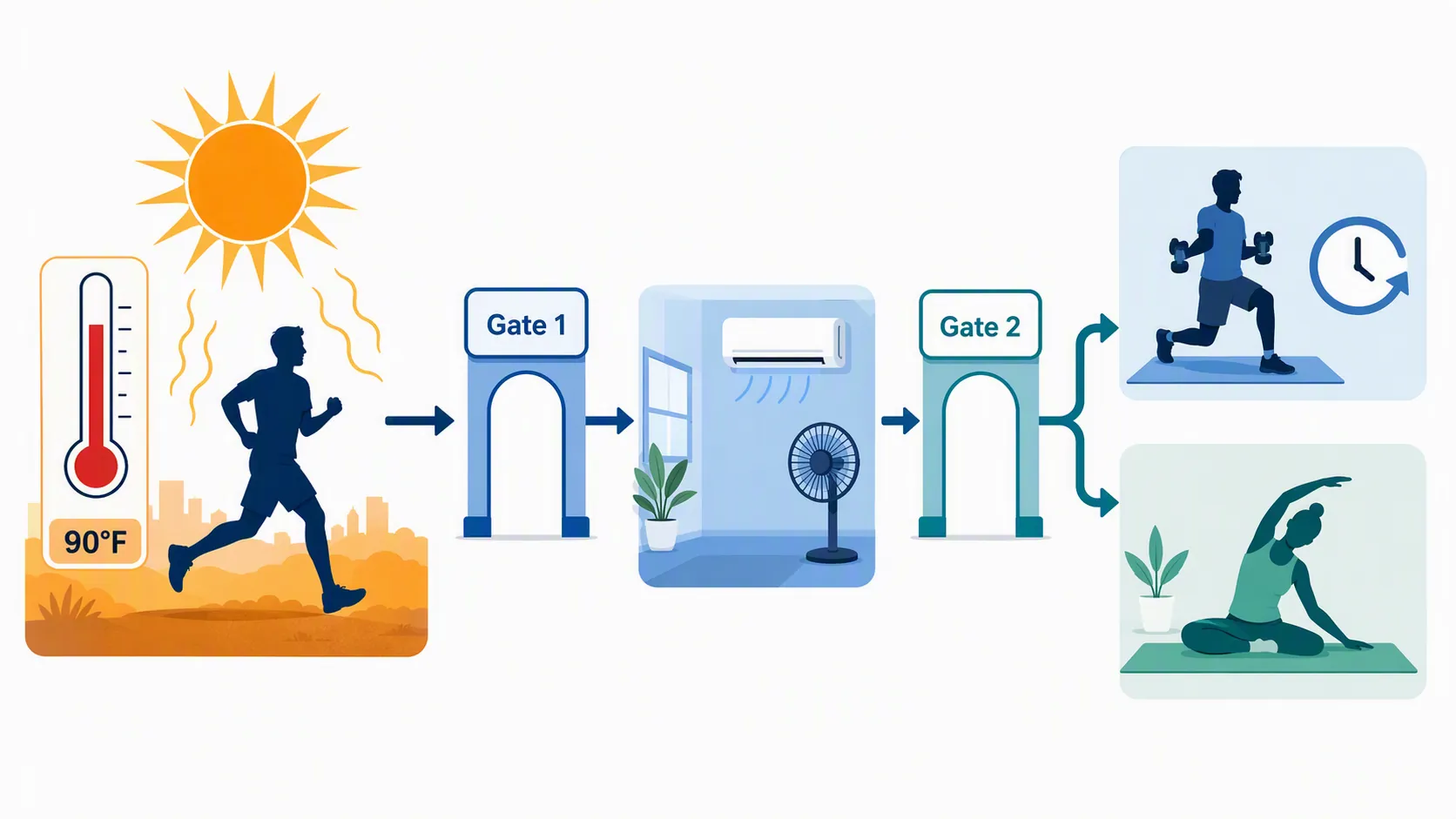
Gate 1: do not treat a heat alert like a suggestion
A heat alert is closer to a stoplight than a motivational quote. It changes the allowed choices before willpower enters the room. The National Weather Service says an Extreme Heat Warning means “take action,” including avoiding strenuous outdoor activities and staying in air-conditioned spaces, including overnight when necessary. A Heat Advisory still means heat conditions can make people sick and that plans should be adjusted. [1]
The exact alert threshold depends on where you live. That matters because a number copied from one forecast office is not a national rule. The National Weather Service office in State College, Pennsylvania, for example, lists an Extreme Heat Warning at a heat index of 105°F or higher and a Heat Advisory at 100°F to 104°F. [5] Other offices can use different local criteria because acclimatization, overnight lows, local climate, and regional risk differ.
For workouts, waiting until the official warning threshold may already be too late for a useful session. The 90°F heat-index caution point is the better practical line for most nonessential outdoor training because it catches the gray zone where the workout is still technically possible but the margin for error shrinks. At that point, the route, pace, and class schedule are no longer the plan; the heat is.
Going earlier can help only if the heat index, sun exposure, and finish time are actually safer. A 6 a.m. start that ends after the index climbs, or a loop with no shade and a long walk back if you overheat, is not much of a workaround. The clean decision is this:
- If an Extreme Heat Warning is active, cancel the outdoor workout and choose air conditioning, a lighter indoor session, or rest.
- If a Heat Advisory is active, reschedule or alter the plan before you start, not after you feel bad.
- If the heat index is around 90°F or higher, move nonessential outdoor intensity indoors or replace it with low-intensity work.
- If the only reason you are continuing is that missing the session feels irritating, that is not a safety argument.
Gate 2: your indoor fallback has to be cooler, not just indoors
“Bring it inside” is good advice only when inside gives your body somewhere to dump heat. The CDC warns not to rely only on fans and says fans should be used only when indoor air temperature is below 90°F. [6] The agency also recommends using air-conditioned places such as malls, libraries, or community cooling spaces for people without reliable air conditioning at home. [7]
That fan cutoff is the kind of instruction that beats vague comfort checks. If the room is near 90°F, a fan may make sweat evaporate and feel briefly helpful, but it is not the same as a cooler training environment. If the room is hotter than the hallway, hotter than a shaded public space, or still holding heat from yesterday, the workout has not been moved to safety. It has just been moved to a smaller hot box.
Uncooled homes can also hold heat after the outdoor temperature drops. The Conversation’s reporting on heat-wave housing risk notes that homes without cooling can become dangerously hot and may fail to cool overnight, even for young, healthy adults. [8] That does not mean every apartment is unsafe during every alert. It means you have to check the actual room you plan to train in.

Before you start, look for the conditions that make indoor training a real downgrade in heat stress:
- The room is air-conditioned or clearly cooler than outside.
- The indoor temperature is below the CDC’s 90°F fan limit if a fan is part of your cooling plan. [6]
- The space has cooled from the previous day, especially if you are training in the morning.
- You can stop, sit, drink, and recover without feeling trapped in the heat.
- You have an air-conditioned backup, even if that means walking in a mall or doing mobility after a library cooling break.
If your problem is specifically a no-AC apartment, do not rebuild the entire cooling strategy from memory while the room is already hot. Use the site’s guide to cooling a no-AC apartment for a quiet heat wave workout and decide from the actual room temperature, not from the fact that you made it indoors.
Once indoors, the workout still has to shrink
Moving inside is not permission to run the same workout with the GPS turned off. During hot conditions, BBC Future’s exercise-safety guidance emphasizes reducing intensity, taking more frequent breaks, and shortening sessions. [9] Columbia exercise physiologist Carol Ewing Garber also told NPR that during extreme temperatures, shifting activity into air conditioning is the safer choice. [10]
Think of the indoor version as a maintenance session. You are preserving the habit and avoiding unnecessary heat strain. That is a training decision, not a consolation prize.
| If this was the outdoor plan | Make the indoor version look more like this |
|---|---|
| Steady run, ride, or hard walk | Shorter low-impact cardio, broken into intervals with full rest |
| Tempo work or hill repeats | Technique drills, easy step work, mobility, or a postponed quality session |
| Outdoor bootcamp or class | One or two easy circuits, longer pauses, no race-the-clock finisher |
| Long endurance session | A short maintenance dose or rest, especially if the room is only marginally cooler |
| Skill workout with bursts, such as boxing or tennis-style drills | Coordination practice at reduced intensity, with heat treated as the limiting factor |
The cleanest substitutions are quiet, low-impact, and easy to stop. Tai chi walking and a 10-minute quiet yoga routine fit that job better than trying to reproduce a threshold run in a warm room. A no-equipment boxing workout or tennis coordination session can still work, but only if you scale down the pace, skip maximal bursts, and rest before you feel forced to.
If you are worried that a shorter session “doesn’t count,” use cardio dose as context rather than punishment. The point on an alert day is not to cram the missed outdoor workload into a living room. It is to keep the week intact without creating a recovery problem. For planning around normal, non-alert days, see how much home cardio your heart actually needs or the 8-week heart-healthy home workout routine.
Hydrate around the session, not after you are already behind
Hydration advice gets lazy fast, but the useful version has timing. Mass General Brigham cites American Council on Exercise guidance to drink 17 to 20 ounces a few hours before exercise, another 8 ounces 20 to 30 minutes before, and 4 to 8 ounces every 15 to 20 minutes during exercise. [2] NPR’s heat-exercise guidance notes that plain water is usually enough for sessions under an hour. [10]
That does not mean forcing fluid past comfort or treating water as armor against a bad plan. Hydration supports a scaled session in a cooler room. It does not make a hot apartment or an active warning safe. For budget-friendly setup ideas, use the site’s hydration tips for home exercise rather than turning the heat-alert decision into a shopping list.
Use symptoms as a stop sign, not as the main plan
You should not need a full heat-illness checklist to decide whether to run intervals during an Extreme Heat Warning. Still, if you become dizzy, confused, nauseated, chilled despite the heat, unusually weak, or unable to recover between efforts, stop. Cool down, get out of the hot room, and seek medical help if symptoms are severe or do not improve.
The prevention rule is better: do not design a session that depends on catching heat illness early. The more severe the alert, the less tolerance there should be for “one more round.”

When skipping is the correct training decision
Some days the decision ends before the warmup. If the alert is severe, the outdoor option is out. If the indoor space is not genuinely cooler, the apartment workout is not a clever workaround. If shortening the session, lowering intensity, adding breaks, and drinking normally still leave you hot, lightheaded, or unable to settle between efforts, the workout is over.
That is not being fragile. Heat illness can take days to recover from, and Garber told NPR that people should not rush back after it. [10] Losing one workout is annoying. Turning one alert day into several bad training days is worse.
Rest, easy mobility, or an air-conditioned walk can be the disciplined choice. The same logic applies to other environmental alerts, including smoke season: the site’s guide to Seattle smoke seasons and indoor workouts treats the alert as a planning input, not an interruption to be muscled through. Extreme heat deserves the same respect.
References
- Understanding Heat Alerts — National Weather Service
- Stay Safe Exercising in the Heat — Mass General Brigham
- Too hot to exercise? Here's how to beat the heat — The Weather Channel — June 28, 2026
- Warm Weather Workouts: How to Stay Safe in the Heat — Catholic Health Long Island
- Definitions, Thresholds, Criteria for Warnings, Watches and Advisories — National Weather Service State College, PA
- About Heat and Your Health — CDC
- Heat and People without Air Conditioning — CDC
- Heat waves can leave homes dangerously hot — even for young, healthy adults — The Conversation
- How to exercise safely in hot weather — BBC Future — June 18, 2026
- How to heat-proof your summer workout — NPR — July 19, 2021
What a small equipment investment adds
We don't have a build tagged to this exact tier yet. Browse all builds.
How often should you repeat this?
See our recovery and rest reference for citation-anchored rest-interval guidance.
Spot something off?
Tell us if a movement, tier assumption, or duration didn't match your experience.