
How Tai Chi Walking at Home Improves Balance and Posture
Tai chi walking is a zero-equipment balance and posture drill you can do at home in a few meters of hallway — no gear, no noise, no class. Learn the correct technique, what the fall-prevention evidence actually supports, and how often to practice before results show up.
- Equipment tier required
- none
- Duration
- 5-10 min
- Difficulty
- Beginner
- Target area
- Balance & posture
- Space footprint needed
- 3-5 m clear floor
- Noise level
- Quiet
Clear three to five meters of hallway, move the shoes away from the door, and check the rug edge you already know is trouble. That is enough room for tai chi walking: a slow, controlled stepping drill where one foot bears all your weight while the other foot is deliberately “empty,” then lands heel-first before you transfer forward.
It looks almost too simple from the outside. The work is in the pause. Instead of letting momentum carry you down the hall, you shift, test, place, and only then commit. For a home exercise, especially in an apartment, that is the charm: no mat, no jumping, no machine, no neighbor underneath wondering what just happened.
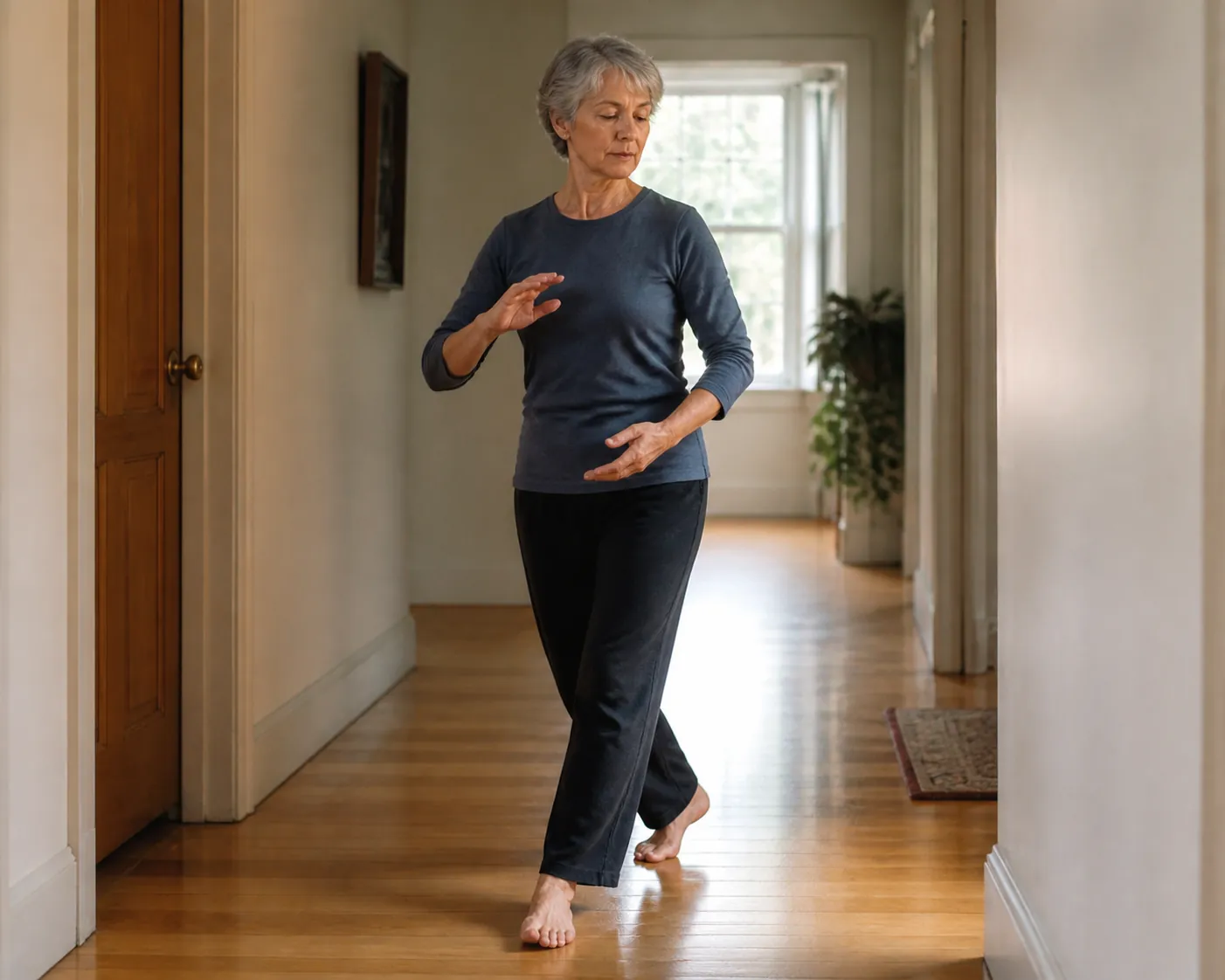
What tai chi walking is, in plain floor-space terms
Tai chi walking is not ordinary walking slowed down for effect. The Tai Chi for Health Institute teaches it as a controlled weight-transfer drill: shift 100% of your weight onto one leg, make sure the other foot carries no weight, step forward gently, place the heel first, then move your weight forward with control.[1]
You will see different versions taught. Some teachers use a cat-walk image; some widen the stance; some emphasize martial applications; some say there is no separate thing called “pure tai chi walking,” only walking drawn out of tai chi practice.[2] For home use, choose one consistent beginner pattern first. The body learns steadiness better from repetition than from collecting variations.
- Space: a clear hallway or room edge, ideally about three to five meters of clear floor.[1]
- Floor: wood, vinyl, low-pile carpet, or another surface where your foot will not unexpectedly stick.
- Feet: barefoot is fine if your floor is safe and your feet tolerate it. Otherwise use flat, supportive shoes with predictable soles. If footwear is part of the problem, not the solution, start with the shoe question before the exercise; this guide to walking shoes for home fitness may help.
- Support: a wall, counter, or hallway rail within reach is not cheating. It is good setup.
- Noise: almost none, if you place the foot instead of dropping it.
The beginner technique: shift, empty, step, transfer
Stand at one end of your clear space with your feet about hip-width apart. Soften the knees. Let the arms hang naturally or rest one hand lightly on the wall. Look ahead rather than down at your toes; you can glance at the floor before you begin, but do not fold yourself over every step.
| Part of the step | What to do | What to feel |
|---|---|---|
| 1. Settle | Bend both knees slightly and let your weight sink into the whole standing foot. | The floor feels broad under you, not just under the heel or toes. |
| 2. Shift 100% | Move all your weight onto the standing leg before lifting or moving the other foot.[1] | The free foot could tap the floor without helping you balance. |
| 3. Empty the stepping foot | Let the stepping foot become light enough that you can move it without dragging. | No push-off, no rush, no lurch. |
| 4. Place heel-first | Reach the empty foot forward and touch the heel down gently.[1] | The front foot is placed, not planted. |
| 5. Transfer forward | Gradually move weight into the front foot until it becomes the new full-weight leg. | The back heel can lift naturally as your body arrives over the front foot. |
| 6. Repeat | Pause long enough to confirm the new empty foot before stepping again. | Each step takes about three to five seconds, slow enough to notice wobble before it becomes a stumble. |
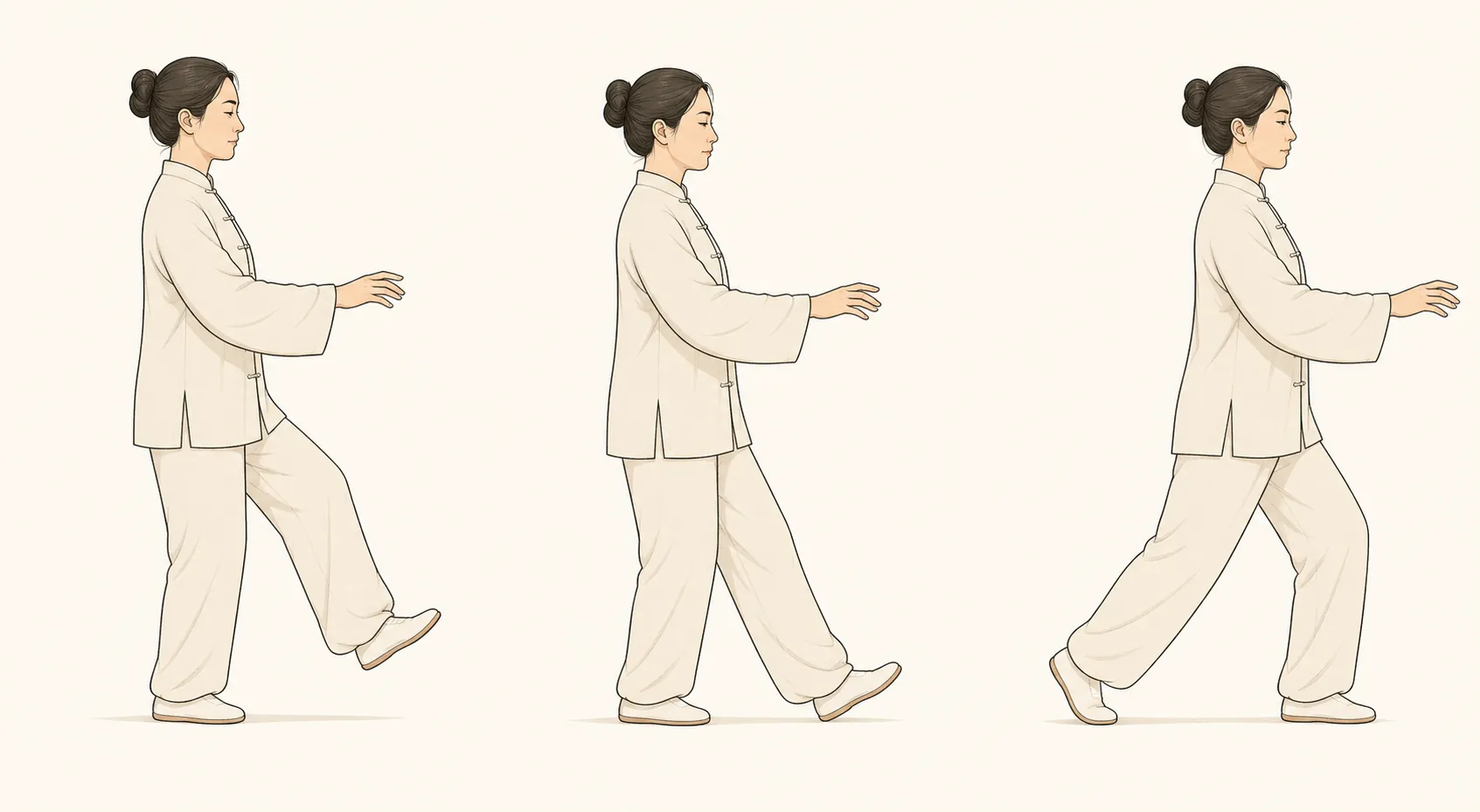
The important word is “empty.” In regular walking, the next foot often lands with weight already chasing it. In tai chi walking, the stepping foot is allowed to arrive first and receive weight second. That small delay is where the balance training hides.
Keep the knees tracking in the same general direction as the toes. If the front knee caves inward as you transfer weight, shorten the step. If the back foot twists because the hallway is narrow, make the stance smaller rather than forcing a dramatic tai chi shape into a rental-apartment corridor.
A two-minute first session
Set a timer for two minutes, not ten. Walk slowly to the end of the hallway, turn around normally, and come back. If turning is the wobbliest part, use the wall, take extra steps, or simply stop after each length and reset. A good first session should feel like practice, not a test you barely passed.
- Week 1: two minutes at a time, most days you remember.
- Weeks 2–3: build toward five minutes, still keeping each step slow.
- After that: five to ten minutes is plenty for a quiet home balance drill.
- On busy days: one-minute segments still count, especially if they keep the habit alive.[2]
This fits beautifully into the odd little gaps of a day: while tea steeps, before the shower warms, while dinner is simmering and you are nearby anyway. If consistency is the hard part, the issue may not be motivation so much as making the routine small enough to survive real life; that is also the argument behind senior home workout motivation.
Why this little hallway drill matters
Falls are not a niche concern. The CDC’s current falls page says one in four adults age 65 and older — more than 14 million people — report falling each year, and about 37% of falls cause injury.[3] That current one-in-four figure is worth using carefully, because the older “one in three” statistic still floats around on some program pages and handouts.
Tai chi walking does not remove loose cords, slippery bathrooms, poor lighting, or medications that make someone dizzy. It does train something more basic: the ability to know which leg is actually carrying you before you move the other one. That is a useful household skill, whether the moment is stepping around a laundry basket or recovering after the cat cuts across the kitchen.
The posture benefit is not “stand tall.” It is stacking.
The best posture cue for tai chi walking is verticality: head centered over torso, torso over hips, hips over feet. Harvard Health explains the same idea in tai chi terms and notes why the head position matters: the head weighs about 10 to 12 pounds, and even a slight forward tilt can more than double the strain on the neck.[4]
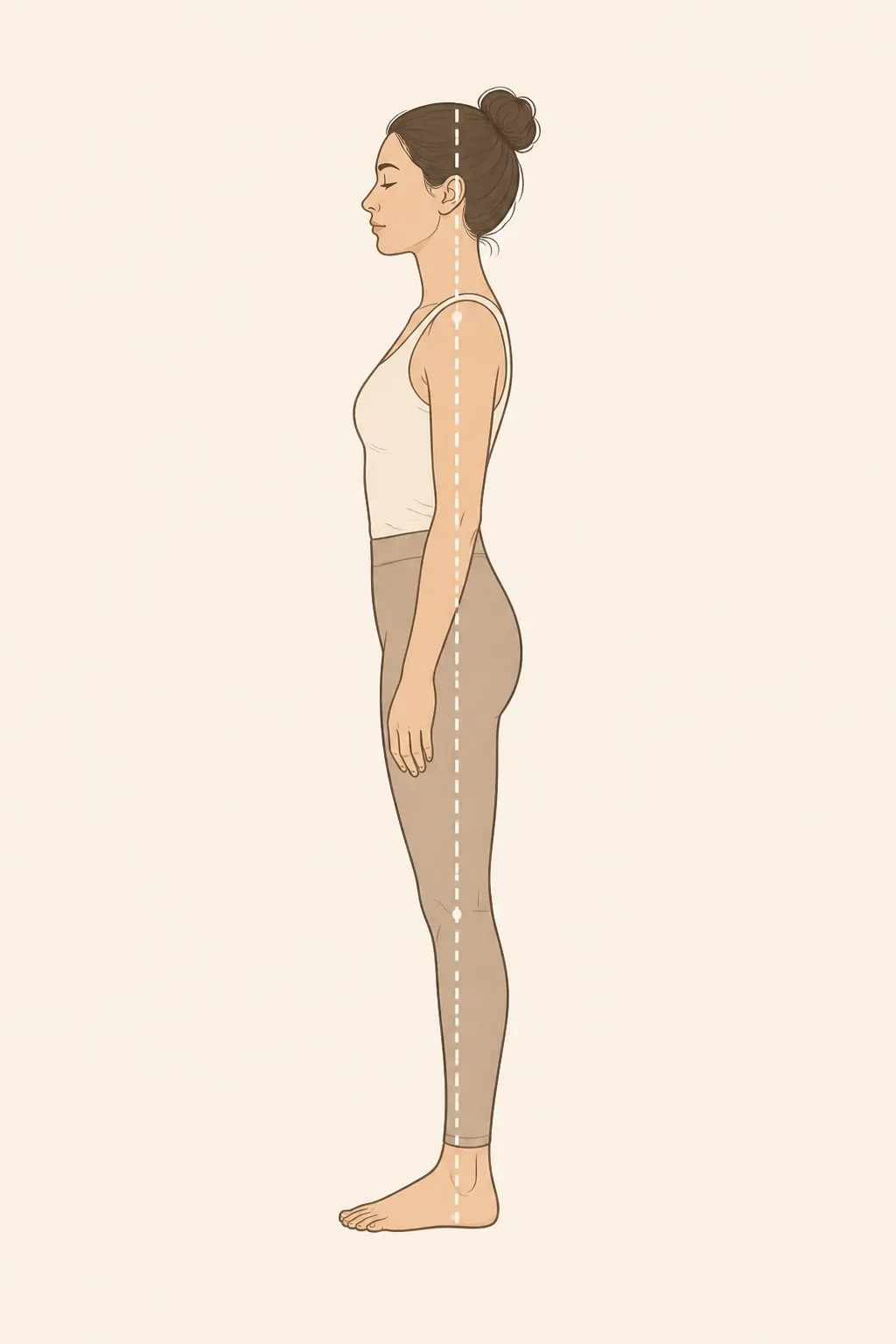
In the hallway, that means you do not fix posture by military-style stiffening. You place the head over the ribs, the ribs over the pelvis, and the pelvis over the foot that is holding you. If you need to look down, move your eyes more than your whole head. If your chest lifts but your lower back clenches, you have overdone it.
A simple check: pause mid-drill with all your weight on one foot. Ask whether your ear, shoulder, hip, and standing ankle feel like they could be connected by a plumb line. You do not have to be perfect. You are teaching the nervous system where “over my feet” lives.
If posture is your main reason for starting, tai chi walking pairs well with a short upper-back and neck routine such as these 10-minute posture exercises. Use tai chi walking for weight shift and alignment while standing; use posture work for the places that have been rounded over a desk, sink, or phone.
What the evidence really supports
Here is the honest split: tai chi as a fuller practice has meaningful research behind it for falls and balance. Tai chi walking by itself is a very reasonable doorway into that kind of training, but the fall-prevention evidence should not be inflated into “this hallway drill alone has proved the same results.” The Tai Chi for Health Institute is plain about this distinction, noting that walking drills alone are less studied and that a full set is “many times more effective.”[1]
A 2023 systematic review and meta-analysis of 24 randomized controlled trials found that tai chi was associated with a pooled 24% lower relative risk of falls, reported as RR 0.76 with a 95% confidence interval from 0.71 to 0.82.[5] The same analysis reported improvements in practical balance measures: Timed Up and Go improved by 0.69 seconds, functional reach by 2.69 centimeters, single-leg balance by 9.63 seconds, and Berg Balance Scale score by 1.80 points.[5]
A Harvard Health summary of a JAMA Internal Medicine trial reported that, after six months, tai chi produced 58% fewer falls than stretching and 31% fewer falls than multimodal exercise.[6] That is an attention-getting result, but it came from a structured tai chi intervention, not from a person doing two minutes of hallway stepping whenever the kettle boils.
NCCIH uses more conservative language. It describes evidence suggesting tai chi may help reduce falls in older adults and cites a low-certainty 19% reduction in fall rate, along with high-certainty evidence for a 20% reduction in the number of people who fall.[7] Those labels matter. A cautious evidence review is not a wet blanket; it is how readers avoid being sold certainty that the research has not earned.
| Claim | What the cited evidence supports | How to read it at home |
|---|---|---|
| Tai chi reduces falls | Supported by full tai chi programs in randomized trials and reviews, with estimates varying by analysis.[5][6][7] | Good reason to take tai chi seriously for balance, but not proof that walking-only drills reproduce every result. |
| Tai chi improves balance tests | The 2023 meta-analysis reported gains in TUG, reach, single-leg balance, and Berg score.[5] | The hallway drill trains pieces of those abilities: shifting, pausing, standing over one foot, and controlled stepping. |
| More practice matters | Later synthesis work links larger one-leg-standing gains to frequent sessions and a multi-week practice window.[8] | Five minutes often repeated is more believable than one heroic session on Sunday. |
| Tai chi walking is enough by itself | Not established by peer-reviewed standalone tai chi-walking RCTs in the material reviewed here.[1] | Use it as an entry point, maintenance drill, or confidence builder; consider broader instruction if falls risk is high. |
How long before it helps?
Balance training is usually a weeks-and-months project, not a “feel the burn” project. In the 2023 meta-analysis, tai chi programs with at least two sessions per week were associated with fall-risk benefits.[5] A 2026 meta-analysis of 21 randomized controlled trials including 2,408 healthy older adults found one-leg-standing time improved by 5.92 seconds overall, with subgroup findings suggesting gains only at five to seven sessions per week and an effective window of 10 to 26 weeks.[8]
That 2026 finding should be treated as guidance, not a magic threshold. It was a meta-analysis with subgroup results, not a kitchen timer rule. Still, it points in the right direction for home practice: make the drill frequent and modest. The nervous system learns from repeated exposure to controlled wobble.
A practical target is five minutes on most days, building toward ten if you enjoy it. If you are starting from very little activity, two minutes is not silly. If one minute after breakfast and one minute before bed are what you can actually repeat, start there. Repeated tiny sessions beat the plan you keep postponing.
Make it safer without making it complicated
The safest version is the one you can do without surprising yourself. Start beside a wall. Keep steps short. Turn slowly. Stop before fatigue makes your foot slap the floor. If you feel lightheaded, chest discomfort, unusual shortness of breath, or sharp pain, stop and get medical advice.
- If balance is poor: use fingertip contact on the wall for every step.
- If knees complain: shorten the step and reduce the bend. The knee should track over the toes, not twist inward.
- If neuropathy affects your feet: wear stable shoes and practice near support.
- If you are deconditioned: practice the weight shift in place before adding the step.
- If you have uncontrolled cardiovascular symptoms, severe osteoporosis, a recent injury, or a recent unexplained fall: ask a clinician or physical therapist before progressing.
A seated version can teach the same idea in miniature: sit tall near the front of a chair, place both feet on the floor, shift pressure into one foot until the other becomes light, then switch. It is not the same balance challenge as standing, but it helps a very cautious beginner feel the difference between weighted and unweighted.
When to add backward steps
Do not start with backward tai chi walking unless forward walking feels steady. Once it does, backward steps are worth learning because the Tai Chi for Health Institute notes that about 20% of falls happen when stepping backward.[1] Use a wall beside you, clear the path twice, and take very short steps. Place the ball of the foot behind you first, then transfer weight only when you know where the floor is.
Backward practice is not for proving bravery. It is for rehearsing a common household move: backing away from the sink, stepping back from a closet, or making room when someone opens a door.
Do not use this as a calorie-burning hack
Tai chi walking may be movement, but it is not a weight-loss workout in disguise. Noom estimates tai chi walking at roughly 80 to 150 calories per 30 minutes, comparable to slow walking, and that is a commercial estimate rather than the central reason to do it.[9] The better payoff is balance attention: quieter steps, cleaner weight transfer, a more upright stack, and less panic during the little wobbles that daily life provides for free.
A simple home prescription
Practice tai chi walking for two minutes today in a clear hallway. Keep one hand near the wall. Shift 100% of your weight before stepping. Let the moving foot be empty. Place the heel softly. Transfer forward over three to five seconds. Turn with patience.
Over the next few weeks, build toward five to ten minutes on most days. If you begin enjoying the rhythm, or if fall risk is already a serious concern, look for broader tai chi instruction or a physical therapist’s balance program. The hallway drill is worth doing because it is quiet, free, private, and specific. It trains balance and posture awareness without making the home solve one problem by creating another.
References
- Tai Chi Walking — Tai Chi for Health Institute
- Tai chi walking is a simple exercise that may help improve balance. What to know — TODAY
- Older Adult Falls Data — Centers for Disease Control and Prevention
- Proper posture: the tai chi way — Harvard Health Publishing
- Tai Chi for fall prevention and balance improvement in older adults: a systematic review and meta-analysis of randomized controlled trials — Frontiers in Public Health, 2023
- Tai chi: The winner at warding off falls — Harvard Health Publishing
- Tai Chi: What You Need To Know — National Center for Complementary and Integrative Health
- Effects of Tai Chi on static balance ability in healthy older adults: a systematic review and meta-analysis — Frontiers in Public Health, 2026
- Tai Chi Walking: Benefits, Technique, and How to Get Started — Noom
What a small equipment investment adds
We don't have a build tagged to this exact tier yet. Browse all builds.
How often should you repeat this?
See our recovery and rest reference for citation-anchored rest-interval guidance.
Spot something off?
Tell us if a movement, tier assumption, or duration didn't match your experience.