
10-Minute Posture Exercises to Improve Your Mood at Home
The evidence is real: upright posture measurably lifts mood and energy in a single session. This 10-minute, no-equipment routine applies that research at home — wall, doorway, and floor exercises for small spaces, with set/rep cues and an honest line between a mood lever and a treatment.
- Equipment tier required
- none
- Duration
- 10 min
- Difficulty
- beginner
- Target area
- posture
- Space footprint needed
- small space
- Noise level
- quiet
If your home office is also your kitchen table, your couch, or the corner of a bedroom, “sit up straight” is not much of a plan. It usually arrives too late, after the shoulders have crept forward, the chin has drifted toward the screen, and the afternoon has turned oddly heavy.
The useful question is smaller: can posture exercises to improve mood at home actually do anything today, without a brace, a workout outfit, or a lecture about discipline? The best answer is yes, with a narrow promise. Randomized studies show that upright posture can improve mood-related states in the same session — energy, positive affect, self-esteem, arousal, fatigue — especially during stressful tasks. That is different from saying posture treats depression or anxiety. It does not.
In a 2015 randomized trial of 74 people, participants were assigned to slumped or upright seated posture during a stress task. The upright group maintained self-esteem, had better mood and arousal, and reported less fear; the slumped group reported more fear, hostility, nervousness, and sluggishness.[1] A 2017 randomized trial in 61 adults with mild-to-moderate depression found that sitting upright during a stressful speech task reduced fatigue and increased positive affect compared with usual posture, though the researchers described the evidence as preliminary.[2] A 2021 Acta Psychologica study with 82 participants found that an implicitly manipulated upright posture produced more positive general mood than a stooped posture, with an effect size of d=0.50, and faster processing speed, with d=0.42.[3]
That is enough to make a 10-minute reset worth trying on a slumpy workday. It is not enough to make posture a mental-health treatment. The measured effects are state effects — what happened during or soon after the posture condition and task — not proof that a few wall slides will change your long-term mood.
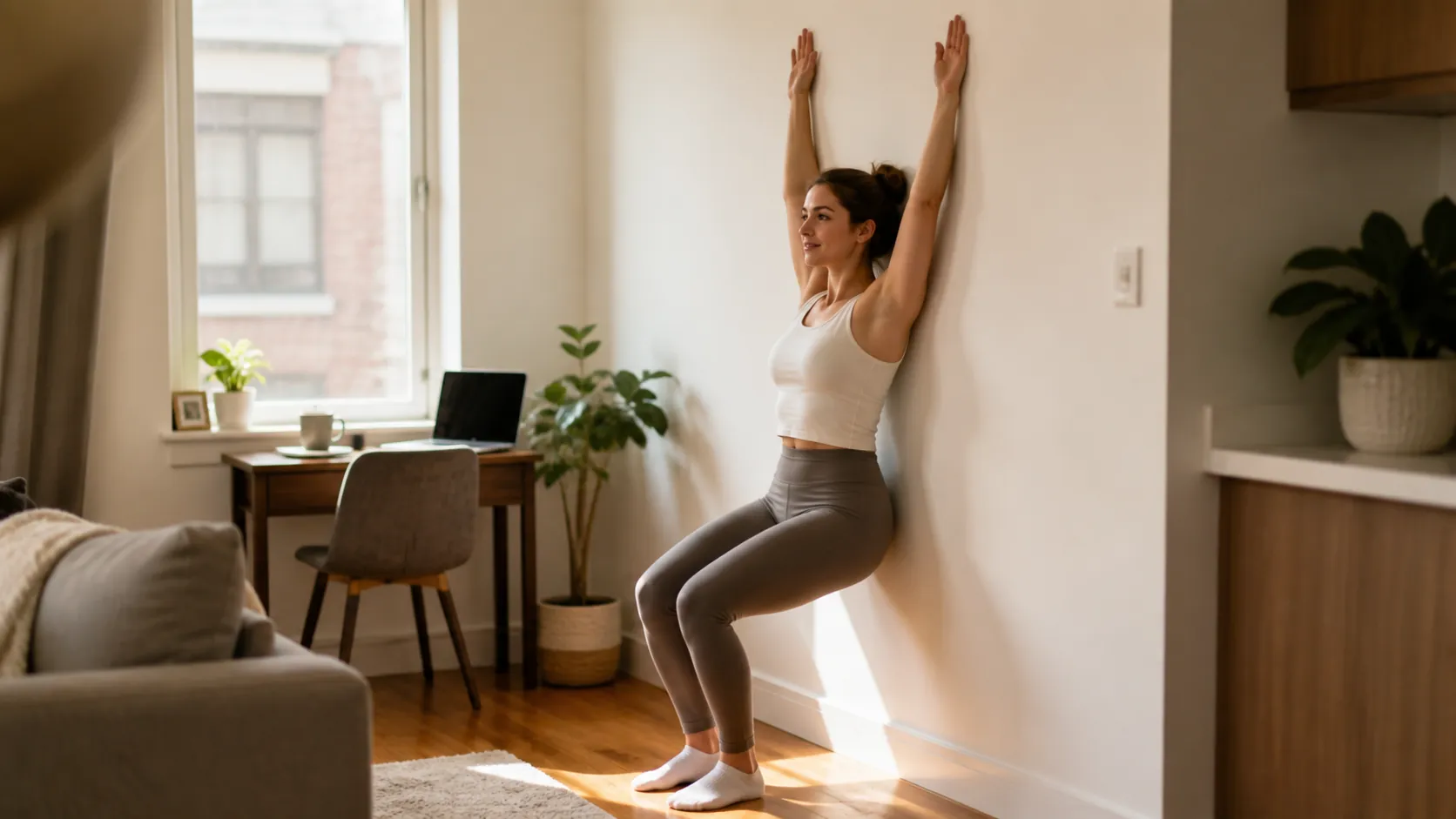
The 10-minute posture reset
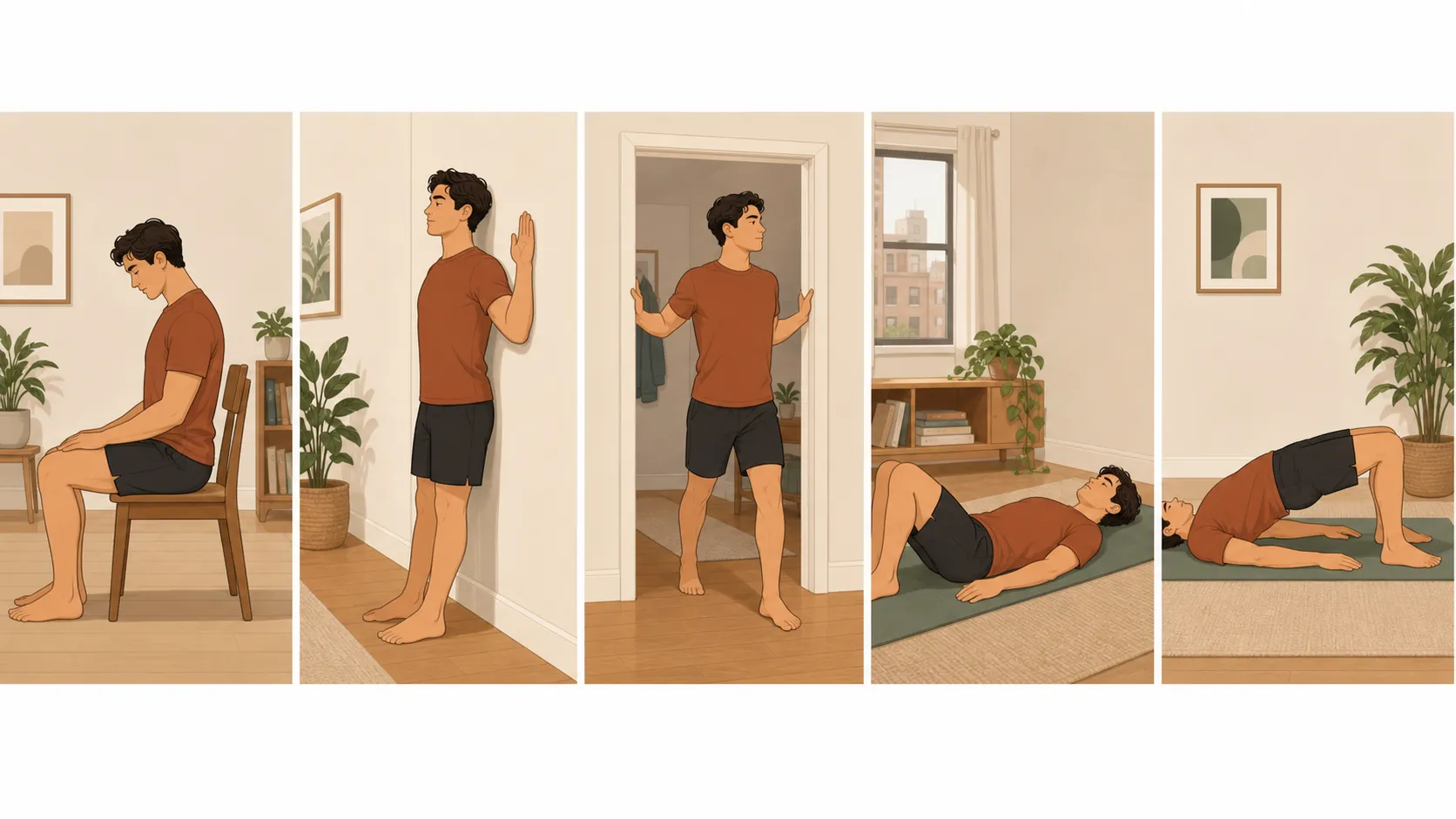
This routine uses a wall, a doorway, a chair, and the floor. No jumping, no equipment, no drilling, no special corner of the apartment. The point is not to hold yourself like a mannequin. It is to remind your head, ribs, shoulders, pelvis, and hips where “upright” is without turning it into a full workout.
| Time | Move | What to do |
|---|---|---|
| 0:00–1:00 | Wall posture self-check | Stand with your back near a wall. Stack ears, shoulders, ribs, and pelvis without forcing your lower back flat. |
| 1:00–2:30 | Seated chin tuck or head retraction | Sit tall, gently glide your head back, pause, and release. Keep the chin level. |
| 2:30–4:30 | Wall slide or wall angel | Slide arms up and down a wall slowly, keeping ribs from flaring. |
| 4:30–6:00 | Doorway chest stretch | Place forearms on a doorway and lean through lightly for 20–30 seconds at a time. |
| 6:00–7:30 | Pelvic tilt | Lie on your back, bend knees, and gently tilt pelvis to find a neutral rib-and-hip position. |
| 7:30–10:00 | Glute bridge | Press through feet, lift hips, pause, lower slowly. Aim for controlled reps, not height. |
If 10 minutes feels like too much on a rough day, do the first three minutes. The posture studies did not require a heroic training block; they tested position during a task. The wall and chin-tuck portion is the fastest way to stop guessing whether you are upright or just tense.
Start with the wall, not with willpower
Cleveland Clinic physical therapist Jennifer Danzo describes a quick wall-based posture check: stand against a wall and look for a plumb-line relationship among the ear, shoulder, and pelvis. Their version takes about 30 seconds.[5] In a tiny apartment, this is useful because the wall does not care how you feel about your desk setup. It gives you a reference point.
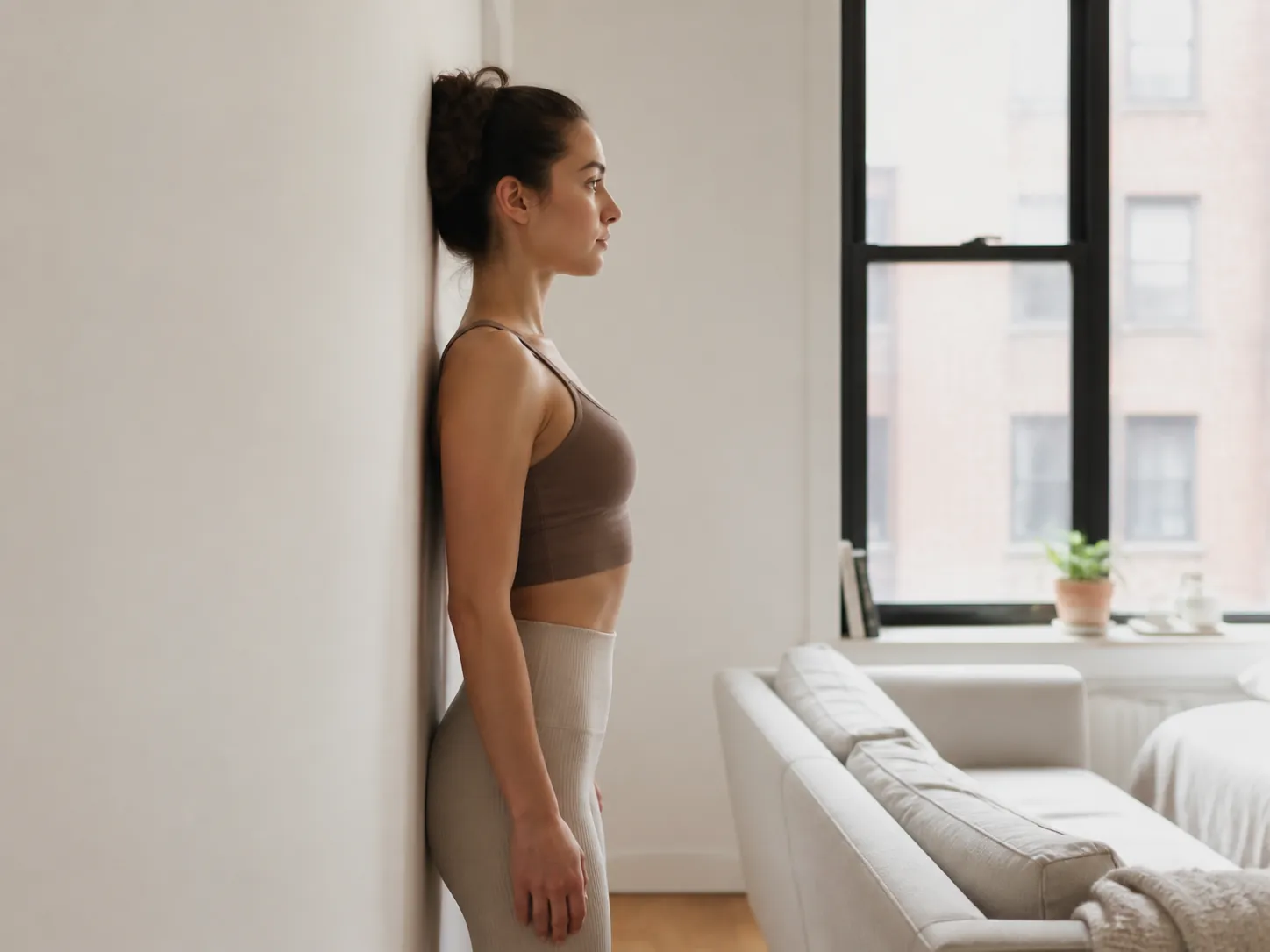
Stand with your heels a few inches from the wall if that feels better. Let your upper back touch lightly. Bring the back of your head toward the wall without tipping your chin up. Then check the part people usually overdo: the ribs. If your chest lifts like you are about to take a dramatic photo, soften the front ribs down until they sit over your pelvis.
Good upright posture for this routine should feel alert, not military. Your shoulders do not need to be pinned down. Your lower back does not need to be smashed flat. Your jaw does not need to join the project.
Chin tuck: the desk-neck reset
Sit on a chair with both feet on the floor. Look straight ahead. Without looking down, slide your head gently backward as if making a small double chin. Pause for one slow breath, then release. The movement is horizontal, not a nod.
NASM includes head retraction in a home posture program and gives a 3-by-10 set-and-rep cue; Health.com gives a 10-rep chin-tuck cue.[7][8] For this 10-minute version, use 8 to 10 slow reps. If you feel throat gripping or jaw clenching, make the movement smaller. A tiny clean glide beats a big strained one.
This is the move that often feels almost too small to matter. It matters because forward-head posture is one of the easiest ways to fake uprightness badly: you lift the chest, pull the shoulders back, and leave the head poking toward the laptop. The chin tuck brings the head back into the stack without asking the shoulders to solve everything.
Wall slide or wall angel: make space without forcing the shoulders
Stand with your back near a wall. Bend your elbows so your arms make a loose goalpost shape. Slide your arms upward as far as you can while keeping the ribs stacked over the pelvis, then slide them down. Harvard Health describes wall slides for posture with 8 to 12 repetitions and a 5-to-10-second pace in each direction.[6]
Use the wall as feedback, not as a test you have to pass. If your wrists do not touch, fine. If your elbows float forward, fine. If your lower back arches hard so the arms can go higher, bring the arms lower and keep the ribs quiet. That tradeoff is the whole point.
Cleveland Clinic also includes wall angels among posture exercises.[5] The difference between a useful wall angel and a performative one is tension. Shoulders should rotate and glide; they should not be jammed down as if you are trying to hide your neck.
Doorway chest stretch: short and gentle is enough
Place your forearms on either side of a doorway, elbows around shoulder height or a little lower. Step one foot through and lean forward until you feel a stretch across the front of the chest. Cleveland Clinic gives a 20-to-30-second cue for the doorway chest stretch.[5]
Do two rounds. Come out before the stretch gets sharp or nervy. This is not a contest with your own shoulder capsule. For desk posture, the doorway stretch is there to make upright position less effortful when you sit back down, not to pry your chest open by force.
Pelvic tilt: fix the stack from the floor
Lie on your back with knees bent and feet on the floor. Put one hand on your lower ribs and one hand near your hip bones if that helps. Gently tilt your pelvis so your lower back moves a little closer to the floor, then tilt the other way so a small arch returns. Move slowly between those two positions, then settle near the middle.
Cleveland Clinic includes pelvic tilts in its posture exercise guidance.[5] In this routine, the pelvic tilt is less about “abs” and more about finding the relationship that sitting tends to blur: ribs over pelvis, pelvis under ribs. Once you feel that on the floor, it is easier to recreate at the chair without bracing your whole torso.
Glute bridge: end with something that wakes up the back line
Stay on your back with knees bent. Set your feet about hip-width apart. Press through the feet, lift your hips until your body forms a comfortable line from shoulders to knees, pause, and lower slowly. Cleveland Clinic gives a 3-by-10 cue for glute bridges.[5]
For a 10-minute mood reset, one or two controlled sets may be enough. Keep the ribs from flaring at the top. If you feel the movement mostly in your lower back, lower the height and think of bringing the front ribs and pelvis with you as one unit.
This is also where the routine stops feeling like a posture scold and starts feeling like movement. That matters on a flat workday. You are not just arranging body parts; you are giving underused muscles a quiet job before returning to the screen.
Why this can affect mood without becoming magic
The posture-and-mood studies are not just vibes with a lab coat. They used randomized posture conditions and measured mood-related outcomes during stressful or performance tasks. That is why the claim can be practical: upright posture improved same-session outcomes that tired desk workers actually notice, such as fatigue, positive mood, arousal, and sluggishness.[1][2][3]
There is also a plausible body-brain bridge. NPR reported on work from Peter Strick at the University of Pittsburgh using viral tracing, which showed connections between the adrenal medulla and brain areas involved in core and posture muscles. Strick described it as “a clear link between how we move, think, and feel.”[4]
Plausible is the key word. The mechanism helps explain why posture and movement could influence stress and mood states. It does not turn this routine into a cure, and it does not require believing old power-pose hormone claims. The safer, better-supported point is smaller: slumped and upright positions can change how people feel and perform in the moment.
How to use it during a workday
Use the full 10 minutes once a day when you tend to sag: before the first call, after lunch, or in the late-afternoon dip. If you want smaller check-ins, use only the wall check and 5 chin tucks between tasks.
Reminder advice varies. Cleveland Clinic mentions setting a timer every 10 minutes, Harvard suggests getting up every 20 minutes, Rush gives a 20-to-30-minute range, and Psychology Today discusses reminders in the 30-to-60-minute range.[5][6][9][10] That spread is a hint not to turn reminders into another thing to fail at. Pick the least annoying interval that makes you move before your body has been folded around the laptop for an hour.
If what you need is a broader movement-break rhythm rather than a posture-specific reset, pair this with 5-Minute Quiet Home Workouts for Workday Energy. If you want a slightly more active mood-focused session on a day that feels heavier than usual, Beat the Monday Blues With a 15-Minute Home Workout sits in that lane. This routine stays narrower: posture, small space, no equipment, same-session mood state.
Optional upgrade: a band row, if you already own the band
The no-equipment version is the default. If you already have a resistance band, Cleveland Clinic includes a band row looped around a doorknob as a posture exercise.[5] Pull the elbows back, keep the ribs stacked, and avoid turning the row into a shrug. If your door or anchor setup feels questionable, skip it. A free routine stops being renter-friendly the moment it risks the door.
For people building a small home setup over time, a band is usually more useful than most posture gadgets. The same logic behind a budget-and-space equipment guide applies here: buy only what adds a job your body will actually do. If you want band-specific beginner programming, use a simple resistance-band workout separately from this reset.
About posture braces and harnesses
A posture-correcting harness is tempting because it promises the part everyone wants: better posture without attention. Cleveland Clinic’s physical therapy guidance is more skeptical. Danzo notes that passive posture supports do the work for you, and the benefit can disappear once the device comes off; she points instead toward active practice and reminders.[5]
That fits the home-work reality better anyway. A wall check, chin tuck, and bridge teach you the position and the muscular work behind it. A harness can nudge, but it cannot make your hips, upper back, and neck coordinate during the next spreadsheet.
When not to make this a posture problem
Use this routine when you feel slumped, flat, foggy, or physically folded by the workday. Do not use it to explain away persistent depression, anxiety, pain, numbness, tingling, weakness, dizziness, or symptoms that worsen with movement. Those belong with a qualified clinician or physical therapist.
Posture is not a personality project, and it is not a cure. It is one of the rare home-workday levers that is cheap, quiet, immediate, plausible, and backed well enough to try today.
References
- Do slumped and upright postures affect stress responses? A randomized trial, PubMed
- Upright Posture Improves Affect and Fatigue in People with Depressive Symptoms, PubMed
- I sat, I felt, I performed: Posture effects on mood and cognitive performance, PubMed
- How posture and movement impact our mood, NPR, October 24, 2023
- Posture Exercises: How To Improve Your Posture, Cleveland Clinic, April 2024
- In a slump? Fix your posture, Harvard Health
- 5 Exercises to Combat the Negative Effects of Bad Posture, NASM
- The Best Exercises to Improve Posture, According to Physical Therapists, Health.com, January 2026
- The Power of Good Posture, Rush University
- Heads Up! Good Posture Helps Both Your Mind and Your Body, Psychology Today, updated May 2024
What a small equipment investment adds
We don't have a build tagged to this exact tier yet. Browse all builds.
How often should you repeat this?
See our recovery and rest reference for citation-anchored rest-interval guidance.
Spot something off?
Tell us if a movement, tier assumption, or duration didn't match your experience.