
What Seattle's smoke seasons mean for indoor workouts
Seattle's smoke seasons swing from 3 affected days in 2025 to a near-record pace in 2026, so a standing indoor-workout protocol beats improvising mid-event. Here's how to read the air-quality data and prep filtration, routine swaps, and an AQI-check habit before the next smoke day.
- Equipment tier required
- none
- Duration
- 20 min
- Difficulty
- beginner
- Target area
- full body
- Space footprint needed
- mat-size area
- Noise level
- low
Seattle does not give you a neat smoke-season average you can plan around. It gives you lopsided years. In 2025, Puget Sound Clean Air Agency counted only 3 smoke-affected days, and King County finished the year with 247 Good air-quality days, 118 Moderate days, and 0 days in the Unhealthy for Sensitive Groups category.[1] That looks almost harmless if all you want is a quick answer to whether wildfire smoke should affect your training calendar.
Then 2026 arrives, and by early August western Washington is already under a smoke pattern serious enough for dated public guidance. Seattle’s wildfire-smoke safety page flagged an air-quality alert for King, Kitsap, Pierce, and Snohomish counties from August 3 through August 5, 2026, with conditions expected to range from Moderate to Unhealthy for Sensitive Groups.[2] The Washington Smoke Blog was tracking the same regional smoke episode as part of the state’s interagency smoke updates.[3] Local coverage described the season as being on pace to rank among the worst in recent history.[4]
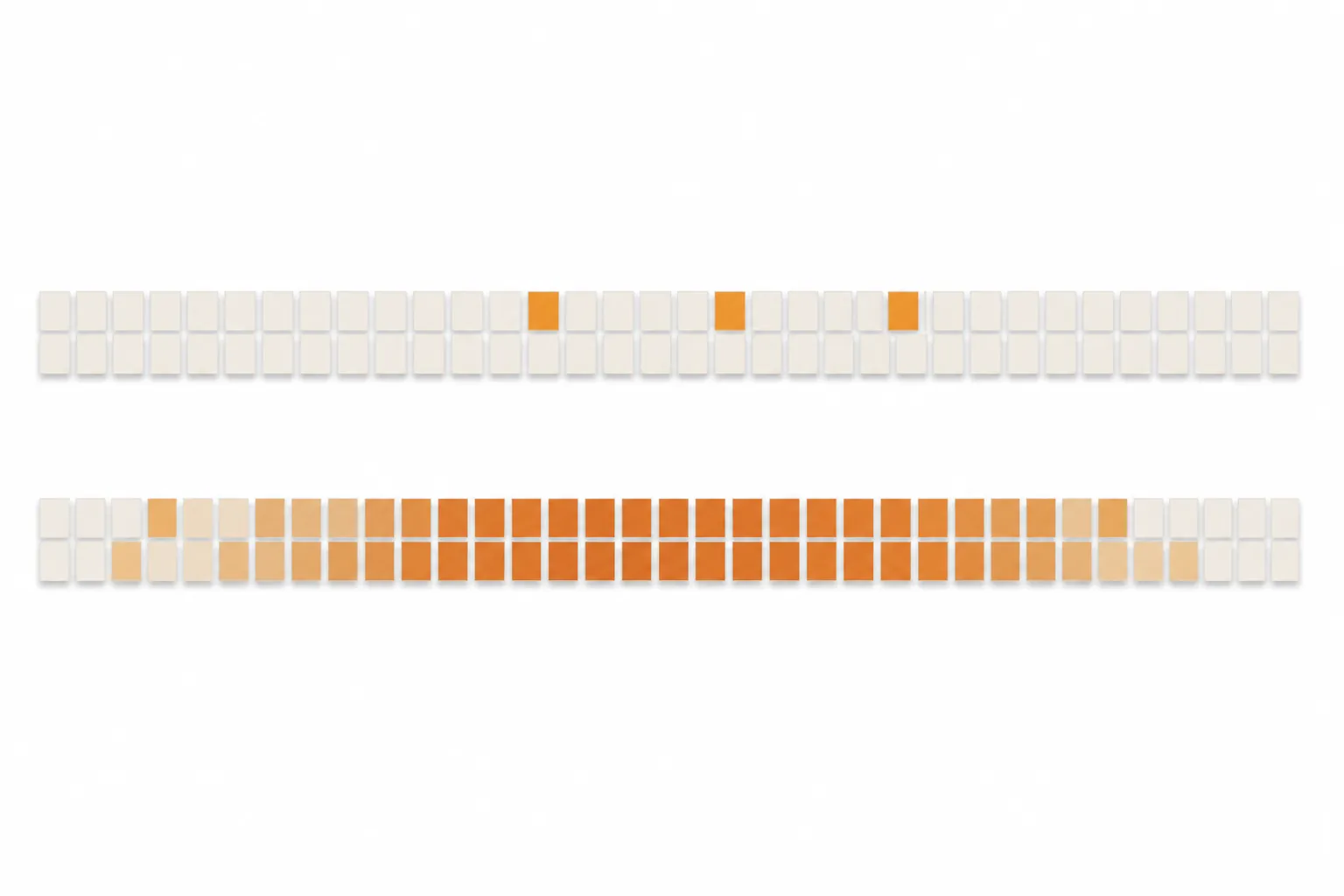
That is the training problem. Not that every summer is ruined. Not that every Moderate day should send a healthy exerciser indoors. The problem is that a calm year can teach the wrong lesson. If your outdoor running, cycling, rowing, boot-camp class, or hill-walk routine assumes smoke is a rare one-day nuisance, a clustered event forces decisions you have not pre-made: where to train, how hard to go, whether the apartment air is clean enough, and whether today’s missed workout becomes one skipped session or the start of a broken week.
The 2025 numbers are useful, but they are not permission to ignore smoke
The cleanest way to read 2025 is as a low-smoke year, not as a stable baseline. Three smoke-affected days is small enough that many Seattle exercisers could have simply shifted a run, moved one session indoors, or ignored the issue if their workout landed at the right time of day.[1] The broader King County day count also looks reassuring: no Unhealthy for Sensitive Groups days for the year.[1]
The Moderate count needs more care. Puget Sound Clean Air Agency notes that the EPA updated the PM2.5 AQI standard in 2024, which moved some days that previously would have been classified as Good into the Moderate category.[1] So a higher Moderate tally after that update does not automatically mean the air physically became dirtier by the same amount. Some of what people see on the dial is a classification change.
That caveat matters because home-gym planning gets silly when every yellow dot is treated as a crisis. But it also does not erase the longer trend. PSCAA says that since 2015, the region has experienced the highest fine-particle levels recorded since monitoring began in 1980.[1] The practical read is narrower than “Seattle is smoky all summer” and more useful than “2025 was fine.” Fine-particle spikes are now part of the region’s training environment, but they arrive unevenly.
| What the local record says | What it means for training |
|---|---|
| 2025 had 3 smoke-affected days in the Puget Sound Clean Air Agency summary. | A light year can pass with almost no visible interruption to a normal outdoor routine. |
| King County logged 247 Good days, 118 Moderate days, and 0 Unhealthy for Sensitive Groups days in 2025. | The annual count does not justify living in permanent smoke mode. |
| The EPA’s 2024 PM2.5 AQI threshold update reclassified some days into Moderate. | Do not interpret every Moderate day as proof of a worsening physical condition. |
| Since 2015, the region has seen the highest fine-particle levels since monitoring began in 1980. | A standing response is still rational, because the bad weeks are plausible even when the average year looks manageable. |
| Early August 2026 brought a regional alert and a season described locally as on pace to be among the worst in recent history. | The plan has to survive clustered smoke days, not just a single cancelled run. |
For an indoor workout during wildfire smoke in Seattle, the planning question is therefore not “How many days will I definitely lose this year?” It is “Can my week absorb several smoky days without turning into a scramble?” A small apartment setup can answer that if it is ready before the alert arrives.
Why improvising breaks faster than fitness does
Seattle has already shown what happens when smoke collides with ordinary outdoor movement. A study of the 2018 smoke event found that daily average bicycle counts at city counters fell by 14.6% to 36.0%, while pedestrian counts fell by 31.7% to 45.2%.[5] Those are not gym-program numbers; they are behavior numbers. People changed what they did outside.
That is the part worth taking seriously. Smoke does not have to be catastrophic to be disruptive. It only has to arrive on the same day as a long run, a commute ride, a group workout, or the one evening in the week when you had time for intervals. If the replacement plan is invented at 5:30 p.m. while the AQI app is already open, the odds tilt toward either overdoing it outside or doing nothing.
There is also a dose problem. Research cited in the Seattle transportation study reports that exposure to wildfire smoke during outdoor physical activity can be up to tenfold higher than during sedentary activity.[5] That does not mean every person faces the same risk at the same AQI, and it is not a substitute for medical advice for people with asthma, heart conditions, pregnancy, or other higher-risk factors. It does explain why “I’ll just keep the pace easy” is not always enough. Breathing harder changes the exposure.
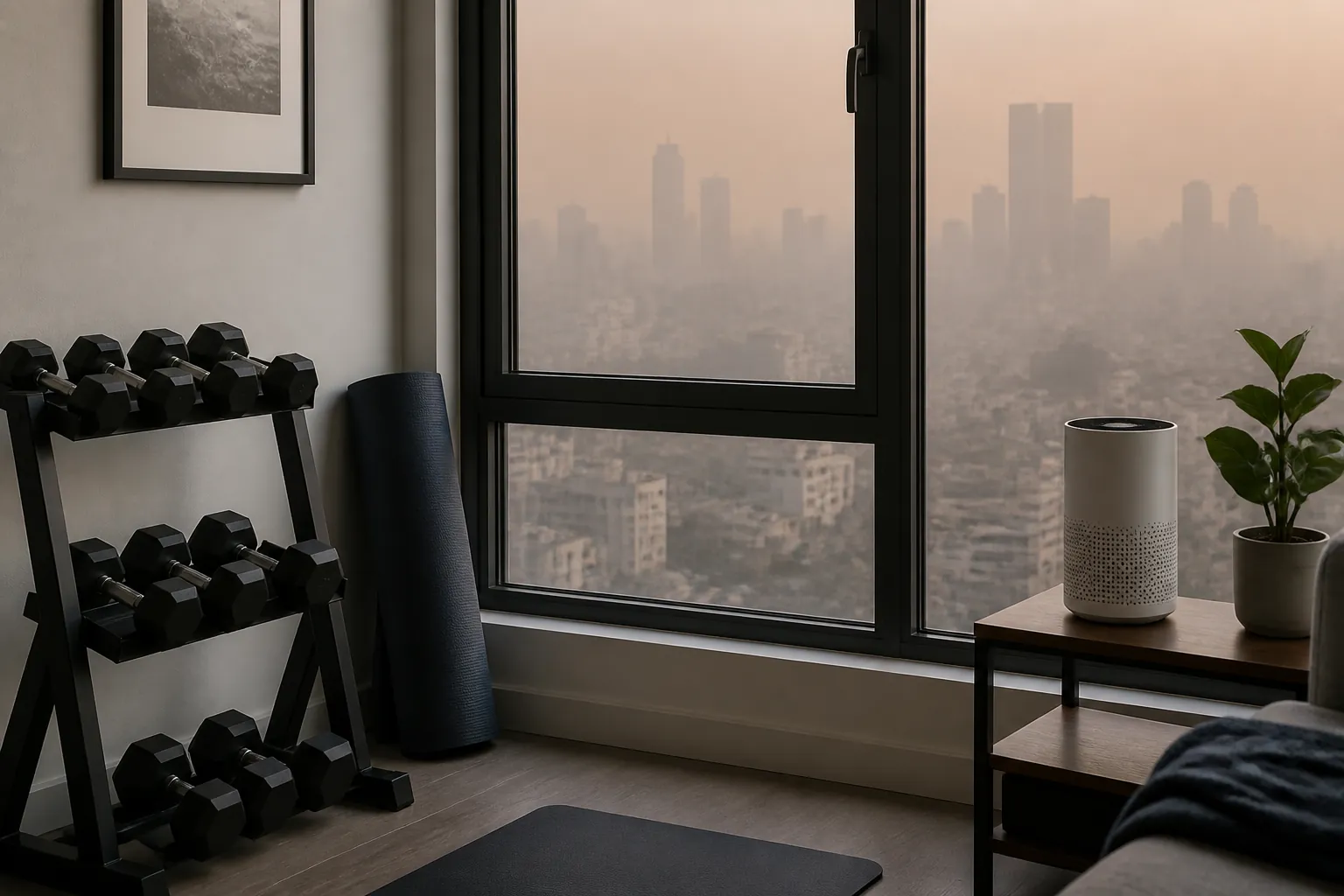
The apartment version of preparedness is deliberately unglamorous. It is not a new identity, a garage gym, or a panic cart full of equipment. It is a room you can make less leaky, a purifier or filtration plan that is not still in a shipping box, and two or three workouts that fit the square footage you actually have.
Build the smoke-day protocol before the first bad forecast
A standing protocol only needs three parts: filtration, routine swaps, and a daily check. The point is to reduce decisions during the event. You should not be comparing purifier specs, inventing a bodyweight circuit, and debating whether to run outside while smoke is already sitting over the city.
Filtration: close the loop before you need it
Pick the room where you can realistically train with windows closed. In a Seattle apartment, that might be the living room corner, not a dedicated workout room. The workable setup is usually simple: keep the workout area clear enough for a mat or dumbbell session, know which windows and vents you will close during smoke, and have the filtration piece ready before August makes it scarce or expensive.
For the detailed room-prep layer, use FitAtHome’s guide to preparing a home gym for poor air quality. If you train in a rental or one-room apartment, the more specific small-space constraints are covered in indoor workouts during wildfire smoke in small spaces. For the planning layer, the main move is simpler: make filtration a standing part of the season, not an emergency errand.
Routine swaps: keep the menu short
A smoke-day menu should be boring enough to choose from quickly. Three categories are plenty for most home exercisers:
- Technique or mobility session: useful when the outdoor plan was high-output and the indoor air setup is acceptable but not ideal.
- Low- to moderate-intensity strength: dumbbells, bands, bodyweight, or controlled tempo work that does not turn the apartment into an interval chamber.
- Smoke-week deload: the choice for a multi-day event, especially if you were already carrying fatigue from a normal training block.
The mistake is trying to replace every outdoor workout with an equal indoor replica. A cancelled long run does not need to become a heroic stair session in a sealed hallway. A threshold ride does not need to become burpees until the windows fog. If smoke has already changed the day, the better question is which session preserves the week.
For actual workout selection, keep the library outside the decision moment. FitAtHome already has an indoor workout alternatives menu for smoky air, a broader guide to indoor workouts on bad-air-quality days, and a 7-day bodyweight plan for wildfire-smoke weeks. Pick your default now, not when the sky turns gray.
AQI check: make it a calendar trigger
The daily habit does not need to become amateur meteorology. During smoke season, check local AQI before committing to outdoor exertion, and check again if the forecast is unstable or smoke is visibly moving in. The useful habit is not memorizing every color band. It is letting the reading trigger the pre-approved choice: outside as planned, shift the time, or use the indoor session.
Timing can still matter. Smoke often changes through the day, and an outdoor workout may be better moved than cancelled when conditions clear. For that narrower planning problem, use the guide to using smoke-clearing times to plan outdoor workouts. The standing rule is that you decide with current local air data, not yesterday’s vibe or last summer’s memory.
Treat clustered smoke as a scheduled training block, not a lost week
A single bad-air day is easy to absorb. Move the run, do strength, take the rest day early. The harder case is three to five days when the forecast keeps extending and the apartment starts to feel smaller each evening. That is where the smoke protocol earns its space.
For a runner, the week may become mobility, easy strength, and short technique drills until outdoor breathing conditions improve. For a home-gym lifter, the change may be less dramatic: keep the main lifts lower in volume, avoid turning the session into conditioning, and use the event as a deload if the cycle was due for one anyway. For a casual exerciser, the protocol can be as light as a mat workout, a walk postponed until air improves, and a reminder that missing one outdoor session is not a moral event.
Heat can complicate this in Seattle apartments without air conditioning. Closed windows may help with smoke but make the workout room hotter. That tradeoff is not solved by pretending every indoor session is automatically safer or more comfortable. If the room is too hot for the planned effort, scale down, shift the time, or use FitAtHome’s guide to indoor workouts in extreme heat apartments alongside the smoke plan.
The gear footprint can stay modest. A compact dumbbell setup, a mat, bands, or a small apartment home-gym tier is enough if the room and workout choices are already decided. If you are still building that base, start with the small apartment home gym tour and keep smoke readiness as one design constraint, not the whole project.
The practical Seattle answer
Seattle smoke is too uneven for a training plan based on averages. A year like 2025 can make smoke feel like a footnote. A year like 2026 can put repeated indoor decisions on the calendar before summer is done. The defensible response is not to assume every season will be awful, and it is not to keep improvising as if clustered smoke is surprising.
Make smoke days boring. Check AQI. Close the loop on filtration. Pick the indoor session you already approved. If the event lasts, treat it as a deload or technique block instead of a failed week.
References
- Data Summary | Puget Sound Clean Air Agency, WA — Puget Sound Clean Air Agency.
- Wildfire Smoke Safety — seattle.gov.
- Washington Smoke Blog — Washington Smoke Blog.
- Wildfire smoke in Seattle: What to know — FOX 13 Seattle.
- Urban bike and pedestrian activity impacts from wildfire smoke events in Seattle, WA — Journal of Transport & Health, 2021.
What a small equipment investment adds
We don't have a build tagged to this exact tier yet. Browse all builds.
How often should you repeat this?
See our recovery and rest reference for citation-anchored rest-interval guidance.
Spot something off?
Tell us if a movement, tier assumption, or duration didn't match your experience.